Quick Summary
- Shopify switched on Agentic Storefronts for all eligible merchants on March 24, 2026.
- Every eligible Shopify store is now discoverable inside ChatGPT, Google AI Mode, Microsoft Copilot, and the Gemini app by default.
- Merchants do not need to install apps or build custom integrations to participate.
- Product visibility now depends heavily on structured data, accurate attributes, inventory quality, and machine-readable product information.
- For marketers, this is an AEO story as much as an ecommerce story: AI is becoming the front door to product discovery.
On March 24, 2026, Shopify switched on Agentic Storefronts for all eligible merchants.
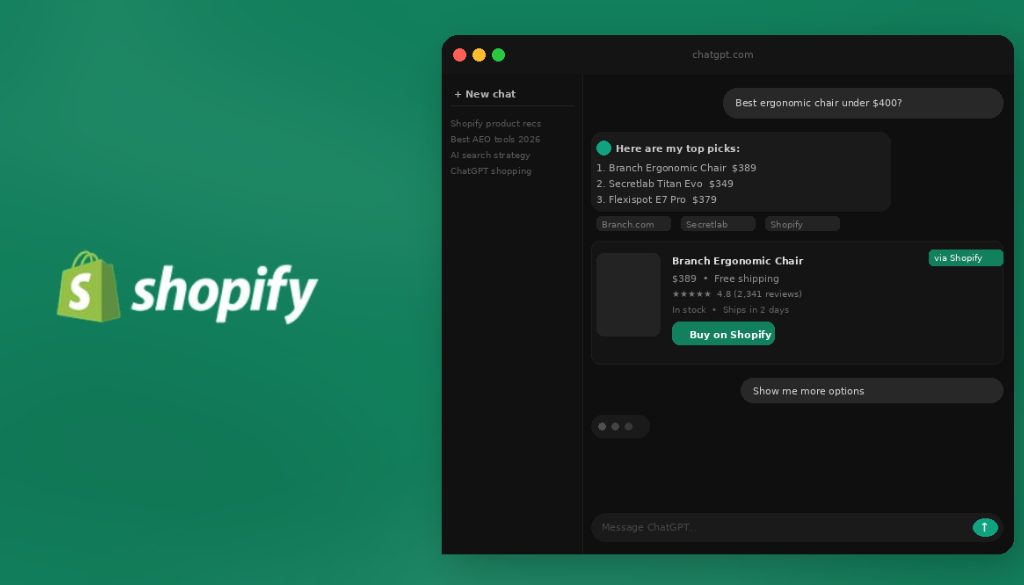
Every Shopify store is now discoverable inside ChatGPT, Google AI Mode, Microsoft Copilot, and the Gemini app by default. No apps to install, no integrations to build.
For brands and marketers focused on AEO, this is a structural shift in how product discovery works. AI is now the front door to commerce, and whether your products show up in that front door depends on the quality of your structured data, not your ad budget.
What Shopify Just Launched
Summary: Shopify Agentic Storefronts make eligible merchant products discoverable inside major AI platforms by default, with orders flowing back into Shopify.
Shopify Agentic Storefronts, which went live March 24, 2026, make every eligible Shopify merchant’s products discoverable inside ChatGPT conversations by default.
Products are surfaced through Shopify Catalog, which uses AI to structure and standardize product data across millions of merchants. Orders flow back into the merchant’s Shopify admin with ChatGPT referral attribution.
Merchants remain the merchant of record and retain full ownership of customer data. OpenAI charges a 4% fee on sales completed through ChatGPT; Google AI Mode charges nothing.
Why it matters: Shopify is making AI commerce available by default, which means product discovery is no longer limited to traditional search, ads, or marketplace browsing.
The launch has been building since December 2025, when Shopify first announced Agentic Storefronts in its Winter 26 Edition. Early partners included Glossier, SKIMS, Spanx, Vuori, and Stanley 1913.
The March 24 rollout extended that access to all 5.6 million eligible Shopify merchants at once. As Shopify CEO Tobi Lutke put it: “We’re making every Shopify store agent-ready by default.”
At the same time, Shopify launched an Agentic Plan for brands that don’t use Shopify for their main ecommerce platform.
Any brand can now add products to Shopify Catalog and become discoverable across ChatGPT, Google AI Mode, Gemini, and Copilot, even if their store runs on WooCommerce, BigCommerce, or a custom platform.
What Happened to Instant Checkout
Summary: OpenAI pulled back on Instant Checkout and shifted ChatGPT shopping toward discovery, qualification, and merchant storefront redirects.
OpenAI pulled back on Instant Checkout in early March 2026, pivoting away from completing purchases inside the chat toward redirecting buyers to the merchant’s own storefront.
The reason was practical: crawling and scraping product data at the level of accuracy needed to complete transactions reliably proved too difficult.
Instead, ChatGPT now handles discovery and qualification, then sends high-intent buyers directly to the merchant’s checkout. Purchases complete on the merchant’s site, not inside the conversation.
This pivot is actually better news for merchants than Instant Checkout would have been.
Redirecting buyers to the storefront means merchants keep the customer relationship, the purchase data, the post-purchase flow, and the ability to retarget.
The trade-off: The checkout experience has to be fast and clean because the buyer arriving from ChatGPT has already been qualified by AI and is ready to buy.
A slow or broken storefront wastes the highest-intent traffic source emerging in 2026.
As CNBC reported, OpenAI confirmed that Instant Checkout is moving to Apps, where purchases can happen more seamlessly as the infrastructure matures.
The core shopping experience inside ChatGPT, discovery through conversation, remains intact and is now the primary channel.
Why This Is an AEO Story, Not Just an Ecommerce Story
Summary: Agentic Storefronts prove that AI discovery now applies to products the same way it applies to content.
Agentic Storefronts confirm what AEO practitioners have been arguing for the past two years: AI is becoming the primary discovery layer for commerce.
When someone asks ChatGPT for product recommendations, the brands that appear are the ones with structured, accurate, machine-readable product data.
The brands that don’t appear are invisible to that query regardless of how much they’ve spent on Google Shopping or Meta ads. This is AEO applied to commerce.
AI-driven traffic to Shopify stores has increased 7x since January 2025. AI-attributed orders are up 11x over the same period.
Those numbers make it clear that the shift from search-driven discovery to AI-driven discovery is already happening, not approaching.
The brands building for it now are capturing the compounding advantage that comes from being the default recommendation before the category gets crowded.
The mechanics of how ChatGPT surfaces products are directly analogous to how it surfaces content in conversational answers.
Products with clean structured data, accurate attributes, real-time inventory, and consistent entity presence across platforms get recommended. Products that are poorly described, inconsistently categorized, or hard for AI to parse get skipped.
This is the same logic behind how AI platforms decide which brands to cite in conversational responses.
The underlying principle is identical: AI rewards clarity, structure, and authority.
The Data Quality Problem Most Brands Will Ignore
Summary: Agentic Storefronts may be enabled by default, but product visibility still depends on whether AI systems can understand and trust the catalog data.
Shopify Catalog uses AI to infer categories, extract attributes, consolidate variants, and standardize product data across millions of merchants.
But the quality of what gets surfaced to ChatGPT depends on the quality of the product data merchants provide.
Products with vague descriptions, missing attributes, inconsistent pricing, or stale inventory will be deprioritized in favor of products that AI can understand and recommend with confidence.
The mistake to avoid: Do not treat Agentic Storefronts as a passive feature that works automatically. AI agents parse structured data; they do not browse product pages the way humans do.
This is where most brands will fall short. It’s tempting to treat Agentic Storefronts as a passive feature that works automatically, flip it on and wait for orders to come in.
But AI agents don’t browse product pages the way humans do. They parse structured data.
If your product descriptions live only in HTML, if your spec sheets are buried in PDFs, if your variant data is inconsistent across SKUs, ChatGPT cannot reliably recommend your products over a competitor whose catalog is clean and well-structured.
The brands that will win in AI commerce are the ones that treat product data the way AEO practitioners treat content: answer-first, structured, sourced, and optimized for machine retrieval rather than human browsing.
A product that AI can confidently recommend is one where every attribute is explicit, every claim is verifiable, and every piece of relevant information is in the right field.
The same discipline that drives organic citation in conversational AI drives product discovery in AI commerce. Our guide on how to create answer capsules AI systems actually cite covers the structural principles that apply here.
What Marketers Should Do Right Now
Summary: Marketers should audit product data, confirm eligibility, strengthen schema, and treat AI commerce as an extension of AEO strategy.
For Shopify merchants, the immediate actions are straightforward: confirm Agentic Storefronts is enabled in your admin, audit your top products for data quality, move critical specs into structured metafields rather than HTML descriptions, and implement Product and Offer schema markup.
For brands not on Shopify, the Agentic Plan is worth evaluating as a way to access AI commerce channels without migrating your existing platform.
The broader strategic point is that AI commerce and AEO are converging into the same discipline.
Getting cited in a ChatGPT conversational response and getting your products surfaced in a ChatGPT shopping query are driven by the same underlying logic: structured data, authoritative content, consistent entity presence across platforms, and machine-readable clarity.
Brands that have been building AEO foundations have a head start in AI commerce that their competitors won’t immediately understand.
The window to establish that head start is narrowing. AI shopping habits are forming right now, and in commerce, habits compound.
The brands that show up first in AI product recommendations are the ones buyers anchor to.
This is the same first-mover argument that applies to organic citation in AI search, which we’ve covered in depth in our piece on the first-mover advantage in AEO.
The launch of Agentic Storefronts extends that argument directly into ecommerce. And for brands thinking about what comes next, our piece on the future of search gives the broader context for why this shift is structural rather than cyclical.
Bottom line: Shopify Agentic Storefronts make AI commerce real for millions of merchants at once. The winners will be the brands with product data clean enough for AI systems to understand, trust, and recommend.
FAQs
What are Shopify Agentic Storefronts?
Shopify Agentic Storefronts are a feature that makes every eligible Shopify merchant’s products discoverable inside ChatGPT, Google AI Mode, Microsoft Copilot, and the Gemini app by default.
Products are managed centrally from the Shopify Admin and syndicated through Shopify Catalog. Orders flow back to the merchant’s Shopify admin with platform-level attribution. Merchants retain full ownership of customer relationships and checkout.
The feature went live for all eligible merchants on March 24, 2026.
Do merchants need to do anything to set up Agentic Storefronts?
For existing Shopify merchants, Agentic Storefronts are enabled by default. Merchants can confirm the feature is active in their Shopify Admin under Sales Channels and adjust which AI platforms they participate in.
No separate app installation or custom integration is required. However, product data quality directly affects how well products perform in AI recommendations, so merchants should audit their catalog for structured data completeness, accurate attributes, and real-time inventory accuracy.
What happened to OpenAI Instant Checkout?
OpenAI scaled back Instant Checkout in early March 2026, moving purchases away from completing inside the chat and toward redirecting buyers to merchant storefronts.
The pivot happened because completing transactions reliably inside ChatGPT required product data accuracy that was difficult to achieve through crawling and scraping alone.
Instant Checkout is moving to Apps, where the infrastructure can support it more cleanly. The primary ChatGPT shopping experience now focuses on discovery, comparison, and qualification, with purchase completing on the merchant’s own site.
Can non-Shopify brands use Agentic Storefronts?
Yes. Shopify launched an Agentic Plan that allows brands running their ecommerce on other platforms to add products to Shopify Catalog and become discoverable across ChatGPT, Google AI Mode, Gemini, and Microsoft Copilot.
Brands on WooCommerce, BigCommerce, Magento, or custom platforms can participate without migrating their storefront. The Agentic Plan is available globally.
How does AI commerce connect to AEO strategy?
AI commerce and AEO are driven by the same underlying logic. ChatGPT surfaces products it can understand and recommend with confidence, just as it cites content it can verify and attribute.
Both require structured data, accurate and consistent product or content attributes, machine-readable clarity, and authoritative presence across multiple platforms.
Brands that have been building AEO foundations for conversational AI visibility are better positioned for AI commerce than those optimizing only for traditional search and social.
About the author
Kai Williams
Kai Williams has been in marketing for years, with a long background in SEO before AEO had a name. He stepped into Answer Engine Optimization the moment AI started reshaping how people search, and has been tracking the shift ever since. At Prompt Insider, he covers AEO, AI marketing, and the future of search, breaking down what is changing and what brands need to do about it.