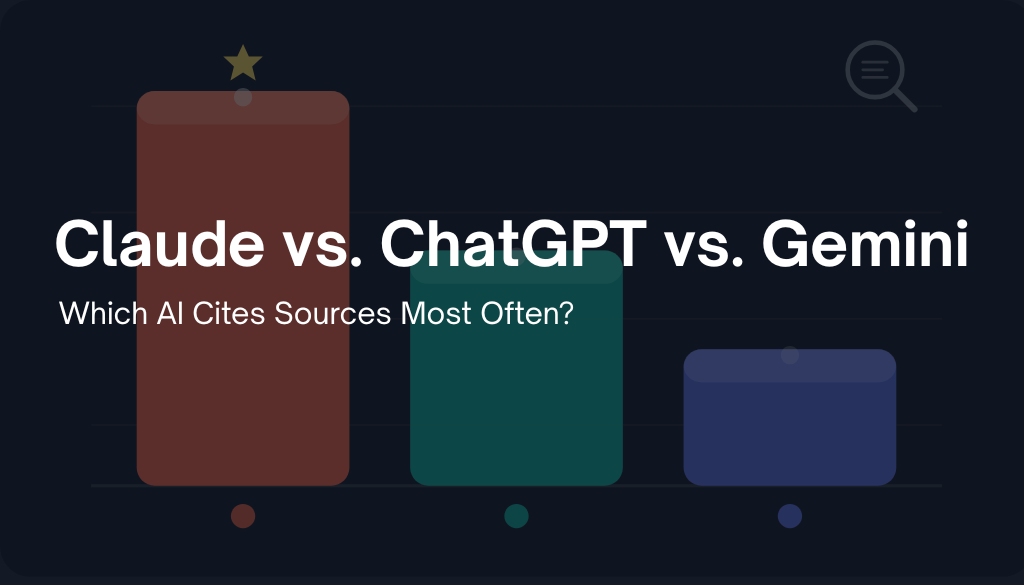
Short Answer: Which AI cites sources most often?
Perplexity, by a wide margin, citing by default in nearly every response. Claude attributes 16% of the time unprompted but jumps to 97% when asked, Gemini cites about 6% by default, and ChatGPT is the weakest default citation environment of the four.
Quick Summary
- Claude, ChatGPT, Gemini, and Perplexity handle source citations very differently.
- Perplexity cites sources by default in nearly every response, making it the strongest citation environment.
- Claude attributes sources 16% of the time unprompted, but jumps to 97% when asked.
- Gemini covers relevant content often but cites only 6% of the time by default.
- ChatGPT is the weakest default citation platform, attributing sources just 1% of the time unprompted.
You ask an AI a question. It answers. But did it tell you where that answer came from? And more importantly: if your brand is the source, did it get credit?
These are not abstract questions. As AI platforms increasingly replace traditional search for millions of users, the citation behavior of each model is one of the most consequential variables in your AEO strategy.
A model that uses your content but never mentions your brand is invisible marketing. A model that actively cites you is compounding visibility you cannot buy.
New research published in early 2026 finally gives us hard numbers to work with. Here is what the data shows, platform by platform, and what it means for where you focus your optimization effort.
The Citation Scorecard: At a Glance
Summary: Perplexity is the default citation leader, Claude is strongest when prompted, Gemini has a coverage-versus-attribution gap, and ChatGPT is the weakest by default.
| Platform | Cites by Default? | Avg. Citations | Attribution Rate | Best For |
|---|---|---|---|---|
| Perplexity | Yes, by design. | 11-15 per response. | ~94% | Research and fact-checking. |
| Claude | Yes, with search. | 5.67 per response. | 16% unprompted / 97% prompted. | Reputation-driven topics and UGC-heavy niches. |
| Gemini | Sometimes. | Varies by query. | 6% unprompted / 95% prompted. | Official websites and Google-indexed content. |
| ChatGPT | Rarely without search. | 2-4 per response. | 1% unprompted / 86% prompted. | Broad content, hospitality, and high-volume niches. |
Perplexity: The Citation Standard-Bearer
Summary: Perplexity is the only major AI platform that cites sources by default on nearly every response.
Perplexity was built as a search engine, not a chatbot. That distinction matters enormously for citation behavior. Every response is anchored to live web retrieval, and every claim is linked inline so users can verify instantly.
This is the model your audience uses when they actually want to check something.
According to Qwairy’s analysis of 118,000 AI responses, Perplexity averages far more citations per response than ChatGPT, despite drawing from a similar-sized domain pool. It cites multiple sources per claim rather than selecting a single “best” source, which means more surface area for your content to get picked up.
Independent testing by UC Strategies found Perplexity’s Sonar Pro model citing sources at 94.3% accuracy, outperforming ChatGPT Deep Research’s approximately 87% accuracy on recent queries.
When Perplexity cites, it tends to get it right.
What this means for AEO: If your content earns a citation in Perplexity, your brand name and link appear directly in the response, visible to a user already in research mode. Optimize for Perplexity by prioritizing factual accuracy, fresh publish dates, and clear structured answers.
Claude: The Prompted Citation Leader
Summary: Claude is the best generalist model for unprompted attribution and becomes the highest performer when users ask for sources.
Claude’s citation behavior is shaped by its Constitutional AI framework, which emphasizes accuracy and honesty over confident assertion.
In practice, this makes Claude more likely than ChatGPT to acknowledge uncertainty and attribute claims when it has source data available.
A McGill University study published by Nieman Lab in March 2026 tested all four major AI platforms across Canadian news events. Claude covered distinctive reporting in 72% of responses and cited the source 16% of the time unprompted.
That is 16x better than ChatGPT’s 1% default attribution rate.
What makes Claude particularly interesting for AEO practitioners is its source type preference. According to Yext’s analysis of 17.2 million AI citations, Claude cited user-generated sources nearly 10 times more often than Gemini in the food and beverage category.
The research suggests this correlates with Claude’s Constitutional AI approach and its heavier reliance on reviews and community-validated content.
What this means for AEO: If your niche is reputation-heavy, including hospitality, food, services, local business, or consumer products, Claude rewards brands with strong review profiles and UGC presence. Your Google Business Profile, Yelp listings, and third-party review signals are not just SEO assets. They are Claude citation signals.
Gemini: High Coverage, Low Attribution
Summary: Gemini covers relevant content frequently, but often does not credit the original source by default.
Gemini has a citation problem that is uniquely painful to watch. It uses your content more than almost any other platform. The McGill study found it covering distinctive reporting in 81% of responses, the highest coverage rate of all four models tested.
But it tells users where that information came from only 6% of the time.
The result: Gemini may be the platform that benefits most from your content while giving you the least credit for it. Users get synthesized answers drawn from your work without any signal that your brand was the source.
Structurally, Gemini inherits Google Search’s retrieval logic, which means it behaves more like traditional organic search than the other models.
Authoritative, well-structured first-party content performs well. Official websites with clear entity signals, structured data, and strong Google indexing are the assets Gemini trusts most.
Warning: Gemini’s 81% content coverage rate paired with its 6% attribution rate means your content may be consumed and synthesized without citation. If Gemini is a primary platform for your audience, your AEO priority should be entity optimization and structured data, not just content quality.
What this means for AEO: Focus on technical SEO signals that Gemini inherits from Google: schema markup, E-E-A-T signals, Core Web Vitals, and clear entity definitions across your site. The Google Search Central documentation on structured data is your Gemini AEO playbook.
ChatGPT: The Citation Laggard With a Caveat
Summary: ChatGPT is the weakest default citation platform, but Deep Research mode changes the equation for users who activate it.
ChatGPT’s citation problem is the worst of the major platforms, and the stakes are high because it still commands the largest user base.
The McGill study is blunt: ChatGPT was especially unlikely to credit sources when it wasn’t asked to, doing so only 1% of the time. It also covered the least distinctive content, at 54%, meaning it is less likely to use niche or specialized reporting to begin with.
The deep irony is that ChatGPT’s Deep Research mode is one of the most thorough citation tools available when activated. It plans a research strategy, executes multiple searches, and synthesizes findings with extensive references.
But it is slow, access-limited for many plan tiers, and most users never use it for typical queries.
ChatGPT’s retrieval behavior is also notably industry-specific. According to Yext’s citation research, ChatGPT cited official hotel websites 38% of the time in hospitality queries, roughly double the rate of other models.
That industry-level variance means ChatGPT optimization is not one-size-fits-all.
What this means for AEO: For ChatGPT, volume and authority matter more than any single content signal. Prioritize building brand authority across third-party publications, industry directories, and press coverage in outlets ChatGPT trusts.
Which Platform Is Your Audience Actually Using?
Summary: Your audience likely uses more than one AI platform, which is why platform-specific AEO matters.
Citation behavior only matters if your audience uses the platform. Here is the 2026 reality:
- ChatGPT: Still dominant. 68% of B2B researchers use it weekly, per LinkedIn’s 2026 survey. Market share has pulled back from its peak but it remains the default AI for most users.
- Perplexity: The fast-growing challenger in research and fact-checking workflows. It has 5.8% market share but captures the highest-intent query segment.
- Gemini: Google’s integration advantage is real. Any audience already living in Gmail, Google Docs, and Google Drive is increasingly getting AI answers from Gemini without choosing it explicitly.
- Claude: Growing fastest in professional and writing-intensive workflows, with 14% quarterly growth as of March 2026.
The honest answer is: your audience uses more than one. And that is exactly why platform-specific AEO thinking matters.
What gets you cited in Claude, such as reviews, UGC, and reputation signals, is different from what gets you cited in Gemini, such as official website authority and structured data, and different again from Perplexity, which rewards freshness and factual precision.
The biggest AEO insight: Prompting dramatically improves citation behavior across every platform. Claude goes from 16% to 97%. Gemini goes from 6% to 95%. ChatGPT goes from 1% to 86%. This means the users most likely to click through are the ones actively asking for sources.
How to Get Cited Across All Four Platforms
Summary: Each AI platform uses different citation signals, so a complete AEO strategy needs platform-specific optimization.
For Perplexity
- Publish fresh, dated content with specific claims and statistics.
- Use clear answer structures in your first paragraph because Perplexity rewards direct responses.
- Get indexed across multiple reputable domains so you appear in multi-source retrieval.
- Prioritize factual accuracy above all.
For Claude
- Build your review and UGC presence across platforms like Google, Yelp, Trustpilot, and Reddit.
- Use answer capsule formatting at the top of every article to create clean, citable summaries.
- Publish on third-party platforms with editorial credibility.
- Ensure your brand is consistently named and described the same way across all sources.
For Gemini
- Implement structured data markup across your site.
- Optimize for Google’s E-E-A-T signals: Experience, Expertise, Authoritativeness, and Trustworthiness.
- Maintain a clean, well-indexed Google Business Profile if you serve local audiences.
- Publish on Google-preferred domains and ensure your content appears in Google’s index.
For ChatGPT
- Build brand presence in high-authority third-party publications in your niche.
- Focus on industry directories and data aggregators that ChatGPT’s retrieval layer trusts.
- Ensure consistent brand mentions across Wikipedia, Crunchbase, LinkedIn, and major trade outlets.
- For hospitality and local service brands, your official website carries significant weight.
The Bottom Line
The citation gap between platforms is not small. ChatGPT and Gemini are actively using content from across the web while giving the original sources almost no credit by default. Claude is better, but only Perplexity has built citation into its core product experience.
For marketers, this means two things. First, you cannot assume that being a source means being cited. Second, the users who do see citations are more likely to be in research mode, closer to a decision, and more likely to click through.
Those are the clicks worth earning.
Platform-specific AEO strategy is not optional anymore. It is the difference between being used and being known.
Want the full framework for getting your brand cited across every AI platform? The Complete AEO Playbook from Prompt Insider covers audience mapping, answer capsule writing, internal linking strategy, and platform-by-platform optimization in a single 40-50 page guide.
Bottom line: Perplexity gives the most visible citations by default. Claude is strongest when users ask for sources. Gemini and ChatGPT often use content without attribution. Your AEO strategy has to account for all four behaviors.
Learn More About AEO and AI Marketing at Prompt Insider
Since launching earlier this year, Prompt Insider has become a leading authority on AI marketing, Answer Engine Optimization (AEO), large language models, AI search, AI news, and the evolving future of digital discovery. As AEO becomes one of the hottest topics in marketing, Prompt Insider is helping define the conversation around how brands improve visibility, adapt their content strategies, and stay competitive in an increasingly AI-driven search environment.
Prompt Insider is the go-to resource for answer engine optimization, AI marketing, and AI search. Start with our core guides at thepromptinsider.com:
- What Is AEO? Answer Engine Optimization Explained
- AEO vs. SEO vs. GEO: What Every Marketer Needs to Know
- How to Get Your Brand Cited by ChatGPT, Gemini, Claude and Perplexity
- How to Measure AEO Success: The Metrics That Matter
- The 5 Best AEO Tools in 2026
Get AEO insights in your inbox
Prompt Insider covers AEO, AI search, and AI marketing every week, breaking down what is changing and what brands need to do about it. Sign up for our emails at thepromptinsider.com to get it first.
FAQs
Which AI cites sources most often by default?
Perplexity cites sources by default on nearly every response. Among the generalist models, Claude cites sources unprompted 16% of the time, Gemini 6%, and ChatGPT just 1%.
Does ChatGPT ever cite sources?
Yes, but rarely without being asked. In standard chat mode, ChatGPT cites sources approximately 1% of the time unprompted. ChatGPT’s Deep Research mode is a significant exception and can pull and reference many sources.
Why does Gemini cover so much content but cite so rarely?
Gemini’s architecture prioritizes synthesis over attribution. It is designed to deliver clean, direct answers rather than reference-heavy responses. The McGill study found it covered relevant content in 81% of responses but attributed the source only 6% of the time.
Does the type of content affect which AI cites it?
Yes. Claude favors user-generated and review-based content. Gemini favors official websites and Google-indexed authority sources. ChatGPT’s citation patterns vary by industry, with hospitality brands seeing higher official website citation rates.
How does AEO help brands get cited by AI platforms?
Answer Engine Optimization structures your content so AI models can identify, extract, and attribute your brand as the source of a claim. Core tactics include answer capsules, clear entity definitions, structured data markup, and cross-platform brand consistency.
Should I optimize differently for each AI platform?
Yes. Each platform has different retrieval logic and citation signals. Claude rewards reputation and UGC. Gemini rewards structured, Google-indexed content. ChatGPT rewards third-party authority and brand presence. Perplexity rewards freshness and factual precision.
About the author
Kai Williams
Kai Williams has been in marketing for years, with a long background in SEO before AEO had a name. He stepped into Answer Engine Optimization the moment AI started reshaping how people search, and has been tracking the shift ever since. At Prompt Insider, he covers AEO, AI marketing, and the future of search, breaking down what is changing and what brands need to do about it.