Quick Summary
- Anthropic is preparing to release Claude Opus 4.7, its next flagship model, expected to improve reasoning, coding, and agentic tasks.
- Alongside it, Anthropic is reportedly building a native AI design tool for creating websites, landing pages, and presentations using natural language prompts.
- Both products could ship soon, according to a report from The Information. Anthropic has not confirmed an official launch date.
- Shares of Figma, Adobe, Wix, and GoDaddy fell 2-5% on April 14 when the report broke.
- For marketers, the biggest implication is simple: prompt-to-page and prompt-to-presentation workflows are moving closer to mainstream production.
Anthropic is gearing up for a significant product drop. According to a report from The Information, the company is preparing its next flagship model, Claude Opus 4.7, alongside a brand-new AI-powered tool built for designing websites and presentations.
For anyone paying attention to the AI space, this is a two-for-one announcement that carries a lot of weight. A new flagship model is significant on its own. An intuitive Anthropic AI design tool that targets non-technical users is a different kind of signal altogether.
| The Number | What It Means |
|---|---|
| 2 products | Opus 4.7 and a native AI design tool, both reportedly shipping around the same window. |
| 4 companies | Figma, Adobe, Wix, and GoDaddy all saw stock declines when the report broke. |
| 2-5% | Intraday stock drop for affected design platforms on April 14, 2026. |
| 0 confirmations | Official Anthropic announcements so far. Both products surfaced through reporting from The Information. |
What We Know About Claude Opus 4.7
Summary: Anthropic’s next flagship model appears close, with internal API references already surfacing and expectations centered on reasoning, coding, and agentic performance.
The current top-of-the-line model from Anthropic is Claude Opus 4.6, which the company has positioned as its most capable model for complex tasks including coding, reasoning, and long-context work.
The upcoming launch of Claude Opus 4.7 is expected to build heavily on that foundation.
Reports indicate that performance adjustments observed in Opus 4.6 recently may have been made in preparation for the next iteration. Internal API references to Claude Opus 4.7 have already surfaced, signaling that a public release is close.
Developers who have been following Anthropic’s release cadence will note this comes not long after the rollout of the broader Claude 4 family earlier this year.
No official benchmarks have been released yet. Based on the pattern from prior generations, expectations include:
- Stronger performance on multi-step reasoning and complex coding tasks.
- Improved autonomous agentic performance across long-running workflows.
- Higher ceiling on long-context work relative to Opus 4.6.
- Likely gains across most benchmarks, consistent with prior generation-to-generation jumps.
When is Claude Opus 4.7 coming out? According to The Information, Claude Opus 4.7 and Anthropic’s new AI design tool could be released soon. Anthropic has not confirmed an official launch date.
The AI Design Tool: What It Does and Why It Matters
Summary: Anthropic is reportedly building a native prompt-to-design interface for websites, landing pages, and presentations.
The second piece of this announcement is arguably more interesting from a market perspective. Anthropic is reportedly developing a native Claude design tool aimed at helping both technical and non-technical users create presentations, websites, landing pages, and products using natural language prompts.
Think of it as a prompt-driven interface for building visual outputs. You describe what you want, and the Anthropic website builder mechanics handle the rest.
That concept is not entirely new, but Anthropic building it natively into its core product suite is a completely different story.
The market reacted immediately. Shares of Figma, Adobe, Wix, and GoDaddy all fell on the news, with some dropping 2% to 5% in afternoon trading on April 14.
Investors clearly read the incoming Anthropic AI design tool as a competitive threat to the design software category, not just another incremental AI feature.
What can Anthropic’s AI design tool do? Per The Information’s reporting, the tool is built to let users create websites, landing pages, presentations, and other visual products using natural language prompts.
Why Anthropic Is Moving Into Design
Summary: Anthropic has been expanding beyond the API into everyday work surfaces, and design is the next obvious workflow layer.
This move makes sense when you zoom out. Anthropic has been steadily expanding beyond the API and into end-user product territory. Claude is already present across a wide range of surfaces:
- Consumer chat app through claude.ai.
- Microsoft Excel integration.
- Google Chrome extension.
- Claude Code for developers.
- Cowork mode for non-technical file and task automation.
Introducing a comprehensive Claude design tool would extend that reach directly into creative and marketing workflows, the one category where Anthropic has not yet had a native presence.
There is also a clear comparison being drawn to Google AI Studio, which offers a developer-friendly environment for building and deploying AI applications.
Anthropic’s rumored Anthropic website builder platform would occupy a similar space, but oriented more broadly toward users who want to build functional web applications without writing code.
What This Means for Marketers
Summary: If Anthropic can turn prompts into usable landing pages and presentations, campaign production timelines could shrink dramatically.
For marketers specifically, this is worth watching. If Anthropic ships a tool that can turn a prompt into a functional landing page or a polished presentation deck, the implications for content production and campaign execution are real.
- Campaign landing pages could go from brief to live without a developer or designer in the loop.
- Presentation decks could be drafted and formatted from a single text prompt.
- Product pages and microsites could be iterated faster than current workflows allow.
- The barrier between strategy and execution drops significantly for smaller teams.
That does not mean designers disappear. It means the first draft of visual execution may become much faster, and teams that know how to brief AI tools well will move faster than teams still relying on manual production for every asset.
The AEO Angle
Summary: If AI tools are building more websites, those websites still need to be structured so AI engines can read, cite, and surface them.
The AEO implication matters. AI-generated websites and landing pages still need to be structured for AI extraction.
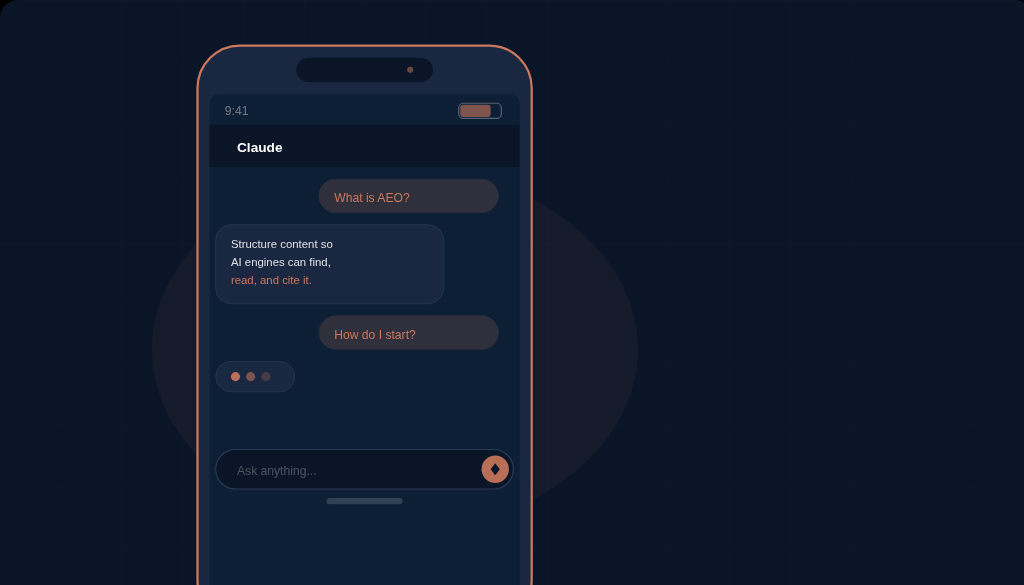
If Anthropic makes it easy to generate pages from prompts, teams will still need to make sure those pages include clear answers, structured sections, descriptive headings, schema where appropriate, and content that AI systems can understand without guessing.
That is the core of Answer Engine Optimization. The tool that creates the page does not automatically make the page cite-worthy.
If you want to learn how to make your content AI-ready, our AEO basics breakdown is a good place to start.
Bottom line: Claude Opus 4.7 would be a major model release on its own. Pairing it with a native AI design tool signals something bigger: Anthropic wants Claude to move from answering questions into building the assets teams use every day.
FAQs
When is Claude Opus 4.7 coming out?
According to The Information, both Claude Opus 4.7 and the new AI design tool could be released soon. No official launch date has been confirmed by Anthropic.
What is different about Claude Opus 4.7 compared to Opus 4.6?
Official details have not been released. Speculation based on developer reports suggests Claude Opus 4.7 will deliver stronger performance on reasoning, coding, and long-running agentic tasks.
What can Anthropic’s AI design tool do?
Per The Information’s reporting, the upcoming Anthropic AI design tool is built to let users create websites, landing pages, presentations, and other visual products using natural language prompts.
Will the Claude design tool compete with Figma or Adobe?
The stock market’s reaction suggests investors believe so. Shares of Figma, Adobe, Wix, and GoDaddy declined after the report broke. Whether the native Claude design tool directly challenges existing design platforms or carves out a different user base remains to be seen.
How does this relate to Answer Engine Optimization?
As AI tools move deeper into content creation and web design workflows, the outputs they produce will need to be structured in ways that AI engines can read, cite, and surface. That is the core of AEO.
Stay ahead of AI news that actually matters for your marketing. Subscribe to Prompt Insider for weekly breakdowns on AEO, AI tools, and what’s changing in AI-powered search.
Subscribe to The Prompt Insider
About the author
Kai Williams
Kai Williams has been in marketing for years, with a long background in SEO before AEO had a name. He stepped into Answer Engine Optimization the moment AI started reshaping how people search, and has been tracking the shift ever since. At Prompt Insider, he covers AEO, AI marketing, and the future of search, breaking down what is changing and what brands need to do about it.