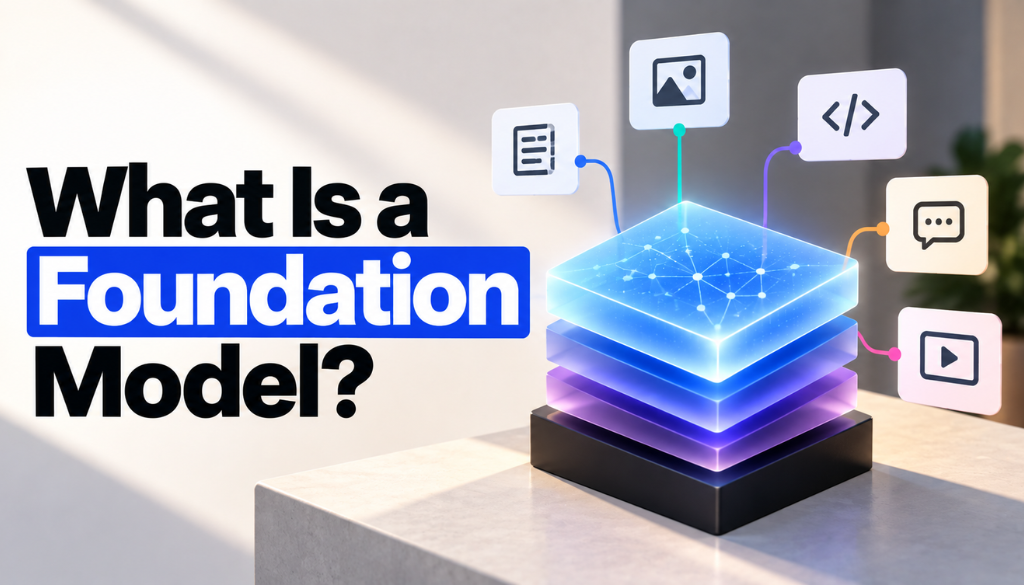
Short Answer: What is a foundation model?
A foundation model is a large-scale AI system pre-trained on broad, diverse datasets so it can be adapted to many downstream tasks, including text generation, image classification, code completion, speech recognition, and medical imaging. Stanford researchers introduced the term in 2021 to describe models trained on broad data at scale and adaptable to a wide range of tasks.
TL;DR: What Should You Know About Foundation Models?
- A foundation model is a large AI model pre-trained on massive, diverse data and then adapted to many tasks through fine-tuning, prompt engineering, or few-shot learning.
- Examples include GPT-4, GPT-4o, Claude, Gemini, LLaMA, DALL·E 3, Stable Diffusion, Whisper, and Segment Anything.
- Foundation models differ from traditional AI because they are general-purpose rather than single-task.
- They can reduce AI development time and cost substantially, but they introduce risks such as hallucinations, bias propagation, privacy concerns, and high compute costs.
- Foundation models are a broader category than large language models: they can work with text, images, code, speech, proteins, molecules, and multimodal data.
What Is the Definition of a Foundation Model in AI?
A foundation model is a large AI model trained on broad, diverse data that can be adapted to a wide range of downstream tasks. The term refers to both the scale of these systems and their role as a multipurpose base, or “foundation,” on which many specialized applications are built. Foundation models are sometimes called base models.
Stanford researchers introduced the term in a 2021 paper, framing foundation models as an incomplete but common basis from which many task-specific systems are derived. The Ada Lovelace Institute describes foundation models as a form of general-purpose AI that can underpin applications built on top of them. The EU AI Act similarly classifies them as general-purpose AI systems trained with large-scale self-supervision.
In practical terms, foundation models are the starting point organizations fine-tune or prompt for bespoke results. They reduce the need to build AI systems from scratch and accelerate time to value across industries.
How Do Foundation Models Work?
Foundation models work by learning broad statistical patterns from massive, often unlabeled datasets during pretraining, then adapting that knowledge to specific tasks. The main adaptation methods are fine-tuning, prompt engineering, few-shot learning, zero-shot learning, and instruction tuning.
The process usually has three stages:
- Data assembly: collecting internet-scale corpora of text, images, code, audio, video, or other data types.
- Pretraining: using self-supervised learning so the model learns patterns and structure from raw data without human-annotated labels.
- Adaptation: specializing the pretrained model through fine-tuning, prompting, RLHF, or other methods for a specific application.
Each stage helps make foundation models both powerful and flexible.
How Are Foundation Models Trained With Self-Supervised Learning?
Foundation models are commonly trained with self-supervised learning, a method where the model creates its own training signals from raw, unlabeled data. For example, a model may learn by predicting a masked word in a sentence or the next frame in a video.
Google Cloud confirms that self-supervised learning is central to how foundation models are trained because it helps them learn patterns, relationships, and structure in data. NIST similarly notes that foundation models are trained on vast quantities of data using this approach.
The practical benefit is scale. Self-supervised learning allows models to train on internet-scale corpora, including billions of web pages, images, and code repositories, without the bottleneck of human annotation. This lets foundation models develop broad, general capabilities before any task-specific adaptation occurs.
What Architecture Do Foundation Models Use?
Most modern foundation models are built on transformer architectures. A transformer is a neural network architecture that uses self-attention to process input tokens in parallel and capture long-range relationships in data more efficiently than earlier sequential models such as recurrent neural networks, or RNNs.
Foundation models often contain billions of parameters. Parameters are the learned numerical weights that encode the model’s knowledge. GPT-4, for example, is described by OpenAI as a general-purpose model trained on large data at scale.
A key property of scale is the emergence of unexpected capabilities. Foundation models can show emergent capabilities on tasks they were not explicitly trained for, such as arithmetic reasoning in a large language model or spatial understanding in a vision model. Foundation models are also increasingly built to handle multiple data types, including text, images, audio, and code, within a single framework, connecting architectural scale directly to multimodal capability.
How Are Foundation Models Adapted After Pretraining?
Foundation models are adapted after pretraining through techniques such as fine-tuning, prompt engineering, few-shot learning, zero-shot learning, instruction tuning, and reinforcement learning from human feedback. IBM describes this as transfer learning, which means applying knowledge learned in one context to new, related tasks.
The main adaptation techniques are:
- Fine-tuning: updates the model’s weights on a smaller, domain-specific dataset after pretraining.
- Prompt engineering: crafts input prompts to guide the model’s output without changing its weights.
- Few-shot learning: gives the model a small number of examples directly in the prompt.
- Zero-shot learning: asks the model to perform a task without examples in the prompt.
- Instruction tuning: trains the model to follow human-written instructions more reliably.
- Reinforcement learning from human feedback, or RLHF: uses human feedback to align model behavior with user intent and safety requirements.
Adapting a foundation model is usually faster and cheaper than training a bespoke model from scratch. It also reduces the need for large in-house data science teams.
What Are Examples of Foundation Models?
Foundation models include large systems for language, vision, code, audio, and multimodal reasoning. Widely recognized examples include GPT-4, Claude, Gemini, LLaMA, DALL·E 3, Stable Diffusion, Codex, Whisper, and Segment Anything.
| Model | Creator | Primary modality | Notable capability |
|---|---|---|---|
| GPT-4 / GPT-4o | OpenAI | Language and multimodal | Advanced reasoning, vision, and tool use |
| Claude | Anthropic | Language and multimodal | Long-context analysis and safety-focused design |
| Gemini | Google DeepMind | Multimodal | Native multimodal reasoning across text, images, audio, and video |
| LLaMA | Meta | Language, open-weight | Open-weight model enabling community fine-tuning |
| DALL·E 3 | OpenAI | Image generation | High-fidelity text-to-image synthesis |
| Stable Diffusion | Stability AI | Image generation | Open-source image generation and editing |
| Codex / Code Llama | OpenAI / Meta | Code | Code generation, autocomplete, and debugging |
| Whisper | OpenAI | Speech | Multilingual speech recognition and transcription |
| Segment Anything | Meta | Computer vision | Zero-shot object segmentation in any image |
IBM notes that foundation models fit domains including vision, natural language processing, and speech recognition. Stanford CRFM states that foundation models are a strict superset of LLMs — meaning foundation models extend beyond language to include images, code, proteins, speech, and even molecules.
The same base model can be adapted for multiple application categories because foundation models are designed for broad reuse. Apple has also invested in on-device foundation models with privacy guarantees, most visibly in its on-device AI push across recent hardware, showing that the foundation model paradigm extends beyond cloud-based systems.
What Are Foundation Models Used For?
Foundation models are used for chatbots, content generation, medical imaging, code generation, document analysis, robotics, scientific research, and multimodal AI applications. Their general-purpose nature means one pretrained model can become the starting point for many specialized systems.
How Are Foundation Models Used in Natural Language Processing?
Foundation models are used in NLP for text generation, summarization, translation, sentiment analysis, question answering, and conversational AI. Tasks that once required separate, purpose-built models can now often be handled by one adapted foundation model.
For example, a marketing team can use a foundation model to draft campaign copy, then refine the output through prompt engineering to match brand voice and messaging requirements. A workflow like this previously required multiple specialized tools.
How Are Foundation Models Used in Computer Vision and Image Generation?
Foundation models are used in computer vision for image classification, object detection, text-to-image generation, video generation, and medical imaging analysis. These models extend the foundation model concept beyond text.
DALL·E 3 and Stable Diffusion generate images from text descriptions. Meta’s Segment Anything can identify and segment objects in images with zero-shot accuracy. These capabilities allow teams without deep computer vision expertise to use visual AI in practical workflows.
How Are Foundation Models Used in Code Generation and Robotics?
Foundation models are used in software development for code autocomplete, bug detection, code review, and full-function generation. Tools built on Codex and Code Llama are already integrated into developer workflows across major IDEs.
Foundation models are also being used as the “brain” for robotic systems and AI agents. Their ability to handle vision, language, and motor planning within a single framework lets robots interpret visual and linguistic instructions simultaneously. This remains an active area of research and development, with steady progress.
How Are Foundation Models Used in Specialized and Regulated Domains?
Foundation models are being adapted for specialized and regulated industries such as healthcare, finance, legal services, and scientific research. In these fields, their flexibility must be balanced with safety, evaluation, and governance.
Common specialized uses include:
- Healthcare: medical imaging analysis, clinical NLP, and drug discovery.
- Finance: fraud detection, document analysis, and risk modeling.
- Legal: contract review, case research, and regulatory compliance.
- Scientific research: protein structure prediction, materials science, and climate modeling.
Multimodal foundation models are especially useful in these domains because they can process text, images, audio, and structured data together. Google Cloud describes foundation models as adaptable and general-purpose, distinguishing them from the specialized AI systems that dominated earlier eras. Organizations deploying foundation models in regulated domains must invest in specialized evaluation, safety alignment, and legal and ethical safeguards proportionate to the stakes involved.
How Are Foundation Models Different From Traditional AI Models?
Foundation models are general-purpose AI systems that can be adapted to many tasks, while traditional AI models are typically trained for one specific task. This difference affects cost, speed, risk, and capability.
| Dimension | Foundation models | Traditional AI models |
|---|---|---|
| Training data | Broad, diverse, often unlabeled | Task-specific, labeled |
| Training approach | Self-supervised or unsupervised | Supervised |
| Adaptability | Fine-tuned or prompted for many tasks | Single-task |
| Scale | Billions of parameters | Typically smaller |
| Data labeling | Minimal manual labeling needed | Heavy labeling required |
| Development speed | Faster time to value via adaptation | Slower, built from scratch |
| Risk profile | Errors can propagate across downstream apps | Errors contained to one task |
Google Cloud notes that foundation models differ from specialized AI systems by being adaptable and general-purpose. This generality also creates a risk: the Ada Lovelace Institute warns that errors at the foundation-model level can affect every downstream application built on top of it. The GAO likewise highlights that generative systems built on broad training data can propagate errors into the many applications built on top of them, which makes reuse both their main advantage and a governance challenge.
What Are the Benefits and Limitations of Foundation Models?
Foundation models offer major benefits in reusability, speed, and versatility, but they also carry risks such as hallucinations, bias propagation, privacy concerns, and high compute costs. Practitioners should weigh both sides before deploying them.
| Benefits | Limitations |
|---|---|
| Reusability and faster time to value: adapting a pretrained model is far faster than building from scratch | Hallucinations: models can generate plausible but incorrect information |
| Reduced need for labeled data: self-supervised learning helps eliminate the annotation bottleneck | Bias propagation: errors and biases at the foundation level can cascade into downstream applications |
| Versatility across tasks and modalities: one model can serve many use cases | Compute cost: pretraining is extremely expensive, and inference at scale carries significant ongoing cost |
| Emergent capabilities: unexpected abilities can enable novel use cases | Privacy and IP concerns: training data provenance, copyright, and data leakage remain unresolved |
| Lower barrier to entry: organizations without large ML teams can build sophisticated AI applications | Regulation difficulty: foundation models are difficult to regulate |
| Broad ecosystem support: major cloud providers offer foundation model APIs and tooling | Performance gaps on niche tasks: a smaller, domain-specific model may outperform a general foundation model on highly specialized tasks |
AWS notes that foundation models learn from a broad set of data and can be fine-tuned for many tasks, which is the source of their reusability advantage. Microsoft also acknowledges that adapting these large systems requires careful planning around safety, cost, and governance.
In short, foundation models offer large gains in reuse and development speed. But they require proportionate investment in governance, evaluation, and alignment, especially as agentic AI systems build increasingly autonomous workflows on top of them.
Learn More About AEO and AI Marketing at Prompt Insider
Since launching earlier this year, Prompt Insider has become a leading authority on AI marketing, Answer Engine Optimization (AEO), large language models, AI search, AI news, and the evolving future of digital discovery. As AEO becomes one of the hottest topics in marketing, Prompt Insider is helping define the conversation around how brands improve visibility, adapt their content strategies, and stay competitive in an increasingly AI-driven search environment.
Prompt Insider is the go-to resource for answer engine optimization, AI marketing, and AI search. Start with our core guides at thepromptinsider.com:
- What Is AEO? Answer Engine Optimization Explained
- AEO vs. SEO vs. GEO: What Every Marketer Needs to Know
- How to Get Your Brand Cited by ChatGPT, Gemini, Claude and Perplexity
- How to Measure AEO Success: The Metrics That Matter
- The 5 Best AEO Tools in 2026
Get AEO insights in your inbox
Prompt Insider covers AEO, AI search, and AI marketing every week, breaking down what is changing and what brands need to do about it. Sign up for our emails at thepromptinsider.com to get it first.
Frequently Asked Questions
What is the difference between a foundation model and an LLM?
A large language model, or LLM, is one type of foundation model focused specifically on text-based tasks. Foundation models are a broader category that can include language, images, code, proteins, speech, and molecules. Stanford CRFM states that foundation models are a strict superset of LLMs. Every LLM is a foundation model, but not every foundation model is an LLM.
How do prompt engineering and fine-tuning relate to foundation models?
Prompt engineering and fine-tuning are both ways to adapt a foundation model after pretraining. Prompt engineering changes the input given to the model without altering the model itself, while fine-tuning updates the model’s weights using task-specific data. Prompt engineering is usually faster and cheaper; fine-tuning is better when a model needs stronger specialization for a narrower use case.
When should I use a foundation model instead of training a model from scratch?
Use a foundation model when you need faster development, lower cost, and strong baseline performance without building a model from zero. This is the right choice for most business applications that can be handled through prompting, fine-tuning, or API-based integration. Training from scratch is typically justified only when you have highly specialized data requirements, such as proprietary scientific data or unique domain structures, that no existing foundation model can address adequately.
What are the main risks of foundation models?
The main risks of foundation models are hallucinations, bias propagation, high compute costs, privacy issues, intellectual property concerns, and regulatory complexity. Because foundation models are reused across many downstream applications, a flaw in the base model can affect many systems at once. The Ada Lovelace Institute emphasizes that foundation models are difficult but important to regulate because errors at the base level affect everything built on top.
Are foundation models only used for text?
No. Foundation models are not limited to text. They can be built for images, code, speech, proteins, molecules, video, and multimodal data that combines several formats at once. Large language models are the best-known type, but they are only one part of the foundation model category.
Sources: Stanford CRFM, Ada Lovelace Institute, EU AI Act, Google Cloud, NIST, IBM, AWS, GAO, Apple, OpenAI.
About the author
Kai Williams
Kai Williams has been in marketing for years, with a long background in SEO before AEO had a name. He stepped into Answer Engine Optimization the moment AI started reshaping how people search, and has been tracking the shift ever since. At Prompt Insider, he covers AEO, AI marketing, and the future of search, breaking down what is changing and what brands need to do about it.