Short Answer: What is GraphRAG?
GraphRAG is an approach that combines retrieval-augmented generation with a knowledge graph of extracted entities and relationships, often organized into summarized communities. Rather than matching similar text passages alone, it helps an AI trace connections across documents. This supports answers to broad or multi-hop questions that standard vector retrieval often misses.
GraphRAG, short for graph retrieval augmented generation, was introduced by Microsoft Research to answer questions over large private document collections — particularly questions that require synthesizing information from many sources rather than pulling one matching paragraph (Microsoft Research GraphRAG project page). Since then, “GraphRAG” has also become a general label for any retrieval system that layers a knowledge graph on top of an LLM. Vendors including AWS, IBM, and graph database providers such as Neo4j use the term this way. This article covers both the general pattern and Microsoft’s specific implementation, and explains where each works best.
Key Takeaways
- GraphRAG combines retrieval-augmented generation with a knowledge graph of extracted entities and relationships, often grouped into summarized communities.
- It helps with multi-hop and corpus-wide questions that standard vector retrieval often misses, because it follows connections instead of only matching wording.
- Microsoft’s GraphRAG is a specific research project and open-source pipeline. The term is also used loosely for any graph-assisted retrieval system.
- It costs more than vector RAG because indexing needs extra LLM calls for extraction and community summaries.
- It does not eliminate hallucinations. Extraction errors, bad entity merges, and flawed summaries can still lead to wrong answers.
What Problem Does GraphRAG Solve?
Standard RAG follows a simple pattern: split documents into chunks, convert the chunks into vector embeddings, retrieve the chunks most similar to a user’s question, and place them in a prompt for the model to answer from.
This works well for direct questions like “What is the refund window?” It struggles when an answer requires:
- Combining evidence scattered across many documents
- Understanding how people, organizations, or events relate to one another
- Summarizing themes across an entire corpus
- Answering questions when the user doesn’t know the exact wording used in the source text
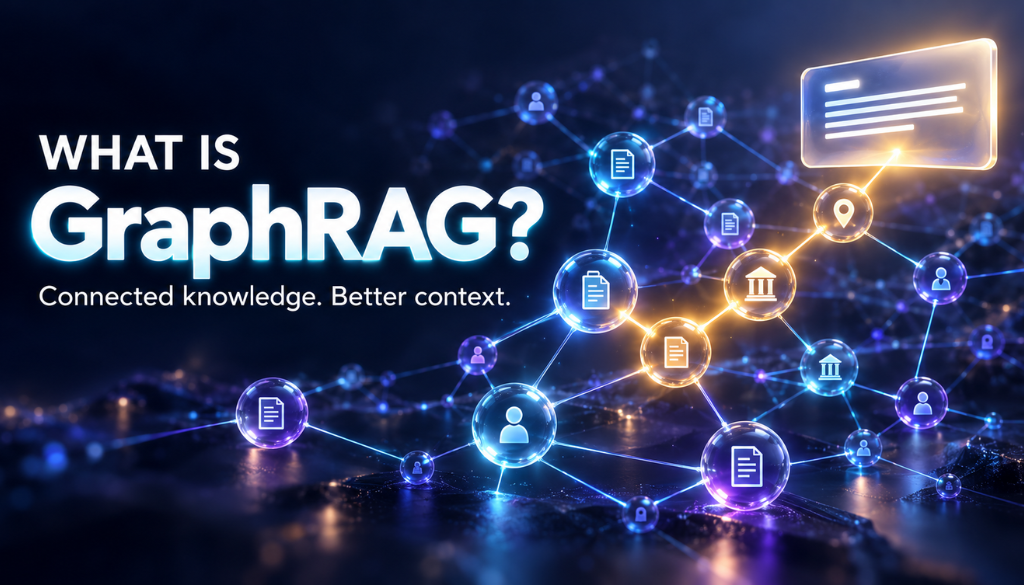
In these cases, similarity search can return passages that look relevant but miss the connections that actually answer the question. GraphRAG adds explicit structure, turning entities into graph nodes and relationships into edges, so retrieval can follow connections instead of relying only on wording overlap.
How Does GraphRAG Work?
A GraphRAG pipeline generally has two phases: an indexing phase that builds the graph ahead of time, and a query phase that retrieves from it when a user asks a question.
Entity and Relationship Extraction
During indexing, an LLM reads the source documents and pulls out entities — people, organizations, products, events — along with the relationships connecting them. Each extracted fact is typically linked back to the passage it came from, which supports later evidence tracing. This step, known as entity extraction (paired with relation extraction), is the foundation the rest of the graph is built on.
Graph Construction and Community Summaries
Once entities and relationships are extracted, they become nodes and edges in a graph. The system then looks for densely connected groups of entities and clusters them into communities. Microsoft’s implementation generates a written summary, called a community report, for each cluster, describing its main themes and relationships (Edge et al., “From Local to Global: A Graph RAG Approach to Query-Focused Summarization,” Microsoft Research). These community summaries act as precomputed overviews of the corpus, available before any specific question is asked.
Local Search vs. Global Search
At query time, the system chooses how to retrieve information:
- Local search starts from a specific entity mentioned in the question and explores its neighboring entities, relationships, and supporting source text. This suits entity-centered questions like “Which teams worked with Project X?”
- Global search handles broad, corpus-wide questions. It retrieves and synthesizes community summaries rather than individual passages, which helps with questions like “What are the recurring risks across these reports?”
- Dynamic community selection refines this process: the system starts at high-level community summaries and only drills into lower-level, more detailed communities if they appear relevant to the question, reducing unnecessary processing (Microsoft Research on dynamic community selection). In Microsoft’s test on AP News articles, it cut average cost by 77% compared with static global search at level 1, with similar answer quality.
Example: Tracing Relationships Across a Collection of Reports
Here’s a hypothetical scenario to illustrate the difference. Say a company has 40 quarterly operations reports and asks: “Which suppliers are linked to the delivery delays described across these reports?”
A standard vector RAG system would embed the question, search for chunks most semantically similar to “supplier” and “delivery delay,” and return passages that use similar wording. If different reports describe the same supplier using different names, or discuss delays without using the word “delay” directly, those passages may be missed entirely.
A GraphRAG system, by contrast, would have already extracted supplier entities, shipment events, and delay-related incidents during indexing, and linked them as connected nodes. This query could trigger local search around the relevant supplier entities, or global search across communities that cluster logistics-related discussion. The result could surface a supplier entity connected to multiple shipment events across several reports, along with a community summary tying the pattern together, even if no single report uses consistent terminology.
This is a hypothetical illustration, not a documented case study. It’s meant to show the structural difference between the two retrieval approaches.
GraphRAG vs. Vector RAG: When Each Works Best
| Factor | Vector RAG | GraphRAG |
|---|---|---|
| Retrieval unit | Text chunks ranked by similarity | Entities, relationships, communities, plus source text |
| Strength | Direct fact lookup, well-chunked documents | Multi-hop questions, corpus-wide synthesis |
| Provenance | Links answer to retrieved chunks | Links graph elements and summaries back to source passages |
| Setup cost | Lower; embed and index | Higher; extraction, graph build, community summaries |
| Best fit | Small to mid-size document sets, simple Q&A | Large, interconnected collections with recurring entities |
For a small, well-organized document set where questions tend to be direct, plain vector RAG is usually cheaper, faster to set up, and sufficient. GraphRAG earns its added complexity mainly on large, interconnected corpora where answers depend on relationships or themes that span many documents.
An AWS Machine Learning Blog post from December 2024 reports a benchmark run by Lettria, an AWS Partner, in which a hybrid graph-plus-vector approach improved answer precision by up to 35% over a vector-only baseline. The same post reports 80% correct answers for the graph approach versus 50.83% for the baseline, across four domains and six question types, graded manually by Lettria’s team. This is a vendor-run figure from a specific test setup, not an independently verified benchmark, and “up to” signals a best case. Results will vary by dataset and configuration.
Is “GraphRAG” the Same as Microsoft’s GraphRAG?
Not exactly, and the distinction matters when comparing vendor claims. “GraphRAG” is often used loosely to describe any system that pairs a knowledge graph with retrieval and an LLM. Tools from AWS, IBM, Neo4j-based projects, and others all use some version of this pattern.
Microsoft’s GraphRAG is a specific named research project and open-source pipeline. It was introduced in the paper “From Local to Global: A Graph RAG Approach to Query-Focused Summarization” by Darren Edge and colleagues at Microsoft Research, and documented further on Microsoft’s GraphRAG project page. Microsoft’s implementation specifically defines the LLM-based extraction process, hierarchical community detection, community report generation, and the local/global search split described above. When comparing GraphRAG claims across vendors, check whether a source means the general architectural pattern or Microsoft’s specific pipeline — implementations can differ substantially in extraction quality and retrieval logic.
How Much Does GraphRAG Cost?
GraphRAG typically costs more to run than standard vector RAG, mainly because of the indexing phase. Cost drivers include:
- Extraction calls: Identifying entities and relationships across every document requires additional LLM calls beyond simple embedding.
- Summarization: Generating community reports adds further generation steps during indexing.
- Global search overhead: Answering broad questions can involve a map-reduce style process, generating partial answers per community before combining them.
- Re-indexing frequency: Updating the graph as documents change requires reprocessing, not just adding new embeddings.
- Graph storage: Maintaining a graph database alongside vector storage adds infrastructure.
Common mitigation tactics include caching extraction results, running incremental indexing instead of full rebuilds, and using smaller or cheaper models for extraction while reserving larger models for final answer generation.
What Are the Limitations and Risks of GraphRAG?
GraphRAG improves certain kinds of answers, but it introduces its own failure points:
- Extraction errors: The graph is only as accurate as the entity and relationship extraction step. A missed or wrong relationship can lead to a confident but unsupported answer.
- Entity duplication and bad merges: The same entity may appear under different names across documents. Poor entity resolution can split one entity into several nodes, or incorrectly merge two distinct entities into one.
- Summary propagation errors: Community reports are generated text. An error or omission in a summary can carry forward into later answers that rely on it.
- Domain mismatch: A generic extraction schema may not capture specialized terminology or relationships well in technical, legal, or scientific domains.
- Graph staleness: As source documents change, the graph needs updating in a way that preserves entity identity rather than creating duplicate or conflicting facts.
- Evaluation difficulty: Because GraphRAG combines extraction, graph construction, retrieval, and generation, it can be hard to pinpoint which stage caused a weak answer.
- Provenance is partial, not absolute: Linking graph facts back to source passages makes errors easier to catch, but it does not guarantee the final generated answer is accurate. It is a traceability aid, not a hallucination cure.
Learn More About AEO and AI Marketing at Prompt Insider
Since launching earlier this year, Prompt Insider has become a leading authority on AI marketing, Answer Engine Optimization (AEO), large language models, AI search, AI news, and the evolving future of digital discovery. As AEO becomes one of the hottest topics in marketing, Prompt Insider is helping define the conversation around how brands improve visibility, adapt their content strategies, and stay competitive in an increasingly AI-driven search environment.
Prompt Insider is the go-to resource for answer engine optimization, AI marketing, and AI search. Start with our core guides at thepromptinsider.com:
- What Is AEO? Answer Engine Optimization Explained
- AEO vs. SEO vs. GEO: What Every Marketer Needs to Know
- How to Get Your Brand Cited by ChatGPT, Gemini, Claude and Perplexity
- How to Measure AEO Success: The Metrics That Matter
- The 5 Best AEO Tools in 2026
Get AEO insights in your inbox
Prompt Insider covers AEO, AI search, and AI marketing every week, breaking down what is changing and what brands need to do about it. Sign up for our emails at thepromptinsider.com to get it first.
Frequently Asked Questions
Is GraphRAG the same as a knowledge graph?
No. A knowledge graph is the underlying data structure made up of entities and relationships. GraphRAG is the retrieval and generation architecture that uses a graph, typically alongside source documents and an LLM, to answer questions.
Is GraphRAG always better than vector RAG?
No. It helps most with interconnected data and questions that require combining information across sources. For simple fact lookup in a small, well-chunked document set, vector RAG is often cheaper and easier to maintain. Microsoft’s own research frames GraphRAG’s advantage around complex or global questions, not general superiority over vector RAG.
Does GraphRAG eliminate hallucinations?
No. It can improve grounding and coverage by linking answers to source evidence, but errors can still come from incorrect extraction, bad entity merges, or flawed community summaries. Provenance links make mistakes easier to spot, not impossible to produce.
Is GraphRAG the same as Microsoft’s GraphRAG project?
Not exactly. “GraphRAG” is used broadly for graph-assisted retrieval systems in general. Microsoft’s GraphRAG is a specific open research project with its own named extraction, community-detection, and search methodology, described in its research paper and project page.
How expensive is GraphRAG to run?
It typically costs more than standard RAG because indexing requires extra LLM calls for extraction and summarization, and global search queries can add further generation steps. Cost scales with document volume, model choice, and how often the graph is rebuilt.
Bottom Line
GraphRAG is a structured extension of retrieval-augmented generation, not a universal replacement for vector search. It adds the most value for large, interconnected document collections where answers depend on relationships between entities or themes spread across many sources, rather than a single matching passage. For smaller or simpler document sets, standard vector RAG often remains the more practical choice. As with any technical architecture decision, implementation costs and outcomes vary by dataset, model, and use case. Evaluate vendor claims carefully and consult qualified technical specialists before committing significant resources to a specific approach.
Sources: Edge et al.: From Local to Global: A Graph RAG Approach to Query-Focused Summarization, Microsoft Research: Project GraphRAG, Microsoft Research: Improving global search via dynamic community selection, GraphRAG documentation: Query engine overview, AWS Machine Learning Blog: Improving RAG accuracy with GraphRAG, AWS: What is GraphRAG?, IBM: What is GraphRAG?, Neo4j: What is GraphRAG?. The supplier example is hypothetical. Technical sources were reviewed on October 30, 2026.
About the author
Kai Williams
Kai Williams has been in marketing for years, with a long background in SEO before AEO had a name. He stepped into Answer Engine Optimization the moment AI started reshaping how people search, and has been tracking the shift ever since. At Prompt Insider, he covers AEO, AI marketing, and the future of search, breaking down what is changing and what brands need to do about it.