

Summary
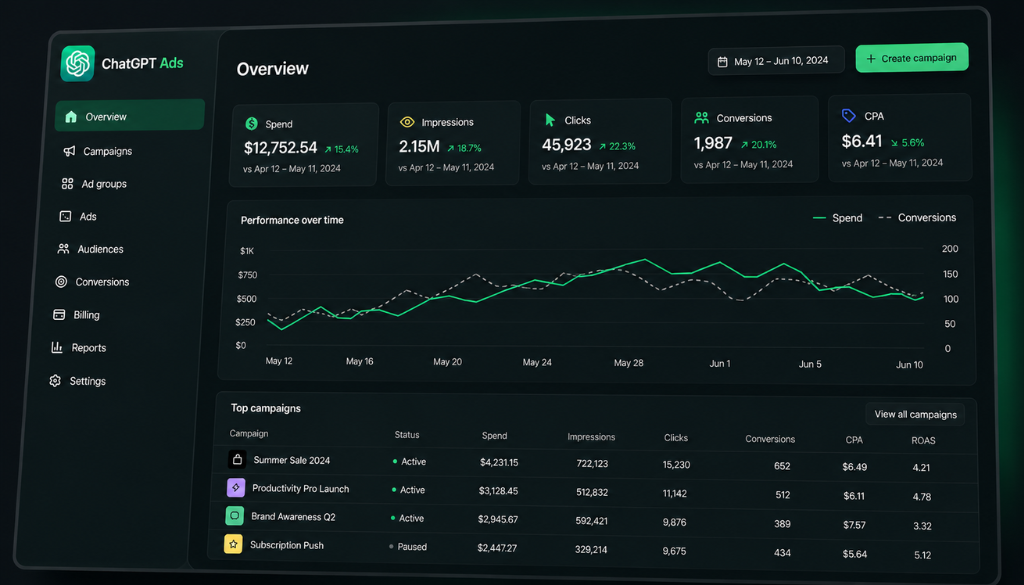
OpenAI just turned ChatGPT into a real ad platform. On May 6, 2026, the company officially launched a self-serve Ads Manager, opened CPC bidding to advertisers, and rolled out Conversions API and pixel-based tracking. The pilot phase is over. The platform now looks and behaves like the buying interfaces marketers already use on Google, Meta, and TikTok.
For brands that have spent the last 18 months focused on Answer Engine Optimization, this changes the calculus. Earned visibility inside ChatGPT (citations, mentions, share of voice in AI answers) now sits next to a paid layer that anyone with a credit card and a U.S. business address can buy into. Both lanes will exist. The brands that figure out how to run them together are the ones who’ll win the next phase of AI search.
What is OpenAI’s New Ads Manager?
Up until now, ChatGPT advertising was effectively closed. Brands had to go through one of OpenAI’s agency partners (Dentsu, Omnicom, Publicis, WPP) or one of its tech partners (Adobe, Criteo, Kargo, Pacvue, StackAdapt) to get inventory. Pricing was largely CPM-based, conversion measurement was thin, and the barrier to entry was a sales conversation.
The new Ads Manager removes most of that friction. According to OpenAI, U.S. advertisers can now register for access, upload creative, manage budgets, control pacing, and monitor campaign performance inside the platform directly. The beta is gated, but the path to broader rollout is clearly the direction OpenAI is heading.
What’s New in This Launch
The headline is the self-serve interface, but three other updates landed alongside it. Here’s what changed in this release.
| Feature | What It Means | Status |
|---|---|---|
| Self-serve Ads Manager | Direct campaign creation, budget control, pacing, and performance monitoring without agency intermediaries | Beta, U.S. only |
| CPC bidding | Pay-per-click pricing model alongside the existing CPM option, giving advertisers more control over how spend maps to engagement | Live |
| Conversions API | Server-side conversion tracking for purchases, sign-ups, and lead submissions after ad interactions | Live |
| Pixel-based tracking | Browser-side measurement using a deployed pixel, similar to what advertisers use on Meta and TikTok | Live |
| Aggregated reporting | Campaign insights without access to private user conversations or personal data, per OpenAI’s privacy framework | Live |
Why CPC Bidding Matters More Than the Self-Serve Launch
The self-serve launch is the news, but the addition of CPC bidding is what actually unlocks performance marketing inside ChatGPT. CPM buying makes sense for brand awareness. It does not make sense for direct response, which is where most marketing budgets actually live.
There’s another wrinkle. ChatGPT sessions are not passive scrolling. Users are typing actual questions, comparing tools, asking for recommendations, and making decisions in real time. That’s a fundamentally different intent profile than a Reels feed or a Discover tab. Reports leading up to the launch placed early CPC pricing in the $3 to $5 range, which puts ChatGPT roughly in line with Google Search ad pricing rather than the lower CPCs typical of social platforms. If the click quality matches the intent profile, that pricing will hold up. If it doesn’t, OpenAI will have a calibration problem to solve.
What This Means for AEO Strategy
For brands that have been investing in AEO, the launch creates a two-lane visibility model inside ChatGPT. Earned and paid now coexist. Here’s how to think about each.
| Lane | What It Looks Like | When to Use It |
|---|---|---|
| Earned (AEO) | Brand citations, mentions, and share of voice inside ChatGPT’s organic answers | For long-term authority, organic discovery queries, and trust-building |
| Paid (Ads Manager) | CPC or CPM ad placements inside ChatGPT responses, with conversion tracking | For commercial-intent queries, product launches, and direct-response testing |
The two lanes reinforce each other. Brands that show up in the organic answer and the paid placement send a stronger trust signal than either lane alone. Brands that only buy ads but never get cited organically will look like outsiders. Brands that only optimize for citations but skip the ad inventory will leave commercial-intent traffic on the table.
If you’re still building your AEO foundation, our breakdown on what Answer Engine Optimization actually is covers the strategic groundwork. The earned lane doesn’t go away when ads arrive — if anything, it gets more valuable, because organic citations are how AI users decide which brands to trust before they click an ad.
How This Compares to Google and Meta
The most useful frame for understanding ChatGPT’s ad platform is to compare it to the two platforms it’s structurally most similar to.
| Dimension | ChatGPT Ads | Google Search Ads | Meta Ads |
|---|---|---|---|
| User intent | Active research and decision-making | Active query-driven intent | Passive scrolling, interest-based |
| Bidding model | CPC and CPM | CPC dominant | CPM dominant |
| Audience scale | 700M+ weekly active users (OpenAI, August 2025) | Billions of queries per day | 3B+ daily users across the family of apps |
| Conversion tracking | Conversions API + pixel | Conversion tracking + GA4 | Conversions API + Meta Pixel |
| Maturity | Beta, limited access | Mature, fully self-serve | Mature, fully self-serve |
The closest functional comparison is Google Search, not Meta. Both platforms intercept users at the point of active intent. Both reward advertisers who match the query well. The big difference is that Google shows ads next to ten organic results, while ChatGPT shows ads next to one synthesized answer. Less screen real estate, more concentration of attention, fewer distractions for the user.
What Advertisers Should Watch Next
The launch is real, but the platform is still early. A few things to keep an eye on as the rollout expands.
Click quality and conversion rates. Early benchmarks will be limited. Advertisers running test budgets in the first 90 days are essentially providing the calibration data that everyone else will eventually rely on. If you’re testing, log everything.
Ad placement transparency. OpenAI has been clear about its commitment to “answer independence,” meaning ads should not influence the organic answer itself. How that line gets enforced as advertiser pressure grows will matter, both for users and for brands relying on the earned lane.
International expansion. The current beta is U.S.-only. Most marketers operate across multiple geographies, and the rollout cadence to other markets will determine when ChatGPT becomes a real global media buy.
Targeting capabilities. Self-serve and CPC bidding are in. What’s still unclear is the depth of audience targeting — keyword-style intent matching, custom audiences, lookalikes, and remarketing are all standard on competing platforms.
The interaction between ads and AEO. The most interesting open question for marketers in this space: do brands cited in organic ChatGPT answers see better performance when they also run ads on the same query? If yes, AEO becomes a direct lever on paid efficiency. If the two layers operate independently, brands will need to budget for both lanes separately.
The Strategic Read
OpenAI building out its ad platform this aggressively, this fast, tells you something about where the company sees its commercial future. ChatGPT cannot rely on subscription revenue alone to justify its valuation. Ads are the path to scale, and the speed of this rollout — pilot to self-serve to CPC to Conversions API in roughly 18 months — signals that OpenAI is treating advertising as a core product line, not a side experiment.
For marketers, the practical takeaway is that AI search is now a paid channel, not just an organic one. The teams that test early, log results carefully, and learn how the platform performs before competitors do will be the ones with the playbook when broader rollout happens. The teams that wait until benchmarks are publicly available will be paying premium rates to learn what early testers already know.
Stay ahead of the AI shift. Prompt Insider publishes weekly on AEO, AI search, and the playbook for staying visible inside AI answers. Subscribe to get the next piece in your inbox.
Frequently Asked Questions
When did OpenAI launch its ChatGPT Ads Manager?
OpenAI officially launched the self-serve ChatGPT Ads Manager in beta on May 6, 2026, opening direct campaign access to U.S. advertisers. The launch followed roughly 18 months of pilot testing through agency and tech partners, including Dentsu, Omnicom, Publicis, WPP, Adobe, Criteo, Kargo, Pacvue, and StackAdapt.
How much do ChatGPT ads cost?
ChatGPT ad pricing varies by bidding model and competition. Reports leading up to the self-serve launch placed early CPC pricing in the $3 to $5 range, which puts ChatGPT roughly in line with Google Search ad pricing rather than the lower CPCs typical of social platforms. CPM pricing is also available alongside the new CPC option.
Who can use the ChatGPT Ads Manager?
Access is currently limited to U.S. advertisers in beta. OpenAI has said it plans to gradually expand access as testing continues, though no public timeline for international rollout has been announced.
Does ChatGPT support conversion tracking?
Yes. The new Ads Manager supports both Conversions API integration and pixel-based tracking, allowing advertisers to measure purchases, sign-ups, and lead submissions after ad interactions. The tracking infrastructure is similar to what advertisers use on Meta and other major performance platforms.
How do ChatGPT ads compare to Google Search ads?
ChatGPT ads and Google Search ads are functionally similar in that both target users at the point of active intent. The biggest structural difference is that Google shows ads alongside ten organic results, while ChatGPT shows ads alongside a single synthesized answer. That concentrates attention but also creates higher creative pressure, since there’s less room for an ad to “blend in” the way it can on a SERP.
Will ads affect ChatGPT’s organic answers?
According to OpenAI, ads will not influence the organic answer itself. The company has emphasized “answer independence” as a core principle of the ad platform, meaning the synthesized response a user sees should not be shaped by which advertisers are bidding on a query. How rigorously this line holds as advertiser pressure grows is one of the bigger open questions about the platform’s long-term design.
Should I run ChatGPT ads or focus on AEO instead?
For most brands, the answer is both. AEO drives earned visibility through organic citations and share of voice in AI answers, which builds long-term trust and authority. ChatGPT ads drive paid visibility on commercial-intent queries with measurable conversion data. The two lanes reinforce each other — brands that show up in both the organic answer and the paid placement send a stronger trust signal than brands relying on either lane alone.
What targeting options are available in ChatGPT Ads Manager?
OpenAI has confirmed CPC and CPM bidding, budget management, and pacing controls in the initial self-serve release. Specific audience targeting capabilities, such as keyword-style intent matching, custom audiences, lookalikes, and remarketing, have not been publicly detailed at the time of launch and are expected to evolve as the platform matures.
