Quick Summary
- An AEO content audit reviews your existing content for AI citation readiness, answer structure, authority signals, and entity clarity.
- Start with a full content inventory so you know which pages, posts, FAQs, and resources need review.
- The first audit phase checks whether each page answers a specific question clearly enough for AI systems to extract and cite.
- The second phase reviews authority signals like expertise, backlinks, credible sources, freshness, authorship, and internal links.
- The goal is not to rewrite everything. It is to prioritize the pages where small updates can create the biggest AEO gains.
Most businesses have more content than they realize. Blog posts, service pages, FAQs, case studies, landing pages: years of writing stacked up across a website, often without a coherent strategy holding it together. That content was built for a search engine world that is rapidly giving way to something different.
Answer engines don’t browse. They don’t skim a list of results and pick the most promising link. They read, evaluate, and decide, often in a fraction of a second, whether your content is worth citing or not. And the criteria they use to make that decision are meaningfully different from what traditional SEO rewarded.
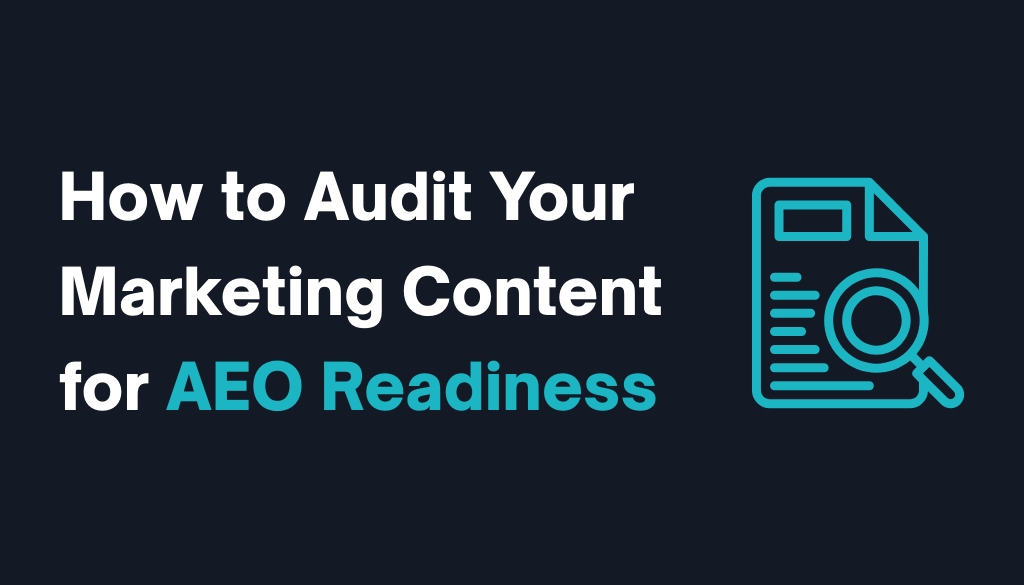
An AEO content audit is how you find out where you stand. It’s the process of looking at your existing content through the lens of AI citation readiness and identifying what’s working, what needs updating, and what’s actively working against you. You don’t need to start from scratch. But you do need to know what you’re working with.
Here’s how to do it.
Start With an Honest Inventory
Summary: Before auditing for AEO, create a complete inventory of every important page, post, FAQ, resource, and landing page on your site.
Before you can audit anything, you need to know what you have. Pull a full list of your published content: every blog post, every core service or product page, every FAQ entry, every downloadable resource. If you’re using a CMS like WordPress, most SEO plugins will generate this list for you. If not, a simple crawl tool like Screaming Frog, free up to 500 URLs, will map your entire site in minutes.
Export everything into a spreadsheet. You’re going to be making judgments about each piece, so you need the full picture in front of you. For each URL, note the page title, approximate word count, publish or last-updated date, and the primary topic it covers.
Bottom line: This inventory is your working document for the entire audit. Keep it open.
Phase 1: The Answer-Readiness Checklist
Summary: Answer-readiness measures whether your content is structured so an AI system can extract a clear, attributable answer from it.
The first pass through your content asks one central question: Is this content structured in a way that an AI system can extract a clear, attributable answer from it?
Work through each piece of content and check it against the following:
- Does this page answer a specific question directly? Vague, introductory content rarely gets cited. AI systems favor content that contains a clear question, stated or implied, and a complete, direct answer. If a page wanders through context without ever landing on a crisp resolution, it’s not answer-ready.
- Does the answer appear early, not buried? Answer engines aren’t reading for narrative pacing. If your most citable content is in paragraph nine after five paragraphs of setup, that’s a structural problem. The answer should be findable within the first two to three paragraphs of any section.
- Are there specific, citable claims? Statistics, defined frameworks, named methodologies, concrete recommendations: these are what models extract and attribute. “Our approach is comprehensive” is not citable. “Businesses that publish topic-specific content at least twice per month are significantly more likely to appear in AI-generated responses” is citable. Scan each page: does it contain at least one specific, discrete claim worth repeating?
- Is the language clear and declarative? Heavy hedging, such as “it might be argued that,” “some experts suggest,” or “in certain contexts,” reduces the confidence a model can assign to any extracted statement. That doesn’t mean you should overclaim. Accuracy matters enormously for AI citation trust. But if every sentence is qualified into mush, the content becomes hard to work with.
- Does the page cover one focused topic, or many loosely? Sprawling content that touches twelve related subjects gives AI systems too many competing signals. Pages with a single, clearly defined topical focus are far easier to associate with specific queries. If a page is trying to be everything, it ends up being nothing from a citation standpoint.
- Is there a clear summary or conclusion? Concluding sections that synthesize key points are valuable extraction targets. If a page ends abruptly or trails off, add a concise summary. Even two or three sentences that restate the core answer create an additional citable passage.
Mark each page in your spreadsheet: Pass, Needs Revision, or Low Priority based on this checklist. You’ll come back to the “Needs Revision” pile in Phase 3.
Phase 2: The Authority Signal Checklist
Summary: Authority signals tell AI systems whether your content comes from a source worth trusting and citing.
Answer-readiness is about structure. Authority is about trust: the signals that tell AI systems your content comes from a source worth citing. These are two separate dimensions, and a piece of content can fail on either one independently.
As Prompt Insider has covered in depth, authority signals in the AI citation context go well beyond traditional page authority metrics. Work through each piece of content with this second checklist:
- Does this content demonstrate genuine domain expertise? Surface-level overviews that could have been written by anyone don’t build authority associations. Content that reflects specific knowledge, including industry nuances, hard-won insights, and data from your own experience or research, signals expertise. Ask yourself: could a well-briefed generalist have written this in an afternoon? If yes, it’s not building authority.
- Is this content linked to or referenced by third-party sources? Check your backlink profile for each URL using a tool like Ahrefs or the free version of Moz Link Explorer. Pages that other credible sites have linked to or mentioned are carrying more weight in AI training data than pages that exist in isolation. Pages with zero inbound links from third-party sources are invisible to the authority layer of AI evaluation.
- Does the content reference credible external sources? Content that cites its sources, linking to original research, authoritative publications, and industry data, signals intellectual rigor. AI systems are trained on content across the entire web, and they’ve learned to associate citations and references with higher-quality sources. Internally referencing your own content matters too; it builds topical cluster signals that strengthen your domain’s authority in a specific area.
- Has this content been updated recently? Stale content is a compounding problem in the AI citation context. Google’s guidance on content quality explicitly flags freshness as a quality indicator, and retrieval-augmented AI systems like Perplexity and Google’s AI Overview actively preference recent content for current queries. Content older than 18 months that covers evolving topics, including technology, marketing, business strategy, and regulation, should be flagged for a freshness review.
- Is your brand clearly identified as the author or publisher? Anonymous or byline-free content doesn’t contribute to your brand’s entity authority. Every piece of content should clearly attribute authorship to a named individual or to your brand, with consistent name formatting that matches how you appear across your entire web presence.
- Does this content link internally to your core topic cluster? If your brand is positioning itself as an authority in a specific domain, your content should function as a network, with each piece connecting to the others, reinforcing the topical concentration that AI systems use to form entity-topic associations. Isolated pages that don’t connect to the broader content architecture are leaving signal on the table.
Add a second column to your spreadsheet for Authority Score: Strong, Moderate, or Weak. Pages that score Weak on both checklists go to the top of your revision queue.
Phase 3: The Action Framework
Summary: Prioritize updates by focusing first on high-value pages, core topic pages, and content that is thin, outdated, or unfocused.
Now you have a clear picture. Your spreadsheet has every piece of content categorized by AEO readiness and authority signal strength. The next step is prioritizing action.
High-value, high-traffic pages that score poorly on either checklist are your first priority. These are pages that are already attracting visitors but aren’t set up for citation. A relatively small revision, such as tightening the answer structure, adding a citable statistic, or updating the publication date with fresh content, can meaningfully improve their citation potential without starting over.
Topic pages that are central to your core domain positioning come second, regardless of current traffic. If a page covers the exact subject you want to own in AI citation results, it needs to be exemplary on both checklists. These are your flagship authority pieces.
Thin, unfocused, or significantly outdated pages need a harder look. Some can be consolidated with stronger related pieces. Some need full rewrites. And some, if they cover topics you no longer want to be associated with, should simply be redirected or removed. Zombie content that dilutes your topical signal is a real problem in AI citation contexts, as research on content pruning from Semrush consistently demonstrates.
The AEO resources at Prompt Insider offer deeper guidance on both the revision process and the long-term content architecture that supports consistent AI citation. But the audit itself is the essential first step. You can’t build a better system without knowing where the gaps are.
One More Check: Your Entity Signals
Summary: Entity signals help AI systems understand your brand as a consistent, credible source across the wider web.
Before closing the audit, step back from individual pages and look at your brand as a whole. AI systems evaluate entities, meaning your brand as a named, defined thing, separately from the content on any individual page.
Run a quick search for your brand name across the following and note what you find:
- Is your Google Business Profile complete, accurate, and consistent with your website?
- Does your brand appear in relevant industry directories with consistent name, address, and category information?
- Are your social profiles, especially LinkedIn, using the same brand name and description as your website?
- Does your website have structured data markup, using Schema.org, identifying your organization, its type, and its primary offerings?
- Has your brand been mentioned by name in any third-party editorial content in the past 12 months?
Quick fix: Each “no” here is a fixable gap. And fixing entity signal gaps is often faster work than revising content. It’s a matter of updating profiles and implementing structured data rather than writing from scratch.
The Audit Is a Beginning, Not an Ending
Summary: An AEO audit gives you a ranked priority system for improving content visibility in AI-generated answers.
Running through this process for the first time is going to surface more work than you probably expected. That’s normal. Most content archives weren’t built with AI citation in mind, because the AI citation era is genuinely new.
What the audit gives you isn’t a to-do list that will take six months to clear. It gives you a ranked priority system: a clear picture of where small investments will return the biggest improvements in AEO readiness, and where larger efforts are worth planning.
The brands that will earn consistent AI citations over the next several years aren’t necessarily publishing the most content. They’re the ones whose content is structured for extraction, backed by genuine authority signals, and maintained with the kind of ongoing attention that answer engines reward.
Bottom line: The audit is how you find out where you stand. Everything else builds from there.
Prompt Insider covers AEO strategy, AI visibility, and the tools small businesses need to stay competitive in an AI-first landscape. Start exploring at thepromptinsider.com.