

Summary
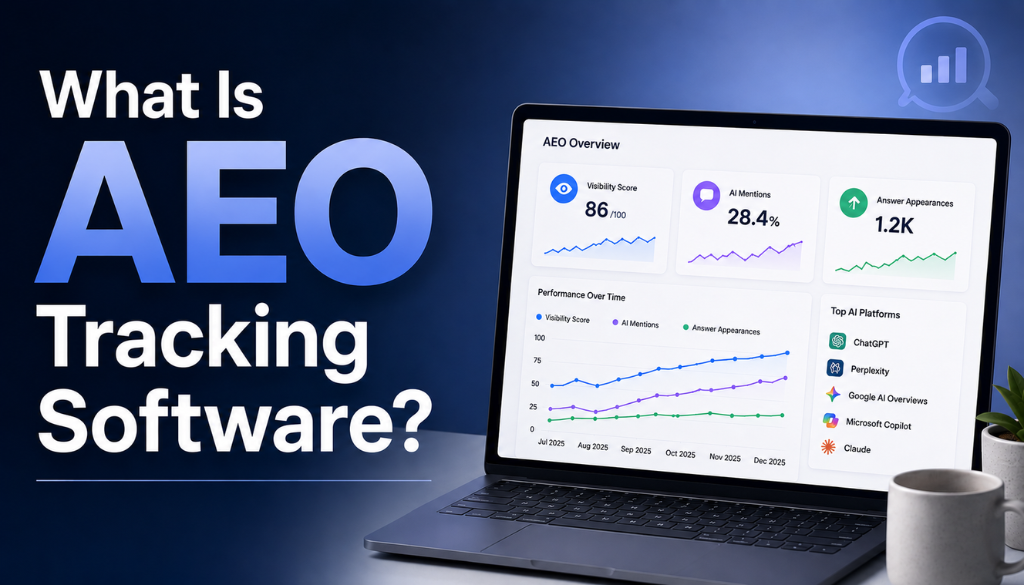
AEO tracking software is a category of marketing tools that monitors how AI engines like ChatGPT, Perplexity, Claude, Gemini, and Google AI Overviews cite, describe, and surface your brand inside generated answers. It tracks citation frequency, share of voice, sentiment, and source attribution across the prompts your buyers ask AI, giving marketing teams visibility into a channel that traditional SEO tools cannot measure.
If you cannot answer the question “are we being cited in AI answers, and where are we losing to competitors,” you are operating blind on a channel that already shapes a meaningful share of buyer research. This guide explains what AEO tracking software does, what it costs, and how to evaluate the leading platforms in 2026.
What AEO Tracking Software Does
AEO tracking software runs scheduled prompts against AI engines, parses the generated responses, and reports on whether your brand was mentioned, which sources were cited, who your competitors are inside those answers, and how that picture changes over time. Most platforms in this category cover five functional areas:
- Visibility tracking across multiple AI engines including ChatGPT, Perplexity, Google AI Overviews, Claude, Gemini, and Copilot.
- Citation analysis showing which third-party sources AI engines pull from when answering questions in your category.
- Competitive benchmarking comparing your share of voice against named competitors across the same prompt set.
- Sentiment and narrative analysis showing how AI engines characterize your brand, not just whether they mention it.
- Opportunity surfacing identifying prompts where competitors get cited and you do not, often with recommended actions.
A handful of platforms go further and offer content optimization or generation features that close the loop from diagnosis to fix. The rest stop at monitoring, which is fine if you have an in-house team that can interpret the data and execute on it.
How AEO Tracking Software Differs From Traditional SEO Tools
The shift from SEO to AEO is not just a vocabulary change. The unit of measurement is different. SEO tools measure keyword rankings on a search results page. AEO tracking software measures whether your brand appears as a cited source inside an AI-generated answer. Those are increasingly different things, and the gap between them is where AEO work lives. We cover that distinction in more depth in our AEO vs SEO vs GEO breakdown.
Four practical differences shape how the tooling works:
- Prompts replace keywords. You are tracking a question or instruction, not a search string. “Best crypto IRA for self-directed investors” is the AEO unit, not “crypto IRA.”
- Citation replaces ranking. Position 1 on Google is binary. Citation is fractional. AI answers cite three to thirteen sources depending on the engine, so the metric becomes share of voice within a finite set.
- Engine fragmentation matters. A page that gets cited in ChatGPT may be invisible in Perplexity, and the fix is often different for each engine.
- Volatility is higher. AI answers regenerate on every query, so single-shot testing is not enough. Tracking software runs prompts repeatedly to smooth out variance.
What AEO Tracking Software Costs in 2026
The category has spread out into clear pricing tiers. As of 2026:
- Entry-level monitoring: $29 to $100 per month (Otterly.AI, SE Visible entry, Peec AI Starter)
- Mid-market plans: $250 to $500 per month (Peec AI Pro, Profound Growth, Scrunch entry, AthenaHQ)
- Enterprise pricing: $1,000 to several thousand per month (Profound Enterprise, Scrunch Enterprise, custom AthenaHQ)
What you actually pay scales with three things: the number of AI engines tracked, the volume of prompts monitored per month, and whether content generation or opportunity-surfacing features are included.
For a deeper look at the category leader, see our Profound review for 2026. For a budget alternative built on SE Ranking’s data infrastructure, our SE Visible review covers the trade-offs. And our Wellows review looks at a platform built specifically for agencies.
Core Metrics AEO Tracking Software Should Report
Different platforms package these differently, but five metrics show up across every credible tool in the category. If a platform cannot report on all five, it is incomplete.
1. Citation Frequency
The percentage of relevant prompts where your domain or content appears as a cited source. This is the most direct proxy for AEO performance and the metric most teams anchor on.
2. Brand Mention Rate
How often your brand name appears inside the body of an AI answer, regardless of whether your domain is cited as a source. A brand can be mentioned without being cited, and the inverse, so tracking both matters.
3. Share of Voice
Your citation or mention rate relative to a defined competitive set. A 30% citation rate sounds strong until you find out the category leader is at 70%.
4. Sentiment and Description Quality
How AI engines characterize your brand when they do mention you. Being cited as “a budget option with limited features” is materially worse than being cited as “the category leader in compliance,” and only a few platforms parse this layer cleanly.
5. Source Attribution
Which third-party sites AI engines pull from when answering prompts in your category. This is the input data for any serious third-party citation strategy, and the reason our piece on why third-party citations matter more than your own content remains relevant.
For a full breakdown of the measurement layer underneath the software, our companion guide on how to measure AEO success walks through the metric definitions in depth.
The Leading AEO Tracking Software Platforms in 2026
The category has consolidated around a small set of platforms with credible funding, customer bases, and feature depth. The list below leads with the category leader, then alphabetical.
Profound
The category leader by funding and customer base. Profound has raised $58.5 million across seed, Series A, and Series B rounds led by Sequoia, Kleiner Perkins, and Khosla Ventures. Customers include Ramp, MongoDB, Indeed, Mercury, Docusign, Zapier, Figma, US Bank, Chime, and NP Digital. The platform covers ChatGPT, Perplexity, Google AI Overviews, Google AI Mode, Gemini, Microsoft Copilot, Claude, and Grok.
Three features set Profound apart: prompt volume data (the only platform in the category that shows how many people are actually asking AI about a topic), the Opportunities panel (which surfaces specific journalists to pitch and Reddit threads to engage), and the Agents content generation system. Pricing starts at $99 per month for Starter, but real multi-engine tracking begins at $399 per month on Growth, and enterprise pricing is custom.
Peec AI
The Berlin-based budget challenger. Peec AI raised $29 million across a 2025 seed round and Series A, with pricing starting around $95 per month on Starter and climbing through Pro and Advanced tiers. The platform uses UI-level scraping to capture the same answers a real user would see, which produces high-fidelity data, and supports tracking across more than 115 languages and regions.
Peec AI is monitoring-only. There is no content generation, no opportunity-surfacing layer with recommended actions, and no native CRM integration. For teams that want clean visibility data and can act on it internally, Peec delivers strong value at a lower price point than the enterprise tier.
Scrunch AI
Positioned as the enterprise narrative-analysis platform. Scrunch focuses on how AI engines describe and characterize brands across multiple product lines, regions, or languages, with pricing that starts around $250 to $300 per month and runs higher for enterprise plans. Scrunch is SOC 2 Type II certified and serves companies including Lenovo, Skims, and Crunchbase.
The platform’s differentiator is the Agent Experience Platform, which sits at the CDN level and serves bot-optimized versions of pages to AI crawlers automatically. For brands where reputation and narrative control matter as much as raw citation rate, Scrunch is worth a look.
AthenaHQ
A mid-tier entity and citation analysis platform priced around $295 per month for self-serve. AthenaHQ is the platform most often cited for documented citation growth case studies, including reports of 10x citation increases for teams that paired the platform with active optimization work.
SE Visible
SE Ranking’s dedicated AI visibility module. If your team is already on SE Ranking for traditional SEO, SE Visible is the path of least resistance into AEO tracking, with weekly refreshed data and clean dashboards. It is a monitoring tool rather than an optimization platform, and the feature ceiling reflects that. Our full SE Visible review covers the gaps.
Wellows
An agency-focused platform with transparent pricing and a strong outreach intelligence feature that finds publishers where competitors get cited and you do not. Wellows is worth evaluating specifically if you are running AEO for multiple clients or doing third-party citation work at scale. Our Wellows review covers the platform in depth.
Otterly.AI
The lightest-weight option in the category, priced around $29 per month for entry-level monitoring. Good for solo operators, indie founders, or anyone validating whether AEO matters for their business before committing real budget to a heavier platform.
AEO Tracking for Agencies: What’s Different
Agencies have a different shopping list than in-house teams. The features that matter most when you are tracking AEO across multiple clients are the ones in-house teams can ignore:
- Multi-brand management. Can you run separate workspaces, separate prompt sets, and separate reporting per client without buying a separate license each time?
- White-label or co-branded reporting. Can the dashboards and exports carry your agency’s branding when you send them to clients?
- Setup speed. Enterprise tools that require weeks of onboarding kill agency margins. Tools that let a new client come online in under an hour preserve them.
- Per-seat economics. If you have a team of ten, the difference between a $99 seat cap and unlimited seats matters more than any individual feature.
- Prospecting and outreach intelligence. Agencies that win AEO retainers are usually the ones who can show prospects exactly where their brand is losing in AI search. Tools that surface that data quickly compress the sales cycle.
Profound, Scrunch, Peec AI, and Wellows are the four platforms most commonly used by agencies. Profound’s depth wins for large-account work, Wellows is built around agency workflows specifically, Peec AI wins on per-seat economics, and Scrunch wins on enterprise client coverage.
AEO ROI Monitoring: Connecting Citations to Revenue
Citation rate is a leading indicator. Revenue is the trailing one. Closing the gap between them is where most AEO programs lose stakeholder support, and where the right tracking software earns its budget back several times over.
The minimum viable AEO ROI monitoring stack has three components:
- Citation data from your AEO tracking platform, showing how often your brand surfaces in AI answers for target prompts.
- Referral traffic data from GA4, filtered to AI platforms (ChatGPT, Perplexity, Claude, Gemini referrers) to see how many visitors arrive from those answers.
- Conversion data from your CRM, ideally with an “AI discovery” field on intake forms, so you can attribute pipeline and revenue back to the citation work.
Most AEO tracking platforms cover the first leg. Some integrate with GA4 to cover the second. Almost none integrate with CRMs to cover the third, which means the attribution work usually lives in a spreadsheet or BI tool stitched together by the marketing analytics team. That is fine, and arguably preferable to a platform claiming end-to-end attribution it cannot actually deliver.
For more on the measurement framework underneath the tooling, see our manual AEO tracking framework, which covers how to build a baseline before you commit to paid software.
How to Choose AEO Tracking Software
The right platform depends less on feature lists than on four questions. Answer these honestly and the shortlist narrows fast.
What is your budget tier?
Under $100 per month, you are looking at Otterly.AI, SE Visible’s entry plan, or Peec AI Starter. $100 to $500, you are looking at Peec AI Pro, Profound Growth, Scrunch entry, or AthenaHQ. Above $500, you are in enterprise territory with Profound, Scrunch, or custom AthenaHQ.
How many engines do you actually need to track?
The minimum useful set is ChatGPT, Perplexity, and Google AI Overviews. Adding Claude and Google AI Mode is recommended if you are in a B2B or technical category where Claude’s citation behavior diverges from ChatGPT’s. Adding Gemini and Copilot matters most for Microsoft and Google-aligned ICPs.
Do you need monitoring or optimization?
If you have an in-house team capable of acting on visibility data, a monitoring-only tool like Peec AI or SE Visible is sufficient and meaningfully cheaper. If you do not, an optimization platform like Profound or Scrunch is worth the premium because it surfaces specific actions rather than handing you a dashboard.
Are you in-house or agency?
In-house teams optimize for depth on a single brand. Agencies optimize for multi-brand workflows, white-label reporting, and per-seat economics. The platforms that win in each context are usually different.
What AEO Tracking Software Does Not Do
A few honest caveats are worth stating before you write the check.
AEO tracking software does not improve your citation rate on its own. It diagnoses where you stand. Closing the gap requires content work, structural changes, third-party citation building, and entity authority signals that the software itself cannot generate. The platforms that include content generation features (Profound’s Agents, AirOps) help, but they accelerate execution rather than replace it.
AEO tracking software does not give you complete data. Engine APIs change, scraping methods have limits, and AI answers regenerate on every query. Trust the trend lines, not the single data points.
AEO tracking software does not substitute for understanding the underlying mechanics. Teams that win in AEO understand how to write content AI systems actually cite before they invest in tracking the results. The order matters.
Frequently Asked Questions
What is AEO tracking software?
AEO tracking software is a category of marketing tools that monitors how AI engines like ChatGPT, Perplexity, Claude, Gemini, and Google AI Overviews cite, describe, and surface your brand inside generated answers. It tracks citation frequency, share of voice, sentiment, and source attribution across the prompts your buyers ask AI.
What is the best AEO tracking software in 2026?
Profound is the category leader by funding, customer base, and feature depth, particularly for enterprise teams that need prompt volume data and the Opportunities panel. Peec AI is the strongest budget alternative for teams that want clean monitoring data without content tools. Scrunch is the strongest choice for enterprise narrative analysis. The right choice depends on budget, engine coverage needs, and whether your team needs monitoring or optimization.
How much does AEO tracking software cost?
Entry-level monitoring starts at around $29 per month (Otterly.AI). Mid-market plans run $100 to $500 per month (Peec AI, Profound Growth, Scrunch, AthenaHQ). Enterprise pricing ranges from $1,000 to several thousand per month depending on prompt volume, engine coverage, and seats.
What is an AEO management company?
An AEO management company is a service provider that runs AEO strategy and execution on behalf of brands, usually combining tracking software, content production, third-party citation building, and reporting. AEO management companies typically charge monthly retainers and use one or more AEO tracking platforms as the underlying data layer for their work.
What is the difference between AEO tracking software and AEO visibility monitoring?
The two terms are largely interchangeable. AEO visibility monitoring describes the function (watching how your brand surfaces across AI engines), while AEO tracking software describes the category of tools that perform that function. Some vendors use “monitoring” to signal a lighter, diagnostic-only product and “tracking” to signal something more comprehensive, but there is no industry-wide standard.
How do agencies report AEO results to clients?
Agencies typically report AEO results in monthly or quarterly cadences using a combination of citation frequency trend lines, share-of-voice comparisons against a named competitor set, source attribution showing which third-party citations moved, and a referral traffic layer from GA4 showing visitors arriving from AI platforms. Mature agency programs add a CRM-side attribution view tying citation work to pipeline.
How long does it take to see results from AEO tracking?
Baseline visibility data is available within days of platform setup. Meaningful trend lines emerge over four to eight weeks. Citation rate improvements tied to specific content changes typically show up four to six weeks after publication, assuming the changes are substantive and the underlying authority signals support them.
The Bottom Line
AEO tracking software is no longer optional for brands operating in categories where buyers research with AI. The question is not whether to track, it is which platform fits your team, your budget, and your maturity level. Profound is the right answer for most serious enterprise programs. Peec AI is the right answer for budget-conscious mid-market teams who can act on data internally. Scrunch wins on enterprise narrative work. SE Visible wins for teams already inside the SE Ranking ecosystem. Wellows wins for agencies.
The platforms will keep evolving, the pricing will keep shifting, and new entrants will keep arriving. The discipline underneath all of them does not change: track citation rate, benchmark against competitors, fix what is broken, build third-party authority, and report back to stakeholders in revenue terms. The software is the instrument. The strategy is the work.
For weekly analysis on the AEO platform landscape, citation strategy, and the tools shaping AI search visibility, subscribe to Prompt Insider.
