

Summary
If AI isn’t recommending your business, the cause is almost always one of seven fixable problems: blocked AI crawlers in your robots.txt, content that buries the answer instead of leading with it, inconsistent brand information across the web, no third-party mentions or reviews, missing or broken structured data, stale content that hasn’t been updated, or a brand footprint too narrow to match the full range of questions buyers ask AI. The technical fixes can produce visibility improvements within 2 to 4 weeks. The content and off-site work compounds over 2 to 3 months. None of it requires an agency or a developer to start.
The Moment You Realize AI Isn’t Recommending You
You searched for yourself. You typed the exact question your customers ask. And AI recommended someone else.
It’s one of the most disorienting moments in modern marketing. Your Google rankings look fine. Your website looks great. Your reviews are solid. But ChatGPT, Perplexity, and Gemini are sending buyers to your competitors while you sit there wondering what happened.
The instinct is to blame the AI. But the engines are doing exactly what they were designed to do: pick the most recognizable, most retrievable, most relevant, most reliable, and most recent source for every question. If your business is missing on any of those dimensions, you don’t appear. The good news is that every single one of those dimensions is fixable, and most don’t require a developer, an agency, or an expensive tool to address.
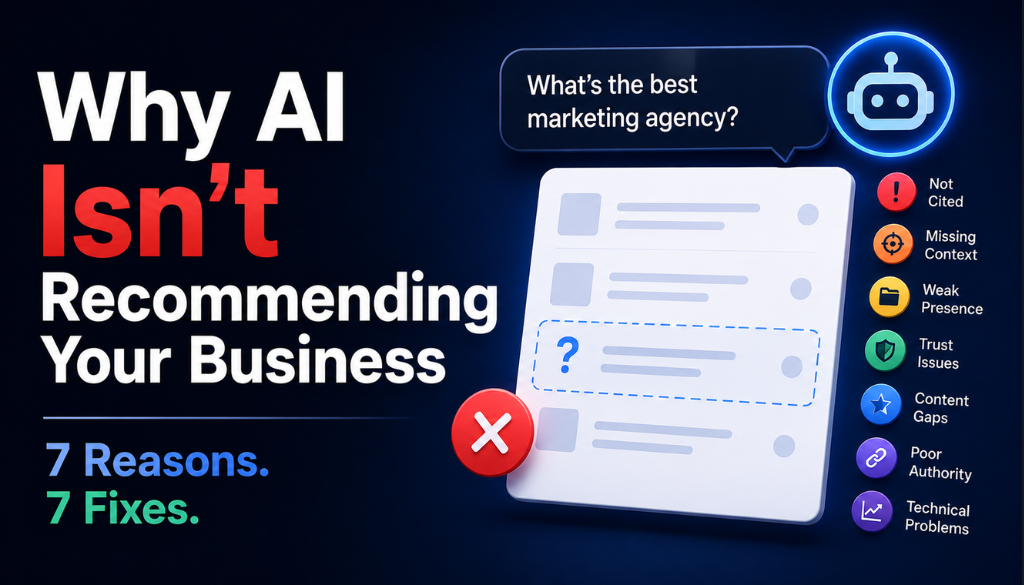
Here are the seven most common reasons AI isn’t recommending your business, and exactly what to do about each one.
Why do some businesses show up in AI recommendations and others don’t?
AI platforms select businesses to recommend based on five core signals:
- Recognizability — does AI know your brand exists as a real, distinct entity?
- Retrievability — can AI crawlers access your site and pull content from it?
- Relevance — does your content directly answer the questions buyers ask?
- Reliability — is your information consistent across sources AI trusts?
- Recency — has your content been updated recently enough to be cited?
Businesses that appear consistently across AI recommendations have clean crawler access, structured data that makes their content machine-readable, consistent entity information across the web, direct answer-first content, and third-party validation from sources AI already trusts. Businesses missing any of these signals are skipped in favor of competitors who have them in place. We break this framework down in more depth in our guide to what AEO actually is and why it matters.
Reason 1: AI Crawlers Can’t Get Into Your Website
This is the most common cause of AI invisibility and the one that shocks most business owners when they find it. If the major AI platforms can’t crawl your pages, nothing else you do matters. You could have the best content in your industry and still be completely invisible on specific platforms because a line in your robots.txt file is blocking the crawler at the door.
Here’s the detail most brands miss. When AI platforms became prominent, many businesses or their developers added rules to block AI bots to prevent their content from being used in training data. That was a reasonable instinct at the time. But the same bots that train AI models are often different from the bots that power AI search. Blocking one can accidentally block the other.
The crawlers you need to allow are:
- OAI-SearchBot for ChatGPT search recommendations (OpenAI’s bot documentation)
- PerplexityBot for Perplexity (Perplexity’s bot guide)
- Google-Extended for Gemini and AI Overviews (Google’s crawler list)
- ClaudeBot for Anthropic (Anthropic’s crawler documentation)
You can block GPTBot, which collects training data, while keeping OAI-SearchBot open. Most businesses that made a blanket block in 2023 or 2024 have never revisited it, and it’s actively costing them AI visibility right now.
The fix takes ten minutes. Go to yourdomain.com/robots.txt and check what’s there. If any of the search crawlers above appear in a Disallow directive, remove them. That single change can restore citation eligibility on platforms you’ve been locked out of for months.
Reason 2: Your Content Doesn’t Answer Questions Directly
AI platforms don’t read your website the way a human does. They scan for passages they can extract and use as a direct answer to a specific question. If your content buries the answer three paragraphs deep, or never states it plainly at all, AI moves on to a source that does.
Most business websites are written to impress, not to answer. They lead with brand story, then explain the problem, then describe the solution, then maybe get to the point. That structure worked fine for human readers who had the patience to follow along. AI has no such patience.
Kevin Indig’s analysis of 1.2 million ChatGPT answers found that 44.2 percent of all LLM citations come from the first 30 percent of a page’s content. The intro isn’t a warm-up. It’s where citations are won or lost.
The fix is structural. For every important page on your site, ask: if someone read only the first two sentences of each section, would they get a complete answer to the question that section is about? If the answer is no, here’s what to change:
- Lead with the answer. Rewrite each section so the conclusion is in the opening sentence, not the closing one.
- Use question-format headings. “How does X work?” outperforms “Understanding X” for AI extraction.
- State conclusions at the top, then support them. Treat every section as a self-contained answer that can stand alone if extracted.
- Use clear, short sentences. AI engines favor declarative statements over flowing prose.
This is a different writing discipline than most brands are used to, but it’s the single most impactful content change you can make for AI visibility. Our guide to writing answer capsules AI systems actually cite walks through the structure in detail.
What does it mean to write answer-first content for AI?
Answer-first content leads with the direct answer to a question in the opening sentence of each section, before any context or explanation. AI platforms extract passages from pages to use in generated responses, and they heavily favor content found in the first 30 percent of a page. A section that opens with the answer and then supports it with detail is far more likely to be cited than one that builds toward the answer gradually. Practically, this means using question-format headings, stating conclusions immediately, and treating every section as a self-contained answer that can stand alone if extracted.
Reason 3: Your Brand Information Is Inconsistent Across the Web
AI platforms build a picture of your brand by aggregating information from dozens of sources: your website, Google Business Profile, directories, review platforms, press mentions, and social profiles. When those sources contradict each other, the AI loses confidence in your brand as a reliable entity and skips you in favor of someone it can confidently describe.
This is called entity fragmentation, and it’s more common than most businesses realize. A business listed as “Smith Consulting” on its website but “Smith Consulting LLC” on Yelp, “Smith and Associates Consulting” on LinkedIn, and “Smith Consulting Co.” in a local directory has fragmented its own entity signal. AI has four conflicting descriptions of what might be the same business, and it cannot make a confident recommendation.
Yext’s analysis of 6.8 million AI citations across ChatGPT, Gemini, and Perplexity found that 86 percent of citations come from sources brands already control, including their own websites, listings, and directory profiles. When the data in those brand-managed sources doesn’t match, the signal that AI relies on to identify and recommend your business breaks down.
The fix requires an audit. Search your business name across every platform where you have a presence and standardize the data. Specifically, check:
- Google Business Profile — name, address, phone, hours, category
- Yelp, TripAdvisor, and industry-specific directories — same fields
- Facebook and LinkedIn business pages — name spelling, description, category
- Review platforms like Trustpilot and G2
- Your own website footer and About page — often the source of the original inconsistency
Standardize your name, address, phone number, description, and category across every single one. This is unglamorous work but it directly improves how AI systems classify and confidently recommend your business.
Reason 4: Nobody Outside Your Own Site Is Talking About You
This is the hardest pill for most business owners to swallow. You can have a perfectly optimized website and still be invisible in AI recommendations if the broader web has nothing to say about you. AI platforms don’t just trust what you say about yourself. They look for external validation.
The sources that matter most vary by platform:
- Gemini trusts editorial content on sites Google already respects.
- ChatGPT draws heavily from directories, review platforms, and third-party listings.
- Perplexity favors industry-specific publications and community platforms like Reddit.
A business with no press mentions, no directory presence, no third-party reviews, and no community discussion is a business AI cannot verify as real.
The fix is to build off-site presence methodically:
- Claim and fill out directory profiles most relevant to your industry, with the same name/address/phone data you use everywhere else.
- Earn at least one press mention per quarter in a publication your audience actually reads, even if it’s a niche trade outlet.
- Participate in relevant subreddits or community forums where your customers ask questions, answering substantively rather than promoting.
- Ask satisfied customers for reviews on Trustpilot, G2, or a category-specific review site in addition to Google.
- Get quoted in roundup articles on industry publications when the opportunity comes up.
None of this has to happen overnight, but it has to happen before AI will confidently recommend you. For more on this dimension, see our piece on why third-party citations matter more than your own content for AI search.
What is third-party validation in the context of AI recommendations?
Third-party validation refers to mentions, citations, reviews, and references to your brand from sources outside your own website. AI platforms use third-party signals to verify that a brand is credible and real before recommending it. Each major platform weights different external sources: Gemini favors editorial content from high-authority publications, ChatGPT draws heavily from directories and review platforms, and Perplexity trusts industry-specific sources and community platforms like Reddit. A brand that exists only on its own website lacks the external validation AI needs to make a confident recommendation, regardless of how well-optimized that website is.
Reason 5: Your Structured Data Is Missing or Broken
Structured data is the machine-readable layer of your website that tells AI exactly who you are, what you do, and how to describe you. Without it, AI systems have to guess. And when they guess, they often either get it wrong or skip you entirely in favor of a business whose data they can read cleanly.
SE Ranking’s research found that roughly 65 percent of pages cited by Google AI Mode and 71 percent of pages cited by ChatGPT include structured data. Yet nearly half of business websites have no structured data at all. That gap represents the clearest technical opportunity in AI visibility right now.
The schema types that matter most for most businesses are:
- Organization schema covering your business name, description, URL, and contact information
- FAQ schema on any page that answers common customer questions
- Service or Product schema if you want specific offerings to be cited accurately
- LocalBusiness schema with accurate NAP data for local businesses
The fix is to implement the basics first, in this order:
- Audit what you have. Use Google’s Rich Results Test to check what structured data is currently on your site and whether it’s valid.
- Add Organization schema to your homepage if it’s not already there. This is the foundation entity signal AI uses to identify your business.
- Add FAQ schema to your most important service or product pages. These are the pages most likely to match buyer questions in AI search.
- Add LocalBusiness schema if you have physical locations, with accurate NAP data matching your directory profiles.
These are relatively simple implementations that most website platforms support natively or through a plugin like Rank Math, Yoast, or Schema Pro.
Reason 6: Your Content Hasn’t Been Updated Recently
AI platforms weight freshness more aggressively than most people expect. A perfectly written piece of content from 18 months ago can lose its citation eligibility simply because it contains no signals that it’s been reviewed or updated since then.
This matters most on Perplexity, which crawls the live web in real time and treats freshness as one of its strongest ranking signals. But it affects Gemini and ChatGPT as well. SE Ranking’s analysis found that content updated within the past three months is roughly twice as likely to be cited in ChatGPT as older, outdated pages. Faking a date without changing the substance backfires, however. AI engines that detect a mismatch between a claimed update date and unchanged content reduce their confidence in that source’s reliability.
The fix is genuine updating, not cosmetic date changes. For each of your top 5 highest-priority pages:
- Audit the stats. Any data point, statistic, or example more than 12 months old gets flagged for replacement.
- Update with current data. Replace stale numbers with the most recent equivalent from a credible source.
- Add a new section addressing something that has shifted in your industry since the article was first published.
- Add a visible “updated Q2 2026” date backed by actual new content, not just a touched timestamp.
- Refresh quarterly. Cycle through your top pages every 90 days rather than treating updates as one-time fixes.
A quarterly refresh of your five highest-priority pages does more for AI citation eligibility than publishing five entirely new pieces of content that are never touched again.
Reason 7: Your Brand Footprint Is Too Narrow
This one affects businesses that are doing everything else right but still only showing up inconsistently in AI recommendations. The cause is usually that all of their content, all of their mentions, and all of their authority is concentrated in one small corner of a topic rather than spread across the full range of questions their audience asks.
AI platforms don’t just need one strong page about your topic. They need evidence that your brand covers the topic comprehensively. A single pillar page no longer wins consistent citations. A topic cluster that addresses the full range of questions your audience asks does. Our guide to query fanout strategy explains how AI engines decompose a single user question into multiple sub-queries, and how to map content against each one.
SE Ranking’s analysis of the Gemini 3 transition found that the model upgrade replaced approximately 42 percent of the domains that had been cited under the previous version, primarily because the new model generates roughly 32 percent more source URLs per response and demands broader topical coverage to match.
The fix is to map the full range of questions your customers ask about your category, not just the primary one, and make sure you have content that directly answers each one. The four question types to cover for any topic are:
- Before questions — “What is X?”, “How does X work?”, “Why does X matter?”
- Comparison questions — “X vs Y”, “Best X for [use case]”, “Alternatives to X”
- Objection questions — “Is X worth it?”, “What are the downsides of X?”, “Does X actually work?”
- How-it-works questions — “How to use X”, “How to set up X”, “How to measure X”
Each one is a sub-query that an AI can match against your content. The more of them you cover with dedicated pages, the more consistently your brand appears across the full range of queries your audience is running.
Where to Start
If you’ve read through all seven and feel overwhelmed, the priority order matters.
- Crawler access check. Takes ten minutes and can restore visibility you’ve lost without knowing it.
- Entity consistency audit across directories and review platforms.
- Structured data check using Google’s Rich Results Test.
- Freshness review of your five most important pages.
- Off-site presence audit done honestly.
The content breadth and third-party visibility work takes longer but compounds over time. The technical fixes in the first three steps can produce noticeable improvements within weeks.
G2’s March 2026 survey of 1,076 B2B decision-makers found that 69 percent of buyers chose a different software vendor than they initially planned based on guidance from an AI chatbot, and one in three purchased from a vendor they had never previously heard of. The buyers are already there. The question is whether your business shows up when they ask. For a deeper view of how to measure whether your visibility work is actually paying off, see our guide to how to measure AEO success.
Frequently Asked Questions
My business ranks on page one of Google. Why am I still not showing up in AI recommendations?
Google rankings and AI citations use overlapping but distinct signals. Ahrefs research found that the overlap between top-10 Google rankings and AI Overview citations has compressed significantly over 2025 and 2026. AI platforms look for entity clarity, structured data, third-party validation, and content that directly answers questions, none of which are guaranteed just because you rank well on Google.
How long does it take to start showing up in AI recommendations after making these fixes?
Technical fixes like crawler access and structured data can produce improvements within 2 to 4 weeks since AI search crawlers index changes quickly. Content and freshness improvements typically take 4 to 8 weeks to register. Building third-party presence through reviews, directories, and press mentions compounds over 2 to 3 months. The brands that do all of it consistently see the most durable results.
Do I need to optimize differently for each AI platform?
The foundation is the same across all platforms: clean crawl access, consistent entity data, structured content, and third-party validation. The differences are in emphasis. Perplexity weights freshness and editorial third-party mentions most heavily. Gemini weights your own well-structured content and Google authority signals. ChatGPT weights directory presence and broad third-party distribution. Fixing the fundamentals lifts all platforms simultaneously, then you can layer in platform-specific refinements.
Is this something I can fix myself or do I need an agency?
Most of the highest-impact fixes in this article require no agency and no developer. Checking robots.txt, auditing entity consistency, validating structured data, and refreshing existing content are all things any business owner or in-house marketer can do. The more complex work, building off-site presence and expanding content breadth, benefits from a strategic approach but doesn’t require outside help to execute.
If I fix all of these, will I show up in every AI answer about my category?
No, and that’s not a realistic expectation. AI responses vary by platform, by query phrasing, and even by the same query run at different times. What these fixes do is make your brand consistently eligible for citation across the platforms and queries where you should be appearing. Consistency and frequency of citation improve over time as your brand’s authority signals compound. The goal isn’t to appear in every answer. It’s to stop being invisible in the ones that matter most.
Does having a Wikipedia page help with AI visibility?
Yes, meaningfully. Wikipedia is one of the highest-authority sources AI platforms draw from when establishing brand entity recognition. It’s not essential for every business, but for brands that qualify, a well-maintained Wikipedia page significantly reinforces entity signals across ChatGPT, Gemini, and Perplexity. For businesses that don’t qualify, Crunchbase, Wikidata, and authoritative industry directories serve a similar function at a smaller scale.
For weekly analysis on AI citation strategy, AEO platform updates, and the tactics shaping AI search visibility, subscribe to Prompt Insider.
