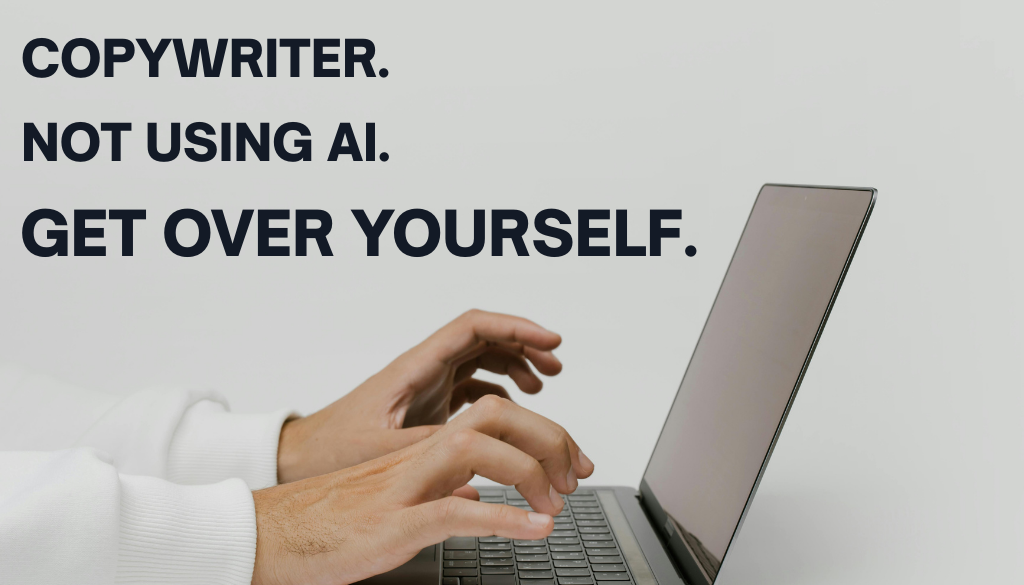
Short Answer: Should copywriters use AI?
Yes, and the real risk is not being replaced by AI. It is being replaced by copywriters who use it. AI supplies raw material and speed; strategy, audience judgment, and voice remain the human contribution, which is why it rewards writers who already have them.
Quick Summary
- Copywriters who refuse to use AI are falling behind professionals who use it for research, drafting, variations, and optimization.
- AI does not replace copywriting expertise. It rewards writers who already understand strategy, audience psychology, positioning, and voice.
- The best copywriters use AI for raw material and speed, then apply human judgment to shape final work.
- AI fluency is becoming part of the job because search, content discovery, and AEO are changing how copy gets found.
- The real threat is not AI replacing copywriters. It is AI-fluent copywriters replacing copywriters who refuse to adapt.
Copywriters who refuse to use AI are falling behind professionals who have learned to use AI as a tool for research, drafting, and optimization while keeping strategy, voice, and editorial judgment firmly in human hands. The resistance is understandable, but the industry has already moved on.
There is a certain kind of copywriter who treats AI like a personal insult. They hear “ChatGPT” and immediately launch into a speech about the irreplaceable value of human creativity, the death of authentic writing, and the inevitable collapse of quality standards. They position themselves as the last line of defense between real craft and robot-generated garbage.

And they are losing clients to the copywriter down the street who uses AI to turn around a first draft in thirty minutes instead of three hours, then spends the saved time actually thinking about strategy, audience psychology, and the client’s business goals.
This is not a piece about AI replacing copywriters. It will not. The data consistently shows that human-edited AI content outperforms both pure AI output and, in many contexts, pure human output working without AI assistance. Teams that combine AI with human expertise report significantly better ROI on content than teams using either approach alone. The question is not whether AI will replace you. The question is whether a copywriter who uses AI will replace you. And the answer to that question is becoming clearer every month.
If you are a copywriter who has been resisting AI, this is the reality check. Not because your skills do not matter, but because your skills matter more when they are amplified by the right tools. Understanding how AI fits into the modern content landscape, including how search itself is changing through Answer Engine Optimization, is now part of the job description whether you put it there or not.
The Resistance Is Not About Craft. It Is About Fear.
Summary: Most AI resistance among copywriters comes from misunderstanding the tool, not from a serious evaluation of what it can and cannot do.
Most copywriters who refuse to use AI frame their resistance as protecting quality. The reality is usually more complicated than that.
Let’s be direct about this. The copywriters who are most vocal about never using AI are rarely the ones who have spent serious time learning what it can and cannot do. They tried ChatGPT once, got a generic paragraph that sounded like a corporate brochure, and decided the entire technology was beneath them. That is like test-driving a car with the parking brake on and concluding that automobiles are overrated.

The tools are only as good as the person using them. A skilled copywriter who understands audience psychology, brand voice, persuasion frameworks, and strategic positioning will get dramatically better output from AI than someone with no writing background. That is the entire point. AI does not replace expertise. It rewards it. The copywriter who knows what good looks like can direct AI toward it. The copywriter who does not will get exactly what they deserve: mediocre output that confirms their bias.
Research shows that roughly 72% of non-adopters cite lack of understanding as their biggest barrier, according to Influencer Marketing Hub’s 2025 survey. That is not a quality concern. That is an education gap. And in a profession where staying current is supposed to be part of the value you deliver to clients, refusing to learn the most significant tool shift in a generation is a strange hill to choose.
What AI Actually Does for Professional Copywriters
Summary: AI helps professional copywriters move faster through research, drafting, testing, and adaptation while leaving strategy and judgment to humans.
The best copywriters using AI are writing better. The difference is in where they spend their time.
Research and Discovery
Before AI, researching a new client’s industry, competitors, audience pain points, and market positioning could take half a day or more. However, AI tools compress that process dramatically.
You can ask an AI to summarize an industry’s key trends, identify the most common objections customers raise, or outline how competitors are positioning themselves, and get a useful starting point in minutes. That starting point still needs human verification and judgment, but it eliminates hours of initial digging. For a deeper understanding of the AI tools available for this kind of work, our tools section breaks down the major platforms.
First Drafts and Ideation
This is where the ego gets bruised. Many copywriters define their value by their ability to produce first drafts. But a first draft is not the product.
The final, polished, strategically aligned piece is the product. AI can generate a workable first draft that gives you raw material to shape, cut, restructure, and refine. This is not different from a journalist working from wire copy or an architect starting with a template. The craft is in what you do with the material, not in the act of generating raw words from a blank page.
Variations and Testing
Good copywriting requires testing. Headlines, subject lines, CTAs, and ad copy all perform better when you can test multiple variations. Producing fifteen headline options used to be a time-consuming exercise.
AI makes it simple. A skilled copywriter can generate dozens of variations in seconds, then apply their expertise to select and refine the strongest options. The result is better work delivered faster, which is exactly what clients want.
Reformatting and Adaptation
Taking a long-form blog post and adapting it into social media snippets, email sequences, ad copy, and presentation talking points is tedious but necessary work. AI handles this reformatting efficiently, allowing copywriters to focus on ensuring each adaptation maintains the right tone and strategic alignment for its channel.
This is especially relevant as content now needs to be optimized not just for SEO but for AI-powered answer engines that synthesize and cite information differently than traditional search.
The Protecting the Craft Argument Does Not Hold Up
Summary: Writers have resisted new tools before, but professionals who adapt usually gain the advantage while holdouts fall behind.
This is not the first time writers have drawn a line in the sand over a new tool. It has never ended the way they expected.
Copywriters in the 1980s resisted word processors. Journalists in the 2000s resisted content management systems and digital publishing. Editors resisted Grammarly. In every case, the tool eventually became standard, and the professionals who adapted early gained an advantage over those who held out.

The pattern is always the same. A new tool arrives. Professionals who define their identity through their process rather than their output feel threatened. They argue that the tool cheapens the work. Meanwhile, professionals who define their identity through results adopt the tool, become more productive, and deliver better outcomes. Within a few years, the tool is table stakes and the holdouts either catch up or get squeezed out.
AI is following this pattern at an accelerated pace. In 2023, roughly 65% of content marketers planned to use AI. By 2025, that number exceeded 90%. The adoption curve is not slowing down. It is steepening. And the copywriters who built their identity around never using AI are watching the industry move on without them.
None of this means craft does not matter. It means craft alone is not enough. The best copywriters in 2026 are the ones who bring deep strategic thinking, genuine understanding of human psychology, and sharp editorial judgment to the table, and then use AI to execute faster and at a higher volume than was previously possible. The craft is elevated by the tool, not diminished by it.
What You Are Actually Losing by Not Using AI
Summary: Avoiding AI costs copywriters speed, strategic leverage, optimization knowledge, and client confidence.
The cost of avoiding AI is not just about speed. It shows up in places most copywriters are not watching.
Speed and Output
This is the most obvious loss. A copywriter using AI can produce a polished blog post, a set of ad variations, or a full email sequence in a fraction of the time it takes to do the same work manually. When clients are comparing proposals, the copywriter who can deliver the same quality in less time, or better quality in the same time, wins the project. Speed is not a compromise on quality. It is a competitive advantage that lets you invest more time where it matters.
Strategic Value
When you spend less time on the mechanical aspects of writing, you have more time for the work that clients value most: understanding their business, analyzing their audience, developing positioning strategies, and thinking critically about messaging. AI frees you to move upstream in the value chain, from a person who writes words to a person who solves communication problems. That shift is where higher rates and longer client relationships live.
Content Optimization Knowledge
The search landscape is changing rapidly. Google now displays AI-generated summaries for a significant portion of searches. ChatGPT, Perplexity, and Claude are becoming primary research tools for millions of users. Content that is written without understanding how AI systems read, evaluate, and cite information is increasingly invisible to the audiences it is trying to reach.
Copywriters who use AI tools develop an intuitive understanding of how these systems process language. They learn what makes content clear and extractable. They understand why structure, specificity, and direct answers matter more than clever wordplay in an era where Answer Engine Optimization is becoming as important as traditional SEO. Copywriters who avoid AI entirely miss this understanding, and their content suffers for it in ways they may not even realize.
Client Confidence
Clients are paying attention. When they ask whether you use AI in your workflow and you say no, they are not impressed by your dedication to purity. They are wondering whether you can keep up. Businesses that are investing in AI across their marketing operations expect their content partners to be fluent in these tools, not as a replacement for expertise, but as evidence of it.
How to Use AI as a Copywriter Without Losing What Makes You Good
Summary: Use AI for research, first drafts, prompting practice, search visibility, and production support, while keeping final quality control human.
There is a right way to bring AI into your workflow without compromising the things that make your work worth paying for.
Start With Research, Not Writing
The easiest and least threatening entry point is using AI for research. Before you write a single word of copy, use AI to map out the competitive landscape, identify audience pain points, summarize relevant industry data, and surface questions your target market is actually asking. This immediately improves the strategic foundation of everything you write, and it requires zero compromise on the creative side.
Use AI for First Drafts, Not Final Drafts
Let AI generate the raw material. Then apply your expertise to reshape, refine, cut, and polish it into something that actually sounds like the brand, speaks to the audience, and advances a strategic objective. The value you deliver is not in the first draft. It is in everything that happens between the first draft and the final version. AI makes that process faster. Your skills make it better.
Build Prompting Into Your Skill Set
The quality of AI output depends directly on the quality of your input. Learning to write effective prompts is a skill, and it is a skill that draws on the same abilities that make you a good copywriter: clarity of thought, specificity, understanding of audience, and the ability to articulate what you want. A copywriter who masters prompting will consistently get better results from AI than a non-writer ever could. This is your advantage. Use it. If you want to understand how AI fundamentally works and why prompting matters so much, our AI Basics section covers the essentials.
Learn How AI Is Changing Search and Discovery
If you write content for the web, and most copywriters do, you need to understand how search is evolving. AI Overviews now appear in a large portion of Google search results. Tools like ChatGPT and Perplexity are becoming primary information sources for a growing share of users. Content that is not structured for these AI systems is losing visibility regardless of how well it is written.
This is where copywriting and AEO converge. Writing content that answers specific questions directly, uses clear heading structures, and provides concrete, citable information is not just good AEO practice. It is good copywriting. The principles overlap more than most people realize, and copywriters who understand both disciplines are significantly more valuable to clients who need content that performs across both traditional search and AI-powered platforms.
Keep Quality Control Human
AI generates. You decide. Every piece that goes out the door should be reviewed, edited, and approved by a human who understands the brand, the audience, and the strategic context. This is non-negotiable. AI is a production tool, not a quality assurance system. The moment you start publishing AI output without rigorous human review is the moment your work starts to sound like everyone else’s, and that is the real threat to craft, not the tool itself.
The Real Threat to Your Career Is Not AI. It Is Stubbornness.
Summary: AI will not replace skilled copywriters, but copywriters who use AI well will outperform those who refuse to adapt.
The professional risk in 2026 is not in adopting AI. It is in refusing to.
Let’s put this bluntly. Nobody is coming to take your keyboard away. AI is not going to walk into a client meeting, understand the nuances of a rebrand, navigate internal politics, and deliver a messaging framework that gets twelve stakeholders aligned. That is human work, and it will remain human work for a very long time.
But the copywriter sitting next to you who does all of that and also uses AI to draft faster, test more variations, research more thoroughly, and optimize content for both SEO and AI-powered answer engines is going to win more business than you. Not because they are more talented. Because they are more effective. And in a market where content demand is growing faster than ever while budgets are tightening, effectiveness is what keeps you in the room.
The copywriters thriving in 2026 are not the ones who produce the most beautiful prose in isolation. They are the ones who combine strategic thinking, audience understanding, creative skill, and technological fluency into a package that delivers measurable results for their clients. AI is part of that package now. Pretending otherwise is not a stance. It is a liability.
Will AI Replace Copywriters?
Summary: AI will not replace copywriters, but hybrid workflows that combine AI speed with human expertise are becoming the standard.
No. The consistent finding across industry research is that the hybrid approach, combining AI tools with human expertise, outperforms both pure AI and pure human workflows. AI handles the parts of copywriting that require speed and scale. Humans handle the parts that require strategy, judgment, creativity, and emotional intelligence.
The roles are complementary, not competitive. What is changing is the baseline expectation. Clients increasingly expect copywriters to be fluent in AI tools the same way they expect fluency in Google Docs, project management software, and content management systems.
Does AI-Generated Content Hurt SEO?
Summary: AI-generated content does not inherently hurt SEO, but low-quality AI content published without human review can hurt performance.
Not inherently. Google’s own guidance states that its focus is on content quality, not how the content is produced. AI-generated content that is well-researched, well-structured, and provides genuine value to readers can perform well in search. The risk comes from publishing low-quality AI content at scale without human review, which Google actively works to detect and demote. For SEO-focused content, the best approach is using AI to accelerate the drafting process while applying human editorial standards to ensure accuracy, originality, and genuine usefulness. The same principles apply to AEO, where content quality and structure directly influence whether AI platforms cite your work in their answers.
What Are the Best AI Tools for Copywriters?
Summary: ChatGPT, Claude, Gemini, Perplexity, Jasper, and Copy.ai are among the most useful AI tools for professional copywriters.
The most widely used and trusted AI tool among content professionals is ChatGPT, followed by Claude and Gemini. For research-heavy work where you need source citations, Perplexity is particularly effective. For specific copywriting tasks like ad variations, email subject lines, and short-form content, specialized tools like Jasper and Copy.ai offer workflow-specific features. Most professional copywriters settle on one or two general-purpose tools and supplement with specialized options as needed.
How Do I Start Using AI Without Losing My Voice?
Summary: Start with research and analysis, then use AI for drafts you heavily edit and reshape in your own voice.
Start by using AI for tasks that do not involve your voice at all: research, competitive analysis, data synthesis, and audience mapping. Once you are comfortable, move into using AI for first drafts that you then heavily edit and reshape in your own voice. The key is never publishing AI output directly. Always run it through your editorial process. Over time, you will develop prompting techniques that get AI closer to your natural style, but the final polish should always be yours. Think of AI as raw material, not finished product.
Can Clients Tell If I Used AI?
Summary: If AI is used well, clients care less about the tool and more about the quality, strategy, and results of the final work.
If you are using AI well, the question becomes irrelevant. Clients care about results: clear messaging, strategic alignment, content that performs, and deadlines met. If the final product meets those standards, the process you used to get there is a professional decision, not an ethical one. That said, transparency is good practice. Many copywriters openly discuss AI as part of their workflow, positioning it as a productivity advantage rather than a shortcut. Clients tend to respond positively when they understand that AI is a tool you direct, not a replacement for your thinking.
Is AI-Written Content Good Enough to Publish Without Editing?
Summary: No. AI-written content needs human editing, fact-checking, voice work, and strategic judgment before it is ready to publish.
No. Unedited AI content tends to be generic, repetitive, and lacking in the specific detail and voice that makes content effective. Research consistently shows that human-edited AI content significantly outperforms raw AI output across engagement metrics, conversion rates, and audience trust. The value of AI is in the acceleration of the process, not in the elimination of the editorial step. Treat AI output the way you would treat a first draft from a junior writer: useful raw material that needs experienced shaping to become publishable.
How Does AI Fit Into Content Strategy and AEO?
Summary: AI changes both how content is created and how content is discovered, making AEO knowledge essential for modern copywriters.
AI is changing both how content is created and how content is discovered. On the creation side, AI accelerates research, drafting, and variation testing. On the discovery side, AI-powered platforms like ChatGPT, Google’s AI Overviews, and Perplexity are becoming primary channels through which people find and evaluate information. Content that is not optimized for these platforms loses visibility. This is the domain of Answer Engine Optimization, which focuses on structuring content so AI systems can easily extract, understand, and cite it. Copywriters who understand both the creation and discovery sides of AI are significantly more valuable than those who only understand one or neither. For a broader look at how AI is showing up in everyday workflows, our Everyday AI section covers practical applications beyond just writing.
Stay Updated With Prompt Insider
Summary: Copywriters need to stay current on AI, AEO, and content discovery because these shifts are now part of professional writing.
AI is reshaping how content is written, how it is found, and how it is evaluated by both humans and machines. For copywriters, marketers, and anyone who works with words professionally, staying informed about these shifts is not optional anymore.
Prompt Insider delivers clear, practical explanations of AI and Answer Engine Optimization written for people who create content for a living. Each edition focuses on what is actually changing, what it means for your work, and what you can do about it.
Sign up for the Prompt Insider and stay ahead of how AI is changing the way we create.
About the author
Kai Williams
Kai Williams has been in marketing for years, with a long background in SEO before AEO had a name. He stepped into Answer Engine Optimization the moment AI started reshaping how people search, and has been tracking the shift ever since. At Prompt Insider, he covers AEO, AI marketing, and the future of search, breaking down what is changing and what brands need to do about it.