Quick Summary
- ChatGPT generated over $100 million in annualized ad revenue in just six weeks.
- That figure came from fewer than 20% of eligible users seeing ads.
- Self-serve advertiser access is expected to open in April 2026.
- OpenAI says paid placements will not influence ChatGPT’s organic answers.
- For AEO, this confirms ChatGPT is becoming both an organic citation surface and a paid media channel.
ChatGPT generated over $100 million in annualized ad revenue in just six weeks — and that figure comes from less than 20% of eligible users seeing ads.
Self-serve advertiser access opens in April 2026.
For brands invested in AEO, this is a signal worth paying attention to: the platform is maturing fast, organic citation still operates independently of paid placements, and the window to establish AI visibility before ad competition drives up the cost of attention is closing.
What Just Happened
Summary: OpenAI’s ChatGPT ad pilot has already crossed $100 million in annualized revenue while still showing ads to only a fraction of eligible users.
OpenAI has confirmed that ChatGPT’s ad pilot, launched in February 2026, has already generated over $100 million in annualized revenue.
The platform currently shows ads to fewer than 20% of eligible Free and Go tier users daily, with approximately 85% of those users eligible but not yet seeing ads.
More than 600 advertisers are active on the platform. Self-serve advertiser access is on track for April 2026, with geographic expansion into Canada, Australia, and New Zealand also being explored.
The signal: ChatGPT’s ad business is scaling quickly even before broad self-serve access opens.
Six weeks. That’s all it took for ChatGPT’s advertising pilot to cross $100 million in annualized revenue — and it’s done that while deliberately limiting the audience seeing ads to a fraction of what’s possible.
The numbers tell a specific story. Less than 20% of eligible users are currently seeing ads daily. Around 85% of Free and Go tier users are eligible. OpenAI has hired former Meta ad executive Dave Dugan to lead ad sales.
And according to Search Engine Land, self-serve access is on track for April — the moment this stops being an enterprise-only pilot and becomes accessible to the broader advertiser market.
For context on scale: OpenAI projects advertising could double ChatGPT consumer revenue to $17 billion in 2026, with ads representing a primary growth driver ahead of an anticipated IPO rather than a supplemental revenue stream.
Why This Matters for Search
Summary: ChatGPT ads create a paid layer below AI answers, but OpenAI says paid placements will not influence what the model says.
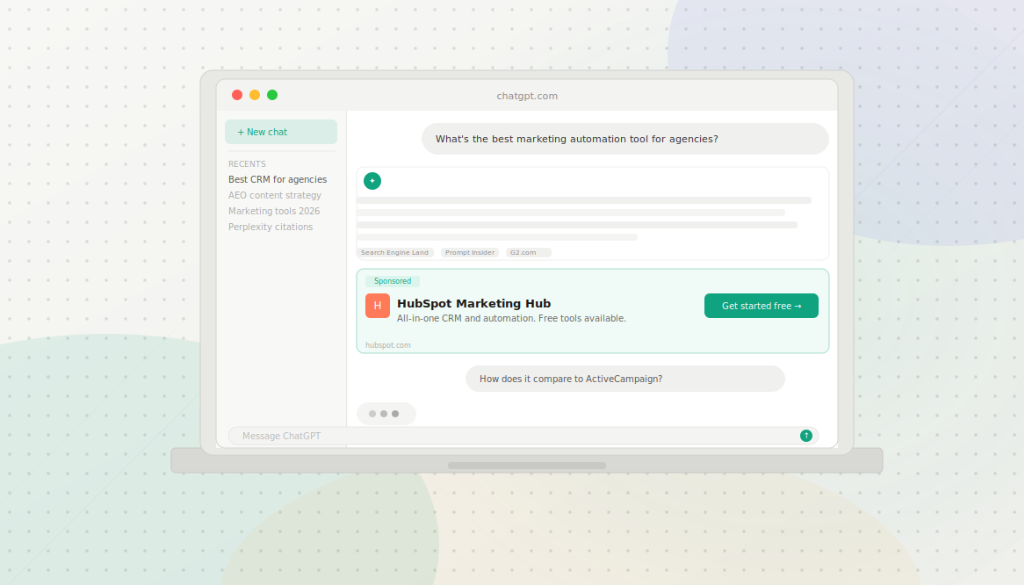
ChatGPT ads appear below the AI-generated response, clearly labeled and structurally separated from the answer itself.
OpenAI has been explicit that paid placements will not influence what ChatGPT says in its responses.
That separation is significant for anyone tracking AI visibility: organic citation and paid placement are two distinct channels, and establishing strong organic AEO presence now is not made redundant by the arrival of ads.
The parallel to Google is useful here but imperfect. When Google introduced ads alongside organic search results, the two operated independently: ranking in organic search required no ad spend, and ad spend didn’t boost organic rankings.
ChatGPT is building the same structural separation. Ads appear at the bottom of responses, not inside them. OpenAI’s stated principle is clear: advertising will not influence model responses.
Organic still matters: The brand cited inside the answer and the brand buying the sponsored placement below it are operating in different systems.
That means the brand that gets cited organically in ChatGPT’s answer to a question and the brand that buys a sponsored placement below it are operating in different systems.
The organic citation depends on content structure, third-party authority, and relevance signals. The sponsored placement depends on budget.
Both will influence brand visibility on the platform, but through fundamentally different mechanisms.
What’s changing is the total real estate for brand presence within a ChatGPT response. Before ads, visibility meant organic citation or nothing.
After April, it will mean organic citation, paid placement, or both.
For brands that haven’t yet built organic AI visibility, the arrival of a paid channel is good news in the short term. For brands that have been investing in AEO, it’s validation that the platform is serious about being a marketing surface.
Either way, the conversation about how AI platforms decide which brands to mention just became more consequential.
Why This Is Actually Good News for AEO
Summary: ChatGPT ads validate the platform as a serious marketing surface, while organic AEO remains a separate compounding channel.
The arrival of ChatGPT ads confirms that the platform is a serious, permanent advertising surface — not an experiment.
That validation accelerates how quickly brands will prioritize AI visibility. Brands investing in organic AEO now are establishing citation authority before ad competition for the same audience raises the cost of paid placement.
Organic visibility doesn’t get bid up. It compounds.
There’s a pattern that played out in search advertising that’s worth remembering.
When Google Ads launched, brands that had already built strong organic search presence didn’t see their SEO results damaged. They gained an additional lever.
Brands that had ignored organic search and relied entirely on paid placement eventually faced rising CPCs and fragile visibility that disappeared the moment budget did.
The same dynamic is setting up in AI search. ChatGPT’s $100M in six weeks from less than 20% of eligible users is a clear signal that advertiser demand for this audience is real and growing.
When self-serve access opens in April and the eligible audience expands, CPMs will reflect that competition.
Early mover advantage in organic AEO — building citation presence before the platform gets crowded — is exactly the kind of compounding advantage that paid placement can’t replicate.
This is the same argument we’ve made about first-mover advantage in AEO.
The brands building citation authority now are doing the equivalent of establishing strong organic rankings before a category gets competitive. The window doesn’t stay open indefinitely.
What the Self-Serve Launch in April Changes
Summary: Self-serve access will move ChatGPT ads from a managed enterprise pilot into a broader ad platform available to more advertisers.
Self-serve advertiser access in April 2026 marks the transition from a managed enterprise pilot to a broadly accessible ad platform.
Before April, participating required a minimum commitment of approximately $200,000 and a managed buying process. After April, the platform becomes accessible to smaller advertisers, budgets become more flexible, and competition for AI ad inventory increases across more categories.
The current pilot has 600+ advertisers and a $200,000 minimum commitment at approximately $60 CPM.
That’s an enterprise play. Most brands, agencies, and marketing teams can’t participate at that level. April changes the access tier entirely.
What changes in April: More advertisers can enter the channel, which means early self-serve testing may happen before competition and CPMs rise.
For brands watching from the sidelines, April is the moment to have a position ready.
The first wave of self-serve advertisers will face lower competition and lower CPMs than what the platform will look like six or twelve months after that.
The playbook from Google and Meta’s early advertising phases is consistent: early entrants establish targeting benchmarks, creative norms, and audience data advantages that compound over time.
The critical strategic point is that organic AEO and paid ChatGPT ads are not either/or decisions.
Just as SEO and Google Ads work in parallel for brands with strong search strategies, AEO and ChatGPT ads will function as complementary channels.
Brands that show up organically in AI responses and in sponsored placements below them are covering the full surface area of user attention on the platform.
Our breakdown of how to get your brand cited by ChatGPT, Gemini, Claude, and Perplexity covers the organic side of that equation in detail.
What Marketers Should Do Right Now
Summary: Marketers should audit organic AI visibility and prepare paid creative before self-serve access opens.
Marketers should treat the ChatGPT ad launch as a trigger to audit both their organic AI visibility and their paid readiness.
On the organic side, assess citation frequency across ChatGPT, Perplexity, and Google AI Mode for the prompts most relevant to your category.
On the paid side, begin preparing creative and targeting frameworks now so you can move quickly when self-serve access opens in April.
The practical steps aren’t complicated, but they require action before April rather than after.
On the organic side, the first question is whether your brand is currently being cited when someone asks ChatGPT a question relevant to your category.
If the answer is no or inconsistently, that’s a content and authority gap that needs addressing regardless of what you do with paid placements.
On the paid side, the value of preparation isn’t access to the platform itself — it’s having a position ready when access opens.
That means knowing which prompts and conversations are most relevant to your audience, having creative that fits the conversational format of ChatGPT responses, and understanding which of your existing high-intent customers are likely to be on the free or Go tiers where ads appear.
The bigger picture is that ChatGPT hitting $100M in ad revenue six weeks into a partial rollout is confirmation that AI platforms are becoming the new advertising frontier.
For marketers who have been treating AEO as optional, this is the moment that changes the calculus.
The platform is real, the audience is enormous, and the organic and paid layers are both open for business.
Our guide to what is AEO is the right starting point if your team is just beginning to map this out, and our breakdown of the future of search gives the broader context for why these moves matter.
Bottom line: ChatGPT ads are moving fast, but they do not replace organic AEO. The strongest brands will build both: citation authority inside answers and paid visibility below them.
FAQs
What is ChatGPT’s ad revenue milestone?
ChatGPT generated over $100 million in annualized ad revenue in the six weeks following its ad pilot launch in February 2026.
This figure was achieved while showing ads to fewer than 20% of eligible Free and Go tier users daily, with approximately 85% of those users eligible but not yet seeing ads.
When does ChatGPT self-serve advertising launch?
Self-serve advertiser access to ChatGPT is on track to launch in April 2026, according to OpenAI.
The current pilot requires a minimum commitment of approximately $200,000 and operates through a managed buying process. Self-serve access will make the platform available to a significantly broader range of advertisers at more flexible budget levels.
Do ChatGPT ads affect organic AI citations?
No. OpenAI has stated explicitly that advertising will not influence model responses.
Ads appear below AI-generated answers, clearly labeled and structurally separated from the content of the response. Organic citations in ChatGPT responses depend on content quality, authority signals, and relevance, not on ad spend.
What does ChatGPT advertising mean for AEO strategy?
The arrival of ChatGPT ads confirms the platform as a serious marketing surface and accelerates how quickly brands need to establish AI visibility.
Organic AEO and paid ChatGPT ads function as complementary channels, similar to how SEO and Google Ads work in parallel.
Brands building organic citation authority now are doing so before ad competition makes the paid channel more crowded and expensive.
Who sees ChatGPT ads?
ChatGPT ads are shown to users on the Free and Go tiers. Paid subscribers on Plus, Team, and Enterprise plans receive ad-free experiences.
OpenAI has indicated that approximately 85% of Free and Go tier users are eligible to see ads, though fewer than 20% are currently seeing them daily as the rollout remains partial.
About the author
Kai Williams
Kai Williams has been in marketing for years, with a long background in SEO before AEO had a name. He stepped into Answer Engine Optimization the moment AI started reshaping how people search, and has been tracking the shift ever since. At Prompt Insider, he covers AEO, AI marketing, and the future of search, breaking down what is changing and what brands need to do about it.