Short Answer
How do you get your brand cited in AI answers?
Getting cited by ChatGPT, Claude, Gemini, Perplexity, and Grok requires three things on every priority page: an answer capsule of 120 to 150 characters under each H2, original first-party data AI cannot generate itself, and third-party validation across Reddit, G2, LinkedIn, and earned media. Each platform has additional signals covered below.
By Kai Williams | Updated July 2026
Quick Summary
- 73% of brands never appear in ChatGPT citations even when they dominate Google, because AI platforms use fundamentally different selection criteria than traditional search engines.
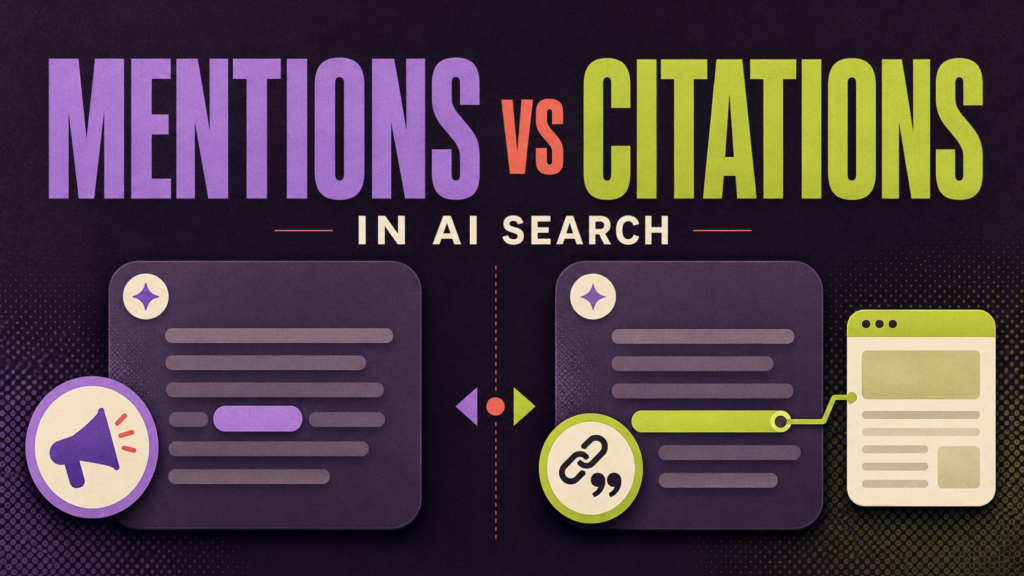
- AI visibility breaks into three distinct outcomes: a mention (brand named without a link), a citation (URL or domain surfaced as a source), and a recommendation (brand suggested as a vendor). Each requires different tactics to earn and separate tracking to measure.
- Perplexity cites fresh content under 30 days 3.2x more often and draws 46.7% of citations from Reddit. ChatGPT relies on Wikipedia for 47.9% of citations and Bing for 87% of web citations. Grok rewards active X presence and earned media in ways no other platform does.
- The fastest path to new citations is reverse-engineering which pages each AI already cites for your target queries, then earning inclusion on those pages or building a competing asset that displaces them.
- AI referral traffic converts at 14.2% versus 2.8% for organic search (Adriel, 2026), making brand citation acquisition one of the highest-ROI activities in a modern marketing stack.
Disclosure: This article includes independent research and analysis. Some tools mentioned are reviewed separately on this site. Platform statistics are sourced and verified as of July 2026.
Your brand ranks near the top on Google for your most important keyword. You have strong reviews, a dedicated content team, and solid domain authority. Yet when people ask ChatGPT, Gemini, Claude, Perplexity, or Grok about solutions in your category, your brand does not appear. Three competitors with significantly lower Google rankings get cited instead. Your buyers are making purchase decisions before they ever reach your website. This is the AI visibility gap, and it is costing you qualified leads every single day. Answer Engine Optimization exists specifically to close it.
The AI Visibility Crisis Most Marketers Do Not Know Exists
Summary: Ranking well on Google no longer means you show up in AI answers, and the gap between those two things is widening fast.
Recent research analyzing 129,000 domains found that 73% of brands never appear in ChatGPT citations, even when they dominate traditional search results. The gap between SEO performance and AI visibility is widening in 2026, and most marketing teams do not even realize they are invisible. Only 20% of AI citations overlap with the number one Google result. You can dominate traditional search and still be completely invisible to AI platforms.
| Platform | Daily / Monthly Usage | Citation Rate | Primary Index |
|---|---|---|---|
| ChatGPT | 2.5 billion daily queries | 2 to 4 sources per answer | Bing + Wikipedia |
| Perplexity | 780 million monthly | 6.61 sources per answer | Reddit, news, Bing |
| Claude | Rapidly growing | 3 to 5 sources per answer | Brave Search index |
| Google AI Overviews | 55% of all searches | 3 to 4 sources per answer | Google index + schema |
| Grok | Integrated across X | Real-time citations | X posts + broader web |
Why Traditional SEO Does Not Work for AI Citations
Summary: AI platforms use retrieval-augmented generation to find semantic chunks that directly answer a query. They are not matching keywords, and your page rankings do not transfer.
Traditional SEO rankings do not guarantee AI visibility because each platform uses fundamentally different selection criteria. Here is what each one actually looks for:
- ChatGPT processes 2.5 billion queries daily and prioritizes Wikipedia-style encyclopedic content. It cites Wikipedia for 47.9% of its top sources, favoring neutral, comprehensive information over promotional content. Content updated within three months earns ChatGPT citations more consistently than evergreen pages that have not been refreshed.
- Perplexity averages 6.61 citations per response and strongly favors fresh content. Articles published within 30 days get cited 3.2x more. It also heavily cites Reddit at 46.7%, YouTube, and LinkedIn for authentic user experiences.
- Claude prioritizes logical reasoning and step-by-step explanations. It retrieves through Brave Search’s index and values source-backed content that explains not just what to do but why and how, making it ideal for technical B2B audiences.
- Grok draws on real-time posts from X and the broader internet. Even with its X integration, Grok still cites traditional news organizations heavily, so editorial press and an active X presence both matter in ways they do not for ChatGPT or Claude.
Mention, Citation, or Recommendation: A Measurement Taxonomy
Summary: AI visibility breaks into three distinct outcomes that require separate tracking. Treating them the same leads to bad strategy and wasted effort.
Most brands ask “are we being cited by AI?” when they should be asking three separate questions. Each outcome requires different content and different distribution tactics, and each signals a different stage in AI-driven purchase behavior.
| Outcome | Definition | How to track | Example in an AI answer |
|---|---|---|---|
| Mention | Brand named, no source link included | Manual prompt audit, tools like Profound or Scrunch AI | “Some platforms, like [Brand], offer…” |
| Citation | Domain or URL surfaced as a source | GA4 AI referral traffic, server logs, Searchable | “[Brand] (brand.com) reported that…” |
| Recommendation | Brand actively suggested as the solution | Prompt audit on buying-intent queries | “For this use case, [Brand] is your best option.” |
To make this reportable, use a weighted formula. Assign each outcome a weight reflecting its impact on purchase behavior:
Where citation rate, mention rate, and recommendation rate each represent the percentage of your target prompts where that outcome occurred. Run this across a set of 30 prompts once a month and you have a trackable, comparable metric rather than a vague impression of whether AI “knows” your brand.
A note on ghost citations. Research by Adriel found that 62% of brand mentions in AI answers are what they call “ghost citations,” where the brand is named but no URL is surfaced. Ghost citations still drive brand familiarity and can influence purchase consideration, but they do not generate referral traffic. Track mentions and citations separately so you know which half of the problem you are actually solving.
The Citation Supply Chain
Summary: AI citations flow through four sequential stages. Most brands fail at stage one and never diagnose why their content improvements are not working.
Before optimizing content structure or building Reddit presence, brands need to know which stage of the supply chain they are failing at. Missing any single stage blocks everything downstream.
| # | Stage | What it means | How to diagnose a failure |
|---|---|---|---|
| 1 | Source eligibility | AI crawlers can access and render your content | Check robots.txt for GPTBot, ClaudeBot, PerplexityBot. Fetch the page as plain text; if you cannot see your key claims, crawlers cannot either. |
| 2 | Entity recognition | The model understands who your brand is and what category it belongs to | Ask ChatGPT “What is [Brand]?” If the answer is vague or wrong, entity signals are missing. Check Wikipedia, Wikidata, Crunchbase, and LinkedIn for consistent descriptions. |
| 3 | Evidence corroboration | Third-party sources repeat the same claims about your brand | Google your brand name plus category. If the top results are all your own pages, you have a corroboration gap. AI platforms treat single-source claims as hallucination risks. |
| 4 | Answer extraction | Your page has concise, quotable language an AI system can lift directly | Check whether your key claims have a 120 to 150 character standalone answer capsule. If the insight is buried in paragraph three, AI systems will not extract it. |
The 3 Elements AI Platforms Require for Citations
Summary: Answer capsules, original data, and third-party validation are non-negotiable. Most marketing content lacks all three.
1. Answer Capsules That AI Systems Can Extract
The single strongest predictor of ChatGPT citations is answer capsules, which are comprehensive standalone answers placed immediately after your primary heading. Research analyzing 216,000 pages found that 72.4% of cited content included identifiable answer capsules, versus just 13.2% of non-cited posts. Key rules for effective capsules:
- Length: 120 to 150 characters, no more. The capsule must be a complete thought that works without context before or after it.
- Placement: Directly under each H2 heading, before any context or background.
- Tone: Zero marketing jargon. Write it like an encyclopedia entry, not a campaign headline.
- No links inside the capsule. Research from Search Engine Land found that link-free capsules are cited more frequently than capsules containing hyperlinks. Place your supporting links immediately after the capsule, not inside it.
- Structure beats writing quality: AI platforms extract the setup text, not the buried insight. If your answer is in paragraph three, it will not be cited.
2. Original Data AI Platforms Cannot Generate Themselves
Pages with unique statistics, proprietary research, or first-party data see 4.1x more AI citations than generic content. If you publish a stat AI cannot generate itself, it must cite you to use it. Most brands are sitting on unpublished data that would force citations immediately. A 2024 study by Princeton and Georgia Tech (KDD 2024) found that adding citations, statistics, and quoted sources to content led to measurable increases in AI-generated answer visibility, with the citation of specific numbers being one of the strongest single signals.
Useful original data formats:
- Customer surveys with proprietary percentages or trends
- Usage statistics from your own product or platform
- Benchmark reports comparing performance across your category
- Internal research on buyer behavior, pricing, or outcomes that competitors cannot replicate
Build a Citable Claim Library
Create an internal document with 10 to 20 approved facts AI engines can quote directly from your site. Include: your category definition, who the product is for, pricing model, key differentiator, an original benchmark, one or two customer proof points, your integration list, and a security or compliance statement. Distribute this language consistently across your website, press releases, G2 profile, and LinkedIn. When the same claim appears in the same wording across multiple owned sources, AI systems are more likely to treat it as a verified fact rather than marketing copy.
3. Third-Party Validation Across Multiple Platforms
ChatGPT, Claude, and Grok cross-reference your claims against external sources before citing you. If your brand only exists on your own website, you are a hallucination risk that AI platforms will avoid. The full breakdown of how each platform decides which brands to mention is covered separately. The platforms AI systems trust most:
- Reddit discussions in subreddits relevant to your category (46.7% of Perplexity citations)
- G2, Capterra, and Trustpilot with active, recent reviews
- LinkedIn thought leadership from founders or subject-matter experts
- X with consistent brand voice and genuine engagement
- Earned media in industry publications that AI models already trust as authoritative sources
- Wikipedia and Wikidata for entity grounding. Wikidata functions separately from Wikipedia as a structured data layer that AI systems use to verify entity relationships. A Wikidata entry for your brand, cross-linked to your Wikipedia article, strengthens entity recognition across all platforms.
- Crunchbase and Product Hunt for B2B and product categories. Crunchbase provides structured company data that AI systems use to verify funding, founding date, and category. Product Hunt mentions serve as launch signals that can accelerate early brand recognition in training data and indexes.
The Corroboration Triangle
A brand claim becomes AI-citable when it appears in all three places simultaneously: an owned source (your website or knowledge base), an independent source (media coverage, a listicle, a review site, or an analyst report), and a community or user source (Reddit, YouTube, G2, LinkedIn, or a forum discussion). Any claim that exists only on your own website is treated as unverified by AI retrieval systems. Any claim that only appears on third-party sites, without a corresponding owned page to link back to, misses the citation anchor. All three legs of the triangle are required.
| # | Source type | Citation influence | Difficulty to earn |
|---|---|---|---|
| 1 | Wikipedia / Wikidata | Highest | Very high |
| 2 | Academic / government / standards sources | Very high | High (requires original research) |
| 3 | Industry press and editorial coverage | High | Medium-high (PR and pitching) |
| 4 | Comparison / listicle pages | High | Medium (outreach to list owners) |
| 5 | Review profiles (G2, Capterra, Trustpilot) | Medium-high | Medium (customer review requests) |
| 6 | Niche directories and databases (Crunchbase, Product Hunt) | Medium | Low (self-submission) |
| 7 | Community discussions (Reddit, Quora, YouTube, LinkedIn) | Medium | Low-medium (participation strategy) |
| 8 | Your own website | Low alone | Low (you control it) |
FAQ: How can I optimize my content to appear in Perplexity and Claude responses?
To appear in Perplexity responses, publish fresh content (under 30 days gets cited 3.2x more), build a Reddit presence in subreddits relevant to your category (Reddit accounts for 46.7% of Perplexity citations), include data-dense formats like tables and statistics, and update publish dates regularly. To appear in Claude responses, focus on long-form, source-backed content with high domain authority, link out to credible studies throughout your articles, structure pages around step-by-step reasoning, and earn citations on high-authority domains. The shared lever for both platforms is third-party validation: brands that exist on Reddit, G2, LinkedIn, and earned media sources get cited more consistently than brands whose only mentions are on their own website.
The Technical Barriers Blocking Your Citations Right Now
Summary: Most marketing websites accidentally block the exact crawlers that enable AI citations, or serve them a JavaScript shell with no readable content. Fix this before anything else.
Each AI platform uses its own crawler. If your robots.txt blocks any of them, you are invisible to that platform regardless of content quality. Check these first:
- GPTBot for ChatGPT
- ChatGPT-User for OpenAI’s live browsing feature (a separate user agent from GPTBot, visible in server logs)
- ClaudeBot for Claude
- PerplexityBot for Perplexity
- Google-Extended for Google AI Overviews
- Grok relies on the broader web index plus X’s own data layer, making general crawler accessibility especially important
Monitoring these user agents in your server logs is a valuable secondary step. If you see GPTBot or ClaudeBot crawling certain pages heavily and ignoring others, that gives you direct data on which content AI systems are actively retrieving. This is faster feedback than waiting for citation audits.
Crawler access is necessary but not sufficient. Two additional technical failures block citations even when crawlers can reach your URL:
JavaScript-rendered content. Crawlers may successfully fetch your URL but see only a loading shell, not the meaningful content. The test: use curl or Google’s Mobile-Friendly Test to fetch the page as a plain-text client. If you cannot see your key claims in that output, neither can AI crawlers. Fix this with server-side rendering for your most critical content blocks, particularly answer capsules, statistics, and definition sections. AI systems retrieve what is in the initial HTML response, not what JavaScript renders after the fact.
Paywalls and login walls. Login walls and hard paywalls block citation eligibility entirely. If your best data lives behind a paywall, create a public-facing summary page with your key claims, statistics, and methodology accessible to crawlers without authentication. That public summary page is your citation asset, not the gated content itself. This is the reason research papers that publish abstracts publicly get cited far more than papers requiring institutional access.
AI Crawler Visibility QA Checklist
- ✓ GPTBot, ClaudeBot, PerplexityBot, Google-Extended are allowed in robots.txt
- ✓ Key claims visible in plain-text fetch of the URL (no JS dependency)
- ✓ No login wall on citation target pages
- ✓ Canonical tags are set correctly (no canonical pointing away from the target page)
- ✓ Server logs show AI crawler activity on your most important pages
- ✓ Answer capsules and statistics appear in the top 200 words of each page, not buried below the fold
- ✓ Organization and FAQPage schema markup implemented and validated
On llms.txt
llms.txt is an experimental file format designed to signal to AI systems which content on your domain is available for AI use. As of July 2026, it is not a confirmed ranking or citation signal for any major platform, and no AI provider has published documentation treating it as a factor in citation eligibility. It is worth deploying as a signal of transparency and openness. The more practically impactful step is ensuring your robots.txt actively allows all major AI crawlers, which has a confirmed and direct effect on crawlability.
How Grok Decides Which Brands to Cite
Summary: Grok is the citation outlier. It pulls from X in real time and rewards an active social presence in a way no other platform does.
While ChatGPT, Claude, and Gemini lean on web indexes and curated authority signals, Grok pulls in real time from X and the broader web, with citations surfaced inline alongside its answers. xAI’s official position is that Grok “draws upon posts from X and webpages from the broader internet to provide timely and accurate answers.” That dual data layer changes the optimization playbook for Grok specifically.
- Active X presence. Brands that post regularly, get quoted, and generate authentic engagement on X are structurally favored in Grok citations in a way they are not on other platforms.
- Editorial news coverage. Independent reporting confirms that even with its X integration, Grok still heavily cites traditional news organizations. Earned media in major outlets translates directly into Grok citation eligibility.
- Real-time relevance. Grok’s retrieval architecture is built for live information. Time-sensitive content, recent commentary, and news-adjacent posts perform better than evergreen content.
- Grokipedia presence. Grokipedia, xAI’s AI-generated encyclopedia launched October 27, 2025, is becoming a parallel citation surface. Brands with accurate, well-structured entries will be increasingly favored as this layer matures.
Note on Grok Citation Reliability
Tow Center research found that Grok 3 produced fabricated or broken URLs in roughly 77% of tested citations, more than any other major AI engine. This is improving as xAI refines retrieval, but the practical implication for brands is that Grok citations matter for visibility and entity recognition even when the surface link itself is unreliable. The mention is the asset, not necessarily the click.
How to Optimize for Each Platform
Summary: Each AI platform has distinct preferences. One approach does not work everywhere, but the foundational work benefits all five simultaneously.
ChatGPT
Wikipedia presence (cited 47.9% of the time)
Encyclopedic depth, 3,000+ words, neutral tone
Bing index presence (87% of citations match Bing top 45)
Content refreshed within 3 months
Key lever: Wikipedia + Bing
Perplexity
Fresh content under 30 days (3.2x more citations)
Reddit presence (46.7% of citations)
Prominent publish dates, regular updates
Data-dense formats: tables, stats, comparisons
Key lever: Freshness + Reddit
Claude
Source-backed, step-by-step reasoning
Long-form with credible outbound links
High-authority domain citations (Brave Search index)
Technical depth preferred over broad coverage
Key lever: Reasoning + authority
Grok
Active X account with consistent brand voice
Editorial news coverage in major outlets
Grokipedia entity presence
Time-sensitive and news-adjacent content
Key lever: X presence + earned media
Prompt-Class Optimization: What Each Query Type Needs
Summary: AI systems retrieve different source types depending on the kind of question being asked. Optimizing for the wrong prompt class is why many pages never get cited even after strong content investment.
Each prompt class triggers different retrieval behavior. A brand that appears in informational answers does not automatically appear in comparison or recommendation answers. Building a citation presence across all five classes requires different content assets for each.
| Prompt class | Example prompt | Best content format | Key citation signals |
|---|---|---|---|
| Informational “What is X?” |
“What is AEO?” | Definition page, answer capsule under H1, FAQ schema | Entity markup, Wikipedia presence, encyclopedic tone |
| Comparison “X vs Y” |
“Profound vs Searchable” | Neutral comparison table, side-by-side features, both brands well documented | Review profiles for both brands, no promotional bias, third-party data |
| Recommendation “Best X for Y” |
“Best AEO tool for enterprise” | Category page, ranked listicle with criteria, third-party validation | G2/Capterra rating, press mentions, customer count or revenue proof |
| Trust / legitimacy “Is X legit?” |
“Is Scrunch AI worth it?” | Review page, transparent pricing, verified data, pros and cons | Press coverage, third-party reviews, named customer examples |
| Local “X near me” |
“AEO consultant near me” | Google Business Profile, local service pages, location-specific reviews | NAP consistency, GBP completeness, local citation sources |
Query Fan-Out: Why One Prompt Needs Five Supporting Pages
Summary: AI systems decompose a single query into multiple sub-queries during retrieval. Brands that only have one page targeting a topic are invisible to most of the sub-queries, even if they rank for the main term.
When someone asks ChatGPT or Perplexity “best CRM for nonprofits,” the AI does not search for that exact phrase. It decomposes the question into a cluster of sub-queries, retrieves sources for each, and synthesizes the answer. A brand that only has a homepage and one “nonprofits” landing page is visible to one sub-query at most.
| Target prompt: “best CRM for nonprofits” | Fan-out sub-query | Content asset required |
|---|---|---|
| Sub-query 1 | nonprofit CRM pricing | Dedicated pricing page with nonprofit discount or plan |
| Sub-query 2 | CRM donation management features | Feature page covering donation tracking and reporting |
| Sub-query 3 | Salesforce alternatives for nonprofits | Comparison page vs Salesforce Nonprofit Cloud |
| Sub-query 4 | G2 nonprofit CRM reviews | G2 profile with nonprofit-tagged reviews |
| Sub-query 5 | nonprofit CRM case studies | Published case study with named nonprofit customer and outcomes |
Apply this thinking to your own category by asking: what five sub-questions would an AI need to answer before it can confidently recommend my product? Then audit whether you have a credible source for each one. The brands that get cited consistently are not necessarily the best products. They are the ones with a page for every sub-query in the fan-out cluster.
Building a Consistent Brand Positioning Phrase
Summary: LLMs rely on corroborated entity descriptions. If your brand is described differently on every platform, AI systems cannot form a stable understanding of what you do or who you serve.
AI systems recognize and cite brands that have a consistent description repeated across multiple authoritative sources. The formula is simple:
Example: “AI search visibility platform for B2B marketers that tracks brand citations across ChatGPT, Gemini, and Perplexity, with 500+ enterprise customers.”
Once you have your phrase, distribute it consistently across all of these:
- Your website: homepage H1, About page, meta descriptions
- LinkedIn: company page tagline and About section
- Crunchbase: company description and category tags
- G2 and Capterra: product description
- Press releases: standard boilerplate at the end of every release
- Author bios: every piece of contributed content or earned media
- Partner pages: integration partner listings and ecosystem directories
- Wikipedia / Wikidata: opening sentence if you have an entry
Consistency across these sources triggers entity corroboration. When an AI system encounters the same description in five independent places, it treats that description as verified rather than as self-reported marketing copy.
What to Do This Week to Start Getting Citations
Summary: The AI visibility gap compounds over time. Early movers capture 60% more AI citations than late adopters because AI platforms develop preference for brands they already recognize.
Week 1: Fix technical access
- Confirm GPTBot, ChatGPT-User, ClaudeBot, PerplexityBot, and Google-Extended are allowed in robots.txt
- Implement Organization schema on your homepage
- Add FAQ schema to your top three pages
- Test your top five pages with a plain-text fetch to confirm AI crawlers see your content
- Audit your X handle, bio, and pinned content to reflect how you want Grok to cite you
Week 2: Fix content structure
- Add link-free answer capsules of 120 to 150 characters immediately after every H2 on your top five pages
- Rewrite paragraphs to be self-contained without referencing content above or below
- Update publish dates and add a “Last verified: July 2026” note to volatile statistics
- Write and distribute your brand positioning phrase to LinkedIn, G2, Crunchbase, and your website
Week 3: Build third-party authority
- Participate genuinely in Reddit communities relevant to your category
- Update your G2, Capterra, LinkedIn, and X profiles with consistent positioning language
- Pitch one earned media opportunity to an industry publication
- Verify or claim your Grokipedia and Wikidata entries
- Set a measurement baseline using tools like Searchable, Profound, or Scrunch AI and track your AI Visibility Score weekly
How to Run a Manual AI Citation Audit
Summary: A 30-prompt audit across five prompt classes gives you a baseline AI Visibility Score and reveals exactly which query types and platforms your brand is winning or losing.
Run this audit at the start of any AI visibility program and repeat it monthly. Copy the table below into a spreadsheet. For each prompt, run it in ChatGPT, Perplexity, Gemini, and Claude, and record the results in separate tabs.
| Prompt class | Prompts to run (6 per class) | Track for each |
|---|---|---|
| Informational | What is [your category]? How does [your solution] work? What is [key term in your niche]? + 3 more | Engine, prompt, cited domains, brand mentioned (Y/N), outcome type (mention/citation/recommendation), competitor named, source type (Wikipedia/Reddit/press/owned), sentiment (positive/neutral/negative) |
| Comparison | [Your brand] vs [Competitor A]? What is the difference between [X] and [Y]? + 4 more | |
| Recommendation | Best [solution] for [your audience]? What [product] do you recommend for [use case]? + 4 more | |
| Trust | Is [your brand] legit? [Your brand] reviews? Is [your brand] worth it? + 3 more | |
| Local | [Service] near [city]? Local [solution] providers in [region]? + 4 more |
After running all 30 prompts across four platforms, calculate your AI Visibility Score using the formula above. Look for patterns: if you are being cited on informational prompts but invisible on recommendation prompts, your third-party validation is the gap. If you appear on Perplexity but not ChatGPT, your Bing index presence and Wikipedia entity are the priorities.
Reverse-Engineering What ChatGPT Already Cites
Summary: The fastest path to AI citations is not creating new content. It is identifying which pages are already being cited for your target queries, then getting your brand onto those pages.
For any query where your brand should appear, someone else is already being cited. Here is how to find out who and what to do about it:
- Pick a high-intent buying prompt in your category. For example: “best [your product type] for [your audience].”
- Run it in ChatGPT, Perplexity, Gemini, and Claude. For each engine, collect every URL cited in the response and paste them into a spreadsheet.
- Categorize each cited URL by type: listicle/comparison page, review profile (G2 etc.), forum or Reddit thread, Wikipedia, news article, brand-owned page.
- For each listicle and comparison page that does not mention your brand, reach out to the author or site owner and ask to be included. Provide your positioning phrase, a relevant data point, and a link to your G2 or review profile as supporting evidence.
- For Reddit threads that are being cited, participate genuinely in the discussion with expertise (see the community seeding section below). Do not post promotional content; add value and disclose your affiliation if you mention your product.
- For Wikipedia or high-authority pages that cite competitors, check whether your brand meets the notability threshold. If it does, a well-sourced Wikipedia entry is one of the highest-value citation assets you can build. If it does not yet, focus on earning the press coverage that will eventually qualify you.
Sources that are cited by three or more platforms simultaneously are your highest-priority targets. Getting onto a page that ChatGPT, Perplexity, and Gemini all already cite multiplies the return on a single outreach effort.
The Timing Advantage: Early movers capture 60% more AI citations than late adopters because AI platforms develop preference for brands they already recognize. The gap widens every week you wait. AI referral traffic already converts at 14.2% versus 2.8% for organic search, according to Adriel’s 2026 benchmark data. That gap will widen further as AI search share grows.
Community Seeding: Ethics, Risk, and What Actually Works
Summary: Reddit and Quora are among the most cited sources in Perplexity and ChatGPT answers, making community participation a high-leverage tactic. But the risk of getting it wrong, in the form of bans, reputational damage, or citation removal, is real.
| ✓ Do | ✗ Do not |
|---|---|
| Answer existing questions with genuine, expert-level information | Create fake accounts, aliases, or sock puppet profiles |
| Disclose your affiliation clearly when you mention your brand | Post the same content across multiple subreddits or forums |
| Target threads that already rank on page 1 of Google (those are the threads AI platforms are already pulling from) | Pay for upvotes, fake reviews, or sponsored community posts |
| Link to third-party data or research, not your own pages | Add your brand name to answers where it does not genuinely fit |
| Track which threads get cited by AI platforms and contribute more to those communities | Create question-and-answer threads specifically engineered as citation bait with no genuine community value |
The underlying risk is not just platform bans. AI systems retrieve community content because it represents authentic user sentiment. If Reddit moderators remove your posts, or if threads you participated in get flagged as promotional, the citation source disappears and your investment is lost. Genuine contribution builds citations that persist. Manufactured contribution builds citations that get removed.
Citation Decay: How to Maintain What You Build
Summary: AI citation visibility is not a one-time project. Citations decay as competitor sources get fresher, listicles update, and Reddit threads drop in ranking. A quarterly maintenance process protects what you built.
Five things cause brand citations to decay over time:
- Competitor sources become fresher. Perplexity and ChatGPT both favor recently updated content. A competitor who publishes a well-structured page after yours can displace you without any change to your content.
- Third-party listicles update and remove your brand. Comparison pages and “best of” lists change regularly. If you were added to a listicle in 2025 and the site has since published a 2026 update that does not include you, your citation source is gone.
- Reddit threads drop in Google rankings. AI platforms primarily cite Reddit threads that are visible in Google search. A thread that slips from page 1 to page 3 stops being a citation source.
- Product positioning changes but external mentions stay outdated. If your brand repositioned in the last year but third-party sources still describe you using old language, AI systems may cite an inaccurate description or ignore you in favor of sources with cleaner signals.
- Pages become gated, blocked, or technically inaccessible. Any site migration, robots.txt change, or new paywall on a page that was previously a citation source eliminates that source immediately.
Run this quarterly maintenance process to protect your citation presence:
- Re-run your 30-prompt audit and compare scores to the previous quarter
- Check your top five cited sources (identified in the previous audit) for accuracy and continued accessibility
- Search for listicles in your category that were updated in the last 90 days and confirm your brand is included
- Update publish dates and refresh statistics on your highest-impression pages
- Verify robots.txt still allows all AI crawlers after any site changes
- Re-check that your brand positioning phrase is consistent across all external profiles
The Prompt Portfolio Framework
Summary: Optimizing for one or two vanity prompts is not a strategy. A 50-prompt portfolio tracked monthly gives you a durable, representative measure of AI citation share across your full market position.
Most brands check whether ChatGPT mentions them in response to one or two obvious queries and stop there. A prompt portfolio replaces that with a systematic, repeatable measure of AI visibility across the full range of query types your buyers use.
Build a portfolio of 50 prompts organized across five classes:
- 10 category-definition prompts: queries that ask what your category is, how it works, and who it is for
- 10 comparison prompts: your brand versus each major competitor, plus category-level comparisons
- 10 recommendation prompts: best-in-class queries across your key use cases and audience segments
- 10 trust and legitimacy prompts: review queries, “is it worth it” queries, and brand-name lookups
- 10 local or vertical prompts: industry-specific or geography-specific queries relevant to your buyers
Run the full portfolio across ChatGPT, Perplexity, Gemini, and Claude once a month. Calculate your AI Visibility Score for each platform separately and in aggregate. Track month-over-month change. This gives you a number that reflects real market share rather than a single lucky prompt hit.
The Complete Implementation Framework
Summary: Getting consistent citations across all five platforms requires treating technical access, content structure, and authority building as one interconnected system, not three separate projects.
The individual tactics above combine into a single integrated system. If you want to audit where your brand currently stands before implementing any of it, the AEO readiness audit is the right starting point. Technical fixes enable crawlers to reach and read your content. Content structure ensures AI systems can extract and cite what they find. Third-party authority ensures AI systems trust and repeat what they find. Remove any one layer and the others underperform. This is why brands that focus only on content structure, without fixing technical access or building external validation, often see no citation improvement despite significant content investment.
The full implementation covers:
- Exact schema markup templates for Organization, FAQ, Article, and HowTo content
- Answer capsule formulas that AI systems actually extract, with real examples
- Platform-specific content structure for ChatGPT vs. Perplexity vs. Claude vs. Grok
- Reddit and X participation frameworks that build authority without self-promotion
- Third-party validation checklists across G2, LinkedIn, YouTube, X, and earned media
- GA4 tracking setup for AI referral traffic and AI Visibility Score calculations
- Monthly prompt portfolio audit processes to measure improvement across all five platforms
Learn More About AEO and AI Marketing at Prompt Insider
Since launching earlier this year, Prompt Insider has become a leading authority on AI marketing, Answer Engine Optimization (AEO), large language models, AI search, AI news, and the evolving future of digital discovery. As AEO becomes one of the hottest topics in marketing, Prompt Insider is helping define the conversation around how brands improve visibility, adapt their content strategies, and stay competitive in an increasingly AI-driven search environment.
Prompt Insider is the go-to resource for answer engine optimization, AI marketing, and AI search. Start with our core guides at thepromptinsider.com:
- What Is AEO? Answer Engine Optimization Explained
- AEO vs. SEO vs. GEO: What Every Marketer Needs to Know
- How to Measure AEO Success: The Metrics That Matter
- The 5 Best AEO Tools in 2026
Get AEO insights in your inbox
Prompt Insider covers AEO, AI search, and AI marketing every week, breaking down what is changing and what brands need to do about it. Sign up for our emails at thepromptinsider.com to get it first.
Frequently Asked Questions
What is the difference between an AI mention, citation, and recommendation?
A mention is when an AI names your brand in its answer without providing a source link. A citation is when an AI surfaces your domain or URL as a source for its answer. A recommendation is when an AI actively suggests your brand as the best solution for a query. Each requires different tactics: mentions come from entity recognition and corroboration, citations come from content structure and technical access, and recommendations come from third-party validation and category authority. Adriel’s 2026 research found that 62% of brand appearances in AI answers are ghost citations, which are mentions with no URL attached. Track all three separately.
How do I get my brand cited by ChatGPT, Claude, Gemini, Perplexity, and Grok?
You need three things on every priority page: an answer capsule of 120 to 150 characters placed directly under each H2, original first-party data that AI engines cannot generate themselves, and consistent third-party validation across Reddit, G2, LinkedIn, X, and earned media. On top of that foundation, each platform requires specific tuning:
- ChatGPT: Wikipedia-style depth and Bing index presence
- Claude: Source-backed reasoning with credible outbound links
- Gemini: Brand-owned domains with strong schema markup
- Perplexity: Fresh content (under 30 days) and Reddit presence
- Grok: Active X account and editorial news coverage
How do I optimize my content for ChatGPT citations?
The highest-leverage moves for ChatGPT, in order:
- Build a Wikipedia presence. ChatGPT cites Wikipedia for 47.9% of its top sources. Nothing else comes close.
- Publish encyclopedic-depth content. 3,000+ words, neutral tone, zero marketing jargon, refreshed within 3 months.
- Submit to Bing via IndexNow. 87% of SearchGPT citations match Bing’s top 45 results.
- Add link-free answer capsules of 120 to 150 characters directly under each H2.
- Earn editorial press mentions. Pages cited by ChatGPT typically rank position 21 or below on Google, so traditional SEO authority alone is not the lever.
How do I get my brand cited by Grok?
Grok is the only major AI platform that explicitly rewards X presence. Its citation logic pulls from X in real time plus the broader web, so the playbook is different from every other platform:
- Post consistently on X with a clear, recognizable brand voice
- Build entity consistency across Wikipedia, Wikidata, and Grokipedia
- Earn editorial coverage in outlets that cover your category
- Publish news-adjacent content with prominent timestamps, as Grok’s retrieval is built for recency
How long before I see results from AI optimization?
Results depend on which layer you are fixing:
- 1 to 2 weeks: Technical fixes like robots.txt and schema markup can show initial citation movement fast.
- 3 to 6 weeks: Content changes like adding answer capsules begin influencing citation frequency.
- 8 to 12 weeks: Authority-building work like Reddit presence, earned media, and G2 reviews is the slowest lever but has the most durable impact.
- 30 to 90 days: Most teams see measurable improvement within 30 days on technical fixes and meaningful share-of-voice gains within 90 days when all three layers run in parallel.
Can small companies compete for AI citations?
Yes. AI platforms do not inherently favor large brands the way traditional Google rankings often do. Citations are awarded based on content structure, entity association across third-party sources, and topical authority within a specific category. A small company with strong original data, an active Reddit presence, and well-structured pages can outperform a Fortune 500 brand that has not built any of those signals. The category leader in AEO citations is often the brand that started AEO work earliest, not the brand with the largest budget.
Does Grok cite different sources than ChatGPT or Claude?
Yes. Grok’s retrieval architecture is built around X plus the broader web, while ChatGPT pulls from Bing’s index and Claude retrieves through Brave Search. The practical effect is that Grok rewards active X presence and real-time content in ways ChatGPT and Claude do not. All three platforms share a baseline preference for editorial press and source-backed content, which is why earned media stays the highest-leverage activity for cross-platform citation visibility.
Do I need different content for each AI platform?
No. Core optimization tactics such as answer capsules, self-contained paragraphs, original data, third-party validation, and schema markup benefit all platforms simultaneously, including Grok. Platform-specific tuning comes after foundational work is in place.
What is query fan-out and why does it matter for AI citations?
Query fan-out is the process by which AI systems decompose a single user prompt into multiple sub-queries during retrieval. When someone asks “best CRM for nonprofits,” the AI may retrieve sources for sub-queries like “nonprofit CRM pricing,” “G2 nonprofit CRM reviews,” and “Salesforce alternatives for nonprofits” before generating its answer. A brand that only has one page targeting the main topic is visible to one sub-query at most. Brands that build content assets covering the full fan-out cluster, including comparison pages, review profiles, and case studies, appear in more sub-query retrievals and get cited more consistently in the final answer.
How do I track my AI citation share of voice?
Use the AI Visibility Score formula: (citation rate x 0.4) + (mention rate x 0.3) + (recommendation rate x 0.3). Run a 30-prompt audit monthly across ChatGPT, Perplexity, Gemini, and Claude. Record how often your brand is cited, mentioned, and recommended in each prompt class. Calculate the score for each platform separately and in aggregate. Track month-over-month change. Tools like Searchable, Profound, and Scrunch AI can automate much of this tracking if you prefer not to run prompts manually.
About the author
Kai Williams
Kai Williams has been in marketing for years, with a long background in SEO before AEO had a name. He stepped into Answer Engine Optimization the moment AI started reshaping how people search, and has been tracking the shift ever since. At Prompt Insider, he covers AEO, AI marketing, and the future of search, breaking down what is changing and what brands need to do about it.