Short Answer
Did Google replace traditional search results with AI?
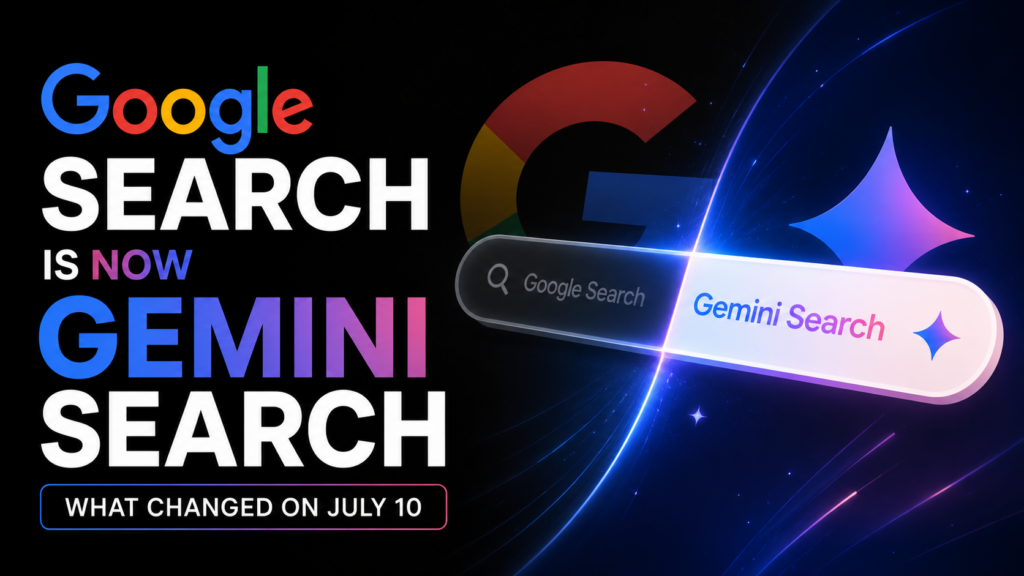
Effectively, yes. On July 10, 2026, Google made Gemini 3.5 Flash the default output for every search query worldwide. An AI-generated prose answer now appears first. The familiar ranked list of ten blue links remains on the page but sits below the fold, and studies show most users stop reading before they reach it. Liz Reid, Google’s VP of Search, called it “the biggest upgrade to our iconic search box in over 25 years.”
Quick Summary
- On July 10, 2026, Google completed the rollout of Gemini 3.5 Flash as the default output for every search query, globally. Blue links now appear below the fold by default for the first time in Google’s 27-year history.
- Publisher click-through rates dropped 58% on pages that show AI Overviews, per Ahrefs. Only 8% of users click a traditional result when an AI answer appears, down from 15% without one. Only 1% click source links inside AI answers.
- Google’s ad revenue grew 19% to $60.4 billion in Q1 2026. Ads now appear in 25.5% of AI Overview results. Publishers whose content powers those answers receive no share of that revenue.
- For brands, the shift means the competition is no longer for rank 1. It is for whether Gemini cites you at all. AI citation strategy is now the primary visibility lever in Google Search.
- Legal pressure is mounting: a German court stripped Google’s search liability shield for false AI answers, the UK forced an opt-out mechanism for publishers, and antitrust lawsuits from major publishers are accumulating on two continents.
Disclosure: Statistics in this article are sourced to their origin studies. Platform claims are distinguished from editorial analysis throughout. Published July 13, 2026.
Three days ago, every Google search changed. On July 10, 2026, Google completed the most significant transformation of its flagship product in 27 years: Gemini 3.5 Flash now generates the primary answer for every query, worldwide, by default. The ranked list of ten blue links that shaped how billions of people found information since the late 1990s is no longer the first thing you see. TechTimes reported this morning that publisher clicks have already fallen 58%, and only 1% of users click source links inside AI answers. For anyone thinking about answer engine optimization, this is the moment the transition became official and complete.
| The Numbers | What It Means |
|---|---|
| 58% | Drop in click-through rates for top-ranking pages when an AI Overview is present (Ahrefs, February 2026) |
| 8% | Users who click a traditional search result when an AI answer appears, down from 15% without one (Pew Research Center) |
| 1% | Users who click source links cited inside AI Overviews. The AI answer is the last stop for 99% of readers (Pew Research Center) |
| 1 billion | Monthly users on Google AI Mode before the July 10 default rollout, with query volume more than doubling every quarter since launch |
| $60.4B | Google search ad revenue in Q1 2026, up 19% YoY. Ads now appear in 25.5% of AI Overview results |
| 91% | Accuracy rate of Gemini AI Overview answers, meaning roughly 1 in 10 answers contains an error, per Oumi analysis for the New York Times |
What Actually Changed on July 10
In one line: Gemini 3.5 Flash is now the default output for every Google search query, not just the opt-in AI Mode tab, and not just in the US.
The July 10 rollout completed a transition Google announced at its I/O developer conference on May 19, 2026. What changed that day is the primary interface. When you search today, Gemini 3.5 Flash generates a prose answer synthesized in real time from multiple web sources. Those sources appear as inline citations within the prose, the way footnotes appear in an essay, rather than as a ranked list below your query.
What did not change: traditional blue links were not deleted from Google. Liz Reid said plainly from the I/O stage that “this new search box does not mean you’ll only get AI responses.” Classic results still exist and are reachable. What changed is that the default path now leads with an AI-synthesized answer, and defaults are destiny. Studies show that most users stop reading before they reach the links below the fold.
Two technical components power the new default. Gemini 3.5 Flash handles the synthesis: it performs retrieval-augmented generation, fetching content from multiple matching web sources and synthesizing a new prose document from that content in its own words. Google Antigravity, a new agentic development framework introduced at I/O 2026, handles the assembly of those answers into custom interactive layouts on the fly, enabling Search to generate not just prose responses but simulations, calculators, and interactive dashboards matched to specific query types. Gemini 3.5 Flash is described by Google as four times faster than comparable frontier models in output tokens per second, which is what makes real-time synthesis at search scale possible.
What this is not
This is not AI Mode, which launched as a separate conversational tab in May 2025. AI Mode was opt-in. The July 10 rollout makes an AI-first experience the universal default, across all query types, for all users, globally. You no longer have to choose AI Mode. Every search now leads with it.
What Gemini 3.5 Flash Does When You Search
In one line: Google went from being a pointer to being a synthesizer, and that distinction has profound consequences for every brand that built visibility on organic search.
Traditional search ranked web pages by relevance signals and returned a list of the most relevant pages. The user decided which page to visit. The search engine was a pointer to other people’s content.
Gemini 3.5 Flash does something fundamentally different. It reads the content, writes a new document summarizing what it found, and presents that document as the primary answer. The underlying sources appear as numbered references. For most queries and most users, the synthesis is the answer. The sources are optional reading.
The implication for answer engine optimization is direct: the competition has shifted from ranking in a list to being included in a synthesis. Those are different problems requiring different strategies. Ranking depended on backlinks, on-page authority signals, and technical SEO. Being cited in a Gemini synthesis depends on the clarity, specificity, and trustworthiness of your content as source material for an AI writer. SEO is not dead, but the primary value it delivers has changed: ranking still helps you get crawled and considered, but citation is the new conversion.
Why Publisher Traffic Is in Freefall
In one line: The math is structural: more searches with AI answers produce fewer publisher clicks, and Google’s ad revenue grows regardless.
An Ahrefs study published in February 2026, analyzing 300,000 keywords and aggregated Search Console data, found that AI Overviews correlate with a 58% reduction in click-through rates for top-ranking pages. That is nearly double the 34.5% decline the same researchers documented in April 2025. A Pew Research Center study tracking nearly 69,000 Google searches found that users click a traditional result link only 8% of the time when an AI summary appears, compared with 15% without one. Only 1% of users click the source links cited within an AI answer itself.
The industry-level data is severe. SEO firm Growtika tracked Ahrefs data from early 2024 to January 2026 and found that ten major technology outlets combined dropped from 112 million monthly US Google visits to just under 50 million, a fall of more than 55% in under two years. Digital Trends went from 8.5 million clicks per month in March 2024 to 264,861 in January 2026, a 97% collapse. The Verge, HowToGeek, and ZDNet each lost more than 85% of Google-referred traffic over the same period.
Google’s defense is that AI Mode is growing total search volume: the company has cited a 10% increase in usage for query types that show AI Overviews. The counterargument is straightforward. More searches without more clicks does not help a publisher whose revenue model depends on visits. Meanwhile, Google placed ads in 25.5% of AI Overview results and grew search ad revenue 19% year-over-year to $60.4 billion in Q1 2026. Publishers whose content powers those AI answers receive no share of that revenue. The person who produced the source material and the person who monetized the answer are no longer the same entity.
What This Means for Brand Visibility in AI Search
In one line: The brands getting cited in Gemini’s answers are winning the new version of page one. The brands that are only ranked are increasingly invisible.
The Pew finding that only 1% of users click source links inside AI answers deserves to be read carefully. It does not mean citations have no value. It means the value of a citation has changed. Being cited in a Gemini answer means your brand name and claims appear in the primary interface that users read. Being ranked at position three beneath that answer means your content is available but unlikely to be seen. Brand mentions in AI answers function more like earned media than traditional search rankings: the exposure happens in the answer, not the click.
This is why how brands earn citations in AI answers is the central strategic question of 2026. The levers are different from traditional SEO: structured, quotable claims; original data that AI models need to cite; clear entity signals; and consistent brand presence across the sources that Gemini draws on. If you want to understand where your brand currently stands in AI answers, an AEO audit is the starting point.
One useful benchmark: what does Gemini say about your brand category right now? Search for the queries your customers use, read the AI answer that appears first, and identify which brands are cited. Those are the brands currently occupying the equivalent of page-one position in the new default search. Tools like Profound track AI citation appearances across Gemini, ChatGPT, Perplexity, and Claude in near real time, which is useful for monitoring whether your brand is in the answer or absent from it. Understanding how each AI platform decides which brands to mention matters because Gemini’s citation logic differs from ChatGPT’s and Perplexity’s.
The question has changed
Before July 10: “How do we rank in position 1?” After July 10: “Does Gemini cite us when someone searches our category?” Those are different questions with different answers. The first is a ranking problem. The second is a content authority and entity recognition problem.
How to Get Traditional Blue Links Back
In one line: There is no permanent off switch, but several reliable workarounds work today if you or your team prefers the classic interface.
Google offers no official toggle to restore the pre-July 10 experience, but four workarounds are reliable.
The quickest per-search fix is the Web filter tab. After any search, look at the filter tabs below the search bar and click “Web.” This returns traditional results without the AI answer. The limitation: it is not persistent. Every new search defaults back to the AI interface.
The most reliable desktop method is the &udm=14 URL parameter. Append &udm=14 to any Google search URL and the page reloads with classic blue-link results only. This can be automated by setting a custom search engine in Chrome, Firefox, or Safari with the URL https://www.google.com/search?q=%s&udm=14, making classic results your permanent browser default. The site tenbluelinks.org provides a one-click browser setup for this.
Adding -ai to the end of any query is a quick per-search shortcut that typically returns traditional results, though it is not guaranteed on every query type.
Alternative search engines remain an option. DuckDuckGo handles approximately 100 million searches daily with AI features fully disableable in settings. Kagi is a paid search service with no forced AI Overviews. Brave Search runs its own independent index and does not use Google’s AI infrastructure.
The Legal Fallout Is Already Here
In one line: A German court just stripped Google of the liability shield it relied on for decades, classifying AI Overview answers as Google’s own speech, not neutral search results.
On May 28, 2026, the 26th Civil Chamber of the Regional Court of Munich ruled that an AI Overview is Google’s own editorial content, not a neutral display of third-party material. The case arose when an AI Overview falsely linked two Munich-based publishers to subscription traps and scams, fabricating connections that appeared in none of the cited sources. The court classified Google as a direct infringer with fines up to €250,000 per violation and an immediate injunction against repeating the false claims. Google has announced it will appeal. The ruling is preliminary and applies only in Germany, but it signals the direction of European jurisprudence: AI-generated summaries are the platform’s speech, not the source’s.
In the UK, the Competition and Markets Authority issued a binding order requiring Google to let publishers opt out of AI-powered search features without losing standard search visibility. The opt-out mechanism, now available in Search Console, is a significant concession Google described internally as “a huge engineering project.” It does not, however, extend to the Gemini app, so publishers who opt out of AI Overviews in Search may still find their content appearing in Gemini responses elsewhere.
On the antitrust front: Penske Media Corporation filed suit in September 2025 alleging Google broke the longstanding exchange in which publishers provided crawlable content in return for referral traffic. The Atlantic filed a federal antitrust lawsuit in January 2026. The European Publishers Council filed a formal complaint with the European Commission in February 2026. The EU AI Act reaches full applicability on August 2, 2026, adding mandatory transparency obligations for AI systems that interact with users. A DMA compliance deadline on July 27, 2026 requires Google to share anonymized search data with rival search engines.
What Comes Next
In one line: The July 10 rollout is not the endpoint: generative UI, agentic booking, and AI-integrated advertising are the next phases of the transition.
Several capabilities announced at I/O 2026 are still rolling out. Generative UI, which allows Gemini to build custom interactive tools, simulations, and calculators on the fly for specific queries, arrives free to all users this summer. Background information agents that monitor topics, news feeds, and data sources continuously and push synthesized updates to users are rolling out first to Google AI Pro and Ultra subscribers. Agentic booking, which allows Google to complete purchases inside Search without the user visiting a vendor’s website, is in early US rollout. Analysts predict Google will introduce advertising inside agentic flows by Q4 2026.
The structural tension the July 10 rollout makes visible is not a product problem. It is an ecosystem problem. Google’s AI answers synthesize the work of publishers and content creators whose traffic is collapsing. If that production declines because the economics no longer support it, the AI will be left synthesizing from an increasingly stale and shrinking content base. There is no self-correcting mechanism in the current model. The regulatory actions now pending in the US and EU represent the industry’s attempt to force one through legal means.
For brands, the takeaway is narrower and more actionable: the AI search landscape is shifting faster than most marketing teams are tracking. Google Search is now, functionally, Gemini Search. The brands that are already building for citation, not just ranking, are positioned well. The brands that have not started yet are competing for real estate that is now below the fold.
Key Takeaways
- July 10 is the line. Gemini 3.5 Flash is the default answer for every Google search, globally. This is not a test, not a rollout for certain query types, and not opt-in.
- The CTR math is brutal. AI Overviews correlate with 58% lower click-through rates. Only 1% of users click source links inside AI answers. Traffic from Google is now materially dependent on whether Gemini cites you.
- The competition has changed. Ranking is still necessary but no longer sufficient. Citation in the AI answer is the primary visibility outcome in Google Search in 2026.
- Legal pressure is real and accelerating. A German court ruling, UK publisher opt-out order, and multiple antitrust lawsuits signal that the regulatory environment around AI search will tighten significantly before August 2026.
- The next phase is agentic. Google is rolling out agentic booking and generative UI this summer. The search interface will continue to evolve toward doing things on users’ behalf, compressing the role of publisher websites further.
Frequently Asked Questions
Did Google permanently remove the blue links?
No. Blue links still appear on the page but below the fold, secondary to the AI-generated answer. Users can restore classic results using the Web filter tab after any search, or permanently via the &udm=14 URL parameter set as a custom browser search engine. There is no official toggle Google provides, but the workarounds are reliable.
Are Google’s AI-generated search answers accurate?
About 91% accurate, according to an Oumi analysis for the New York Times. A May 2026 arXiv study of 98,020 AI Overview claims found that 11% were unsupported by the sources Google cited, and that even many correct answers could not be traced to the cited sources. A German court ruled in May 2026 that false AI Overview claims are Google’s direct liability, not a neutral display of third-party content. For consequential decisions, verify AI answers against primary sources.
How does this affect my brand’s SEO strategy?
Traditional ranking still matters: you need to be indexed and considered by Gemini to be cited by it. But ranking without citation now produces minimal traffic, since 58% fewer users click through when an AI answer appears. The strategic addition is building for citation: structured, specific, quotable content; original data; and clear entity signals that help Gemini identify your brand as a credible source for your category.
Can publishers opt out of having their content used in AI Overviews?
Yes, partially. The UK Competition and Markets Authority issued a binding order requiring Google to provide an opt-out mechanism in Search Console. The toggle blocks content from appearing in AI Overviews, AI Mode, and AI Overviews in Discover without affecting standard search rankings. The limitation: it does not apply to the Gemini app, and control is at the site level, not the query level. Publishers outside the UK gained access to the same mechanism when Google extended it as part of its global policy response.
What is Google Antigravity and why does it matter?
Google Antigravity is the agentic development framework announced at I/O 2026 that powers generative UI in Search. It allows Gemini to build custom interactive interfaces, calculators, simulations, and dashboards on the fly matched to specific query types, rather than just returning prose text. It is rolling out free to all users this summer, and it represents the next layer of the transition: Search becoming not just an answer engine but a task-completion environment.
Which alternative search engines do not use AI Overviews by default?
DuckDuckGo, Kagi, and Brave Search are the most commonly used alternatives. DuckDuckGo handles approximately 100 million searches daily and allows full disabling of AI features in settings. Kagi is a paid subscription service without forced AI summaries. Brave Search runs its own independent index without Google’s AI infrastructure. All three provide traditional ranked results by default.
About the author
Kai Williams
Kai Williams has been in marketing for years, with a long background in SEO before AEO had a name. He stepped into Answer Engine Optimization the moment AI started reshaping how people search, and has been tracking the shift ever since. At Prompt Insider, he covers AEO, AI marketing, and the future of search, breaking down what is changing and what brands need to do about it.