Short Answer
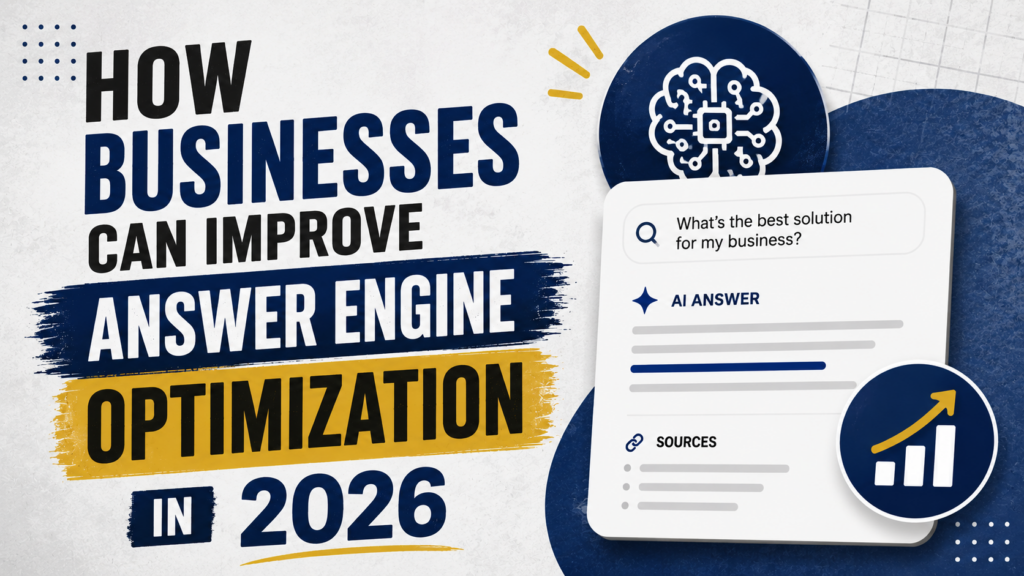
How can businesses improve answer engine optimization in 2026?
Businesses can improve answer engine optimization in 2026 by making their content easy for AI platforms to understand, trust, extract, and cite. The winning approach is to lead with direct answers, use structured data, build consistent brand entities, strengthen E-E-A-T signals, and measure AI citation share instead of relying only on organic traffic.
Quick Summary
- Answer Engine Optimization is the practice of structuring content so AI platforms like ChatGPT, Google AI Overviews, Perplexity, and Gemini can find, understand, and cite it.
- Use answer-first formatting: concise answers at the top of every page and section, followed by evidence, examples, and supporting detail.
- Schema markup, entity consistency, expert authorship, citations, and original data increase the likelihood that AI systems will trust and reference your content.
- Measure success by AI citation share, branded search lift, AI referral traffic, and downstream conversions, not just rankings and clicks.
- The goal: become the source that powers the AI-generated answer.
Zero-click and AI Overview figures are cited to their sources throughout this article. All platform statistics reflect conditions as of July 2026.
Businesses that are not structured for AI extraction may rank well in Google and still be completely invisible inside ChatGPT, Perplexity, Gemini, and Google AI Overviews. That gap is closing fast, and the brands that close it first earn disproportionate citation share. This breakdown covers every layer of AEO implementation: from content structure and schema markup to entity consistency, authority signals, a six-step action plan, and how to measure what actually matters.
| The Numbers | What It Means |
|---|---|
| 65% | Share of searches ending without a click as AI answer engines replace traditional blue links with direct responses. |
| 83% | Zero-click rate on queries that trigger Google AI Overviews, meaning most users never reach a source page after the answer appears. |
| 40–60 | Optimal word count for an AEO lead answer: complete enough to stand alone, concise enough for AI systems to extract cleanly. |
| 6 steps | The AEO implementation framework businesses can layer onto existing SEO without starting from scratch. |
What Is Answer Engine Optimization, and Why Does It Matter in 2026?
In one line: AEO is the practice of structuring content so AI platforms like ChatGPT, Gemini, Perplexity, and Google AI Overviews can extract and cite it, at a moment when zero-click search is approaching 65%.
Answer Engine Optimization, or AEO, is the practice of structuring and optimizing digital content so AI-driven platforms can find, understand, trust, and cite it when generating answers to user queries.
This matters because the way people find information has fundamentally changed. AI-powered platforms like ChatGPT, Google AI Overviews, Perplexity, and Gemini now synthesize direct answers instead of serving only traditional blue links, and zero-click search is approaching 65%. For businesses, visibility in 2026 is no longer defined only by where you rank on a search results page. It is increasingly defined by whether an AI assistant mentions your brand when a prospect asks a question.
AEO helps brands surface in AI-generated responses, which makes it an operational priority, not an optional experiment. When an AI engine cites your content at the moment someone is evaluating solutions, you capture demand with built-in credibility. AI Overviews alone drive an 83% zero-click rate on triggered queries, meaning the traditional click-through model is eroding fast.
The goal of AEO is simple: become the source that powers the AI-generated answer. Answer engine optimization strategies in 2026 are about building a reputation with AI engines through consistency, authority, and extractable content.
How Is AEO Different From Traditional SEO?
In one line: SEO optimizes for ranking positions; AEO optimizes for citations inside AI-generated answers, adding answer-first formatting, entity clarity, and structured data to the SEO foundation.
AEO and SEO are complementary disciplines, not competing ones. SEO optimizes for ranking positions in search result lists, while AEO optimizes for earning citations inside AI-generated answers. Both matter. Neglecting SEO fundamentals can hurt AEO because site speed, internal linking, crawlability, and technical health still affect whether content can be discovered and trusted. For more on this distinction, see whether SEO is dead in the age of AEO.
The critical distinction is that answer engines reward extractability and authority signals, and they value semantic clarity over keyword density. AEO adds new priorities: answer-first formatting, entity clarity, factual credibility, structured data, and content freshness. The mindset shift: treat the AI-generated response as your new landing page. Your content needs to be unambiguous, citation-ready, and structured for machine extraction.
| Dimension | Traditional SEO | Answer Engine Optimization |
|---|---|---|
| Primary goal | Rank on SERPs | Get cited in AI-generated answers |
| Content format | Keyword-optimized long-form | Answer-first, atomic paragraphs |
| Technical focus | Meta tags and crawlability | Schema markup and entity signals |
| Success metric | Rankings, clicks, organic traffic | AI citation share, zero-click visibility |
| Trust signals | Backlinks and domain authority | E-E-A-T, original data, third-party mentions |
How Should Businesses Structure Content for Answer Engines?
In one line: Lead every section with a concise 40–60 word direct answer, then expand with evidence, examples, and nuance using the inverted pyramid.
Businesses should structure content using the inverted pyramid: lead with the direct answer, then add supporting detail, evidence, examples, and nuance. Putting direct answers near the top of the page improves extraction because AI systems need a clear statement they can quote or summarize. A strong AEO answer is usually concise, specific, and self-contained.
What Does Answer-First Content Look Like?
Answer-first content starts with the conclusion instead of slowly building toward it. This makes the content easier for AI systems to extract and easier for human readers to scan.
Before: traditional paragraph
“In today’s fast-changing digital environment, businesses of all sizes are discovering the importance of content strategy. There are many factors to consider when thinking about how to approach this challenge…”
After: answer-first rewrite
“Businesses improve AEO by leading each content section with a direct, concise answer in 40 to 60 words, then expanding with supporting evidence. This inverted pyramid format makes content extractable by AI systems that need to pull a definitive statement.”
The difference is immediate. AI platforms need a clear, citable statement, not a slow build to a thesis. Answer-complete content should explain what something is, who it is for, how to choose it, and what makes it different, all in a format a machine can parse without interpretation.
Why Do Question-Style Headings Help AEO?
Question-style headings help AEO because they mirror how people ask AI tools for information. They also give AI systems a clear semantic structure for matching user prompts to page sections. A clear heading hierarchy is a core AEO tactic because it helps AI systems understand how topics, subtopics, and answers relate to each other. Use H2s and H3s that reflect real user questions, follow a logical hierarchy, and make each section easy to interpret in isolation.
How Can Businesses Find the Right Questions to Answer?
Businesses can find strong AEO questions by combining search data, customer language, and sales intelligence. The best questions often come from the same places your customers already reveal intent. Prioritize long-tail, conversational queries, especially “how,” “why,” “best,” and “vs” queries. These are the prompts users type into ChatGPT and Perplexity when they are actively evaluating options.
Useful sources include Google Search Console query reports, People Also Ask boxes, Reddit and community forums, sales call transcripts and CRM notes, and customer support ticket themes. For a deeper look at writing content specifically for AI search, see how to write content for AI search in 2026.
How Does Schema Markup Improve AEO?
In one line: Schema gives AI systems machine-readable context about your content, organization, and page structure, making extraction and citation more reliable. FAQ and structured data are fundamentals of AEO, not optional extras.
Schema markup improves AEO by giving AI systems machine-readable context about your content, organization, products, authors, and page structure. Schema markup is a standardized vocabulary of code, typically JSON-LD, added to web pages so search engines and AI platforms can better understand meaning and relationships. When implemented correctly, schema helps AI systems extract, verify, and cite your information with more confidence. AI Overviews favor concise, clearly structured answers with schema markup, making structured data a necessary part of any answer engine optimization strategy in 2026.
Which Schema Types Should Businesses Prioritize for AEO?
Businesses should prioritize schema types that make their content, brand, products, and answers easier for AI systems to interpret. The best schema choice depends on the page type and user intent.
| Schema type | Best for | AEO benefit |
|---|---|---|
| FAQPage | Q&A content, help centers, knowledge bases | Maps directly to how AI systems parse question-answer pairs |
| HowTo | Step-by-step tutorials and process documentation | Enables extraction of sequential instructions |
| Article | Blog posts and thought leadership content | Signals author, publish date, and headline for trust |
| Organization | Homepage and About page | Establishes brand as a recognized entity with consistent attributes |
| Product / Review | Commercial and comparison pages | Surfaces pricing, ratings, and features in AI product recommendations |
| LocalBusiness | Businesses with geographic presence | Supports local discovery in voice assistants and map-based AI answers |
Schema is only effective on a technically healthy site. Use Schema.org markup throughout your content, but pair it with fast load times, mobile responsiveness, and clean crawl paths. Lists, tables, and short paragraphs further increase extractability. Formatting and schema work together to maximize AI pickup.
How Can Businesses Build Entity Consistency for AI Answer Engines?
In one line: Standardize your brand name, descriptions, and key facts across every digital property so AI systems can build a reliable knowledge graph around your brand without ambiguity.
Businesses build entity consistency by standardizing their brand name, descriptions, product details, and factual claims across every digital property. In AEO, an entity is a clearly identifiable thing, such as a company, product, person, place, or category. AI systems use entities to understand what your brand is, what it does, who it serves, and how it relates to other known topics.
This matters because LLMs judge whether your information ecosystem is comprehensive enough to trust. If your brand description differs between your website, LinkedIn, and Crunchbase, AI systems have less confidence in citing you. Smaller businesses should not try to compete on breadth. Building topical authority in a narrow niche is more effective than spreading thin across broad categories.
A simple positioning formula: “[brand] + [category] + [audience]” or “[brand] + [category] + [problem].” Embed that consistently across your content so AI systems can categorize you with confidence.
Which Brand Properties Should Businesses Audit for Entity Consistency?
Businesses should audit every high-visibility property where AI systems might verify brand information. The goal is to make your core facts match across owned, earned, and structured sources.
- Website About and Company pages
- Google Business Profile
- Crunchbase
- Industry directories
- Wikipedia and Wikidata, if applicable
- Organization schema markup
- Product pages and documentation
- Social profiles and press boilerplates
How Do Authority, E-E-A-T, and Digital PR Affect AEO?
In one line: AI engines increasingly cite sources backed by verifiable expertise, third-party mentions, and original data. E-E-A-T is the trust layer that determines whether your content gets cited or skipped.
Authority signals affect AEO because AI engines increasingly rely on trusted, verifiable, and third-party-supported information. E-E-A-T stands for Experience, Expertise, Authoritativeness, and Trustworthiness, and it helps signal whether content deserves to be cited. Author bios, citations, and first-hand content strengthen AI trust signals. Every serious AEO page should show who wrote it, why they are qualified, and what evidence supports the claims.
Beyond consistency, AI engines increasingly pull from third-party mentions, not just your own site. A digital PR strategy that earns mentions, quotes, and citations on authoritative external publications directly feeds the trust layer AI models rely on. For a deeper look at this dynamic, see why third-party citations matter more than your own content for AEO.
Concrete trust-building tactics include publishing original research, surveys, or proprietary data; adding named expert author bios with credentials; including inline citations to reputable sources; earning backlinks from recognized industry publications; securing third-party mentions, quotes, and citations; and keeping claims, dates, and statistics current.
What Is the Step-by-Step AEO Implementation Plan for Businesses?
In one line: A six-step workflow covering visibility audits, question prioritization, content rewrites, formatting, credibility signals, and a quarterly refresh cadence.
Businesses can improve answer engine results by layering AEO onto their existing SEO program through a practical six-step workflow. The process starts with visibility audits and ends with ongoing measurement, refreshes, and governance.
Audit Your Current AI Visibility
Query your brand name and core service categories in ChatGPT, Perplexity, Google AI Overviews, and Gemini. Document where you appear, where competitors appear, where incorrect information appears, and where no one is cited. This baseline is the foundation of every decision that follows. For a structured approach, see the content gap analysis framework for AEO.
Prioritize Questions That Influence Pipeline
Pull questions from Search Console, People Also Ask, support tickets, sales calls, and CRM notes. Prioritize evaluation-stage queries like “best,” “vs,” and “pricing.” These are the questions AI systems are already answering, and your goal is to become the source behind those answers.
Rewrite Existing Pages for Answer-First Structure
If the answer is buried in paragraph three, move it to the top. Use concise 40–60 word lead answers, then expand with supporting facts, examples, citations, and nuance. Every content block should follow the inverted pyramid. This step alone can produce meaningful citation lift without publishing a single new page.
Add Formatting and Schema That AI Can Parse
Use question-style headings, short paragraphs, bulleted lists, comparison tables, and appropriate schema markup. Prioritize FAQPage, HowTo, Article, and Organization schema where relevant. Format and markup work together, so do both. Important content should also be available in static HTML, since some AI crawlers do not execute JavaScript.
Add Credibility Signals to Every Key Page
Add real statistics, original data, expert quotes, reputable citations, and third-party mentions. Every important piece of content should have a named, credentialed author. Missing author attribution can weaken AI citation potential even when the content itself is strong.
Refresh Content on a Quarterly Cadence
Stale information gets deprioritized. Refresh statistics, examples, author details, screenshots, schema, and internal links every quarter so content stays current and citation-ready. Tracking answer engine visibility over time turns AEO into continuous improvement rather than a one-time project. For help choosing a tracking tool, see the AEO tracking software breakdown.
How Should Businesses Measure AEO Performance?
In one line: Measure AI citation share, branded search lift, AI referral traffic, and downstream conversions. Rankings and organic clicks alone do not capture answer engine performance.
Businesses should measure AEO performance by tracking AI citation share, branded search lift, AI referral traffic, and conversions influenced by AI visibility. AI citation share is the percentage of relevant AI-generated answers that reference or cite your brand. In 2026, this is one of the most important AEO metrics because it shows whether your brand is appearing inside the answer itself, not just on the page below it. For a comprehensive breakdown, see AEO success metrics that matter.
| Metric | What to track | How to track it |
|---|---|---|
| AI citation audits | Brand mentions in AI answers for target topics | Query ChatGPT, Perplexity, Gemini, and AI Overviews weekly and log results |
| Branded search lift | Increases in branded search volume | Monitor Google Search Console and Google Trends |
| AI referral traffic | Visits originating from AI platforms | Filter referral sources in your analytics platform |
| Conversion attribution | Demo requests and sign-ups from AI-cited visitors | Tag and track downstream conversions by referral source |
| Content freshness | Last-updated dates correlated with citation frequency | Maintain a content calendar with refresh dates and track citation changes after each update |
Use structured prompt tests across ChatGPT, Perplexity, Gemini, and Google AI Overviews to audit visibility systematically. If a page is not getting cited, check whether it is missing verifiable data points, clear author attribution, structured formatting, or current information. Assign someone on your team to own AI visibility monitoring, issue detection, and content updates so it becomes an ongoing program rather than a one-time audit.
What AEO Trends Should Businesses Prepare for in 2026?
In one line: Multi-modal answers, agentic AI research, comparison content, local AEO, and deeper topical authority requirements are the five trends reshaping how businesses get cited.
The AEO environment is changing quickly, but the direction is clear: answer engines are rewarding content that is structured, verifiable, and easy to reuse across formats and surfaces.
How Will Multi-Modal AI Answers Change AEO?
Multi-modal AI answers will make text, images, video, and audio part of the same answer experience. Businesses should invest in multi-format content such as video transcripts, infographics with descriptive alt text, and podcast show notes. Hidden PDFs and images reduce the chance of AI citation. Make all important content accessible, crawlable, and supported by text.
How Will Agentic AI Affect Business Content Strategy?
Agentic AI systems perform multi-step research tasks on behalf of users, which means content must be structured for machine consumption across the entire customer journey, not just at the search query stage. AI answer engines can draw from knowledge bases, technical docs, and media assets. Your help center, documentation, product information, and support content can all become citation-eligible if structured correctly.
Why Are Listicles and Comparison Pages High-Priority for AEO?
Listicles and comparison pages are important because AI users often ask for recommendations, alternatives, and side-by-side evaluations. Creating “best of,” “vs,” and “top tools” content optimized for AI extraction is one of the highest-leverage tactics available right now. These formats naturally match how users ask AI systems for buying guidance. For more on this format, see how to write a listicle that gets cited by AI.
How Should Local Businesses Approach AEO?
Local businesses should optimize their Google Business Profile, LocalBusiness schema, location-specific pages, and voice-friendly content. Local AEO helps businesses appear in geographic and map-based AI answers. Perplexity-style answers increasingly include location-aware results, and AI assistants on mobile devices routinely surface local business recommendations for “near me” and service-category queries.
Why Does Topical Authority Matter for Answer Engines?
Topical authority matters because AI systems are more likely to trust sources that cover a subject deeply and consistently. Businesses that build comprehensive, interlinked content hubs around their core topics earn disproportionate citation share. Entity-based optimization beats keyword density; clear definitions and thorough coverage win. Organizations that combine answer-first content, structured markup, verifiable evidence, and coordinated digital PR consistently see higher AI citation rates than those optimizing individual pages in isolation.
Key Takeaways
- Answer-first formatting is the most controllable lever. Moving the direct answer to the top of each section can improve AI citation rates without publishing any new content.
- Schema markup is not optional. FAQPage, HowTo, Organization, and Article schema give AI systems the machine-readable context they need to extract and cite your content confidently.
- Entity consistency determines whether AI trusts your brand. Mismatched descriptions across your website, directories, and social profiles create ambiguity that reduces citation likelihood.
- Third-party validation matters as much as your own content. AI engines rely on external mentions, press, and citations to verify expertise. A digital PR strategy is an AEO strategy.
- Measure citation share per platform, not just in aggregate. A brand with strong Perplexity visibility and weak ChatGPT presence has a specific problem to fix, and a blended number hides it.
Frequently Asked Questions
What is the best way for a business to start with AEO?
Start by auditing what ChatGPT, Perplexity, Gemini, and Google AI Overviews already say about your brand and category. Then identify high-value questions where competitors are cited and rewrite your content to answer those questions directly. For a structured starting point, see AEO best practices for 2026.
How long should an AEO answer be?
A strong AEO answer is often 40 to 60 words at the start of a section, followed by supporting detail. The answer should be specific, self-contained, and easy for an AI system to quote or summarize without needing to interpret surrounding context.
Does AEO replace SEO?
No. AEO builds on SEO rather than replacing it. Technical SEO, crawlability, backlinks, and site health still matter, but AEO adds answer-first formatting, schema markup, entity consistency, and AI citation measurement. Neglecting SEO fundamentals can directly hurt AEO performance because site speed, indexability, and crawl health affect whether content can be discovered and trusted by AI systems.
Why is schema markup critical for AEO success?
Schema markup provides machine-readable context that helps AI platforms understand a page’s structure, topic, author, organization, and intent. Implementing FAQPage, HowTo, Article, and Organization schema can increase the likelihood that content is selected and cited in AI-generated answers. AI Overviews favor clearly structured answers with schema markup, making it one of the highest-ROI technical changes available.
How can businesses track their visibility in AI answer platforms?
Businesses can track AI visibility through regular citation audits, branded search lift, AI referral traffic, and downstream conversions from AI-cited visitors. Run a consistent set of 20 to 50 target prompts across ChatGPT, Gemini, Perplexity, and Google AI Overviews each month and log the results. Dedicated AEO tracking software like Profound can automate much of this monitoring at scale.