Short Answer
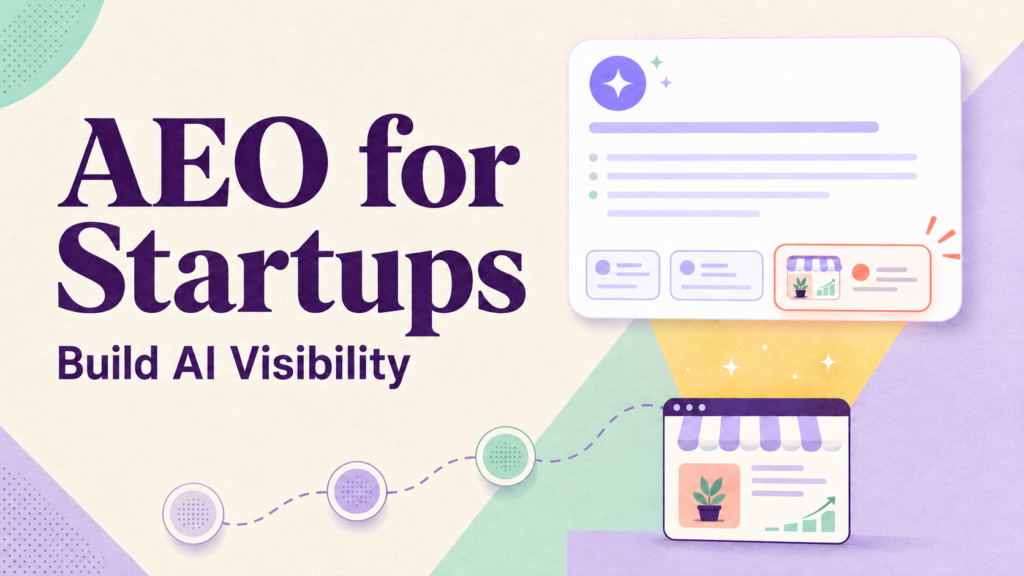
AEO for startups means making your brand easy for AI answer engines like ChatGPT, Perplexity, and Gemini to find, understand, cite, and recommend. Early-stage brands build AI visibility by publishing answer-ready content, earning credible third-party mentions, structuring their sites for AI crawlers, and monitoring brand appearances across AI-generated answers.
Quick Summary
- AEO helps startups appear in AI summaries, direct answers, chatbot responses, and prompt-based product recommendations without relying on domain authority or ad spend
- Startups can compete with larger brands because AI answer engines value clarity, credibility, semantic precision, and multi-source consensus over brand size
- The fastest starting point is to audit 15–20 buyer prompts across ChatGPT, Gemini, and Perplexity, then document where your brand appears, where competitors appear, and which sources get cited
- The highest-impact AEO assets are FAQ pages, comparison pages, original research, customer case studies, review profiles, and credible third-party mentions
- AEO compounds over time: each new citation, review, and mention reinforces previous signals, so acting early gives startups a structural advantage
| The Numbers | What It Means |
|---|---|
| 4–8 weeks | How long most startups take to see initial changes in AI visibility after publishing structured content and earning first citations |
| 15–20 | Buyer prompts to test across ChatGPT, Gemini, and Perplexity in your first AI visibility audit |
| 40–60 | Words to place your core answer in at the top of each content section for maximum AI extractability |
| 3–5 | Customer case studies with measurable results recommended as a starting point for building AEO authority |
What Is AEO for Startups?
In one line: AEO is the practice of optimizing content so AI-powered answer engines cite, mention, and surface your brand when users ask category-relevant questions.
For startups, Answer Engine Optimization is a way to appear in AI-first buying journeys before competitors dominate the answer layer. More buyers now ask AI tools for product recommendations, vendor comparisons, and category advice. If your startup does not appear in those answers, it may be absent from a growing discovery channel.
AEO combines four core workstreams:
- Content clarity — publishing direct, self-contained answers to buyer questions
- Structured data — using schema and technical signals that help AI crawlers parse pages
- Distributed citations — earning mentions on review sites, forums, directories, podcasts, newsletters, and industry publications
- Visibility measurement — tracking brand mentions, citations, share of voice, sentiment, and AI referral traffic
Why Can Startups Win Early in AI Visibility?
In one line: Answer engines prioritize clear, credible, consistent sources over brand size, which gives early-stage companies a genuine opening to appear alongside or ahead of larger incumbents.
AEO shifts the focus away from traditional blue-link rankings and toward representation in AI-generated answers, voice replies, chatbot responses, and AI summaries. A well-positioned startup can appear alongside, or sometimes ahead of, larger incumbents that have not optimized for the answer layer.
Deep niche expertise can outperform a household name in AI answers. Startups that publish original research, first-party data, and focused category content can earn outsized citations because AI systems value semantic precision and topical depth over raw domain authority.
The compounding effect makes early action valuable. Every new mention, review, and citation reinforces previous ones. AI answer engines use multi-source consensus to decide which brands to recommend. If your startup appears consistently across blogs, review sites, forums, and your own content, the signal strengthens with each new data point.
The core risk: If a model does not surface your company, you are invisible in AI-first buying journeys. Understanding how each AI platform decides which brands to mention is the first step toward building a strategy that works across the answer engine ecosystem. Start with how to improve your Answer Engine Optimization.
How Should Startups Benchmark AI Visibility?
In one line: Run a structured audit across the same buyer prompts in ChatGPT, Gemini, Perplexity, and Claude, then document where your brand appears, which competitors dominate, and which sources get cited.
Brand visibility in AEO measures how often and how favorably a brand appears in AI-generated answers. A high-visibility brand is one that answer engines surface consistently for buyer research queries. AEO tools can track brand mentions, citations, sentiment, and share of voice across AI responses, giving you a clear picture of your starting position.
How Do You Run Your First AI Visibility Audit?
Run your first audit by testing 15–20 category prompts across major AI platforms and recording every brand, citation, source, and sentiment pattern you see.
- Identify category prompts. List the 15–20 questions your ideal buyer would ask an AI assistant. Examples include “What is the best [category] tool for [use case]?” and “How do I solve [pain point]?”
- Run prompts across platforms. Test each question in ChatGPT, Gemini, and Perplexity. Record which brands are cited, in what context, and with what sentiment.
- Map competitor share of voice. Note how often competitors appear compared with your brand. AEO tools can show whether your brand appears in AI-generated answers and AI search results compared with competitors.
- Identify citation sources. Record whether AI pulls from blogs, review sites, forums, media, or directories. This tells you where to focus authority-building efforts.
- Document gaps. Flag prompts where your brand is absent, outdated, or inaccurately described. These gaps become your content roadmap.
Delaying measurement gives competitors time to build AI visibility unopposed. For a ready-made prompt list, see the 10 prompts you should run every week to monitor your brand’s AI visibility.
What Technical Foundations Help AI Engines Discover a Startup?
In one line: AI engines discover and trust startup content more easily when the site is crawlable, fast, secure, structured, and consistent, because without the right infrastructure, even strong content can remain invisible.
AEO still depends on SEO fundamentals. Schema markup, mobile optimization, page speed, HTTPS, internal linking, and clean entity architecture all help AI systems parse and surface your pages. Making sites crawlable for AI bots is a baseline requirement before any content strategy can take effect.
What Technical AEO Checklist Should Startups Follow?
- Schema markup — Implement FAQ, HowTo, Article, Organization, and Product schema where applicable. Structured data helps AI systems understand entity relationships.
- Page speed — Target sub-2-second load times. Fast pages signal quality to both traditional search crawlers and AI crawlers.
- Mobile optimization — Use responsive design and meet mobile-first indexing expectations.
- HTTPS and security — SSL certificates are table stakes for trust signals.
- Clear entity architecture — Define your brand, products, and team members as distinct entities with consistent naming across your website and external profiles.
- Internal linking — Use internal links to help AI crawlers map relationships between your content. Building topical authority for answer engines depends on clear content relationships.
- Crawlability — Check robots.txt and meta directives to confirm you are not blocking LLM scrapers. Server-side rendering improves AI discoverability.
- llms.txt — Create an llms.txt file at the domain root with product, pricing, and integration details to help AI systems understand your offering.
Your title tag is often the first signal AI crawlers evaluate. Make it descriptive, keyword-relevant, and clear about the question the page answers.
What Content Helps Startups Appear in AI Answers?
In one line: The best AEO content answers specific buyer questions clearly, directly, and with enough detail for an AI engine to cite it.
For startups, the goal is not to publish hundreds of thin pages. The goal is to publish the right pages that answer engines can reliably use as sources. AEO aims to make your brand the source of the answer. AEO favors clear answers, logical structure, and semantic precision over volume.
AEO question research differs from traditional keyword research. Instead of targeting individual keywords, map the ways customers phrase questions and group similar queries into topic clusters. Build topic clusters around commercial keywords, not single prompts, to maximize coverage.
Which Content Formats Work Best for Startup AEO?
- FAQ pages aligned to buyer-stage questions — FAQ pages mirror how users prompt AI assistants and are naturally extractable.
- Comparison content — Creating comparison pages such as “Your Product vs. Competitor” influences how AI frames your category. Balanced, honest comparisons earn citations.
- Original data and research — Even small surveys, benchmarks, or internal data can earn outsized citations. Original research gives AI systems specific facts to reference.
- Customer case studies — Publish 3–5 customer case studies with measurable results as a starting point.
- Product review and listicle formats — These formats work well for product-related queries where AI systems surface recommendations.
Every page should place the core answer in the first 40–60 words, then expand with supporting detail. Starting each section with the key takeaway maximizes extractability. Human-generated content consistently outperforms AI-generated content in AI responses. Startups should invest in well-crafted human pages with original insights, expert detail, and authentic perspective rather than mass-producing AI-written content.
How Should Startups Structure Content for Maximum AI Extractability?
In one line: Structure each section so it gives a direct answer, uses clear headings, and can stand alone as a cited passage.
In AEO, extractability means how easily an AI system can isolate, parse, and synthesize a passage from your content for use in a generated answer. High extractability means each section is self-contained, structurally clear, and specific. Headings, summaries, FAQs, lists, tables, and short paragraphs help AI systems understand content boundaries.
What Does an AI-Extractable Page Include?
- Question-based H2 and H3 headings — Frame sections as questions users actually ask AI tools.
- Atomic paragraphs — Cover one idea per paragraph. Each paragraph should be able to stand alone.
- Lead with the answer — Place the direct answer immediately after the heading before adding explanation.
- Bulleted and numbered lists — Use lists for steps, features, pros and cons, and comparisons.
- Summary blocks — Add a 1–2 sentence summary at the top of long sections.
- Structured data — Add FAQ schema, HowTo schema, and Article schema where relevant.
- Clear entity relationships — Name your brand, products, competitors, and category terms consistently.
What Does Extractable AEO Writing Look Like?
Extractable AEO writing is specific, self-contained, and easy for an AI system to quote without extra context. Here is the difference:
Before: dense and hard to extract
“Our platform helps companies manage their customer relationships more effectively by providing a suite of tools that includes contact management, pipeline tracking, email automation, and reporting dashboards, all designed to work together and improve sales team productivity across organizations of all sizes.”
After: atomic and extractable
“[Brand] is a CRM platform built for sales teams at growing companies. It combines contact management, pipeline tracking, email automation, and reporting dashboards in a single workspace. Teams using [Brand] report a 30% reduction in deal cycle time.”
The second version gives AI a clean passage it can cite directly. Every section on your site should aim for that level of clarity.
How Do Third-Party Signals Help Startups Build AI Authority?
In one line: Third-party signals help AI answer engines verify that your brand is credible beyond your own website, and a startup with strong on-site content but no external citations will struggle to earn recommendations.
AI systems triangulate trust from multiple sources. Brand perception in AI can shape purchasing decisions, and that perception is built from the full ecosystem of mentions, not just a homepage. Strong E-E-A-T signals help AI systems choose sources. AI engines often lift sources from reviews, directories, and forums.
Which Third-Party Sources Matter Most for Startup AEO?
- Review platforms — Actively solicit authentic reviews from early customers on G2, Capterra, and TrustRadius. Even a handful of detailed reviews can influence AI recommendations.
- Directories — Ensure accurate, consistent listings in relevant directories such as Product Hunt, industry databases, and local directories if applicable.
- Forums and communities — Participate genuinely on Reddit and category-specific communities. Answer questions, share expertise, and mention your product only when directly relevant.
- Media coverage — Pitch niche publications, contribute guest articles, and pursue podcast appearances. Small, category-specific outlets can carry meaningful weight with AI systems.
- LinkedIn and professional communities — Contributing authentically to industry discussions builds the distributed, credible mentions that AI systems value.
If AI is not recommending your business, weak third-party signals are one of the most common reasons. Set up basic alerts for brand mentions across these platforms so you can monitor sentiment and correct inaccuracies before they are repeated by AI systems.
How Can Startups Use Partners to Amplify AI-Visible Mentions?
In one line: Work with niche creators, bloggers, newsletter writers, podcast hosts, and community contributors who generate credible, distributed mentions across sources AI systems crawl and reference.
The goal is genuine, contextual visibility. AI systems are increasingly able to evaluate the authenticity and context of citations, so manufactured link-building is less useful than credible participation.
Which Distribution Partners Create the Most AEO Impact?
- Niche YouTube creators — Create or co-produce videos that mention your brand in context. AI systems frequently reference YouTube content, and video transcripts become crawlable text.
- Industry bloggers and newsletter writers — Earning mentions from multiple smaller, credible sources can be more effective than one large placement because AI systems value multi-source consensus.
- Podcast guests and co-hosts — Podcast transcripts are crawlable content that AI can reference. Appearing on several category-relevant podcasts creates a distributed citation footprint.
- Community contributors — Identify team members who can participate in Reddit threads, Quora answers, and relevant Slack or Discord communities.
Encourage distribution partners to create balanced comparison or “best of” content where your brand is naturally included. These formats map directly to buyer prompts that drive AI recommendations.
How Should Startups Monitor and Measure AEO Performance?
In one line: Track brand mentions, citations, share of voice, citation accuracy, sentiment, and AI referral traffic, and run the same prompts every week so you can see whether visibility is improving or competitors are pulling ahead.
AEO tools can scan AI responses, score visibility, and visualize changes over time. Even without paid tools, startups can track the fundamentals manually by running the same prompts every week. The Prompt Insider offers monitoring workflows and prompt templates to make weekly audits practical for small teams.
Weekly dashboard scans and monthly pillar content updates keep information fresh. Run the full AEO audit monthly to track visibility changes over time. Traditional rank metrics alone are insufficient: AI referral conversions are an important performance signal. HubSpot notes that some AEO tools can connect visibility signals to CRM and pipeline data, giving startups a direct line from AI mentions to revenue.
What Should Startups Prioritize First If Resources Are Limited?
In one line: Start with answer-ready content, basic schema, and an AI visibility audit, then build technical strength, third-party credibility, and original research in that order.
Early adopters that combine clear answers, structured signals, and distributed citations can shape the AI-layer narrative around their category. Startups that act early can claim disproportionate share of AI recommendations before incumbents optimize for the same space.
What Should Startups Do This Week for AEO?
- Build answer-ready pages for your top 5–10 buyer questions. Put the direct answer in the first 40–60 words of each section.
- Implement basic schema markup. Add FAQ, Organization, and Article schema to key pages.
- Run a baseline AI visibility audit. Test prompts across ChatGPT, Gemini, and Perplexity using the benchmarking process above.
What Should Startups Do This Month for AEO?
- Fix page speed and mobile optimization issues.
- Claim and optimize review site profiles on G2, Capterra, Trustpilot, or industry-specific platforms.
- Begin participating authentically in 2–3 forums or communities where your category is discussed.
- Create your first comparison page addressing a common buyer question.
What Should Startups Do This Quarter for AEO?
- Produce original research or data that AI systems can cite.
- Activate 2–3 distribution partners, such as niche YouTubers, bloggers, or newsletter writers.
- Establish a weekly AI visibility monitoring cadence and track month-over-month trends.
- Publish 3–5 customer case studies with measurable results.
AEO requires simultaneous work across content, technical SEO, PR, and measurement. Move quickly through the first-week actions, then build systematically. The cost of waiting is that competitors fill the answer space first, and displacing an established AI recommendation is harder than earning one from a clean slate.
Key Takeaways
- Startups can win on day one: AI answer engines value clarity, credibility, and topical depth over domain authority or ad spend, giving early-stage brands a structural opening
- Start with 15–20 prompts: Your first audit across ChatGPT, Gemini, and Perplexity tells you where you stand and where your content roadmap needs to go
- Extractability is everything: Put the core answer in the first 40–60 words of each section, use question-based headings, and make each paragraph self-contained
- Third-party citations are non-negotiable: On-site content alone is not enough. Reviews, forums, directories, and media mentions build the multi-source consensus AI systems look for
- Human content beats AI content for AEO: Well-crafted human pages with original insights and authentic perspective are more likely to be cited than mass-produced AI text
- AEO compounds: Each new mention, review, and citation reinforces previous signals. Acting early is the highest-leverage move available to a startup
Learn More About AEO and AI Marketing at Prompt Insider
Since launching earlier this year, Prompt Insider has become a leading authority on AI marketing, Answer Engine Optimization (AEO), large language models, AI search, AI news, and the evolving future of digital discovery. As AEO becomes one of the hottest topics in marketing, Prompt Insider is helping define the conversation around how brands improve visibility, adapt their content strategies, and stay competitive in an increasingly AI-driven search environment.
Prompt Insider is the go-to resource for answer engine optimization, AI marketing, and AI search. Start with our core guides at thepromptinsider.com:
- What Is AEO? Answer Engine Optimization Explained
- AEO vs. SEO vs. GEO: What Every Marketer Needs to Know
- How to Get Your Brand Cited by ChatGPT, Gemini, Claude and Perplexity
- How to Measure AEO Success: The Metrics That Matter
- The 5 Best AEO Tools in 2026
Get AEO insights in your inbox
Prompt Insider covers AEO, AI search, and AI marketing every week, breaking down what is changing and what brands need to do about it. Sign up for our emails at thepromptinsider.com to get it first.
Frequently Asked Questions
Which AI platforms should startups focus on for AEO?
Startups should prioritize ChatGPT, Google Gemini (including AI Overviews and AI Mode), and Perplexity AI. These platforms dominate the current answer engine ecosystem and are most likely to cite well-structured startup content. Voice assistants like Alexa, Siri, and Google Assistant also draw from similar content signals.
How should startup content be structured to maximize AI citations?
Place the core answer in the first 40–60 words of each section, use question-based headings, and include FAQ and Article schema where relevant. Each section should be self-contained so answer engines can extract individual passages without losing context.
Does AI-generated content work as well as human-created content for AEO?
No. Human-generated content consistently outperforms AI-generated content in AI responses. Well-crafted human pages with original insights, expert detail, and authentic perspective are more likely to be cited than mass-produced AI text. Use AI to assist with research and structure, but keep the writing human.
How can startups track AI visibility without paid tools?
Startups can manually track AI visibility by running the same category prompts weekly across ChatGPT, Gemini, and Perplexity. Record brand mentions, competitor mentions, citations, sentiment, and factual accuracy in a simple spreadsheet. The Prompt Insider publishes ready-made prompt sets and monitoring workflows that make this practical for small teams.
How long does AEO take to show results?
Most startups see initial changes in AI visibility within 4–8 weeks of implementing structured content and earning their first third-party citations. AEO compounds over time because each new review, citation, and mention strengthens multi-source consensus. The brands that start earliest build the hardest-to-displace positions.
What is the single most important AEO action for a new startup?
Run a baseline AI visibility audit. Test 15–20 buyer prompts across ChatGPT, Gemini, and Perplexity before you build anything. You need to know where your brand stands and where competitors already appear before you can prioritize content or citations. Without a baseline, you are optimizing blind.
About the author
Kai Williams
Kai Williams has been in marketing for years, with a long background in SEO before AEO had a name. He stepped into Answer Engine Optimization the moment AI started reshaping how people search, and has been tracking the shift ever since. At Prompt Insider, he covers AEO, AI marketing, and the future of search, breaking down what is changing and what brands need to do about it.