

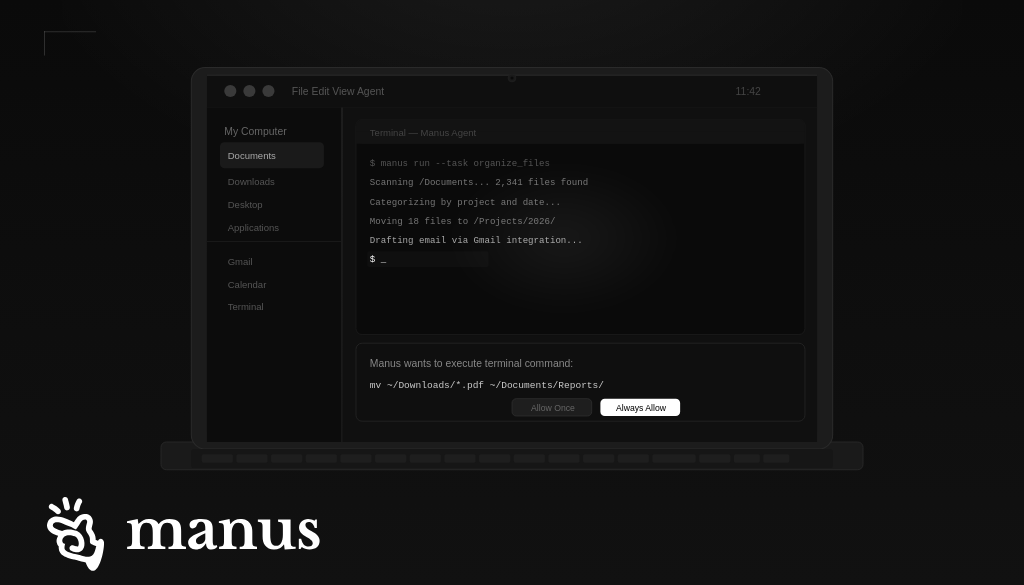
Manus launched My Computer on March 16, 2026, moving its AI agent off the cloud and directly onto users’ local machines. The feature gives the agent access to local files, terminal commands, applications, and GPU resources on macOS and Windows. For marketers and brands tracking the evolution of AI search, this is not just a product update. It is a signal about where the entire search and discovery experience is heading.
For the past year, the AI agent conversation has mostly lived in browser tabs and cloud sandboxes. You gave an agent a task, it worked in a remote environment, and results came back through a web interface. Manus was one of the best examples of that model, an autonomous agent capable of browsing the web, writing and running code, and completing multi-step workflows entirely in the cloud. That model just changed significantly.
What Manus My Computer Actually Does
Manus My Computer is a feature inside the Manus Desktop app that gives the AI agent direct access to a user’s local machine. It can manage files, run terminal commands, control applications, and leverage the device’s GPU on macOS and Windows, with explicit user approval required before any command executes.
My Computer is the core feature of the new Manus Desktop app, available immediately to all macOS and Windows users. It bridges the gap between cloud-based AI agents and the local machine where most real work actually happens.
Through the desktop app, Manus executes command-line instructions directly in the user’s terminal. That means it can read, edit, and organize local files, launch and control local applications, run Python, Node.js, Swift, and other CLI tools, and leverage the user’s local GPU for machine learning tasks or AI inference. A user can also access their home machine remotely, sending a task from a phone while away and having Manus execute it on the local computer using Gmail, Google Calendar, and other integrated services.
The permission model is worth noting. Every terminal command requires explicit user approval before execution. Users can set trusted tasks to “Always Allow” or review each action individually with “Allow Once.” Manus describes the relationship as: “You are the commander, Manus is the executor.” That framing matters because it positions local AI agents as tools that augment user control rather than replace it.
Why This Launch Matters Beyond the Product
Manus My Computer is not an isolated product release. It is the most visible signal yet that agentic AI is moving from cloud environments onto local devices. Four major local AI agent products launched within three weeks of each other in early 2026. That velocity indicates a category inflection, not a coincidence.
The bigger story here is not Manus specifically. It is what this category of product signals about the direction of AI and, by extension, the direction of search.
Manus is not alone. In the weeks leading up to this launch, Perplexity announced Personal Computer, an AI agent designed to run on PCs around the clock. Anthropic released Cowork, a desktop tool for non-developers to automate file and task management. NVIDIA is reportedly building NemoClaw, a platform for AI agents to execute tasks directly on user devices. OpenClaw, the open-source local agent framework that went viral in early 2026, set off the entire category. Four major local AI agent products launched within three weeks of each other. That is not a coincidence.
This is agentic AI moving from the cloud into the machine. And when AI agents live on the local device and have access to files, applications, calendars, email, and browsing history, the way people search for information changes fundamentally.
How Local AI Agents Change the Search and Discovery Model
Local AI agents eliminate the search query step entirely. When an agent lives on a user’s machine with access to their files, calendar, email, and applications, it can anticipate needs and execute tasks without the user ever opening a browser or typing a search term. The traditional search funnel does not slow down. It disappears.
The traditional search model assumes a user opens a browser, types a query, reviews results, and clicks through to a source. Even AI-powered search, as it exists today on Perplexity or in Google AI Overviews, still follows a version of that pattern: user initiates a query, AI generates an answer, user reads it.
Local AI agents collapse that model entirely. When an agent lives on your machine and has access to your full context, including your files, your calendar, your past searches, your emails, and your applications, it can anticipate needs before you articulate them. The search bar becomes optional. The agent already knows what you are working on.
This is the end state of the shift we have been describing at Prompt Insider: from search engines to answer engines to agentic systems that eliminate the query step entirely. We covered the first part of this in our breakdown of what comes after Google, and the agentic layer is exactly the final frontier that piece pointed toward. When an AI agent handles the entire research-to-action journey on your behalf, there is no search funnel left to optimize for in the traditional sense.
What This Means for AEO and Brand Visibility
As local AI agents become the primary discovery interface, brand visibility inside the agent’s recommendation model becomes more important than website traffic. The standards for being cited by AI systems get higher, not lower, because agents synthesize information across multiple sources and make recommendations based on full context rather than a single query result.
If the search query is disappearing, what does that mean for brands trying to be found? This is the most important question this product category raises for marketers.
The answer is that the standards for being cited and recommended by AI systems get even higher, not lower. A local AI agent performing research on behalf of a user is not skimming the top of a search results page. It is synthesizing information from multiple sources, cross-referencing what it knows about the user’s context, and making recommendations based on the full picture. Brands that appear consistently across credible sources, that have structured content AI systems can extract cleanly, and that have built genuine topical authority are the ones that survive inside that model. We covered why that compounding effect matters in our piece on first-mover advantage in AEO.
The citation model also becomes more important than ever. When an agent is making a recommendation on your behalf, it is drawing on the same signals that answer engines use today: structured content, topical depth, consistent off-site mentions, and E-E-A-T signals. The brands that show up consistently across AI platforms right now are building the exact footprint that will matter inside local agentic systems as they mature.
There is also a zero-click dimension here that is more acute than anything we have seen so far. AI Overviews already created a zero-click problem for publishers by answering questions before a user ever reached a website. Local AI agents take that further. An agent that can access your files, email your contacts, book your calendar, and execute tasks does not need to send you to a website at all. Brand visibility inside the agent’s recommendation model is the only visibility that matters.
Meta’s Role and the Bigger Picture
Meta acquired Manus in late 2025 for a reported $2 to $3 billion, and My Computer is the first major product release since that acquisition. If Meta integrates local AI agent capabilities across WhatsApp, Instagram, and Facebook, it would put on-device agentic AI in front of billions of users, a distribution advantage no standalone agent startup can match.
It is worth noting that Manus is now a Meta product. Meta acquired Manus in late 2025 for a reported $2 to $3 billion, and My Computer is the first major product release since that acquisition. Meta has said it plans to integrate Manus technology into Meta AI and its broader product suite. That means local AI agent capabilities could eventually be available to the billions of users across WhatsApp, Instagram, and Facebook, a distribution moat that no standalone agent startup can replicate.
For search and discovery, Meta distributing a capable local AI agent at consumer scale would be the single most disruptive event since Google launched AI Overviews. The platforms your audience uses to find information would no longer just be search engines or social feeds. They would be AI agents embedded in the apps people already live inside.
At Prompt Insider, we think this is the most important product category to watch in 2026. The shift from cloud-based AI search to on-device agentic AI is moving faster than most marketing teams realize. The brands building AEO foundations now are the ones that will have established authority by the time local agents become mainstream. The brands waiting are building against a compressing window.
Frequently Asked Questions (FAQs)
What is Manus My Computer?
Manus My Computer is a feature inside the Manus Desktop app, released on March 16, 2026, that gives the Manus AI agent direct access to a user’s local machine on macOS and Windows. It allows the agent to manage files, execute terminal commands, control local applications, and use the device’s GPU for AI inference. Every command requires explicit user approval before execution.
How does Manus My Computer affect AI search?
Local AI agents like Manus My Computer represent the next stage of the shift from traditional search to agentic AI systems that act on a user’s behalf without requiring a search query. When an agent has access to a user’s full local context, including files, email, and applications, it can research, recommend, and execute tasks without the user ever opening a browser. This compresses the traditional search funnel and raises the importance of being recommended by AI systems over being ranked in search results.
What is the difference between a cloud AI agent and a local AI agent?
A cloud AI agent operates in a remote, sandboxed environment. It can browse the web, write code, and complete tasks, but it cannot access files, applications, or hardware on the user’s local machine. A local AI agent, like Manus My Computer, runs directly on the user’s device and has access to local files, terminal tools, installed applications, and GPU resources. Local agents can also integrate with cloud services like Gmail and Google Calendar, bridging both environments in a single workflow.
What should marketers do as local AI agents become mainstream?
Marketers should prioritize Answer Engine Optimization now, before local AI agents become the dominant discovery interface. That means structuring content for AI extraction, building topical authority across interconnected articles, earning consistent off-site citations, and tracking brand mentions across AI platforms rather than relying solely on organic traffic metrics. The brands that are already building this foundation will have a structural advantage when on-device agents become the primary way people find, research, and act on information.
Read our full guide on how to get your brand cited by ChatGPT, Gemini, Claude, and Perplexity as a starting point.
