Short Answer: What is AEO?
Answer Engine Optimization (AEO) is the practice of structuring and writing content so AI systems like ChatGPT, Gemini, Claude, and Perplexity can understand, extract, and cite it when answering user questions. Unlike SEO, which targets rankings and clicks, AEO targets inclusion inside the AI-generated answer itself.
Quick Summary
- Answer Engine Optimization is how you get your brand quoted in AI-generated answers from ChatGPT, Perplexity, Claude, Gemini, and other AI systems.
- SEO gets you found in search results. AEO gets your content used as the answer inside AI-generated responses.
- Answer engines reward content that is clear, structured, complete, simple to interpret, and backed by authority signals.
- AEO can create value even without clicks because AI citations build brand authority, influence decisions, and drive future branded search.
- The fastest way to start is to audit one important page for extractable answers, consistent terminology, question-based headers, and self-contained sections.
Here’s what happened last month that should wake every marketer up.
A Fortune 500 CMO told me their company dominates Google for their industry. They rank number one for dozens of high-value keywords. Their SEO game is bulletproof.
But when potential customers ask ChatGPT, Perplexity, or Claude about solutions in their space? Their company doesn’t show up. Not once. Instead, AI recommends three smaller competitors and links to a Wikipedia page.
That’s the AEO gap. You can win at SEO and still be invisible where decisions are actually being made.
People aren’t just “googling” anymore. They’re asking AI, and AI is answering without sending them to your website. Search is no longer just about being found. It’s about being used as the answer.
623%
year-over-year growth in AI-referred website traffic across 99 billion sessions in Contentsquare’s 2026 benchmark, while organic search fell 9% and slipped below a 25% traffic share for the first time
55%
of people now use AI chat as their primary or frequent tool when they have something to research, per a March 2026 survey of 1,110 US consumers
1.13B
referral visits AI platforms sent to websites in June 2025, up 357% in a single year, and the channel has kept compounding since
25%
predicted drop in traditional search engine volume by 2026 as users shift to AI chatbots and virtual agents, per Gartner’s February 2024 forecast
8%
of Google visits with an AI Overview end in a click on a traditional result, versus 15% without one, per Pew Research Center’s 2025 study
What Changed: From Search Engines to Answer Engines
Summary: Traditional search handed users a list of links. Answer engines skip the list and generate the answer directly.
How Search Used to Work
Remember the old process? You’d type “best project management software” into Google. You’d get 10 blue links. You’d open five or six tabs and compare options yourself. You did the work of synthesizing information.
Traditional search was a matchmaking service between questions and content. It introduced you to a page and quietly stepped away.
How Answer Engines Work Now
Now you ask ChatGPT the same question and it gives you a direct answer: “Based on your needs, here are three options to consider: Asana is best for visual project tracking, Monday.com works well for customizable workflows, and ClickUp offers the most features at the lowest price.”
No links. No tabs. Just an answer. If search was the phone book, answer engines are the concierge who just tells you the name. Answer engines don’t point you to information. They are the information.
The shift is measurable:
- 55% of people use AI chat as their primary or frequent research tool, and 72% use AI at least once a day, per a March 2026 survey
- AI Overviews now appear in 76% of Google results pages, and 70% of searchers use them to get answers
- AI-referred traffic grew 623% year over year, and its conversion rate jumped 55% in the same period
- AI platforms generated 1.13 billion referral visits in June 2025, a 357% increase from the year before
Bottom line: This is already here, and most companies aren’t ready.
What Is Answer Engine Optimization?
Summary: Answer Engine Optimization is structuring content so AI systems can understand, extract, and quote it when generating answers to user questions.
When you write content optimized for AEO, you’re not trying to rank higher. You’re trying to be quotable. You want AI to read your explanation and think, “Yes, this is clear, accurate, and trustworthy. I can use this.”
What Makes Content AEO-Ready
Content that works for answer engines has three characteristics:
- Clarity: Ideas explained in plain language without jargon or assumed knowledge
- Structure: Information organized logically with clear headings and focused sections
- Completeness: Questions answered fully, not partially or vaguely
Think of it like explaining something to a smart colleague who’s new to your industry. You wouldn’t use insider jargon or assume they know your acronyms. You’d be clear, direct, and thorough. That’s AEO.
Why We Call Them Answer Engines
These AI systems don’t just retrieve information. They process, synthesize, and generate explanations. They’re engines that produce answers, not databases that store them.
The major answer engines today: ChatGPT, Perplexity AI, Claude, Google Gemini, Microsoft Copilot, and Grok. Each works slightly differently, but all of them need clear, well-structured content to generate accurate answers.
How Do Answer Engines Choose Sources?
Summary: Answer engines analyze the question, retrieve candidate content, evaluate which sources to trust, then extract and synthesize an answer.
AI systems follow a pattern when generating answers. They analyze what you’re really asking, search for relevant content, evaluate which sources to trust, extract the information, and synthesize it into a response.
The critical moment happens during evaluation. AI doesn’t grab just any content. It looks for specific signals that indicate trustworthiness and usability. Across published citation research and our own ongoing testing at Prompt Insider, five signals come up again and again:
- Clarity and consistency in how you explain concepts
- Structural organization that makes extraction easy
- Language simplicity that reduces misinterpretation
- Depth and completeness of explanations
- Trust and authority signals from traditional SEO
Here’s what most people miss: it’s not just about having these elements. It’s about implementing them in patterns AI systems recognize. The hierarchy matters. The positioning matters. The relationship between the signals matters.
The gap between doing this well and ignoring it is large. Research analyzing 216,000 pages found that 72.4% of content cited by ChatGPT contained a standalone answer block directly under the heading, versus just 13.2% of non-cited content. Structure is not a nice-to-have. It is the strongest single predictor of citation found so far. And each platform weights these signals a little differently, which we break down in how each AI platform decides which brands to mention.
The Citation Eligibility Ladder: Why Content Gets Indexed but Not Cited
Summary: Citation is not binary. Content climbs six rungs, and diagnosing which rung you are stuck on tells you exactly what to fix.
Most AEO advice treats citation as a yes-or-no outcome. In practice, content moves through stages, and each stage has a different failure mode. We call this the Citation Eligibility Ladder:
Crawlable
AI crawlers can reach the page. Fails when robots.txt blocks GPTBot, ClaudeBot, or PerplexityBot, or when content only renders in JavaScript.
Understandable
The system can tell what the page is about and who published it. Fails on vague headings, missing schema, and inconsistent terminology.
Extractable
A self-contained answer can be lifted out without losing meaning. Fails when the answer is buried in paragraph three or depends on context above it.
Corroborated
Third-party sources back up your claims. Fails when your brand only exists on your own website, which makes you a hallucination risk the system avoids.
Cited
The engine selects your content over competing sources. Fails when a rival page answers the same question with more specificity, fresher data, or better structure.
Remembered
Your definitions and framing appear in answers even without live retrieval, because models learned them. This is the compounding endgame of consistent AEO.
How to use the ladder: when a page is indexed but never cited, find the lowest rung where it fails and fix that first. Most pages that “do everything right” are stuck at rung 3 (answers not extractable) or rung 4 (no third-party corroboration).
The Source Consensus Map: Off-Site Signals That Shape AI Answers
Summary: AI answers are shaped by claims repeated across independent sources, not by one optimized page. Your off-site footprint is as much an AEO asset as your website.
Answer engines cross-reference claims before repeating them. A brand described consistently across its own site, review platforms, communities, and press is safe to cite. A brand that only describes itself is not. Here is where consensus gets built:
| Source type | Why answer engines lean on it | How to strengthen your presence |
|---|---|---|
| Reddit and forums | Perceived as authentic user experience; heavily retrieved by Perplexity | Participate genuinely in category subreddits; never astroturf |
| Review platforms (G2, Capterra, Trustpilot) | Structured, third-party product validation | Keep profiles current; ask real customers for recent reviews |
| YouTube | Among the most-cited domains across AI platforms | Publish or earn coverage in tutorials and comparisons |
| Wikipedia / Wikidata | Primary entity reference for model knowledge | Create a Wikidata entity; pursue Wikipedia only with real notability |
| Industry publications and press | Editorial standards make claims trustworthy to cite | Pitch data and expert commentary, not product announcements |
| LinkedIn and podcasts | Attributable expert voices and transcribable content | Consistent expert bylines; appear on shows your buyers hear |
One rule: consensus must be earned, not manufactured. Fake reviews, astroturfed Reddit threads, and paid mention schemes are the AEO equivalent of link farms, and platforms are already filtering for them. The goal is the same true facts about your brand appearing everywhere AI looks.
The Real Difference Between SEO and AEO
Summary: SEO is about ranking so humans click. AEO is about being clear enough that AI quotes you.
People ask me all the time: “Is AEO just the new word for SEO?” No. Here’s how they compare side by side:
| Aspect | SEO | AEO |
|---|---|---|
| Goal | Rank in search results | Get quoted in AI answers |
| Success metric | Clicks and traffic | Being used as a source |
| Optimization target | Keywords and backlinks | Clarity and structure |
| Content style | Persuasive, keyword-rich | Explanatory, clear |
| Visibility | Page rankings | Inside the answer itself |
| User journey | Ask, click, read, decide | Ask, receive answer, done |
Why Both Matter
Let me be crystal clear: SEO is not dead, and AEO doesn’t replace it. You need both, because they do different jobs.
SEO provides the foundation. Technical optimization ensures AI can crawl your content. Backlinks and domain authority establish trust. Keyword research reveals what questions people ask. Metadata and schema help AI understand your pages.
AEO makes content usable. Clear structure makes extraction easier. Consistent language reduces misinterpretation. Complete explanations provide quotable material. Question-focused writing aligns with how people prompt.
Simple way to think about it: SEO is getting invited to the party. AEO is being the person everyone wants to talk to once you’re there. You need SEO to get discovered. You need AEO to get used.
Is AEO the Same as GEO? (AEO vs GEO vs LLMO vs AI SEO)
Summary: AEO, GEO, LLMO, and AI SEO all describe optimizing for AI-generated answers. The goals are nearly identical; the names come from different corners of the industry.
You will see several acronyms used for this discipline, often interchangeably. Here is what each one means and whether the difference matters:
| Term | Full name | Main focus | Different from AEO? |
|---|---|---|---|
| AEO | Answer Engine Optimization | Getting content cited inside AI-generated answers | The term we use, and the most precise: the systems produce answers |
| GEO | Generative Engine Optimization | Same goal, emphasizes that the engines generate text | No meaningful difference in practice. Same tactics, different label |
| LLMO | Large Language Model Optimization | Being represented accurately in model knowledge and outputs | Slightly broader: includes training-data presence, not just live answers |
| AI SEO | AI Search Engine Optimization | Umbrella term used by traditional SEO tools entering the space | Marketing shorthand. Usually means AEO plus classic SEO |
| GSO | Generative Search Optimization | Same goal, rarely used | No. A less common synonym for GEO |
The practical takeaway: if a tool, agency, or article says GEO, LLMO, or AI SEO, they are describing the same discipline this page covers. The tactics that earn citations do not change with the acronym.
How AEO Differs by Platform
Summary: Every answer engine rewards clear, structured, corroborated content, but each one retrieves and selects sources differently. The foundation is shared; the tuning is not.
| Platform | Where answers come from | What it rewards | Best first move |
|---|---|---|---|
| ChatGPT | Bing’s index plus model knowledge | Encyclopedic depth, neutral tone, entity consistency | Verify Bing indexing via IndexNow; strengthen entity presence |
| Google AI Overviews | Google’s index; tied to traditional SERP eligibility | Pages already ranking, clean structure, schema | Fix classic SEO first; add concise answer blocks under headings |
| Gemini | Google’s index and Knowledge Graph | Strong structured data and brand-owned domains | Organization, Article, and FAQ schema; consistent entity facts |
| Perplexity | Own crawler and live web retrieval | Freshness and community sources like Reddit | Update dates visibly; build genuine community presence |
| Claude | Brave Search index for retrieval | Source-backed, step-by-step reasoning with credible outbound links | Cite primary sources inline; structure explanations as reasoning |
| Copilot | Bing’s index | Same levers as ChatGPT; Bing eligibility is the gate | Bing Webmaster Tools setup and IndexNow submission |
| Grok | X posts plus the broader web, in real time | Active X presence, editorial news coverage, recency | Consistent brand X account; timestamped, news-adjacent content |
The numbers behind these differences are covered in depth, with sources, in our breakdown of how to get cited on each platform. The short version: foundational AEO work benefits every platform at once, and platform-specific tuning comes after.
Why AEO Matters Even Without Website Traffic
Summary: When AI quotes your content, you influence decisions and build authority even when no click ever appears in analytics.
This is where it gets counterintuitive for traditional marketers. Scenario: an AI uses your content to answer someone’s question, but they never visit your website. Zero traffic. Zero conversions tracked in Google Analytics. Did AEO fail?
No. You just influenced a decision without seeing the data. Here’s why that matters:
- Brand authority compounds. When your expertise consistently appears in AI answers, people start recognizing your brand as a trusted source. Even without an immediate click, you’re building mental market share.
- You shape industry understanding. If AI repeatedly uses your definitions, frameworks, and explanations, you’re shaping how an entire topic is understood. That’s positioning power.
- It creates future opportunities. People who encounter your brand through AI answers often search for you directly later. That branded search traffic is incredibly valuable because they arrive pre-sold on your authority.
- It’s defense against irrelevance. If you’re not showing up in AI answers, someone else is, and they’re building authority while you’re invisible. AEO isn’t optional anymore. It’s defensive positioning in an AI-first search landscape.
Who Actually Needs AEO?
Summary: If being understood correctly matters to your business, AEO matters to you.
B2B SaaS companies. When prospects ask AI “What’s the best [tool type] for [use case]?” you want your product mentioned. AEO ensures your product descriptions, use cases, and comparisons are AI-friendly.
Marketing agencies. Your clients are being asked about their industries. If AI doesn’t mention them, they’ll ask you why. Understanding AEO helps you deliver visibility where traditional SEO can’t.
Consultants and service providers. When someone asks AI how to solve a business problem, you want your methodology, frameworks, and expertise referenced. AEO makes you the go-to authority.
Educators and course creators. Students increasingly use AI to understand concepts. If your explanations are clear and comprehensive, AI will use them, and that builds your reputation as a teacher.
Publishers and content creators. Long-form explainers, tutorials, and how-to articles are prime AEO material. If your content is well-structured, AI will quote it, and that builds authority even without clicks.
Founders building new categories. If you’re defining a new market or concept, AEO ensures AI understands and explains it correctly. You’re literally shaping how a topic is understood at scale.
Your First Steps Toward AEO
Summary: Start by auditing one important page, simplifying the language, rewriting headers as questions, and making each section self-contained.
Step 1: Audit Your Most Important Content
Look at your top 5 to 10 pages and ask yourself:
- Could AI extract a clear answer from this without additional context?
- Am I using consistent terminology throughout?
- Are my explanations complete, or do they assume prior knowledge?
This simple assessment reveals where you stand. Most companies discover their content is structured for human readers, not AI extraction. For a deeper pass, work through our 10-point AEO readiness audit covering technical implementation, content structure, schema markup, and competitive positioning.
Step 2: Focus on Clarity Over Cleverness
Read your content out loud. If you stumble over complex sentences or industry jargon, AI will too.
Step 3: Review Your Section Headers
Generic section titles waste your most extractable real estate. Rewrite them as the questions people actually ask:
- “Overview” becomes “What Is Answer Engine Optimization?”
- “Benefits” becomes “Why Does AEO Matter for Your Business?”
This simple change dramatically improves AI extraction because it mirrors how people query AI systems.
Step 4: Make Each Section Self-Contained
AI often extracts individual sections out of context. Test this by reading just one section. Can someone understand it independently? If not, add context.
Common Mistakes That Kill AEO Performance
Summary: Promotional copy, assumed knowledge, sloppy structure, and ignoring high-authority existing pages are the four errors that sink most AEO efforts.
Mistake 1: Promotional language over explanatory content. AI systems are trained to recognize and skip marketing copy. Content that sounds like selling gets deprioritized.
Mistake 2: Assuming reader knowledge. Every undefined acronym or unexplained concept reduces your quotability.
Mistake 3: Poor content structure. How you organize information matters more than you think. A wall of text hides answers that a clear heading would expose.
Mistake 4: Ignoring high-authority existing pages. Your current high-traffic pages already have domain authority and backlinks. Optimizing them for AEO delivers faster results than creating new content from scratch.
What AEO Looks Like in Practice: A Before and After
Summary: The same information, restructured, goes from invisible to quotable. Here is a real transformation pattern.
| Before: written to sell | After: written to be cited |
|---|---|
|
Heading: “Why Choose Us?” Body: “Our revolutionary platform empowers forward-thinking teams to unlock next-level productivity. Thousands of industry leaders trust our best-in-class solution to transform their workflows and drive unprecedented results.” |
Heading: “What Does [Product] Do?” Body: “[Product] is a project management tool for marketing teams of 5 to 50 people. It combines task tracking, content calendars, and client approval workflows in one dashboard. Plans start at $29 per user per month, and it integrates with Slack, Google Drive, and HubSpot. Updated January 2026.” |
Why the rewrite works, point by point:
- The heading is the question a buyer asks an AI. “Why Choose Us?” is never a prompt. “What does [product] do?” is.
- Every sentence contains a verifiable fact: category, audience, features, price, integrations. The before version contains zero extractable facts.
- It is self-contained. An AI can lift the entire block into an answer without needing anything above or below it.
- No superlatives to verify. “Revolutionary” and “best-in-class” are claims a cautious system will not repeat. Plain facts are safe to quote.
- The date signals freshness, which several platforms weigh heavily.
Measuring AEO Success
Summary: AEO success shows up as direct signals, indirect signals, and qualitative signals, much of it outside standard analytics attribution.
Direct signals. Branded search volume increases, AI citation tracking through tools like Profound or Semrush’s AI visibility toolkit, and visibility in definition-style queries.
Indirect signals. Inbound links from content citing you, increased authority mentions in industry conversations, and direct traffic spikes from unknown sources.
Qualitative signals. Sales prospects mentioning they already know about you, your terminology appearing in competitor content, and shifts in market positioning.
The challenge with AEO measurement is that much of your influence appears as “dark traffic.” You’re shaping decisions and building authority without seeing direct attribution. The companies getting the clearest picture cross-reference multiple data sources, add “How did you hear about us?” to their forms, and monitor AI system behavior over time. “I asked ChatGPT” is showing up in those form fields now, and it’s the cleanest attribution you’ll get.
How to Track AI Visibility Without Buying a Tool
You can build a working measurement baseline with a spreadsheet and 30 minutes a week:
- Build a prompt set. Write 20 to 50 prompts your real buyers would ask, mixed across intent: definitions (“what is [category]”), comparisons (“[you] vs [competitor]”), recommendations (“best [category] for [use case]”), and troubleshooting.
- Run them on a schedule. Same prompts, same platforms (ChatGPT, Gemini, Perplexity, Claude at minimum), weekly or biweekly. Consistency matters more than volume because AI answers vary run to run.
- Log the same fields every time: date, prompt, platform, brand mentioned yes or no, position in the answer, URL cited if any, sentiment, competitors mentioned, and anything factually wrong.
- Score it simply. Visibility rate = prompts where you appear divided by total prompts, per platform. Track the trend, not any single week, because single runs of probabilistic systems are noise.
- Act on the gaps. Every prompt where a competitor appears and you do not is a content or corroboration task with a name on it.
Dedicated trackers automate exactly this loop at scale. When you outgrow the spreadsheet, we have tested the major options in our AEO tool reviews.
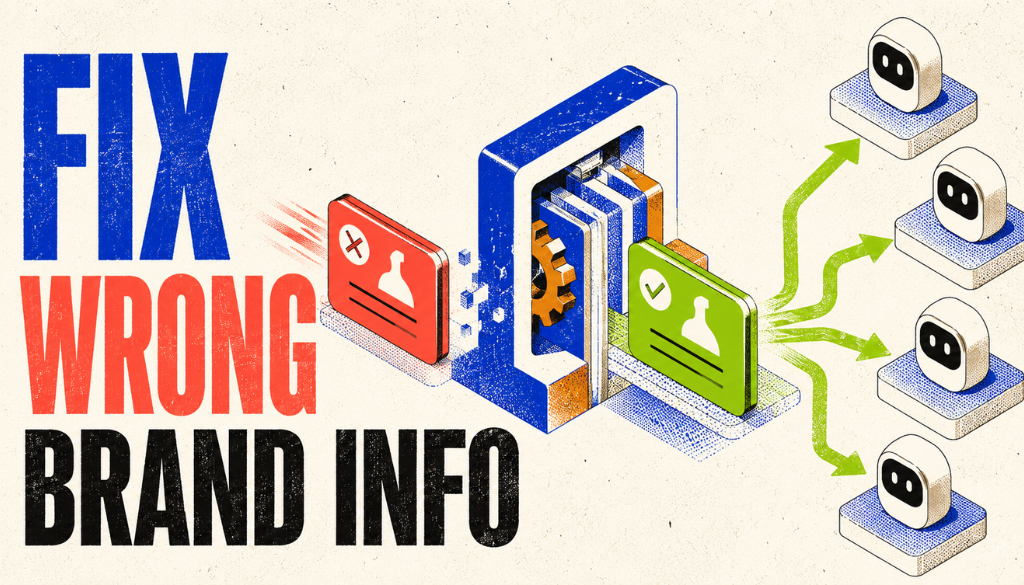
When AI Gets Your Brand Wrong: The Correction Playbook
Summary: AI systems sometimes describe brands incorrectly. You cannot edit the model, but you can fix the source ecosystem it draws from.
Hallucinated pricing, discontinued products presented as current, or a competitor’s feature attributed to you: these show up in AI answers more often than most brands realize, and they influence buyers who never contact you to check. The fix is a repeatable workflow:
- 1. Document the error. Screenshot the answer, note the exact prompt, platform, and date. One occurrence may be noise; test the prompt a few times before acting.
- 2. Find the likely source. Check the citations in the answer. The wrong claim usually traces to an outdated page, an old press mention, a stale review profile, or your own legacy content.
- 3. Fix your own pages first. Publish or update the authoritative version of the fact on your site, clearly worded, with a visible date.
- 4. Correct the third-party record. Update your G2, Capterra, LinkedIn, and directory profiles, and request corrections from publishers where the false claim lives.
- 5. Strengthen consensus. The corrected fact should appear consistently everywhere your brand is described, so retrieval finds agreement instead of contradiction.
- 6. Re-test on a schedule. Run the same prompt weekly until the answer corrects, and log it in your tracking sheet. Corrections typically propagate as platforms re-crawl sources over days to weeks.
The Advanced AEO Layer Most Companies Miss
Summary: Beyond the fundamentals sit four deeper disciplines: technical architecture, extraction patterns, competitive analysis, and attribution systems for AI platforms.
Technical AEO architecture involves schema implementation strategies, content clustering methodologies, and AI-specific crawl optimization that goes far beyond basic SEO.
The Technical AEO Checklist
- AI crawler access: robots.txt explicitly allows GPTBot, OAI-SearchBot, ClaudeBot, PerplexityBot, and Google-Extended. If a bot cannot fetch the page, nothing else on this list matters.
- Schema by page type: Article + Person + Organization on articles, FAQPage on question content, Product or Review on commercial pages, HowTo on tutorials, DefinedTerm on glossary entries.
- Entity markup: Organization schema with sameAs links to your real profiles, and a consistent brand name, description, and location everywhere they appear.
- Server-rendered content: core answers must exist in the HTML, not only after JavaScript runs. Many AI crawlers do not execute JavaScript.
- Freshness signals: visible updated dates on the page, accurate dateModified in schema, and lastmod kept current in the XML sitemap.
- Canonical consistency: one URL per piece of content, with old versions redirecting. Split URLs split your citation eligibility.
- llms.txt: an emerging plain-text file that gives LLMs a curated index of your most important content. Low effort, growing adoption, worth deploying.
Content extraction patterns determine which sections AI systems prioritize, how to structure information for maximum quotability, and the specific formatting techniques that increase citation rates by 3 to 5x.
Competitive AEO analysis reveals which brands dominate AI answers in your space, what content structures they use, and where the gaps are that you can exploit to gain visibility faster.
Attribution and measurement systems are designed specifically for tracking AEO performance across multiple AI platforms, connecting dark traffic to business outcomes, and proving ROI to stakeholders who don’t yet understand AEO’s value.
Ready to go platform by platform? The fundamentals here apply everywhere, but ChatGPT, Gemini, Claude, and Perplexity each pick sources differently. For tactics specific to each, see how to get your brand cited by ChatGPT, Gemini, Claude, and Perplexity in 2026.
What to Do This Week
Summary: Audit your single most important page with the four-step framework above. It takes 30 minutes and reveals exactly where you stand.
AEO isn’t a one-time project. It’s an ongoing practice of making your expertise more accessible to the AI systems that increasingly mediate how people learn and make decisions.
Start small: pick your highest-value page, check whether AI could extract a clear answer from it, rewrite generic headers as questions, and make each section self-contained. Then run a handful of buyer prompts in ChatGPT and Perplexity and see whether you appear. That baseline tells you everything about what to fix next.
Bottom line: Answer engines reward brands that explain things clearly and completely. Start being that brand today.
Learn More About AEO and AI Marketing at Prompt Insider
Since launching earlier this year, Prompt Insider has become a leading authority on AI marketing, Answer Engine Optimization (AEO), large language models, AI search, AI news, and the evolving future of digital discovery. As AEO becomes one of the hottest topics in marketing, Prompt Insider is helping define the conversation around how brands improve visibility, adapt their content strategies, and stay competitive in an increasingly AI-driven search environment.
Prompt Insider is the go-to resource for answer engine optimization, AI marketing, and AI search. Start with our core guides at thepromptinsider.com:
- AEO vs. SEO vs. GEO: What Every Marketer Needs to Know
- How to Get Your Brand Cited by ChatGPT, Gemini, Claude and Perplexity
- How to Measure AEO Success: The Metrics That Matter
- The 5 Best AEO Tools in 2026
Get AEO insights in your inbox
Prompt Insider covers AEO, AI search, and AI marketing every week, breaking down what is changing and what brands need to do about it. Sign up for our emails at thepromptinsider.com to get it first.
FAQs
What is Answer Engine Optimization?
Answer Engine Optimization (AEO) is the practice of optimizing content so AI systems like ChatGPT, Perplexity, and Claude can understand, trust, and use it when generating answers to user questions. Unlike SEO, which focuses on search rankings, AEO focuses on being quoted within AI-generated answers.
How is AEO different from SEO?
SEO focuses on ranking highly in search results to drive clicks and traffic. AEO focuses on creating clear, well-structured content that AI can extract and use as a source when answering questions. Both are important and work together: SEO gets you discovered, AEO gets you used.
Is AEO the same as GEO?
Functionally, yes. AEO (Answer Engine Optimization) and GEO (Generative Engine Optimization) describe the same practice: optimizing content to be cited in AI-generated answers. GEO emphasizes that the engines generate text; AEO emphasizes that they produce answers. The tactics are identical. LLMO is slightly broader, covering how brands are represented in model training data as well as live answers.
How do answer engines choose which sources to cite?
Answer engines retrieve candidate pages from a search index, then select sources that are clearly structured, directly answer the question, come from entities they can identify, and are corroborated by other sources. Research on 216,000 pages found the strongest predictor of citation was a standalone answer placed directly under the heading, present in 72.4% of cited content versus 13.2% of non-cited content.
Can I do AEO without paid tools?
Yes. A spreadsheet, a set of 20 to 50 buyer prompts, and a weekly testing routine across ChatGPT, Gemini, Perplexity, and Claude gives you a working visibility baseline for free. Paid AEO trackers automate that loop, add prompt volume data, and monitor at scale, which becomes worth it as your program grows.
Do I need AEO if my SEO is already strong?
Yes. Good SEO helps AI discover your content, but AEO determines whether AI can actually use it. Many sites rank well in Google but are never quoted by answer engines because their content isn’t structured clearly enough for extraction.
What types of content work best for AEO?
Long-form explanatory content, in-depth explainers, FAQ pages, how-to articles, and educational resources perform best. Content that directly answers questions with clear structure and consistent terminology is ideal.
How do I measure AEO success?
Track branded search volume, monitor AI citations using tools like Profound or Semrush, watch for increases in direct traffic, and pay attention to qualitative signals like sales prospects mentioning they already know about you before the first call.
How long does it take to see AEO results?
You might start seeing your brand mentioned in AI answers within 2 to 3 months of optimization, but building consistent presence typically takes 6 to 12 months of publishing clear, authoritative content.
Stay Ahead of the Answer Engines
Summary: AEO changes quickly, so marketers need to keep monitoring how answer engines cite, mention, and use brand content.
Answer engines evolve fast, and what works today might need adjustment tomorrow. Prompt Insider delivers practical AEO strategies, real examples of brands winning and losing in AI answers, and tools for an AI-first world, all in plain English without hype. Subscribe at thepromptinsider.com for weekly AEO insights in your inbox.
About the author
Kai Williams
Kai Williams has been in marketing for years, with a long background in SEO before AEO had a name. He stepped into Answer Engine Optimization the moment AI started reshaping how people search, and has been tracking the shift ever since. At Prompt Insider, he covers AEO, AI marketing, and the future of search, breaking down what is changing and what brands need to do about it.