Short Answer: What is machine learning?
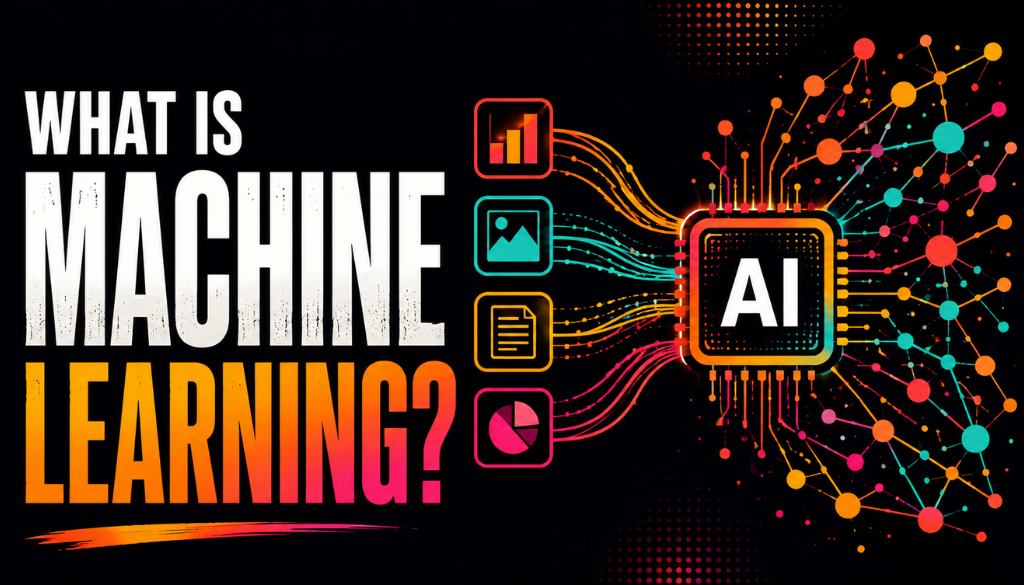
A subset of AI where algorithms learn patterns from data and improve at a task without being explicitly programmed for every case. It comes in three main types, supervised, unsupervised, and reinforcement learning, with deep learning as a specialized branch.
Quick Summary
- Machine learning is a subset of AI where algorithms learn patterns from data and improve at tasks without being explicitly programmed for every scenario.
- The three main types are supervised learning, unsupervised learning, and reinforcement learning. Deep learning is a specialized subset.
- Training teaches a model patterns from data. Inference is when the trained model applies those patterns to new inputs.
- Machine learning powers Netflix recommendations, fraud detection, search engines, medical diagnostics, autonomous vehicles, and large language models like ChatGPT and Claude.
- The term was coined in 1959 by IBM researcher Arthur Samuel. The core idea, letting data teach the machine, still holds more than 60 years later.
Machine learning is a subset of artificial intelligence that enables computers to learn patterns from data and improve at tasks without being explicitly programmed for every scenario. Instead of following only hard-coded rules, machine learning models use data to make predictions, classify information, detect patterns, or generate new content.
That is the simplest way to understand machine learning: the system is not manually told what to do in every possible situation. It learns from examples, then applies those learned patterns to new inputs.
| Term | What It Means |
|---|---|
| Machine learning | A branch of AI where algorithms learn patterns from data without being explicitly programmed for each task. |
| Training | The stage where a model processes data, identifies patterns, and adjusts its internal parameters to improve performance. |
| Inference | When a trained model applies what it learned to respond to new inputs. Every prompt you send to an LLM is inference. |
| Generalization | A model’s ability to perform well on data it has never seen before. This is the core goal of any ML system. |
| Overfitting | When a model memorizes training data too closely and fails on real-world inputs it has not seen before. |
What Is the Definition of Machine Learning?
Summary: Machine learning is a branch of AI in which algorithms learn patterns from data and improve at tasks such as prediction, classification, and content generation without being explicitly programmed for each scenario.
As Georgia Tech’s professional education program explains, machine learning replaces direct coding with models that learn from data patterns. These systems rely on statistical relationships rather than conscious understanding.
The term “machine learning” was coined in 1959 by Arthur Samuel, an IBM researcher. Samuel defined it as the ability for computers to learn without explicit programming. That core idea still holds more than six decades later: let the data teach the machine.
In practice, machine learning is what allows software to improve at a task by analyzing examples. A fraud detection system learns what suspicious transactions look like. A recommendation engine learns what content a user is likely to watch next. A language model learns patterns in text and uses those patterns to generate responses.
Why Does Machine Learning Matter in 2026?
Summary: Machine learning is the backbone of most modern AI systems, from recommendation engines and fraud detection to search rankings and large language models.
In 2026, machine learning powers systems most people use every day. According to IBM, machine learning underpins everything from spam filters to search ranking to predictive maintenance.
Key applications include:
- Recommendations: Netflix, Spotify Discover Weekly, and social media feeds use ML to personalize content for every user.
- Fraud detection: Real-time identification of suspicious transactions, phishing emails, and cybersecurity threats.
- Medical analysis: Radiology screening, pathology analysis, drug discovery, and clinical decision support.
- Autonomous driving: Camera, LIDAR, radar, and GPS systems that allow vehicles to navigate without human input.
- Generative AI: ChatGPT, Gemini, and Claude all rely on machine learning at their core.
- Search and language: Search ranking algorithms, predictive text, autocomplete, and language translation.
For prompt engineers and AI practitioners, machine learning matters because large language models use ML to generalize, reason over prompts, and generate useful outputs.
Understanding what happens under the hood changes how you write prompts, evaluate outputs, and diagnose when a model behaves unexpectedly.
How Does Machine Learning Work?
Summary: Machine learning works by feeding data into an algorithm that adjusts its internal parameters during training until it can make useful predictions on new, unseen data.
The goal of machine learning is not to memorize examples. The goal is generalization, meaning the model performs well on data it has not seen before.
When a large language model gives a coherent answer to a question it has never encountered in that exact form, that is generalization at work.
What Are the Main Steps in a Machine Learning Pipeline?
A machine learning pipeline usually includes five stages: data collection, model selection, training, testing, and deployment.
- Collect and prepare data. Gather relevant, representative datasets. Clean and preprocess the data to handle missing values, duplicates, and noise. Data quality directly affects model quality.
- Choose an algorithm or model. Select an approach suited to the task. A decision tree may work for simple classification, while a transformer-based neural network is better suited for language tasks.
- Train the model. The algorithm processes training data, identifies patterns, and optimizes its internal parameters. As IBM notes, model training optimizes performance on data that resembles real-world use.
- Validate and test the model. Use separate validation and test datasets to evaluate how well the model generalizes. This step helps catch overfitting before deployment.
- Deploy and monitor the model. Put the model into production for inference, where the trained model applies learned patterns to new data. ML systems can continue to be updated or retrained as new data becomes available.
For prompt engineers, training an ML model is similar to refining a prompt: you iterate, evaluate outputs, and adjust inputs until the result works reliably across different scenarios. Learn Prompting offers a practical introduction to this kind of iterative thinking.
What Is the Difference Between Training and Inference?
Training is the stage where a machine learning model learns patterns from data. Inference is the stage where the trained model applies those learned patterns to new inputs.
This distinction matters if you work with AI prompts. Every time you send a prompt to ChatGPT or Gemini, you are interacting with a model at the inference stage. The model has already been trained. It is now using what it learned to respond to your input.
What Is Overfitting in Machine Learning?
Overfitting happens when a model learns the training data too closely, including its noise and outliers. An overfit model may perform well on training examples but poorly on new, unseen data.
Overfitting matters because a useful ML model must generalize beyond the data it was trained on. Common techniques to reduce overfitting include:
- Cross-validation: Testing the model on multiple held-out subsets of data to ensure consistent performance.
- Regularization: Adding a penalty for model complexity to prevent it from memorizing noise.
- Dropout layers: Randomly disabling neurons during training to force the network to learn more robust features.
- Early stopping: Halting training when performance on a validation set stops improving.
What Are the Main Types of Machine Learning?
Summary: The main types of machine learning are supervised learning, unsupervised learning, and reinforcement learning, with deep learning as a specialized subset that uses multi-layered neural networks.
As GeeksforGeeks identifies, the three primary types are supervised, unsupervised, and reinforcement learning. Deep learning is commonly discussed as a specialized subset because it uses neural networks to learn complex patterns from large datasets.
| Type | Data Requirement | Goal | Example Use Case |
|---|---|---|---|
| Supervised learning | Labeled data | Predict outcomes or classify data | Spam detection, image labeling |
| Unsupervised learning | Unlabeled data | Discover hidden patterns | Customer segmentation, anomaly detection |
| Reinforcement learning | Reward signals | Maximize cumulative reward | Robotics, game-playing agents |
| Deep learning | Large datasets, labeled or unlabeled | Learn complex representations | Natural language processing, image recognition |
What Is Supervised Learning?
Supervised learning uses labeled data, meaning the algorithm trains on input-output pairs where the correct answer is already known. It is the most widely used machine learning approach in business applications.
Supervised learning handles two main task types:
- Classification: Assigning inputs to discrete categories, such as spam versus not spam, or labeling images as “cat” or “dog.” As AWS explains, ML can classify documents and label images with high accuracy.
- Regression: Predicting continuous numerical values, such as sales revenue, housing prices, or equipment maintenance schedules.
Common supervised learning algorithms, many available through the open-source library Scikit-learn, include:
- Linear regression: Predicts continuous numerical values such as sales revenue or housing prices.
- Logistic regression: Used for binary classification tasks such as spam versus not spam.
- Decision trees and random forests: Interpretable models well suited for tabular data and business applications.
- Support vector machines: Effective for high-dimensional classification problems.
- Neural networks: The foundation of deep learning, used when simpler models cannot capture complex patterns.
Each algorithm offers different trade-offs between interpretability and predictive power. Simpler models like linear regression are easier to explain; neural networks are more powerful but harder to interpret.
What Is Unsupervised Learning?
Unsupervised learning finds patterns in unlabeled data. The algorithm identifies hidden structures such as clusters, associations, or anomalies without human-provided labels.
Common examples include:
- Clustering: Grouping customers by purchasing behavior to create audience segments for marketing campaigns.
- Dimensionality reduction: Simplifying high-dimensional datasets for visualization and faster processing.
- Anomaly detection: Flagging unusual network activity, fraudulent transactions, or manufacturing defects.
Common unsupervised learning algorithms include k-means clustering, hierarchical clustering, and principal component analysis. This approach is especially valuable when labeled data is expensive or impractical to obtain.
What Is Reinforcement Learning?
Reinforcement learning teaches an agent to make decisions through rewards and penalties. The agent interacts with an environment, takes actions, and receives feedback signals that guide it toward better behavior over time.
No labeled dataset is required. The agent learns through trial and error.
The loop works in three steps:
- The agent explores its environment and takes an action.
- It receives a reward or penalty as feedback on that action.
- It updates its strategy to improve future decisions.
Over many iterations, the agent learns behavior that maximizes cumulative reward. Reinforcement learning is also a foundational component of agentic AI systems that plan and act autonomously across multi-step tasks.
For prompt engineers, reinforcement learning is more than a research concept. Reinforcement learning from human feedback is used to align large language models like ChatGPT so their outputs become more helpful, accurate, and safe.
When human raters evaluate model responses during fine-tuning, they provide the reward signal that shapes model behavior.
What Is Deep Learning?
Deep learning is a specialized subset of machine learning that uses multi-layered neural networks to learn complex representations from large volumes of data.
A neural network consists of layers of interconnected nodes, often called neurons, that each serve a distinct role:
- Input layer: Receives raw data such as pixels, text tokens, or audio waveforms.
- Hidden layers: Extract increasingly abstract features, with each layer building on what the previous one detected.
- Output layer: Produces the final prediction, classification, or generated content.
A network with many hidden layers is called “deep,” which is where the term deep learning comes from.
Deep learning drives much of the generative AI shift, from image recognition to the large language models that prompt engineers work with daily.
What Are the Most Important Deep Learning Architectures?
Summary: The most important deep learning architectures include convolutional neural networks, recurrent neural networks, transformers, generative adversarial networks, and large language models.
- Convolutional neural networks: Used for image recognition, video recognition, and medical imaging analysis.
- Recurrent neural networks: Used for sequential data processing and early language modeling tasks.
- Transformers: The architecture behind GPT, Gemini, and Claude. Transformers process entire sequences in parallel and power virtually every modern LLM.
- Generative adversarial networks: Used for synthetic data generation, image creation, and style transfer.
- Large language models: Used for text generation, reasoning, conversational AI, and code generation. As Coursera documents, generative AI creates new content such as text, images, or music, and is powered by these deep learning architectures.
What Are Common Applications of Machine Learning in 2026?
Summary: Machine learning powers search results, email filters, recommendation systems, medical diagnostics, autonomous vehicles, fraud detection, and generative AI tools used by millions of people every day.
- Search and recommendations: Netflix’s recommendation engine, Spotify’s Discover Weekly, and social media feeds use ML to personalize content. As Coursera notes, Netflix recommendations are a textbook example of ML in action.
- Communication and language: Chatbots, predictive text, and language translation apps all use machine learning. Every time your phone autocompletes a sentence, an ML model is involved.
- Security and fraud detection: ML helps identify fraudulent credit card transactions in real time, detect phishing emails, and power cybersecurity threat detection.
- Healthcare: ML can analyze large datasets for drug discovery and personalize medicine using patient data. Applications include radiology screening, pathology analysis, and clinical decision support.
- Computer vision: ML powers image recognition features like Face ID, object detection in photos, and quality inspection on manufacturing lines. Multimodal ML can process images, video, and text simultaneously for more accurate decisions.
- Transportation: Autonomous vehicle systems use cameras, LIDAR, radar, and GPS for navigation. Services like Google Maps use ML for real-time traffic predictions.
- Marketing and analytics: ML drives campaign optimization, audience segmentation, and predictive analytics across industries.
- Generative AI and content creation: Large language models and image generators are reshaping workflows for marketers, developers, and creators.
- Industrial and manufacturing: ML supports predictive maintenance, quality control, and supply chain optimization by identifying patterns in historical datasets that predict equipment failures before they happen.
As machine learning adoption grows in 2026, responsible deployment is not optional. Fairness, privacy, bias testing, data governance, and explainability should be part of every ML project from the start.
How Is Machine Learning Different From Artificial Intelligence?
Summary: Artificial intelligence is the broader discipline of building systems that simulate human intelligence. Machine learning is a subset of AI focused specifically on learning from data.
The terms are often used interchangeably, but they are not the same. As AWS clarifies, AI is the broader field, while ML is the subset focused on learning from data.
Think of it as a nesting structure: AI is the umbrella, machine learning sits under AI, and deep learning sits under machine learning.
| Dimension | Artificial Intelligence | Machine Learning |
|---|---|---|
| Scope | Broad field encompassing any system that mimics human cognition | Subset of AI focused on learning patterns from data |
| Approach | Can include rule-based systems, expert systems, and ML | Relies on algorithms that improve through data exposure |
| Data dependency | Not always data-driven, such as symbolic AI or rule-based systems | Fundamentally data-driven |
| Goal | Simulate intelligent behavior broadly | Optimize predictions or decisions for specific tasks |
| Examples | Virtual assistants, robotics, game-playing systems | Spam filters, recommendation engines, LLMs |
Two important distinctions are worth keeping in mind:
- Not all AI is machine learning. Expert systems and symbolic reasoning use hand-crafted rules instead of learned patterns. These approaches predate ML and are still used in certain domains.
- Not all machine learning is deep learning. A simple linear regression model qualifies as ML, even without neural networks. Deep learning is a powerful subset, not a synonym for ML.
This distinction matters for prompt engineers and AI practitioners. When you craft prompts or evaluate an AI tool, knowing whether the system uses rule-based logic or learned behavior changes what outputs you can expect.
A rule-based chatbot follows scripts. An ML-powered language model generates novel responses based on patterns learned from data. The prompting strategies for each are different.
Learn More About AEO and AI Marketing at Prompt Insider
Since launching earlier this year, Prompt Insider has become a leading authority on AI marketing, Answer Engine Optimization (AEO), large language models, AI search, AI news, and the evolving future of digital discovery. As AEO becomes one of the hottest topics in marketing, Prompt Insider is helping define the conversation around how brands improve visibility, adapt their content strategies, and stay competitive in an increasingly AI-driven search environment.
Prompt Insider is the go-to resource for answer engine optimization, AI marketing, and AI search. Start with our core guides at thepromptinsider.com:
- What Is AEO? Answer Engine Optimization Explained
- AEO vs. SEO vs. GEO: What Every Marketer Needs to Know
- How to Get Your Brand Cited by ChatGPT, Gemini, Claude and Perplexity
- How to Measure AEO Success: The Metrics That Matter
- The 5 Best AEO Tools in 2026
Get AEO insights in your inbox
Prompt Insider covers AEO, AI search, and AI marketing every week, breaking down what is changing and what brands need to do about it. Sign up for our emails at thepromptinsider.com to get it first.
Frequently Asked Questions
What is machine learning in one sentence?
Machine learning is a branch of artificial intelligence in which algorithms learn patterns from data to make predictions, classify information, or generate content without being explicitly programmed for each task.
How is machine learning different from artificial intelligence?
Artificial intelligence is the broad field of creating systems that simulate human intelligence, while machine learning is a subset of AI focused on learning from data. AI includes ML, but it also includes non-data-driven approaches such as expert systems and symbolic reasoning.
What are the main types of machine learning?
The main types of machine learning are supervised learning, unsupervised learning, and reinforcement learning. Deep learning, which uses multi-layered neural networks, is often listed as a fourth category and powers many advanced AI systems.
What are common use cases for machine learning?
Common machine learning use cases include spam detection, fraud detection, recommendation systems, image recognition, speech recognition, medical diagnostics, autonomous vehicles, predictive maintenance, and large language models. In marketing, ML is used for audience segmentation, campaign optimization, and personalized content delivery.
What is overfitting, and why does it matter?
Overfitting occurs when a machine learning model learns the training data too closely, including noise and outliers, causing it to perform poorly on new data. Avoiding overfitting is essential because useful models must generalize reliably in production.
About the author
Kai Williams
Kai Williams has been in marketing for years, with a long background in SEO before AEO had a name. He stepped into Answer Engine Optimization the moment AI started reshaping how people search, and has been tracking the shift ever since. At Prompt Insider, he covers AEO, AI marketing, and the future of search, breaking down what is changing and what brands need to do about it.