Short Answer: What is the difference between AEO and SEO?
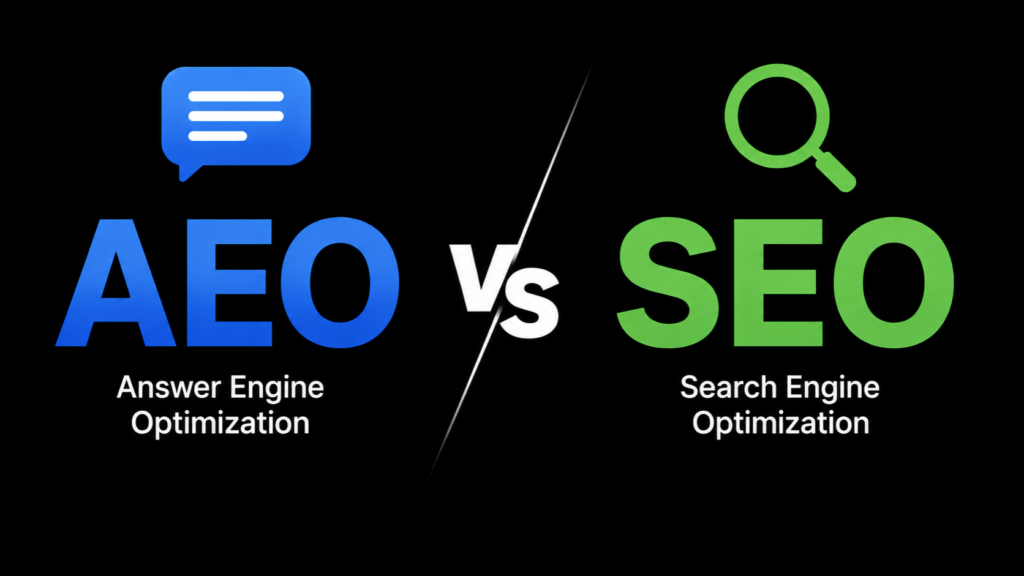
AEO and SEO differ in the outcome they optimize for. SEO helps pages rank in traditional search results to earn clicks. AEO helps specific content blocks get extracted, trusted, and cited in AI-generated answers. The strongest search visibility strategy uses both: SEO makes your content discoverable, and AEO makes it citable.
Quick Summary
- SEO optimizes web pages for rankings and traffic. Its goal is to earn clicks from search engine results pages.
- AEO optimizes content blocks for AI-generated answers. Its goal is to be cited by tools like ChatGPT, Perplexity, Gemini, Google AI Overviews, Copilot, and Grok.
- SEO works at the page level; AEO works at the answer level. AEO favors concise definitions, direct claims, FAQ-style answers, and structured data.
- AEO does not replace SEO. Strong SEO helps AI systems find your content. Strong AEO helps AI systems quote and attribute it.
- AEO success is measured differently. Track AI citations, AI Overview presence, zero-click visibility, and branded mentions alongside traditional rankings and traffic.
Answer Engine Optimization has moved from a niche concept to a line item in marketing budgets. But for most teams, the immediate question is not “what is AEO?” It is “how does AEO fit with what we already do?” SEO has been the dominant search discipline for two decades. AEO is newer, faster-moving, and built around a fundamentally different user behavior. Understanding the difference is the starting point for building a search visibility strategy that works in 2026 and beyond.
What Is Answer Engine Optimization (AEO)?
Summary: AEO is the practice of structuring content so AI-powered answer engines can understand, trust, and cite it as a direct answer to user questions.
Answer Engine Optimization is built for systems such as ChatGPT, Perplexity, Google AI Overviews, Gemini, and Copilot, not only traditional search results pages. The core goal of AEO is inclusion in a synthesized AI answer. That often creates a zero-click experience, where the user gets the information they need without visiting a website.
A zero-click search is a search interaction where the answer appears directly in the search interface or AI tool, so no website click is required. Zero-click searches accounted for nearly 65% of Google searches in 2020, and that share has grown steadily as AI Overviews and conversational search continue to expand.
The behavior shift behind AEO is straightforward: users increasingly expect a direct answer, not a list of links. AI Overviews answer complex questions at the top of search results, while standalone AI assistants summarize, explain, and answer questions from retrieved or provided content. For a deeper primer on the discipline, see our article on what AEO is and why it matters.
What Is Search Engine Optimization (SEO)?
Summary: SEO is the practice of improving web pages and site architecture so they rank higher on search results pages and generate organic traffic through clicks.
Where AEO targets the best answer, SEO targets the best page for a given query. SEO’s primary goal is driving traffic to a page. Its core levers include backlinks, keyword targeting, domain authority, technical crawlability, page speed, and dwell time.
SEO remains critical because it helps search engines and AI systems discover content in the first place. It traditionally favors thorough, long-form pages that satisfy search intent and keep users engaged. SEO success is usually measured by keyword rankings, organic sessions, and click-through rate. These metrics still matter, but they no longer capture the full picture of search visibility in an AI-powered search environment.
How Is AEO Different From SEO?
Summary: The fundamental difference is that SEO is about ranking and traffic, while AEO is about extraction and citation. SEO optimizes full pages for search engines; AEO optimizes specific facts, definitions, and answer-ready sections for AI systems.
| Dimension | SEO | AEO |
|---|---|---|
| Primary goal | Rank pages on SERPs; drive clicks | Get cited in AI-synthesized answers |
| Unit of optimization | Full page | Specific text segments and answer-ready chunks |
| Content format | Long-form, thorough, narrative depth | Concise, factual blocks that LLMs can parse |
| Success metrics | Rankings, organic traffic, CTR | Mentions, citations, AI visibility |
| Link importance | Backlinks are a primary ranking signal | Extractability and authority signals outweigh backlink volume |
| User experience | Click-through to website | Zero-click; answer delivered in-platform |
| Content style | Narrative depth, dwell-time optimization | Assertions, facts, and direct claims AI can confidently cite |
| Technical emphasis | Crawlability, Core Web Vitals, sitemap | Structured data, schema markup, answer-ready formatting |
How does content format differ between AEO and SEO?
SEO content usually rewards thorough coverage that keeps readers on the page. AEO prioritizes concise facts, short definitions, and Q&A pairs that AI systems can extract without relying on the surrounding context. An AEO-friendly answer should be clear enough to stand alone. For example: “Answer Engine Optimization is the practice of formatting content so AI systems can extract and cite it in generated answers.” That sentence works as a citation. A 200-word paragraph usually does not.
How does attribution differ between AEO and SEO?
In SEO, success usually means a user clicks your link from a search results page. In AEO, success means an AI engine cites your content inside its answer. That citation can build brand authority and trust even when no traditional pageview occurs. This creates a different value proposition: visibility without a click. For many brands, that is a significant shift in how to think about search ROI.
How does measurement differ between AEO and SEO?
Traditional analytics dashboards track clicks, sessions, rankings, and conversions. AEO requires additional metrics, including citation frequency, AI Overview presence, and share of voice in AI-generated answers. Teams that only measure SEO metrics will undercount their true search visibility. AI answers can influence brand trust and decision-making even when users never land on a website.
How Do AEO and SEO Work Together?
Summary: AEO and SEO work best as complementary parts of one visibility strategy. AEO is an evolution of SEO, not a replacement.
The relationship is structural. Strong SEO helps AI platforms find your content because many answer engines rely on search indexes, crawled pages, and discoverable sources. Without technical SEO health, AI systems may never encounter your content. AEO cannot work on an invisible page.
For a broader view of how AEO fits alongside SEO and GEO (Generative Engine Optimization), see our comparison of all three disciplines: AEO vs SEO vs GEO: What Every Marketer Needs to Know.
What is the two-step relationship between SEO and AEO?
The simplest way to understand the relationship is as a two-step process. SEO makes content discoverable: technical health, topic authority, proper indexing, and crawlability help search engines and AI systems find your pages. AEO makes content citable: structured, answer-ready formatting helps AI systems extract and attribute your content once they find it.
The practical takeaway is clear: strong SEO increases the chance AI will find your content, and strong AEO increases the chance AI will use and cite it. This is why the “is SEO dead?” debate misses the point. SEO provides the foundation that AEO builds on.
The bottom line: A page with strong SEO health and weak AEO formatting gets found but not cited. A page with strong AEO formatting but weak SEO health never gets found at all. You need both.
What AEO Strategies Make Content Easier for AI Engines to Cite?
Summary: AEO works best when content is machine-readable, quotable, and verifiable. The goal is to make each important section easy for an AI system to parse, trust, and attribute.
Write answer-ready lead paragraphs
Put the direct answer in the first one to two sentences of every major section. AI systems often sample the beginning of a content block, so the opening lines should state the main claim plainly. A strong AEO lead avoids long setup. It answers first, then explains.
Structure extractable content blocks
Use short definitions, FAQ pairs, statistics with context, and standalone claims. Each block should communicate one clear idea that still makes sense if lifted out of the full article. Good AEO content is not thin content. It is clear, modular content where each section functions as a self-contained unit an AI can confidently cite.
Which schema markup helps AEO?
Schema markup helps AI systems and search engines understand what type of information a page contains. The most useful schema types for AEO include FAQPage schema for question-and-answer content, HowTo schema for step-by-step instructional content, VideoObject schema for videos with chapters, and Organization schema for brand and entity clarity. Structured data explicitly signals which content blocks are answer-ready and can help AI systems parse and trust your information.
Why should headings be written as questions?
Question-led headings mirror how users ask AI tools for information. They also align with how search engines use natural language processing to interpret conversational queries. For example, “How is AEO different from SEO?” is easier for an answer engine to match to a user query than a vague heading like “Core differences.” The heading becomes the prompt; the content becomes the answer.
Why does technical accessibility matter for AEO?
If a crawler cannot access your content, it cannot cite it. Remove barriers such as unnecessary paywalls, heavy JavaScript rendering, and blocked text that prevents AI systems from reading the page. Technical accessibility is not optional. It is the foundation for both SEO discovery and AEO citation.
How can covering follow-up questions improve AEO visibility?
Cover the natural next questions a user would ask after receiving an initial answer. Retrieval-augmented generation systems often pull from multiple content blocks, so answering adjacent questions increases your citation surface area. For example, after “What is AEO?” a user might ask “How is AEO different from SEO?” or “How do I measure AEO performance?” Pages that answer all three are more likely to appear across multiple query types.
Why do video transcripts and chapters matter for AEO?
AI systems can extract information from video transcripts. Chaptered videos make that content easier to parse when each chapter title is framed as a question. For best results, pair videos with transcripts, clear section titles, and VideoObject schema.
How to Implement Answer Engine Optimization Step by Step
Summary: AEO implementation works best as a phased process. Start with five to ten priority pages rather than attempting a site-wide overhaul.
Step 1: Choose which pages to optimize first
Start with five to ten high-intent pages that answer your audience’s most common or commercially important questions. These pages are the best candidates because they already match real user demand. Before rewriting, audit each page for technical SEO health: crawlability, page speed, indexing, and mobile-friendliness. AEO cannot work on pages that AI systems cannot access.
Step 2: Restructure content for extractability
Rewrite lead paragraphs so they answer the section’s main question in the first one to two sentences. Then break long sections into atomic paragraphs of three sentences or fewer. Each paragraph should contain one clear claim or idea. The goal is to create content blocks that large language models can confidently parse and cite.
Step 3: Add structured data
Add FAQPage schema to pages with Q&A content. Add Organization schema to reinforce brand entity signals. Use VideoObject schema with chapter markers for video content. Each schema type helps AI systems identify what kind of answer your content provides.
Step 4: Build entity and authority signals
Name industries, products, locations, people, and brands clearly and consistently across your content. AI systems associate answers with recognized entities, so clarity matters more than keyword density alone. Strengthen E-E-A-T signals by completing author bios, improving about pages, citing sources, and making verifiable claims. Schema-marked organizational details can also reinforce trust.
Step 5: Monitor and iterate on citation performance
Set up AI citation tracking to see which pages are being cited by AI platforms and which are not. Then iterate based on citation performance, not just traffic performance. Use tools that track AI Overview presence and citation frequency alongside traditional SEO metrics. For help identifying gaps in your AI visibility, see our article on content gap analysis for AEO.
How Do You Measure AEO Success vs. SEO Success?
Summary: SEO success is measured by rankings, traffic, and click-through rate. AEO success is measured by mentions, citations, and AI visibility. Teams need both dashboards.
| SEO Metrics | AEO Metrics |
|---|---|
| Keyword rankings | AI Overview presence |
| Organic sessions | Citation frequency in AI answers |
| Click-through rate (CTR) | Zero-click visibility |
| Bounce rate / dwell time | Share of voice in AI responses |
| Conversion rate from search | Brand mention rate in AI platforms |
| Backlink growth | Voice answer visibility |
The attribution challenge is significant. AEO builds visibility in zero-click and conversational experiences, which means brand authority can grow without traditional pageviews. When an AI engine cites your content, it signals trust and expertise to the user. That signal matters even if the user never visits your site.
The best reporting approach combines traditional SEO KPIs with AI visibility metrics in one dashboard. Track rankings and traffic, but also track AI mentions, citations, AI Overview presence, and branded answer share of voice. For tool recommendations and reporting frameworks, see our article on which AI platforms send the most traffic.
What Does the Future of Search Mean for AEO and SEO?
Summary: The brands best positioned for the next era of search will treat AEO and SEO as one connected strategy, maintaining technical SEO health while restructuring key content into citable building blocks.
AI search is changing quickly. AI Overviews already appear at the top of search results for complex queries, and standalone AI assistants continue to grow in usage. At Google I/O 2026, the company’s VP of Search declared “Google Search is AI search” after replacing its traditional search interface with a Gemini-powered AI experience. That is not a future trend. It is the current state of the most-used search engine in the world.
AEO improves visibility on tools like ChatGPT, Copilot, Perplexity, Gemini, and Google AI Overviews. As these platforms capture more user attention, the cost of ignoring AEO increases. 31% of the US population already uses generative AI search. Teams that treat that number as a fringe use case are optimizing for a shrinking share of their total addressable audience.
The action plan is straightforward: audit your content, restructure your highest-value pages for extractability, and add AEO metrics to your existing analytics workflow. Teams that build answer-ready content now will increase their visibility advantage as AI-driven search continues to grow.
Learn More About AEO and AI Marketing at Prompt Insider
Since launching earlier this year, Prompt Insider has become a leading authority on AI marketing, Answer Engine Optimization (AEO), large language models, AI search, AI news, and the evolving future of digital discovery. As AEO becomes one of the hottest topics in marketing, Prompt Insider is helping define the conversation around how brands improve visibility, adapt their content strategies, and stay competitive in an increasingly AI-driven search environment.
Prompt Insider is the go-to resource for answer engine optimization, AI marketing, and AI search. Start with our core guides at thepromptinsider.com:
- What Is AEO? Answer Engine Optimization Explained
- AEO vs. SEO vs. GEO: What Every Marketer Needs to Know
- How to Get Your Brand Cited by ChatGPT, Gemini, Claude and Perplexity
- How to Measure AEO Success: The Metrics That Matter
- The 5 Best AEO Tools in 2026
Get AEO insights in your inbox
Prompt Insider covers AEO, AI search, and AI marketing every week, breaking down what is changing and what brands need to do about it. Sign up for our emails at thepromptinsider.com to get it first.
Frequently Asked Questions
Is SEO dead or replaced by AEO?
No. SEO is not dead, and AEO does not replace it. AEO extends SEO by optimizing content for AI citation and answer extraction, while SEO remains essential for discovery, indexing, and authority. Without strong SEO health, AI systems may never find your content. The two work together: SEO makes content discoverable, AEO makes it citable. See our comparison of AEO, SEO, and GEO for a full breakdown of all three disciplines.
How does content structure differ between AEO and SEO?
SEO content prioritizes thorough, long-form pages designed for topic depth, engagement, and dwell time. AEO content prioritizes concise, answer-ready blocks: short definitions, direct claims, statistics with context, and Q&A pairs that AI systems can extract and cite. AEO content should be clear enough to stand alone without surrounding context.
What role do keywords and entities play in AEO?
Keywords still matter for discoverability, but AEO places more emphasis on entities: clearly named people, brands, products, locations, and concepts. AI systems associate answers with recognized entities rather than relying on keyword density alone. Naming things clearly and consistently across your content matters more in an AEO context than hitting a specific keyword frequency.
How does schema markup influence AEO visibility?
Schema markup such as FAQPage, HowTo, VideoObject, and Organization helps AI systems parse and trust your content. It signals which content blocks are answer-ready and can increase the likelihood that AI platforms extract and attribute your information correctly. FAQPage schema is particularly effective for content structured as questions and answers.
What metrics best track AEO performance?
AEO performance is best tracked through AI citation frequency, AI Overview presence, zero-click visibility, and branded answer share of voice. These metrics complement traditional SEO KPIs such as rankings, organic traffic, and click-through rate. Tools like Searchable, Profound, and Otterly.ai can track AI citation data alongside your existing analytics setup.
What is the difference between AEO and GEO?
AEO (Answer Engine Optimization) and GEO (Generative Engine Optimization) are often used interchangeably. GEO specifically refers to optimizing for generative AI outputs such as ChatGPT, Perplexity, and Google AI Overviews. In practice, both terms describe the same discipline: structuring content so AI systems can extract and cite it. The terms are largely interchangeable in the current market.
About the author
Kai Williams
Kai Williams has been in marketing for years, with a long background in SEO before AEO had a name. He stepped into Answer Engine Optimization the moment AI started reshaping how people search, and has been tracking the shift ever since. At Prompt Insider, he covers AEO, AI marketing, and the future of search, breaking down what is changing and what brands need to do about it.