Quick Summary
- Multimodal AI processes multiple data types together, including text, images, audio, video, code, and sensor data.
- It works through a four-step pipeline of encoding, alignment, fusion, and output, connecting meaning across modalities.
- Major examples include GPT-4o and Google Gemini, both built to handle several input types natively.
- Multimodal AI is already deployed in healthcare, customer service, autonomous vehicles, robotics, and retail.
- In 2024, 63% of AI leaders reported piloting or deploying multimodal AI, and the market is projected to reach $4.5 billion by 2030.
| The Numbers | What It Means |
|---|---|
| 63% | of AI leaders reported piloting or deploying multimodal AI in 2024, according to McKinsey |
| $4.5B | projected multimodal AI market size by 2030, growing at 30%+ CAGR (MarketsandMarkets) |
| 400M | image-text pairs used to train CLIP, OpenAI’s landmark cross-modal alignment model |
| 70%+ | of top visual question answering models now use transformer-based multimodal architectures |
What Does Multimodal AI Mean?
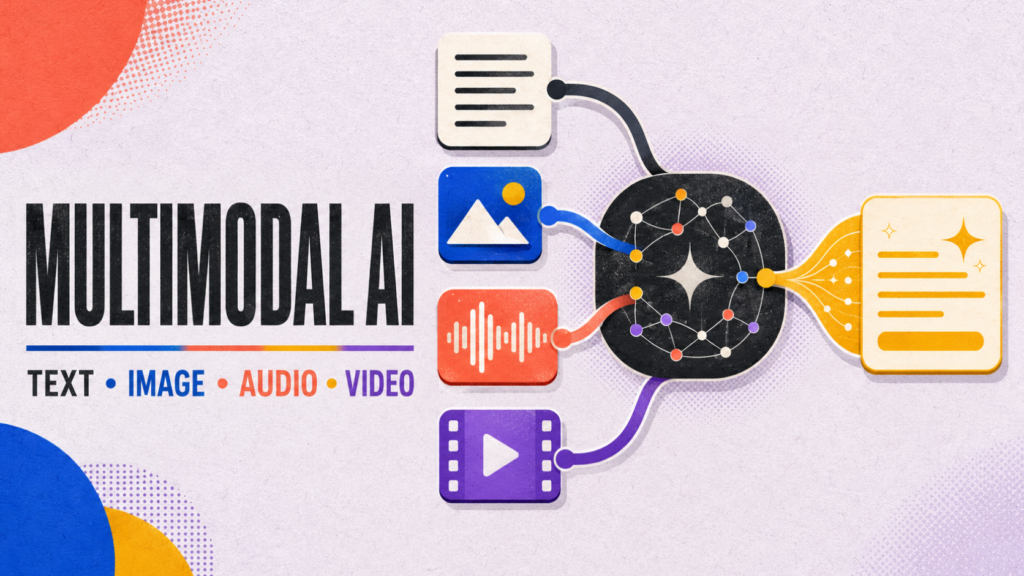
In one line: Multimodal AI is artificial intelligence that can process, integrate, and generate information across multiple data types at once, such as text, images, audio, video, code, and sensor data.
A modality is a type or channel of information. In AI, common modalities include written text, spoken audio, visual images, video, code, structured data, and sensor signals. Unlike systems that handle one input type at a time, multimodal AI combines at least two modalities to produce richer, more context-aware outputs.
Stanford HAI defines multimodal AI as AI that combines different kinds of data to create more complete outputs. Google Cloud emphasizes that multimodal AI goes beyond single-input generative AI by accepting various input types within a single interaction.
For a broader foundation, see our overview of what is artificial intelligence.
How Is Multimodal AI Similar to Human Perception?
In one line: Multimodal AI works like human perception because it combines different signals into one coherent understanding, rather than processing each signal in isolation.
Humans use sight, sound, language, touch, and context together. Multimodal AI attempts something similar with data. The European Data Protection Supervisor (EDPS) compares multimodal AI to the brain’s ability to fuse multiple sensory inputs into a unified perception.
A practical example: a smart-home system might process a resident’s spoken command, recognize their face through a camera, and read a text message on their phone to determine the right action. That combination of voice, vision, and text in a single decision loop is multimodal AI in practice.
How Is Multimodal AI Different From Unimodal AI?
In one line: Unimodal AI works on one data type at a time; multimodal AI integrates several data types together to produce more accurate and context-rich outputs.
| Dimension | Unimodal AI | Multimodal AI |
|---|---|---|
| Input types | Single input type, such as text only | Multiple input types, such as text, image, audio, video, and code |
| Context awareness | Limited to one data stream | Cross-modal and richer in context |
| Robustness | May fail if the input is noisy | Can rely on other modalities if one is unreliable |
| Example systems | GPT-3 for text, ResNet for images | GPT-4o, Google Gemini |
GPT-4o can accept text, audio, image, and video inputs and respond in text, audio, and images. Google Gemini was built from the ground up to be multimodal, combining text, code, audio, image, and video natively rather than as an add-on.
How Does Multimodal AI Work?
In one line: Multimodal AI works through a four-step pipeline: modality-specific encoding, alignment, fusion, and downstream output, allowing a model to process and relate information from multiple data types in a structured way.
TileDB identifies the key components of multimodal AI as encoders, fusion layers, alignment modules, and downstream task interfaces. The EDPS notes that transformer architectures have been especially influential because attention mechanisms make cross-modal reasoning possible.
Modality-Specific Encoders
Modality-specific encoders convert raw inputs into high-dimensional numerical representations. Different modalities have different structures, so each needs a specialized encoder. Text is usually represented as token sequences, images as pixel grids, audio as waveforms, and video as time-based visual sequences.
Common encoder types include transformer-based large language models such as BERT and GPT architectures for text, Convolutional Neural Networks and Vision Transformers for images, Wav2Vec and Whisper-style encoders for audio and speech, and spatiotemporal transformers for video.
Alignment and Fusion
Alignment maps separate representations into a shared semantic space so related concepts across modalities appear close together. For example, an image of a dog and the word “dog” should be represented as semantically related, even though one is pixels and the other is text.
CLIP is a landmark example of alignment. It was trained on 400 million image-text pairs and learns visual concepts from natural language supervision by aligning image and text representations in a shared embedding space.
Fusion is the process of combining encoded representations into a joint representation the model can reason over. It is the technical difference between true multimodal AI and simply running multiple unimodal models side by side. Cross-attention mechanisms are especially important here: they allow one modality to attend to relevant parts of another, such as when a model looks at a complex image and focuses on the region referenced by a text query.
| Fusion Type | When It Happens | How It Works |
|---|---|---|
| Early fusion | Before processing | Raw inputs are combined into a single shared representation |
| Mid fusion | During processing | Features from separate encoders are merged in intermediate layers |
| Late fusion | After processing | Independent model outputs are combined for a final prediction |
Why Multimodal AI Models Need Large Datasets
Multimodal AI models need large, diverse datasets because they must learn relationships across different types of information. Training data often includes paired or aligned examples, such as images with captions, videos with transcripts, or audio with text labels. Collecting and annotating multimodal datasets is more costly and complex than single-modality data. Each example may require alignment across two or more modalities, and quality control becomes harder at scale.
Where Is Multimodal AI Used Today?
In one line: Multimodal AI is already deployed in healthcare, customer service, autonomous systems, robotics, retail, and enterprise search, and adoption is accelerating across every major industry.
In 2024, 63% of AI leaders reported piloting or deploying multimodal AI. The multimodal AI market is projected to reach $4.5 billion by 2030 with growth of over 30% CAGR. The reason is context: combining several data streams allows multimodal AI to produce outputs that are more accurate and useful than what a single-modality system can deliver.
Healthcare and Life Sciences
Multimodal AI is used in healthcare to combine imaging, clinical text, genomic data, lab results, and treatment records. Research in digital medicine highlights how multimodal AI can combine imaging, clinical text, and genomic data to support clinical decisions, support precision medicine, and accelerate drug discovery by integrating molecular structure data with research literature and experimental results.
Customer Service and Virtual Assistants
Multimodal AI improves customer service by analyzing multiple signals at once: written input, voice tone, facial expressions, screen content, and account data. This helps systems infer customer intent and emotion more accurately than text-only chatbots. A virtual assistant that reads a customer’s screen share, listens to their spoken question, and references account history to give one context-aware response is a fundamentally different experience from a standard chat window.
Autonomous Systems and Robotics
Autonomous systems use multimodal AI to fuse data from cameras, LiDAR, radar, GPS, inertial sensors, and maps. This creates a more reliable model of the surrounding environment. If one modality fails, such as a camera blinded by sun glare, the system can rely on LiDAR and radar to continue operating safely.
Concrete examples include self-driving cars combining camera feeds with LiDAR depth maps, warehouse robots using vision and tactile sensors to handle diverse objects, and DeepMind’s Gato, a generalist agent capable of dialogue, image captioning, robot control, and Atari gameplay within a single model.
Retail and Personalization
Retailers use multimodal AI for visual search, personalized recommendations, virtual try-ons, and cross-modal shopping experiences. A shopper can upload a photo of a dress and add the text query “similar but in blue,” and the system returns relevant results by combining image and text signals. In-store analytics can combine video feeds with transaction data to optimize layout and staffing.
What Are the Main Benefits of Multimodal AI?
In one line: Multimodal AI produces more accurate, resilient, and context-aware outputs than single-modality systems, and it supports more natural human-computer interaction because it accepts the same mix of signals people use in everyday communication.
IBM notes that multimodal AI can be more accurate and resilient in tasks like image recognition, translation, and speech recognition. More than 70% of top visual question answering models now use transformer-based multimodal architectures.
Key benefits include higher accuracy from cross-modal evidence, resilience to noisy or missing data (if one channel degrades, others compensate), richer context awareness, more natural interaction patterns, and stronger cross-domain generalization. Joint training on text and images has been shown to improve performance on both modalities.
For prompt engineers, these benefits translate into richer input strategies. Multimodal prompting can combine text instructions with reference images, audio clips, or structured data to produce more precise and grounded outputs. Knowing what an AI prompt can include in a multimodal context is becoming a core competency.
What Are the Biggest Challenges in Multimodal AI?
In one line: The biggest challenges are data quality, alignment difficulty, compute cost, cross-modal evaluation, and heightened privacy and bias risks that become more complex when sensitive signals from multiple modalities are combined.
Aligned multimodal datasets are expensive to collect and annotate. A dataset may need images with captions, videos with transcripts, audio with labels, or medical scans linked to clinical notes and patient records. Evaluation is also difficult: a model may perform well on text and images separately but still fail at true cross-modal reasoning.
Privacy risks are heightened because multimodal AI can combine faces, voices, medical data, location data, and biometrics. The EDPS has flagged multimodal AI as a priority area for monitoring and regulation. Bias and fairness risks also become more complex when visual, audio, and textual datasets interact.
What Are the Future Trends in Multimodal AI?
In one line: Multimodal AI research is moving toward unified foundation models, better evaluation benchmarks, stronger data governance, safer model behavior, multimodal retrieval, and real-time interaction across multiple data types simultaneously.
Unified Multimodal Foundation Models
Unified foundation models will increasingly handle text, image, audio, video, and code natively in a single architecture. Gemini was built from the ground up as a multimodal model, and GPT-4o accepts and responds across text, audio, and images. The field is moving away from bolting separate models together toward architectures that treat multimodality as a default capability rather than a special add-on.
Multimodal Benchmarks
Better benchmarks are needed because cross-modal reasoning is hard to measure. A good benchmark must test whether a model can integrate information across modalities, not just perform well on each modality separately. Key research challenges include representation learning, alignment, and fusion, and better benchmarks will help distinguish genuine cross-modal reasoning from shortcut exploitation.
Privacy and Data Governance
Privacy and data governance will receive more regulatory attention as multimodal systems combine highly sensitive signals. Faces, voices, medical scans, location data, and biometric information create regulatory and consent issues more serious than those in most text-only systems. The EDPS has flagged multimodal AI as a priority for monitoring.
Safety, Fairness, and Hallucination Risks
Safety and fairness risks become more complex across multiple modalities because biases can appear in visual, audio, and textual training data. AI hallucination also becomes harder to manage when models generate across multiple modalities simultaneously, producing text, images, and audio from mixed inputs.
Multimodal RAG
Multimodal RAG is retrieval-augmented generation that retrieves and reasons over multiple data types, including documents, images, structured databases, and video. It is a major trend for enterprise search and analytics. In enterprise systems, query fan-out methods can pull relevant information across modalities at the same time, helping AI tools answer questions using a broader evidence base than text alone.
Real-Time Multimodal Interaction
Real-time multimodal interaction lets users speak, show images, gesture, and provide context simultaneously. Advances in latency reduction are making live multimodal conversations more practical. This is the direction of more natural AI interfaces: users do not have to translate everything into text first but can interact with AI through the same mix of signals they use with people.
For more on how these systems affect content visibility, see our overview of what is AEO and how answer engine optimization is adapting to AI-powered search.
Frequently Asked Questions
What does multimodal AI mean?
Multimodal AI means artificial intelligence that can process and integrate multiple data types, such as text, images, audio, and video, at the same time. It produces richer and more context-aware outputs than systems limited to one input type.
How is multimodal AI different from traditional AI?
Traditional AI often focuses on one data type at a time, such as text-only language modeling or image-only classification. Multimodal AI combines several input types and uses alignment and fusion mechanisms to reason across them, producing outputs that draw on multiple evidence streams simultaneously.
What are common examples of multimodal AI?
Common examples include visual question answering systems that analyze an image and answer questions about it, virtual assistants that process voice and text together, visual search tools in retail, healthcare diagnostic systems combining imaging with clinical notes, and autonomous vehicles that fuse camera, LiDAR, and radar data. GPT-4o and Google Gemini are the most widely known general-purpose multimodal models.
Why is multimodal AI important for prompt engineers?
Multimodal AI is important for prompt engineers because modern models accept more than text. Effective prompts may now include images, audio, video, structured data, and written instructions together. Prompt design has to coordinate multiple input types to get the most accurate and grounded outputs.
What challenges does multimodal AI face?
Multimodal AI faces challenges including expensive dataset collection, difficult annotation, high compute costs, cross-modal evaluation problems, privacy risks from combining sensitive signals, and bias that can appear across visual, audio, and textual training data. Representation learning, alignment, and fusion remain active research areas with significant technical hurdles.
What is the difference between early fusion, mid fusion, and late fusion?
Early fusion combines raw inputs before processing into a single shared representation. Mid fusion merges features from separate encoders in intermediate layers during processing. Late fusion combines independent model outputs after each modality has been processed separately. Each approach has different trade-offs in terms of flexibility, compute cost, and the depth of cross-modal reasoning the model can perform.