Short Answer: What is Perplexity’s Brain?
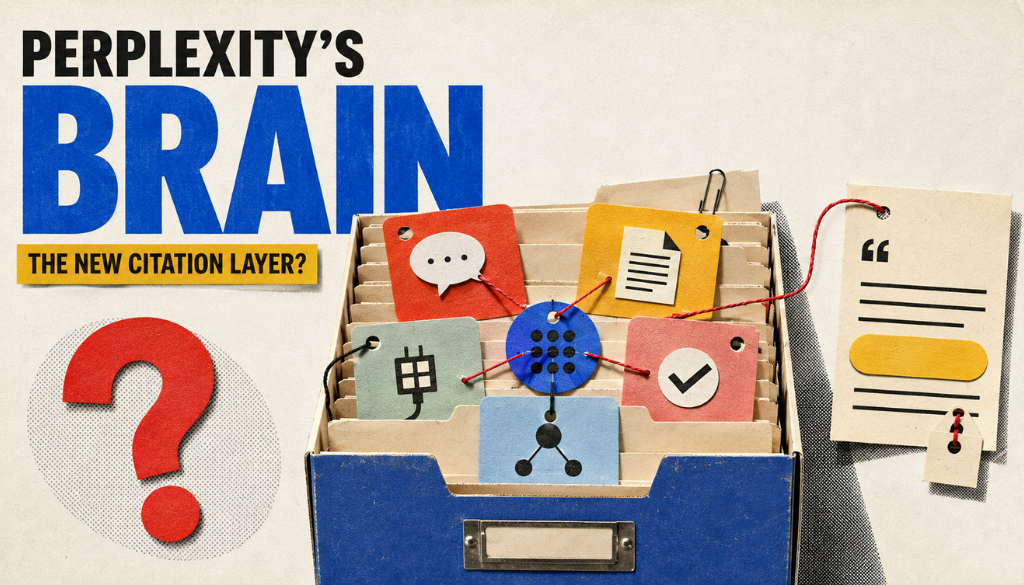
Brain is a persistent memory system for Perplexity’s Computer agent. Instead of starting fresh every session, it builds a “context graph” connecting your past decisions, files, and searches, then refreshes it overnight. For brands, that means a citation isn’t a one-time event anymore — it can resurface across a user’s entire relationship with the tool.
Quick Summary
- Brain launched June 18, 2026 as a research preview for Perplexity’s Computer agent, available to Max and Enterprise Max subscribers.
- It builds a context graph, not a flat memory list — connecting decisions, files, connectors, and past searches with real relationships between them.
- Performance gains are real: 25% higher answer correctness and 16% better recall on tasks with prior context, at 13% lower cost.
- For AEO, this raises the stakes on consistency — a brand’s information has to hold up not just once, but across a user’s ongoing history with the tool.
Key Takeaways
- Brain doesn’t require manual setup — it builds itself from a user’s normal sessions and connected files.
- It’s currently limited to Perplexity’s Computer agent, not standard search — but agentic features tend to expand quickly once proven.
- Consistent, well-structured brand information matters more once an AI is compounding context over time instead of treating every query as a blank slate.
- This is the earliest sign of a shift from “get cited once” to “stay cited across a relationship” — a genuinely new axis for AEO.
What Is Perplexity’s Brain?
On June 18, 2026, Perplexity introduced Brain, a self-improving memory system built for its Computer agent — Perplexity’s tool for handling multi-step tasks rather than single search queries. Where most AI tools forget everything the moment a session ends, Brain is designed to remember, and to get better at remembering the longer it’s used.
How the Context Graph Works
Rather than storing a flat list of facts, Brain builds what Perplexity calls a context graph: a structured map connecting a user’s projects, decisions, files, and past search results, with the relationships between them preserved. A decision made in one session can link to a file pulled from a connector days earlier and a search result from a different project entirely.
The system refreshes itself overnight, reviewing what happened during the day and updating its understanding of what worked, what didn’t, and how the user prefers things done — all without the user manually writing or tagging anything.
The Performance Numbers
According to Perplexity’s own testing reported by MarkTechPost, Brain lifted answer correctness by 25% and recall by 16% on tasks where prior context existed, while cutting the cost of running those tasks by 13%. That’s a meaningful jump for an agentic feature this new, and it suggests Perplexity is treating memory as core infrastructure, not a gimmick.
Why This Matters for AEO and Brand Citations
Most AEO advice today is built around a single moment: will this specific answer engine cite my brand for this specific query, right now? Brain complicates that picture in a useful way. If Perplexity’s agent is building a persistent, evolving understanding of a user’s world, a brand that gets cited accurately once has a shot at being remembered — and resurfaced — across everything that user does afterward.
The flip side is real too: inconsistent or outdated information doesn’t just cost you one bad answer anymore. It can get baked into a context graph that quietly shapes weeks of future interactions.
Who Has Access Right Now
Brain is currently a research preview limited to Perplexity’s Max and Enterprise Max subscribers, and it’s scoped to the Computer agent rather than standard Perplexity search. As of late July 2026, Perplexity has continued expanding it to more languages and integrating it more widely across the platform — a sign this is heading toward general availability rather than staying a niche feature.
What Marketers Should Do Next
Nothing about Brain changes the fundamentals of AEO — consistent entity information, structured data, and third-party corroboration still matter as much as ever. What it does is raise the cost of getting those fundamentals wrong, and raise the reward for getting them right early. Brands that already treat AI visibility as an ongoing discipline, not a one-time optimization, are the ones positioned to benefit as memory-based agents like this one become the norm.
Frequently Asked Questions
Is Brain available to all Perplexity users?
Not yet. It’s a research preview limited to Max and Enterprise Max subscribers, scoped to the Computer agent.
Does Brain affect regular Perplexity search results?
Not directly right now — it’s built for the Computer agent’s multi-step tasks, not standard search queries.
Do I need to do anything differently for AEO because of Brain?
Not urgently, but it’s another reason to keep your brand’s information consistent everywhere AI systems can find it — the cost of inconsistency compounds under memory-based systems.
About the author
Kai Williams
Kai Williams has been in marketing for years, with a long background in SEO before AEO had a name. He stepped into Answer Engine Optimization the moment AI started reshaping how people search, and has been tracking the shift ever since. At Prompt Insider, he covers AEO, AI marketing, and the future of search, breaking down what is changing and what brands need to do about it.