Short Answer: What is AI bias?
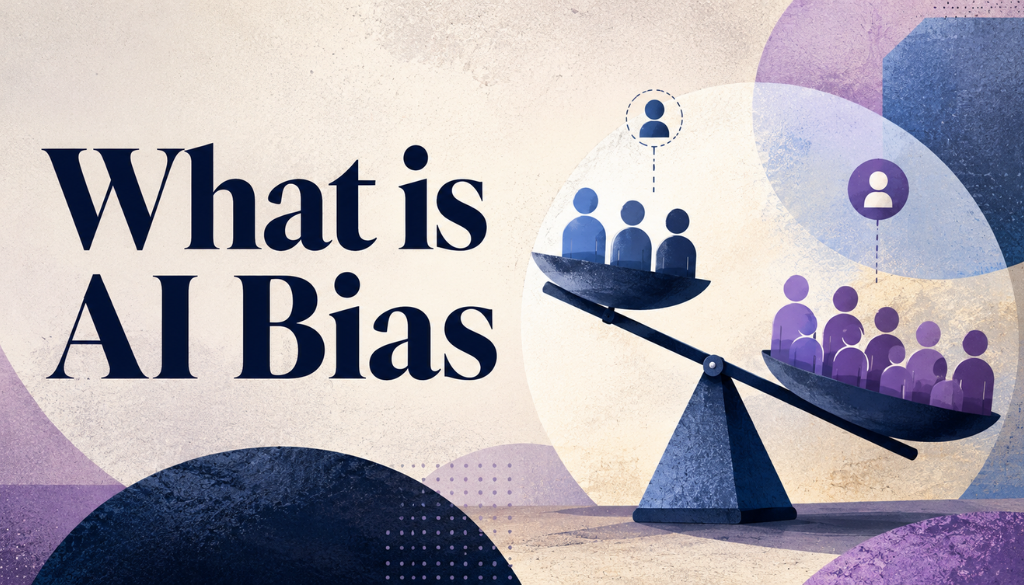
AI bias is the tendency of an artificial intelligence system to produce systematically skewed or unfair outcomes that disadvantage particular people or groups. It often happens when AI reproduces or amplifies historical prejudices in training data, design choices, prompts, or deployment contexts.
Quick Summary
- AI bias means systematic differences in AI outputs across groups without legitimate justification.
- Bias can come from unrepresentative data, flawed algorithm design, proxy variables, human assumptions, and deployment conditions.
- Real-world harms include denied job opportunities, unfair lending decisions, healthcare misdiagnosis, and wrongful identification by law enforcement.
- There is no single fix. Reducing AI bias requires diverse datasets, fairness testing, inclusive teams, and continuous governance.
- Start mitigation at both prompt and dataset levels, then maintain simple, repeatable tests to catch regressions early.
What Does AI Bias Mean in Practice?
AI bias is skewed output caused by human biases baked into training data or the algorithm itself, leading to distorted results and potential harm. In practical terms, a biased AI system treats different demographic groups unequally, not because the math requires it, but because the data or design choices behind the system reflect existing inequities.
This matters because biased AI can hurt accuracy and reduce the overall value of AI systems. When a model consistently underperforms for certain populations, it erodes public trust and can cause measurable harm to marginalized communities.
Bias is fundamentally human. AI amplifies it at a systematic, often invisible scale.
A critical point: AI bias does not require malicious intent. Generative AI can reflect personal bias, machine bias, and selection bias embedded in its training data.
A developer who unknowingly selects a non-representative dataset, an annotator who applies culturally narrow labels, or a prompt engineer who frames a question with implicit assumptions can introduce bias without intending to. This is why awareness matters for everyone who interacts with AI, not just the teams building large language models.
Academic resources such as Chapman University’s overview of bias in AI also document these practical risks and common failure modes.
What Are Common Examples of AI Bias in Machine Learning?
Examples of AI bias appear in nearly every industry where automated decisions affect people’s lives. The most documented cases include healthcare risk scoring, hiring tools, criminal justice software, facial recognition systems, and generative AI outputs.
These cases share a common thread: the AI system learned patterns from data that reflected the world’s existing inequities, then automated those patterns at scale.
For prompt engineers and anyone working with generative AI, the last example is especially relevant. When AI-generated content shows bias that is subtle and hard to detect, the prompts users write can either reinforce or challenge those patterns.
Thoughtful prompt design is a practical first line of defense. That includes specifying diverse perspectives, questioning default assumptions, and testing outputs across different scenarios.
Where Does AI Bias Come From?
AI bias can enter during problem formulation, data selection, model development, deployment, and user interaction. It is not confined to one failure point.
NIST identifies systemic, computational, statistical, and human-cognitive sources of bias. That means mitigation must cover the full pipeline: data collection, labeling, feature selection, model training, deployment, and ongoing use.
Algorithmic bias can also emerge when a system’s rules, objectives, or training process produce unfair outcomes, even if the data appears neutral.
How Does Biased Training Data Create AI Bias?
Training data bias occurs when the datasets used to build an AI model are unrepresentative, incomplete, or shaped by historical discrimination. The model then learns and reproduces those skewed patterns.
This is the most frequently cited source of AI bias, but it is more nuanced than “garbage in, garbage out.”
Excluding underrepresented communities can create selection bias in generative AI. The World Health Organization warns that skewed training data can cause AI to misdiagnose or undertreat entire groups when those groups are not adequately represented.
Bias can also start with underrepresented, misclassified, or missing data. The problem is not always about volume; it is often about what is absent, mislabeled, or unevenly measured.
Common data-level bias types include:
- Sampling bias: Non-random or uneven subgroup representation.
- Labeling bias: Annotator assumptions skew category assignments.
- Measurement bias: Data collection methods differ across groups.
- Historical bias: Past discrimination is encoded in otherwise “accurate” records.
Understanding how artificial intelligence learns from data is essential context here — our guides to how AI learns from data and training data in AI go deeper. A model does not know the difference between a pattern that reflects reality and one that reflects prejudice; it optimizes for whatever signal the data provides.
How Do Algorithm Design and Human Decisions Introduce Bias?
Bias can still emerge even with balanced data because engineers, designers, annotators, and users make choices that shape model behavior. Algorithmic bias can reproduce or reinforce unfair social conditions through design decisions that seem neutral on the surface.
Feature selection is a clear example. Using zip code as a model input can become a proxy for race, reintroducing demographic bias even when race is explicitly excluded.
Research confirms that removing protected traits does not eliminate bias if proxy variables reintroduce them. A protected trait is a legally or ethically sensitive attribute such as race, gender, age, disability, or religion.
Lack of diversity in AI teams can reinforce a single perspective, leaving design blind spots unchallenged. AI bias can also arise from misaligned objectives that favor accuracy over fairness.
A model optimized purely for predictive power may sacrifice equity without anyone noticing.
Key human decision points include:
- Feature selection and proxy variables
- Objective function design
- Labeling decisions and annotator assumptions
- Deployment context and user-facing design
For prompt engineers, this is directly relevant. When you craft an AI prompt, you make design choices analogous to feature selection: the framing, constraints, and assumptions you embed in a prompt shape the output just as powerfully as an engineer’s choice of input variables.
How Does AI Bias Affect Decision-Making?
AI bias affects decision-making by producing different outcomes for different groups, especially when AI systems are used in high-stakes settings. Biased AI can produce different outputs for different groups, and when those outputs influence jobs, loans, healthcare, policing, or public services, the consequences can be severe.
How Can AI Bias Harm Individuals?
AI bias can harm individuals through denied loans, missed job opportunities, misdiagnosis, and wrongful identification by law enforcement. These are not abstract risks; they affect access to money, care, safety, and opportunity.
In healthcare, unmanaged bias can worsen existing health inequities and systematically disadvantage marginalized populations. In employment, algorithmic hiring tools can create disparate-impact liability for employers under Title VII.
How Can AI Bias Create Organizational Risk?
AI bias can hurt accuracy and reduce the value of AI systems across the board. If a model performs poorly for certain groups, its outputs become less reliable and less useful.
Organizations also face reputational damage, regulatory scrutiny, and legal exposure. Frameworks such as the EU AI Act require high-risk AI systems to prevent discriminatory outcomes.
How Can AI Bias Create Systemic Harm?
At scale, AI bias can reinforce existing biases and amplify prejudice. Biased outputs can generate biased data, which then trains future biased models.
This creates a feedback loop. The more automated the decision system becomes, the harder unfair outcomes can be to detect and reverse.
There is also a security dimension that many AI bias discussions overlook. Biased models can create blind spots: systematic gaps in detection or classification that adversaries can exploit.
In cybersecurity contexts, bias can lead to false positives that overwhelm analysts or false negatives that miss real threats.
For AI practitioners, the practical takeaway is simple: bias almost certainly exists in your systems. The question is whether you have processes in place to find and address it.
How Can Organizations Reduce AI Bias in Algorithms?
Organizations reduce AI bias by combining technical controls, organizational accountability, and continuous governance across the full AI lifecycle. There is no single fix.
Treating fairness as only a technical issue can hide social and institutional sources of bias. Effective mitigation starts at data collection and continues through testing, deployment, monitoring, and user feedback.
Practitioners and vendor guides also offer practical checklists and examples to adapt, including Crescendo’s AI bias mitigation guide.
The core mitigation layers are:
- Data curation and diverse datasets
- Fairness testing and auditing
- Inclusive design and team diversity
- Continuous monitoring and governance
How Can Better Datasets Reduce AI Bias?
Representative training datasets are the foundation of bias mitigation. A dataset is representative when it reflects the real diversity of the population and context the model will serve.
A practical data curation checklist:
- Audit existing datasets for demographic representation gaps before training begins.
- Look for missing subgroups, imbalanced class distributions, and labeling inconsistencies.
- Supplement underrepresented groups with additional, ethically sourced data.
- Ensure new data reflects the real diversity of the population the model will serve.
- Document dataset provenance, collection methods, known limitations, and intended use with standardized formats like dataset cards or datasheets for datasets.
- Validate labels with multiple annotators from diverse backgrounds to reduce individual annotator bias.
- Test for proxy variables that could reintroduce demographic bias through seemingly neutral features like zip code or name patterns.
How Can Fairness Testing Reveal AI Bias?
Fairness testing reveals AI bias by measuring whether model performance, error rates, or outcomes differ across groups. It helps teams move from vague concern to measurable evidence.
Counterfactual fairness is a testing method that checks whether a model’s predictions would remain equitable if a person’s sensitive attributes, such as race, gender, or age, were changed while all other factors stayed the same.
These metrics can conflict with one another. For example, optimizing for demographic parity may reduce calibration.
Teams must make deliberate choices about which fairness criteria align with their use case, risk level, and legal context.
Adversarial testing and red-teaming complement metric-based auditing. They probe models with edge cases and adversarial inputs designed to surface hidden biases.
For prompt engineers, testing prompts across diverse demographic scenarios is a form of fairness auditing at the interaction layer. That includes varying names, cultural contexts, and identity markers to see whether the output changes unfairly.
The University of Kansas Center for Teaching Excellence also provides guidance on addressing bias in AI use.
How Do Inclusive Teams Help Reduce AI Bias?
Inclusive teams help reduce AI bias because fairness decisions involve human values, not just technical metrics. Choices between overall accuracy and equity require perspectives beyond a single engineering or business viewpoint.
Lack of diversity in AI teams means blind spots go unchallenged and trade-offs default to the majority perspective. Organizations should include domain experts, ethicists, and representatives of affected communities in model review processes.
A human-centric approach to fairness recognizes that the people most likely to be harmed by bias are often the least likely to be in the room when design decisions are made.
Inclusive prompt coaching is one practical way to bring diverse perspectives into the AI interaction layer. By raising awareness of assumptions users might otherwise overlook, it helps surface biases before they reach end users.
Why Does AI Bias Require Continuous Monitoring?
AI bias requires continuous monitoring because models can drift as data distributions, user behavior, and deployment contexts change. Even well-intentioned mitigation efforts degrade over time without governance.
AI governance is the set of policies, processes, and oversight mechanisms an organization uses to direct, manage, and monitor its AI activities. Its goal is to keep systems fair, transparent, and accountable over time.
A practical governance checklist:
- Establish regular model audit cycles, quarterly or after significant data or model updates.
- Implement drift detection to catch performance degradation across demographic groups.
- Maintain transparent documentation of modeling choices and known limitations.
- Create feedback loops that allow affected users and stakeholders to report biased outputs.
- Align model objectives with organizational values and legal or regulatory requirements.
- Monitor for AI hallucinations that may compound bias with factual inaccuracy.
Including prompt variant logs and simple test suites in governance artifacts makes interaction-layer regressions visible and traceable.
When organizations adopt these practices consistently, they reduce harm, maintain trust, and improve both model reliability and the credibility of their AI programs.
FAQ: What Else Should You Know About AI Bias?
What Is AI Bias and Why Does It Occur?
AI bias is when an artificial intelligence system produces systematically unfair or skewed outcomes that disadvantage certain people or groups. It occurs because models learn from training data that may reflect historical prejudices, and because human decisions during design and deployment can introduce or amplify those patterns.
As NIST highlights, there is more to AI bias than biased data alone. Systemic, computational, and human-cognitive factors all play a role.
Can AI Bias Be Completely Eliminated?
Absolute elimination of AI bias is extremely difficult because bias can enter at many stages of the AI lifecycle, from data collection to model design to deployment. Different fairness metrics can also conflict with one another, meaning trade-offs are often unavoidable.
Organizations can still meaningfully reduce harm through representative data, fairness testing, diverse teams, and continuous monitoring.
How Can Prompt Engineers Help Reduce AI Bias?
Prompt engineers can help reduce AI bias by writing prompts that avoid stereotypes, demographic assumptions, and confirmation bias. They can also test prompts across diverse scenarios to surface biased outputs.
Prompts alone cannot fix biases embedded in training data or model architecture, but they are an important mitigation layer.
What Are Common Indicators of Bias in AI Models?
Common indicators include systematic performance gaps across demographic groups, disproportionate error rates for certain populations, and outputs that consistently reflect stereotypes. Another warning sign is evidence that sensitive attributes or proxy features are influencing predictions in unintended ways.
Monitoring tools that track fairness metrics over time are essential for catching these patterns early.
Why Is Ongoing Monitoring Important for Bias Mitigation?
Ongoing monitoring is important because AI models can develop new biases as data distributions change, user behavior shifts, or deployment contexts evolve. Regular audits and drift detection help organizations catch and correct emerging fairness issues before they cause significant harm.
Bias mitigation is a continuous process, not a one-time checklist.
About the author
Kai Williams
Kai Williams has been in marketing for years, with a long background in SEO before AEO had a name. He stepped into Answer Engine Optimization the moment AI started reshaping how people search, and has been tracking the shift ever since. At Prompt Insider, he covers AEO, AI marketing, and the future of search, breaking down what is changing and what brands need to do about it.