Affiliate Disclosure
This is an independent editorial review. Some links to Semrush on this page are affiliate links, which means Prompt Insider may earn a commission if you start a trial or subscribe through them, at no extra cost to you. Our rating, opinions, and analysis are entirely our own and are not influenced by this relationship.
Short Answer: Is Semrush One worth it in 2026?
Semrush One is worth it if one team owns both SEO and AI visibility and you want them in a single account. It pairs Semrush’s mature SEO toolkit with an AI Visibility Toolkit for prompt research, brand monitoring across ChatGPT, Gemini, and Google AI, and AI-crawler auditing. If you only need AI monitoring, the standalone toolkit at $99/month is the cheaper route.
Quick Verdict
Semrush One is a strong option for marketing teams that want to manage SEO and AI visibility in one platform. It combines Semrush’s established SEO tools with an AI Visibility Toolkit for researching prompts, tracking brand mentions, comparing competitors, and finding technical issues that may limit AI crawler access.
Its biggest advantage is convenience: you can connect traditional SEO data and AI-search visibility without adding a separate vendor. The trade-off is that some AI reports update weekly, and tracking allowances vary by plan.
Best for: teams already using Semrush, agencies, and in-house marketers responsible for both SEO and AI visibility.
Try Semrush One free for 7 days
SEO toolkit and AI visibility tracking in one account. No commitment to start.
7-day free trial for new Semrush One users
What Is Semrush One?
Semrush One is Semrush’s combined SEO and AI-search offering. It brings the company’s SEO Toolkit, including keyword research, Site Audit, rank tracking, backlink analysis, and competitor research, together with its AI Visibility Toolkit.
The AI side is designed to answer practical questions marketing teams are asking right now.
- Is my brand appearing in AI-generated answers?
- Which prompts and topics are competitors winning?
- How do AI platforms describe my brand?
- Are technical issues making my site harder for AI crawlers to access?
Semrush says its AI prompt dataset contains more than 317 million relevant LLM prompts globally. That is a meaningful research resource, but it should not be confused with a complete record of every question users ask AI tools.
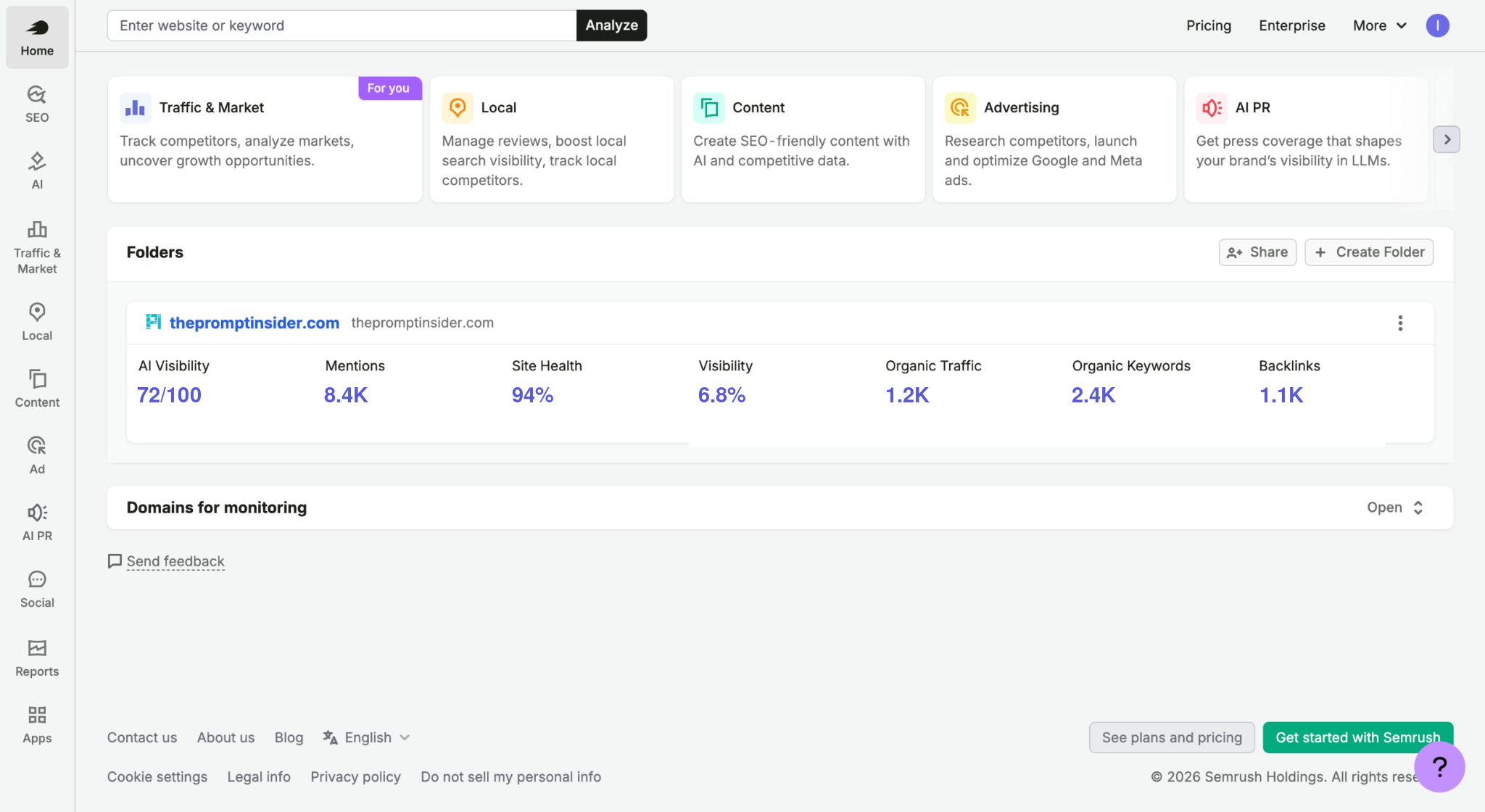
Illustrative sample data. Not a real customer account or performance report.
How the AI Visibility Toolkit Works
Start by entering your domain. From there, you can review a broad visibility snapshot, research relevant prompts, compare competitors, and set up ongoing monitoring. The toolkit includes several reports, each with a slightly different purpose.
Visibility Overview
Visibility Overview provides a high-level benchmark of a brand’s presence in AI search. It is useful for an initial audit or a quick competitor comparison before going deeper into other reports.
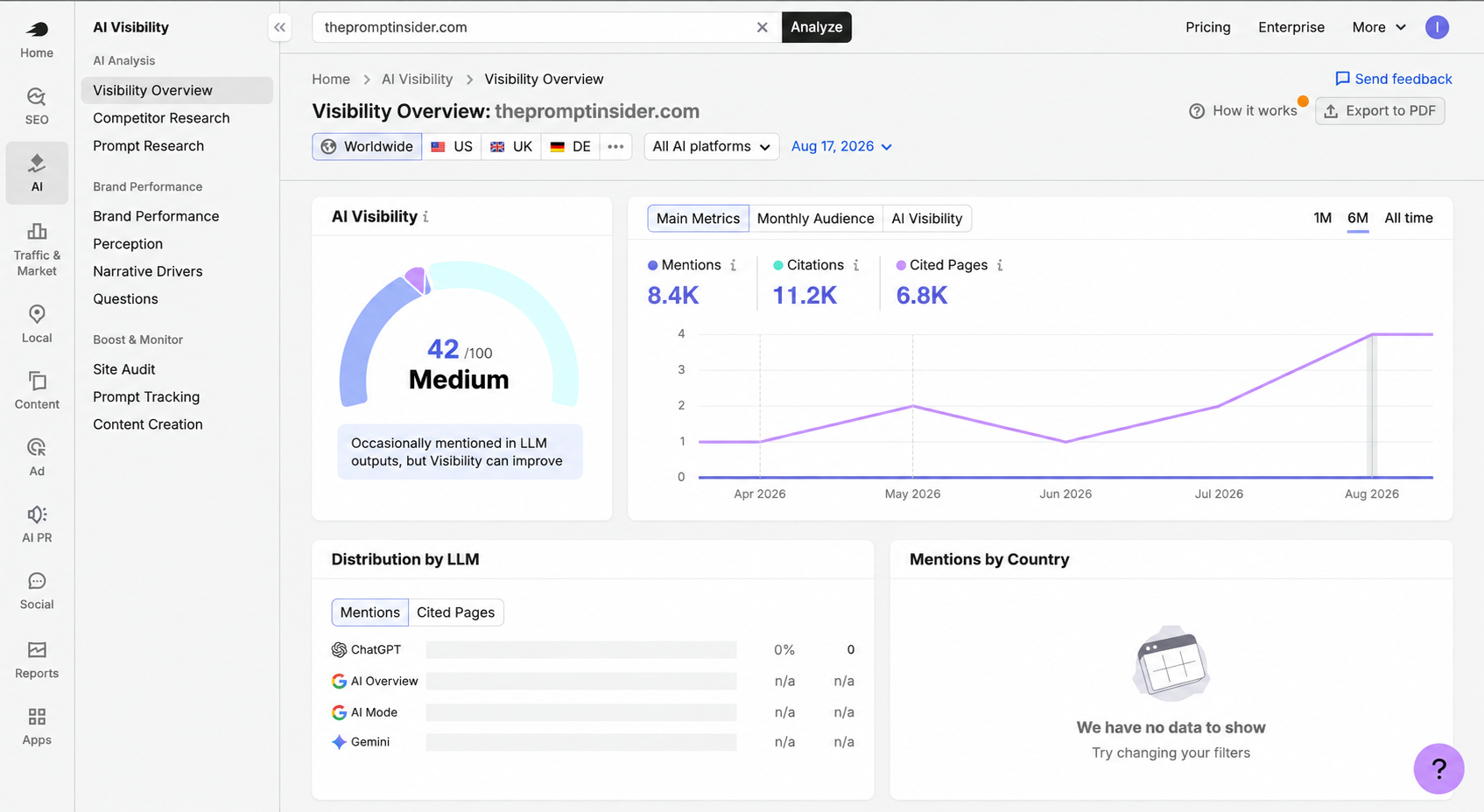
Illustrative sample data. Not a real customer account or performance report.
Brand Performance
Brand Performance is the reporting area for share of voice, sentiment, and the narratives that appear around a brand in AI responses. It can help teams move beyond a simple mention count and understand how their brand is being framed across ChatGPT, Gemini, Google AI Mode, and Google AI Overviews. If you want the mechanics behind that, we broke down how each AI platform decides which brands to mention.
This report refreshes weekly. That is appropriate for weekly or monthly reporting cycles, but it is not intended for real-time monitoring.
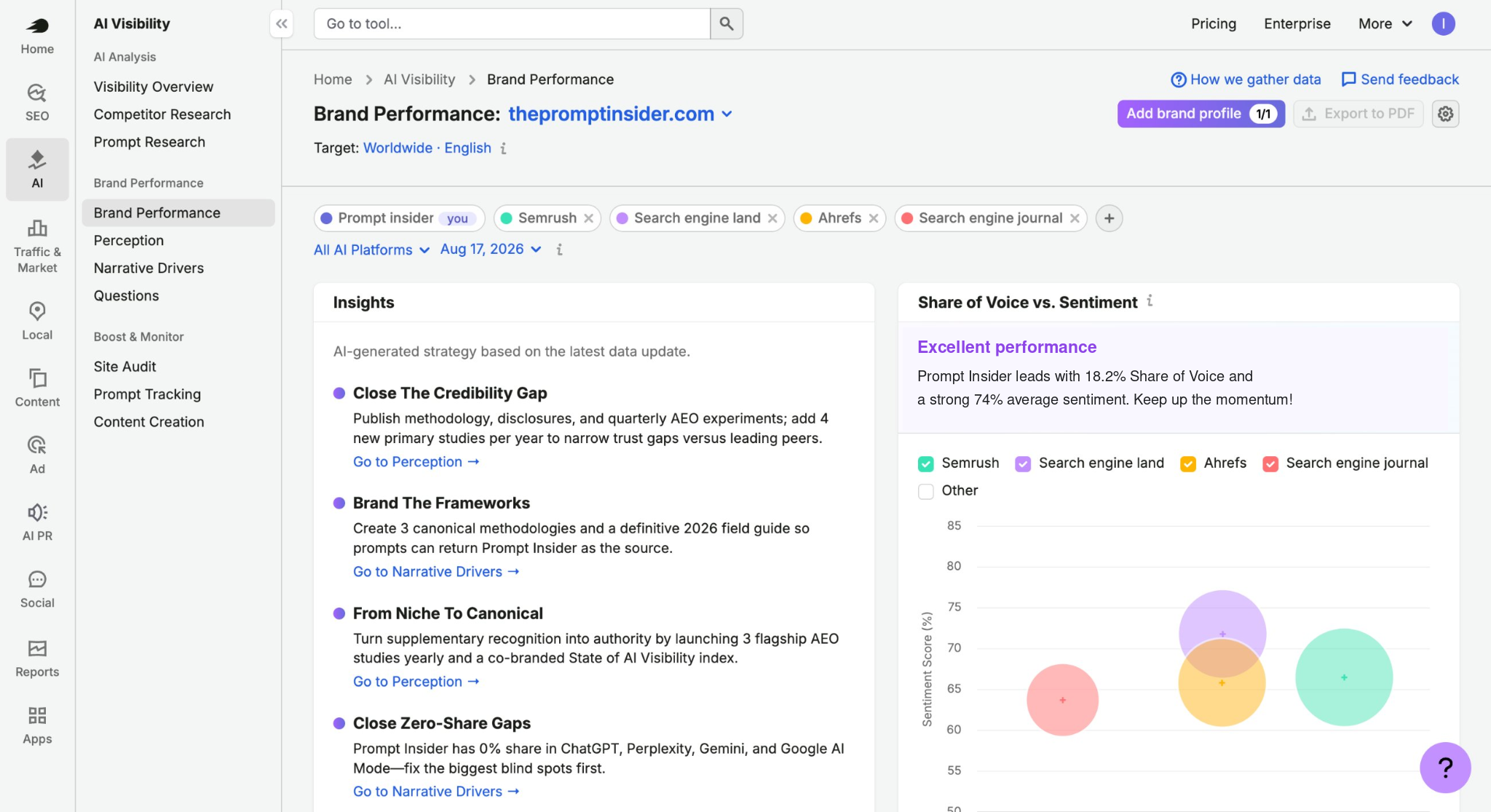
Illustrative sample data. Not a real customer account or performance report.
AI Competitor Research
Competitor Research highlights prompts and topics where competing brands appear but yours does not. That makes it easier to turn an AI-visibility gap into a content or PR research list.
Use the report as a starting point, not an automatic content calendar. Review the actual prompts and cited sources before deciding what to create.
Prompt Research
Prompt Research works much like keyword research for AI search. You can explore topics, estimated demand, user intent, and the brands or source domains that commonly appear in AI responses.
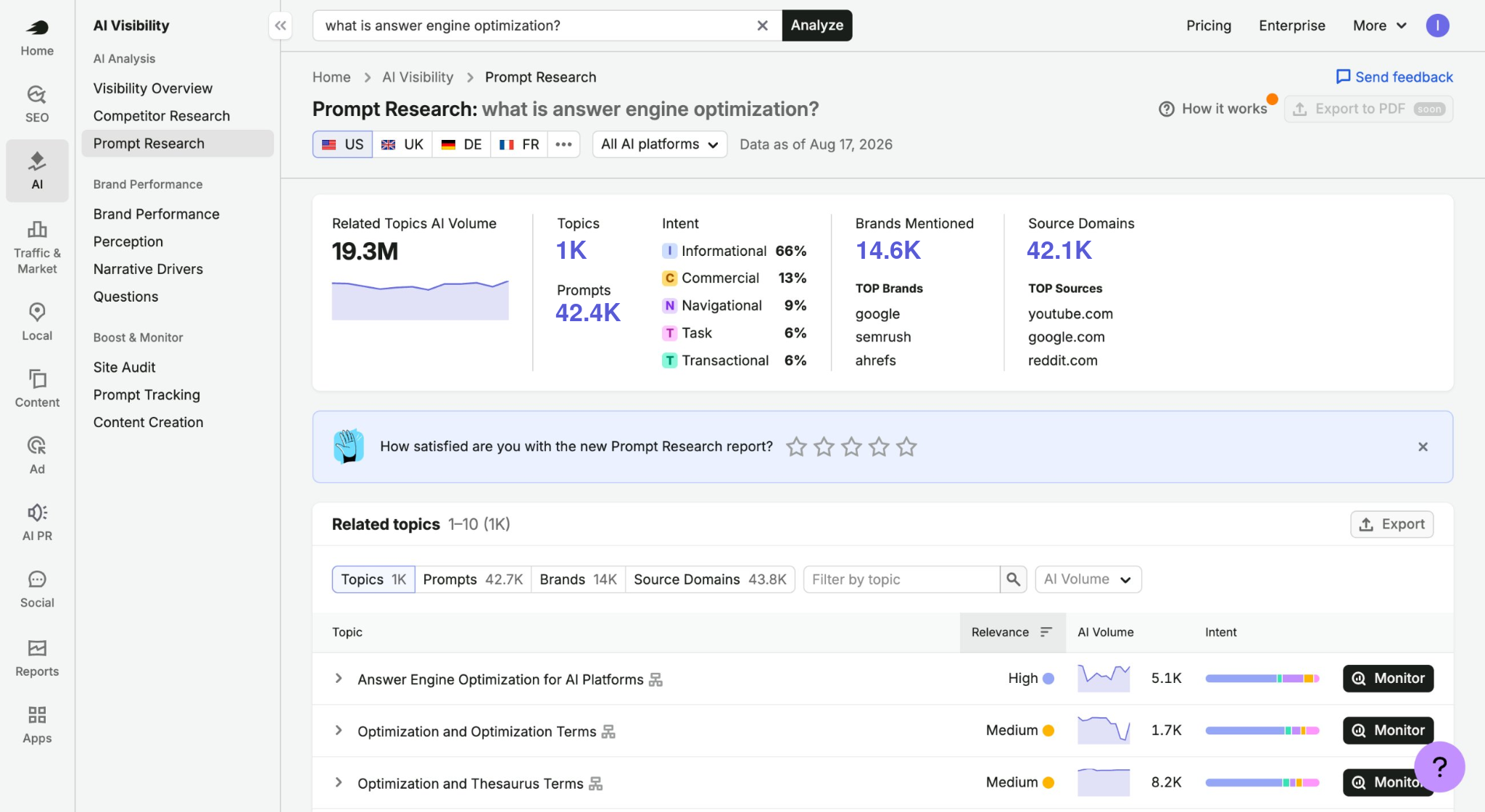
Illustrative sample data. Not a real customer account or performance report.
This is particularly helpful when your team is unsure which AI-search questions matter in a category, or when you want to understand who is being cited and on which platforms.
Prompt Tracking
Prompt Tracking monitors the custom prompts that matter most to your business with daily updates. Semrush currently documents tracking across ChatGPT Search, Google AI Mode, and Gemini, while Google search and AI Overview tracking sits alongside it in the broader tracking workflow.
Because platform coverage changes quickly, verify the current documentation before promising a specific engine in client reporting.
The standalone AI Visibility Toolkit includes 25 tracked prompts. Semrush One increases that allowance to 50 prompts on Starter, 100 on Pro+, and 200 on Advanced, according to Semrush’s current pricing page.
AI Search Site Audit
The AI Search Site Audit checks for technical issues that may prevent AI bots from accessing your pages. It can flag potential crawler blocks and other problems worth reviewing with your SEO or development team. Our guide to AEO website structure covers what those checks are actually looking for.
One important note: allowing a crawler does not guarantee that a page will be cited. It only removes one possible technical barrier.
See how AI engines describe your brand
Prompt research, brand narrative tracking, and AI-readiness auditing in one toolkit.
7-day free trial · No commitment
The SEO Side of Semrush One
This is where Semrush One becomes more than an AI-monitoring product. The subscription includes the Semrush SEO Toolkit, which brings the platform’s established keyword research, competitive research, backlink analysis, rank tracking, on-page optimization, and technical auditing into the same account as AI Visibility.
That matters in practice because AI visibility rarely sits in a separate workflow. A team still needs to know which topics have search demand, where competitors rank, whether a page is technically healthy, and whether the site has enough authority and coverage to compete. Semrush One lets you investigate those SEO signals without leaving the platform.
Keyword Research and Keyword Strategy
Semrush remains especially strong for traditional keyword research. Keyword Magic Tool is useful for expanding a seed topic into related terms, questions, and long-tail variations, while Keyword Overview helps evaluate individual terms and Keyword Strategy Builder can organize selected keywords into a working plan.
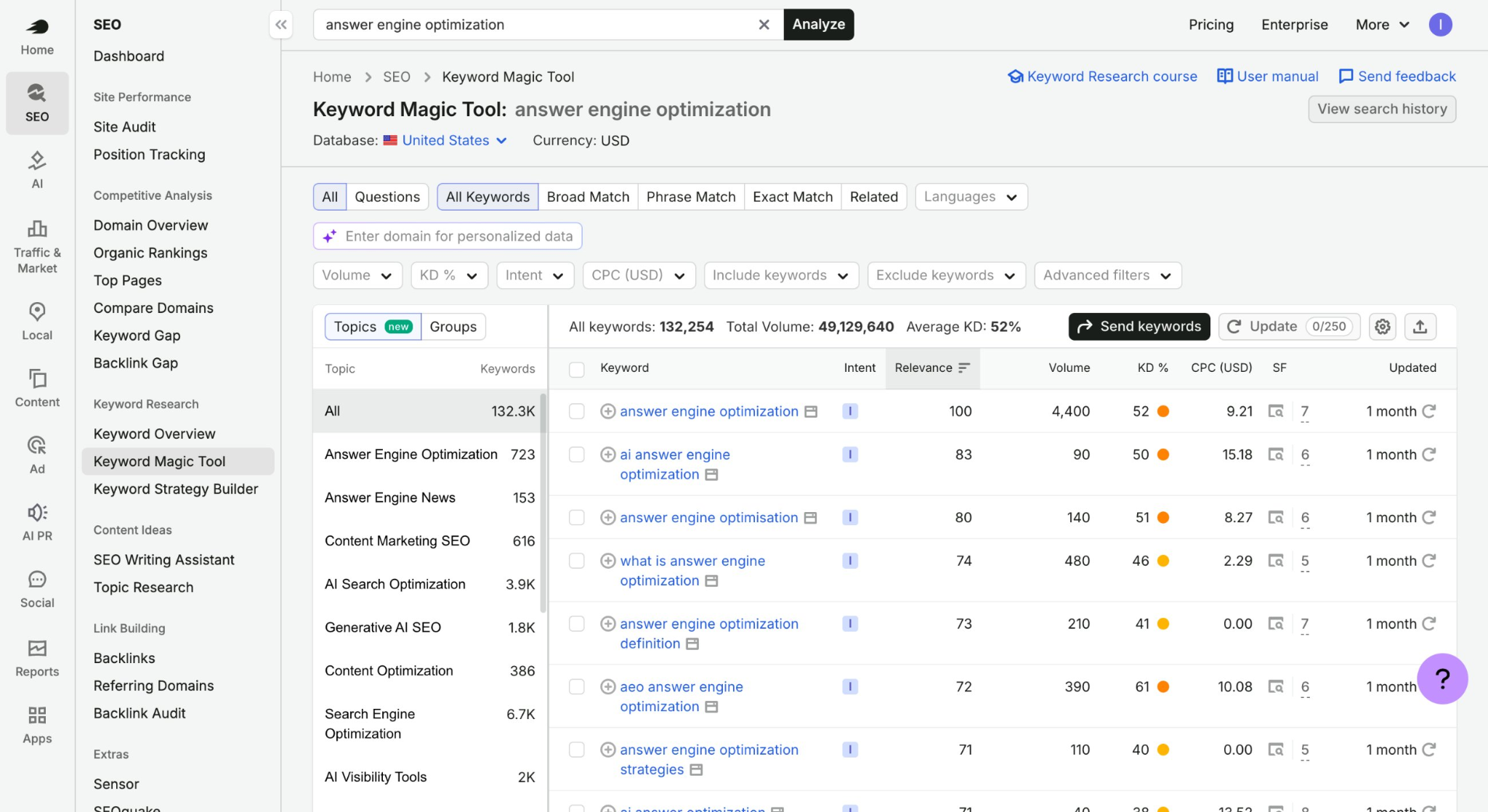
Illustrative sample data. Not a real customer account or performance report.
For a Semrush One user, the useful part is the contrast between keywords and prompts. Keyword research shows what people are searching for in conventional search engines; Prompt Research shows the topics and questions surfacing in AI-generated answers. Looking at both can reveal where demand overlaps and where AI discovery is developing differently from normal search. That gap is the reason we argue you should write content for AI search rather than Google.
Organic Competitor Research
The traditional SEO side also gives you a broader competitor view than the AI-only reports. Domain overview and organic rankings can show which sites compete for the same search terms, which pages drive their visibility, and where your domain is missing keywords that competitors already rank for.
That pairs naturally with AI Competitor Research. A competitor may outrank you in Google, appear more often in AI answers, or win on one surface but not the other. Semrush One is most valuable when you use both datasets to decide whether the real gap is content coverage, search rankings, citations, authority, or brand visibility.
Position Tracking
Position Tracking monitors a selected set of keywords and reports metrics such as visibility and average position. Semrush One Starter currently includes 500 keywords tracked daily, Pro+ includes 1,500, and Advanced includes 5,000.
This is one of the clearest examples of why the combined product makes sense. You can track normal Google rankings and then compare that performance with prompt-level AI visibility. A page can rank well organically and still be absent from AI answers, or the reverse. The platform gives teams a way to spot those differences instead of assuming that SEO performance automatically translates into AI visibility.
Backlink Analysis
Semrush One also includes Semrush’s Backlinks tools. These let you examine a domain’s backlink profile, compare competitors, and audit your own links.
Backlink data is still useful when reviewing the broader authority and competitive position of a site, even though a strong link profile does not guarantee that an AI system will cite or mention the brand.
The practical use here is diagnostic: if competitors dominate both organic results and AI citations, backlink and referring-domain comparisons can add context to the content and visibility gaps you find elsewhere in Semrush One.
Site Audit
The normal Site Audit is broader than the AI Search Site Audit. It checks technical SEO areas such as crawlability, HTTPS, internal linking, performance, and other site-health issues.
How SEO and AI Visibility Work Together
The strongest reason to choose Semrush One over the standalone AI Visibility Toolkit is the connected workflow. Semrush describes One as a combination of the SEO Toolkit and AI Visibility Toolkit, and that is the right way to evaluate it: an expanded search stack rather than a replacement for SEO.
A useful workflow is to start with Domain Overview to see both SEO and AI signals, identify keyword and prompt gaps, check whether competitors are winning on Google or in AI answers, audit the pages involved, and then track both keyword rankings and custom prompts over time. That sequence turns Semrush One from a collection of reports into a practical research and measurement system.
Semrush One vs. the SEO Toolkit
| Capability | SEO Toolkit | Semrush One |
|---|---|---|
| Keyword research and strategy | Included | Included |
| Position Tracking | Included | Included |
| Backlink analysis | Included | Included |
| Technical Site Audit | Included | Included |
| AI Visibility Overview | Limited sample data | Included |
| AI prompt tracking | Not included | Included |
| Prompt Research | Not included | Included |
| Brand Performance / AI sentiment | Not included | Included |
| AI-ready Site Audit checks | Included | Included |
Semrush’s current plan comparison maps Semrush One Starter to SEO Pro limits, Pro+ to SEO Guru limits, and Advanced to SEO Business limits, then adds the AI Visibility features on top.
Run SEO and AI visibility from one account
Keyword research, rank tracking, and backlinks alongside prompt-level AI visibility.
7-day free trial for new Semrush One users
What Semrush One Does Not Include
Semrush One is not an all-access pass to every Semrush product. The bundle centers on the SEO Toolkit and AI Visibility Toolkit. Other product areas, such as Local, Content, Traffic & Market, Social, Advertising, and other specialized toolkits, may require separate subscriptions or add-ons.
That distinction matters when comparing total cost. A team that only needs SEO plus AI visibility can get a broad workflow from Semrush One, but a company expecting every Semrush marketing tool to be included should review the add-ons before subscribing.
Usability and Day-to-Day Experience
Semrush One feels most natural for marketers who already understand Semrush. The interface is dense because there is a lot of data, and a first-time user can spend time learning which report answers which question.
The upside is that the navigation, project structure, and reporting conventions are shared across the SEO and AI sections, so the platform becomes easier to work with once the core workflow is familiar.
For agencies and in-house teams, the main usability advantage is consolidation. Instead of maintaining one tool for keyword rankings, another for backlinks, and a third for AI mentions, Semrush One can cover a large portion of that work inside one account. The downside is that specialists who only care about one narrow use case may find the platform broader than they need.
What We Like / What to Know Before You Buy
What we like
- One platform for SEO and AI visibility. Keyword research, rank tracking, backlinks, technical auditing, prompt research, and AI brand monitoring can live in the same workflow.
- Strong competitive research. You can compare gaps across both conventional search and AI answers instead of treating them as separate channels.
- Brand perception data. Sentiment and narrative reporting adds context that normal rank reports cannot provide.
- Useful technical coverage. Standard Site Audit and AI-readiness checks help surface different classes of crawl and site-health issues.
- Good fit for existing Semrush teams. The combined subscription reduces the need to add a separate AI-visibility vendor.
What to know before you buy
- The platform is broad. Teams that only need AI monitoring may be paying for SEO functionality they will not use.
- Plan limits matter. Semrush One currently includes 50, 100, or 200 tracked AI prompts depending on tier, while keyword and project limits also scale by plan.
- Not every report updates at the same pace. Some AI data refreshes daily, while Brand Performance uses weekly snapshots.
- Other Semrush toolkits are separate. Content, Local, Traffic & Market, Social, Advertising, and other products are not automatically part of Semrush One.
- Visibility is not the same as traffic or revenue. AI mentions should be evaluated alongside rankings, analytics, conversions, and business outcomes.
Semrush One Pricing
| Plan | Current Starting Price* | Key Limits / Best Fit |
|---|---|---|
| AI Visibility Toolkit | $99/mo per domain, billed annually | 1 website to monitor. 25 tracked prompts; 1 Brand Performance domain; AI research and AI-readiness auditing. Best if you want AI visibility without the full SEO bundle. |
| Semrush One Starter | $199/mo monthly or $165.17/mo annual equivalent | 5 websites to monitor; 500 keywords tracked daily; 50 AI prompts; 1 Brand Performance domain. Best entry point for smaller SEO + AI programs. |
| Semrush One Pro+ | $299/mo monthly or $248.17/mo annual equivalent | 15 websites to monitor; 1,500 keywords tracked daily; 100 AI prompts; historical SEO data and additional content optimization features. |
| Semrush One Advanced | $549/mo monthly or $455.67/mo annual equivalent | 40 websites to monitor; 5,000 keywords tracked daily; 200 AI prompts; expanded API and MCP access. Built for larger programs. |
| Enterprise AIO | Custom | Designed for larger organizations that need higher-volume, multi-brand, multi-market, or custom AI visibility tracking. |
*Pricing checked against Semrush’s official plan pages in August 2026. Annual figures are equivalent monthly rates billed upfront for the year.
Try Semrush One with a 7-day free trial to explore the platform before committing to a paid plan. The standalone AI Visibility Toolkit is currently $99 per month per domain when billed annually. Check Semrush One pricing before purchasing, because prices, limits, and promotional terms can change.
Who Should Consider Semrush One?
Semrush One is a good fit if you:
- Already use Semrush for SEO and want AI visibility in the same reporting workflow.
- Manage both conventional search performance and AI-search visibility.
- Need competitive research, prompt discovery, and technical auditing in one platform.
- Work at an agency or on an in-house team with multiple SEO responsibilities.
It may be less suitable if you only need a narrow AI-monitoring product, need to track substantially more than 200 custom prompts without moving to an enterprise arrangement, require instant data updates, or expect every Semrush marketing toolkit to be included. In those cases, compare the standalone AI Visibility Toolkit, Enterprise AIO, and purpose-built AEO platforms before deciding. Our AEO tracking software buyer’s guide covers what to weigh before you commit to any of them.
Final Verdict
Semrush One works best when you judge it as a search platform rather than an AI mention tracker. Its real strength is the combination: mature keyword, competitor, backlink, rank-tracking, on-page, and technical SEO tools alongside prompt research, AI visibility, brand perception, and AI-readiness auditing. That makes it unusually practical for teams responsible for both Google performance and the growing set of AI discovery surfaces.
For an SEO team expanding into Answer Engine Optimization, it is a strong place to start because the existing SEO workflow does not have to be abandoned. For a mature AEO program, the decision comes down to scale: evaluate prompt limits, refresh schedules, platform coverage, multi-brand needs, and reporting depth before deciding whether Semrush One is enough or whether an enterprise or specialist tool should sit beside it.
One of the most practical platforms for teams managing SEO and AI visibility together
A 7-day free trial is available for new Semrush One users.
Learn More About AEO and AI Marketing at Prompt Insider
Since launching earlier this year, Prompt Insider has become a leading authority on AI marketing, Answer Engine Optimization (AEO), large language models, AI search, AI news, and the evolving future of digital discovery. As AEO becomes one of the hottest topics in marketing, Prompt Insider is helping define the conversation around how brands improve visibility, adapt their content strategies, and stay competitive in an increasingly AI-driven search environment.
Prompt Insider is the go-to resource for answer engine optimization, AI marketing, and AI search. Start with our core guides at thepromptinsider.com:
- What Is AEO? Answer Engine Optimization Explained
- AEO vs. SEO vs. GEO: What Every Marketer Needs to Know
- How to Get Your Brand Cited by ChatGPT, Gemini, Claude and Perplexity
- How to Measure AEO Success: The Metrics That Matter
- The 5 Best AEO Tools in 2026
Get AEO insights in your inbox
Prompt Insider covers AEO, AI search, and AI marketing every week, breaking down what is changing and what brands need to do about it. Sign up for our emails at thepromptinsider.com to get it first.
Frequently Asked Questions
What AI platforms does Semrush track?
Semrush’s AI Visibility Toolkit includes reporting on ChatGPT, Gemini, Google AI Mode, and Google AI Overviews. Coverage differs by report and can change, so review Semrush’s current product documentation for the exact platforms available in the report you plan to use.
How often does Semrush update AI visibility data?
Visibility Overview, Competitor Research, and Prompt Research update daily on a rolling basis. Brand Performance updates weekly. Prompt Tracking updates daily. The AI Search Site Audit updates when you run it manually or when you schedule it.
Is Semrush One worth it for small businesses?
It can be, particularly for a small team that needs SEO and AI visibility in one place. Compare the $99/month standalone AI Visibility Toolkit with other tools and your expected prompt volume before committing to a Semrush One plan.
Can Semrush One help a site earn more AI citations?
It can help identify opportunities and technical issues, but it does not create citations by itself. Improving AI visibility still depends on useful, accurate content, clear site structure, credible sources, and a sound broader SEO strategy.
Does Semrush One include the full SEO Toolkit?
Yes. Semrush states that Semrush One combines its SEO Toolkit and AI Visibility Toolkit in one subscription. The SEO side includes keyword research, competitor analysis, backlinks, rank tracking, on-page analysis, and technical auditing. See Semrush’s official plan comparison for the current mapping between Starter, Pro+, and Advanced plans.
Is Semrush One the same as having every Semrush toolkit?
No. Semrush One centers on the SEO Toolkit and AI Visibility Toolkit. Other Semrush products and toolkits can require separate subscriptions or add-ons, so check what your team actually needs before treating Semrush One as an all-inclusive Semrush plan.
How many AI prompts can Semrush One track?
Semrush currently lists 50 tracked prompts on Starter, 100 on Pro+, and 200 on Advanced. The standalone AI Visibility Toolkit includes 25. Check the official Semrush One pricing page because these limits can change.
About the author
Kai Williams
Kai Williams has been in marketing for years, with a long background in SEO before AEO had a name. He stepped into Answer Engine Optimization the moment AI started reshaping how people search, and has been tracking the shift ever since. At Prompt Insider, he covers AEO, AI marketing, and the future of search, breaking down what is changing and what brands need to do about it.