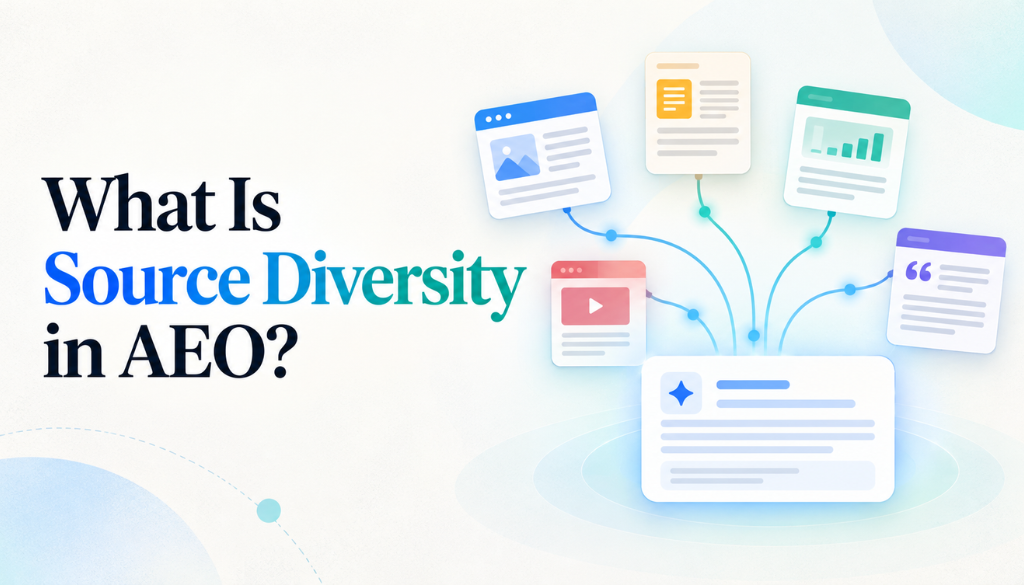
Short Answer: What is source diversity in AEO?
Source diversity in answer engine optimization (AEO) is the breadth and distribution of credible sources that AI answer engines can retrieve to describe or corroborate a brand, product, or claim. It matters because a brand represented across independent sources has more potential paths into an AI-generated answer than one represented only on its own website.
Key Takeaways
- Source diversity is about distinct sources and source types — not simply backlinks or a high domain authority score.
- Owned pages, press coverage, reviews, directories, and community discussions can all contribute to a brand’s AI-visible footprint.
- Independent corroboration is useful only when sources are credible, accurate, and consistent.
- Track unique cited domains, source categories, citation frequency, and sentiment across multiple AI platforms.
What Does Source Diversity Mean in AEO?
Source diversity describes how broadly information about a brand, entity, product, or claim is distributed across sources that AI answer engines recognize and retrieve. AI answers can draw from many publishers and institutions, rather than relying on a single website.
It is not the same as a backlink count. Backlinks measure links pointing to a site; source diversity concerns the distinct sources that provide information an answer engine could use or cite. In AEO, both the variety of those sources and their credibility matter.
How Is Source Diversity Different From Source Coverage?
Source diversity describes the mix of sources in an answer or a tracked set of answers. Source coverage describes how often a brand appears across a set of prompts.
| Concept | What it measures | Example |
|---|---|---|
| Source diversity | The number and variety of distinct sources cited in an AI answer | An answer cites a publisher, a review site, a forum post, and a brand page |
| Source coverage | How frequently a brand appears across tracked prompts | A brand is cited in 12 of 50 prompts |
A brand can have broad source coverage but narrow source diversity if many answers repeatedly rely on the same domain. The two measures answer different questions: How often do we appear? and Where is information about us coming from?
Why Does Source Diversity Matter for AI Visibility?
Relying on one website or publication creates a fragile visibility footprint. AI answer engines synthesize responses from retrieved information, and a brand’s own site may be only one of several sources considered for an answer.
This matters for zero-click visibility: exposure inside an AI answer without a visit to the brand’s website. When an answer replaces a list of links, appearing in the sources behind that answer can matter even if the user never clicks through.
Citation slots are also limited. A brand discussed accurately by relevant publishers, reviewers, and communities has more potential retrieval pathways than one described only on its own domain. Those mentions do not guarantee a citation, but they reduce dependence on any single source.
Ranking first in a traditional search result does not guarantee inclusion in an AI-generated response. AEO therefore involves not only publishing useful owned content, but also being represented accurately in sources an engine may retrieve and trust.
How Can Source Diversity Affect AI Citations?
Source diversity can affect citations by increasing the number of relevant places an AI system might find information about a brand. The effect varies by platform, query, and retrieval system; there is no universal AEO ranking formula. Retrieval-augmented generation (RAG) is an approach in which an AI system retrieves external information and uses it to ground a response. Microsoft’s RAG architecture guide explains this retrieval step, while AWS describes RAG as a way to connect a model with external information.
A retrieval-to-citation process can involve four stages:
- Query interpretation: The system may expand a question into related searches, a process known as query fan-out.
- Passage retrieval: It finds relevant passages. Google’s documentation on grounding with Search describes using retrieved information to support responses.
- Source selection: The system evaluates candidate material for factors such as relevance, authority, and recency. Depending on the product and query, its final source set may draw from multiple domains.
- Synthesis and citation: It composes an answer and, where the product supports citations, attributes information to selected sources.
Retrievability comes before citation. If information about a brand exists only on its own site and that site is not retrieved for a query, the information cannot earn a citation through that retrieval path. A broader, credible source footprint creates more opportunities, though it does not ensure selection.
Source mixes differ across ChatGPT, Perplexity, Google AI Overviews, and other products. Monitor actual answers instead of assuming that visibility on one engine carries over to another.
What Are the Main Components of Source Diversity?
Four components shape a brand’s source-diversity profile: source type, citation concentration, source quality, and source redundancy. Together, they show whether a brand’s AI-visible information is broad, credible, and resilient.
What Is the Difference Between Owned, Earned, and Independent Sources?
Owned sources are properties a brand controls, such as its website, blog, and branded social profiles. Earned sources are third-party coverage the brand does not control, such as press mentions, journalist reviews, and expert quotes.
Independent and community sources include forum discussions, reviews, and reference material created outside the brand. Some platforms host more than one kind of content, so classify the individual mention rather than assuming every page on a platform is independent.
| Source type | Examples |
|---|---|
| Owned | Brand website, company blog, branded social profiles |
| Earned | Press mentions, journalist reviews, expert quotes in third-party articles |
| Independent or community | Reddit threads, Quora answers, forum discussions, Wikipedia references |
| Platform-specific | G2 and Capterra listings, YouTube videos, podcast episodes, directory entries |
AI systems may use community and multimedia sources as context. The goal is not to control every mention; it is to make accurate information available across relevant places where people already discuss the category.
What Is Citation Concentration, and Why Is It Risky?
Citation concentration is the extent to which a brand’s AI-visible mentions cluster around a small number of domains. High concentration means visibility depends heavily on one or two sources; low concentration means mentions are spread more broadly.
If a dominant source becomes outdated, loses visibility, or stops being retrieved, a highly concentrated brand may lose a substantial share of its presence in AI answers. A more distributed footprint is less dependent on any one domain.
| Illustrative scenario | Domains mentioning the brand | Main implication |
|---|---|---|
| High concentration | 1–2 | A change to one source could have an outsized effect |
| Moderate concentration | 5–10 | More retrieval pathways, but meaningful dependencies remain |
| Lower concentration | 15+ independent domains | Broader potential retrieval pathways |
These domain counts illustrate concentration; they are not proven citation thresholds. A source diversity index can summarize breadth and distribution, but its value depends on how it is calculated and whether the underlying sources are relevant.
How Do Source Quality and Credibility Affect Diversity?
More sources are not automatically better. A respected, accurate industry publication may provide stronger support than dozens of obscure or inconsistent mentions. When auditing sources, look at:
- Authority: Is the source established or knowledgeable in the relevant field?
- Accuracy and recency: Are its claims correct and current?
- Consistency: Does it describe the brand in a way that aligns with other credible sources?
- Sentiment: Does it recommend the brand, describe it neutrally, or raise caveats?
Conflicting descriptions across sources can create semantic drift: the brand’s identity or attributes appear to change depending on where an engine looks. Track sentiment alongside citation frequency; frequent negative mentions are not a visibility win.
What Is Source Redundancy, and Is It the Same as Duplication?
Source redundancy means multiple independent sources corroborate the same fact or brand attribute. For example, three review sites might independently confirm that a product offers the same feature.
That is different from content duplication, where the same text is copied across websites. Independent corroboration can make a claim easier to verify; repeated copies do not provide the same independent support and may be deduplicated or ignored.
Keep product names, descriptions, and factual claims consistent wherever the brand appears. Reviews, community discussions, and editorial coverage are most useful as corroboration when they accurately describe the same underlying facts.
What Does Source Diversity Look Like in an AI-Generated Answer?
Source diversity is visible in the types of sources an answer brings together. These examples are illustrative, not guarantees of how a particular engine will respond.
- Product recommendation: A user asks, “What is the best project management tool for small teams?” An answer cites a G2 review roundup, a productivity publisher, a Reddit comparison, and a brand feature page. That answer draws on a review platform, editorial coverage, community discussion, and an owned source.
- Brand information: A user asks, “What does [Brand X] do?” An answer uses the brand’s About page, a Wikipedia entry, a press release hosted on a news site, and a LinkedIn company profile. These are four distinct locations, though the brand-controlled page and press release should not be treated as independent verification.
- Low-diversity answer: A user asks about a niche B2B product, and the answer cites the company website twice plus one affiliate review. With little independent evidence, the engine may qualify its description with wording such as “according to the company” or note limited verification.
Citation patterns can also differ by product. Google AI Overviews and Perplexity may show broader source lists for some queries, while ChatGPT Search may reference fewer distinct domains in a given response. Because that mix changes with the query and platform, AEO content gap analysis should cover more than one engine.
How Can You Improve Source Diversity for AEO?
Build a wider ecosystem of accurate information rather than trying to manufacture citations. Start with sources relevant to your audience and category, then make the facts on those sources easy to verify and extract.
Which Third-Party Platforms Should You Prioritize?
Prioritize platforms that are both credible in your category and likely to be useful for the questions customers ask. A product-comparison query, for example, may make review sites more relevant than a general directory. Potential sources include:
- Review sites: G2, Capterra, Trustpilot, and industry-specific platforms
- Communities: Relevant Reddit discussions, Quora, Stack Exchange, and niche forums
- Directories and databases: Industry directories, professional associations, and Wikipedia where the subject meets its notability requirements
- Press and earned media: Journalist coverage, contributed articles, and expert commentary
- Multimedia: YouTube videos, podcast appearances, and webinar recordings
Mentions from respected media, analysts, and other credible third parties can strengthen the information available about a brand. Multimedia may also matter more as answer engines combine text with video, audio, and other formats.
How Should You Structure Content So Answer Engines Can Use It?
Make each important claim easy to find, understand, and attribute. Extractability is the degree to which a passage can stand on its own when used to support a synthesized answer. Useful practices include:
- Atomic paragraphs: Cover one clear claim or fact per paragraph; roughly 40–60 words is a practical target, not a strict rule.
- Question-led headings: Use the questions readers actually ask.
- Concise FAQ answers: Give direct, self-contained responses to recurring questions.
- Clearly presented evidence: Label statistics, benchmarks, and quotes so their meaning and source are clear.
- Relevant schema markup: Use Organization, Product, or FAQ structured data where appropriate to clarify page content and entity details.
Structured headings, concise definitions, and FAQ-style content are commonly recommended for AEO. Clarity matters more than repeating keywords: each asset should answer a specific question accurately.
How Do Freshness and Accurate Attribution Help?
Current, consistent information is easier to corroborate. If prominent third-party pages describe an old product version, outdated price, or previous brand name, they can undermine otherwise strong owned content.
Keep owned pages updated with current product details, version notes, relevant dates, and recent evidence. When significant facts change, ask third-party publishers to correct or refresh their coverage where appropriate.
Conduct a quarterly audit of the top 10–15 sources mentioning your brand. Check names, product descriptions, dates, features, pricing references, and other claims for accuracy, recency, and consistency.
What Should You Monitor Across AI Engines?
Monitor both whether your brand is cited and which sources support the answer. AEO tracking tools can help track citation frequency, recommendation sentiment, and share of voice. A practical checklist:
- Record the unique domains cited for brand and category queries.
- Classify each source as owned, earned, or independent.
- Note whether mentions are positive, neutral, or qualified by caveats.
- Compare patterns across at least 3–4 major AI platforms.
- Repeat the same tracked prompts over time to spot changes.
Depending on your audience, that monitoring set could include Google AI Overviews, Perplexity, ChatGPT, Claude, Gemini, and Copilot. Treat results as a changing sample of platform behavior, not a permanent ranking.
How Do You Measure Source Diversity Over Time?
Measure the health of the source ecosystem separately from individual citation wins. Tactical monitoring tells you what appeared in a particular answer; strategic measurement shows whether your footprint is becoming broader or more dependent on a few sources. Track these metrics:
- Unique domain count: The number of distinct domains appearing in tracked AI citations about your brand.
- Source category distribution: The share of cited sources that are owned, earned, or independent.
- Citation rate: The percentage of relevant tracked prompts that cite your brand. See the guide to citation rate in AEO.
- Source diversity index: A consistently calculated measure of breadth and distribution across sources.
- Platform-level variance: Differences in cited sources and brand visibility between AI engines.
- Sentiment: The tone and caveats attached to brand mentions.
Use the same prompts, classification rules, and index formula each reporting period. Otherwise, a changing measurement method can look like a change in performance.
| Metric | Q1 baseline | Q2 target | Q2 actual | Trend |
|---|---|---|---|---|
| Unique domains citing brand | — | — | — | — |
| Owned vs. earned vs. independent ratio | — | — | — | — |
| Citation rate (% of tracked prompts) | — | — | — | — |
| Source diversity index | — | — | — | — |
| Average sentiment score | — | — | — | — |
Compare competitors using the same framework. If a competitor appears in a credible source category where your brand is absent, that gap can guide outreach, content, or profile-maintenance efforts. Revisit the framework as AI platforms and their citation behavior change.
Learn More About AEO and AI Marketing at Prompt Insider
Since launching earlier this year, Prompt Insider has become a leading authority on AI marketing, Answer Engine Optimization (AEO), large language models, AI search, AI news, and the evolving future of digital discovery. As AEO becomes one of the hottest topics in marketing, Prompt Insider is helping define the conversation around how brands improve visibility, adapt their content strategies, and stay competitive in an increasingly AI-driven search environment.
Prompt Insider is the go-to resource for answer engine optimization, AI marketing, and AI search. Start with our core guides at thepromptinsider.com:
- What Is AEO? Answer Engine Optimization Explained
- AEO vs. SEO vs. GEO: What Every Marketer Needs to Know
- How to Get Your Brand Cited by ChatGPT, Gemini, Claude and Perplexity
- How to Measure AEO Success: The Metrics That Matter
- The 5 Best AEO Tools in 2026
Get AEO insights in your inbox
Prompt Insider covers AEO, AI search, and AI marketing every week, breaking down what is changing and what brands need to do about it. Sign up for our emails at thepromptinsider.com to get it first.
What Else Do Readers Ask About Source Diversity in AEO?
Can source diversity help a smaller brand compete?
Yes. A smaller brand with credible coverage in a specific niche, relevant reviews, and useful community mentions may earn citations alongside larger competitors. Size alone does not determine whether a source is useful for a particular question.
Which AI platform cites the most diverse sources?
There is no dependable winner for every query. Source counts and types vary by platform, topic, and answer format, so compare engines using the same set of prompts.
Is more source diversity always better?
No. Relevant, accurate, independent sources are more valuable than a larger collection of weak or conflicting mentions. Evaluate source quality alongside domain count.
What is a source diversity index?
It is a composite measure of how broadly and evenly a brand’s AI-visible mentions are distributed across distinct sources. There is no single standard formula, so define your method and apply it consistently over time.
What is the fastest way to spot a source-diversity problem?
Review citations for your most important brand and category prompts. If answers repeatedly rely on your own site or the same one or two third-party domains, your visibility may be overly concentrated.
Sources: Microsoft, AWS, Google Cloud, Content Science Review.
About the author
Kai Williams
Kai Williams has been in marketing for years, with a long background in SEO before AEO had a name. He stepped into Answer Engine Optimization the moment AI started reshaping how people search, and has been tracking the shift ever since. At Prompt Insider, he covers AEO, AI marketing, and the future of search, breaking down what is changing and what brands need to do about it.