Short Answer: What did Google roll out on October 13, 2026?
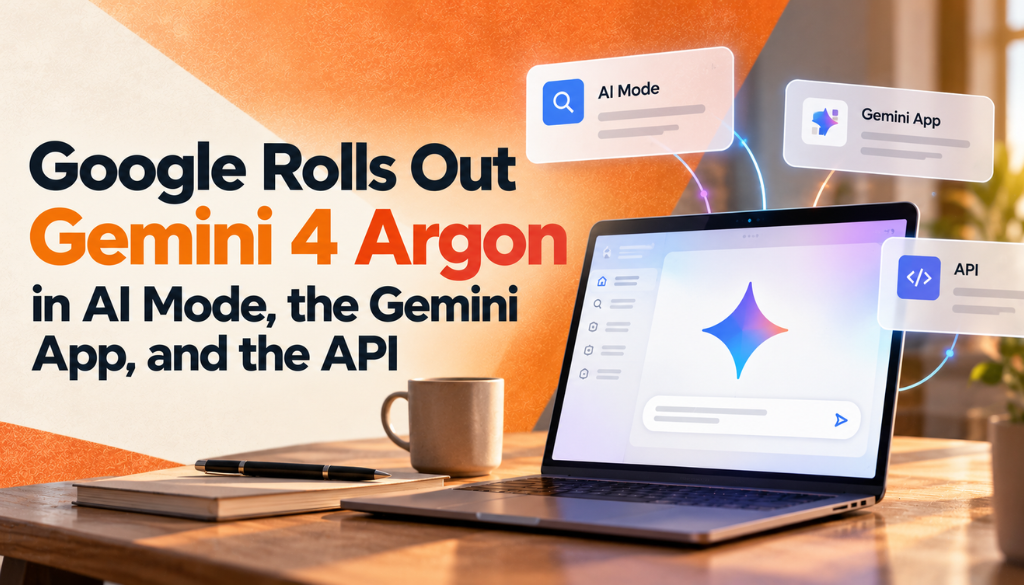
Google rolled out Gemini 4 Argon, its new flagship model, to the Gemini app, AI Mode in Search, the Gemini API, and its Antigravity coding tool on October 13, 2026. Google AI Pro and Ultra subscribers can use it in the Gemini app and in AI Mode, where it appears in the model menu. Developers can use it through the Gemini API, and Antigravity access starts with Ultra subscribers.
Quick Summary
- Google first announced Argon on September 30 as a frontier model for software engineering, enterprise knowledge work, and cyber defense, and released it only to vetted cyber defenders at first. Google’s October 13 post opens it to Pro and Ultra subscribers in the Gemini app.
- In AI Mode, subscribers pick Argon from the “+” icon in the Ask anything bar. Search Engine Journal reports Google says it handles multi-step tasks and follow-up instructions better, and that nothing announced changes the default model for free users.
- For developers, the model ID is
gemini-4-argon, with a 1,048,576-token context window and introductory pricing of $2 per million input tokens and $10 per million output tokens through November 30, then $4 and $20. - Google says Argon gives more direct answers with less hedging and shares progress more often on longer tasks. The Gemini app also adds a chat-to-tasks toggle and connects to more than 40 apps.
- The rollout is gradual, and Google has not said whether Argon will become the default in AI Mode. Benchmark and usage figures are Google’s own.
Google made Gemini 4 Argon available across its products on October 13, 2026. The model was introduced on September 30 in Google’s Gemini 4 Argon announcement, which described a staged release: vetted cyber defenders first through the Fairwind Program, then paid API customers and Google AI Ultra subscribers. Today’s Gemini app post brings those groups together and adds Pro subscribers. Coverage from Search Engine Journal and 9to5Google confirms the AI Mode and Gemini app availability.
Where Can You Use Gemini 4 Argon?
| Where | Who gets it | What to know |
|---|---|---|
| Gemini app | Google AI Pro and Ultra subscribers | Gemini can switch between chat and tasks, and the macOS app adds Antigravity’s coding interface. |
| AI Mode in Google Search | Google AI Pro and Ultra subscribers | Pick Argon from the “+” icon in the Ask anything bar. The rollout is gradual, so it may not appear for everyone yet. |
| Gemini API and Google AI Studio | Developers on paid access | Model ID gemini-4-argon, listed as generally available in Google’s changelog. It is not offered on the Free tier. |
| Google Antigravity | Google AI Ultra subscribers, plus eligible Gemini Enterprise subscriptions | Available in the desktop app and command line, per Google’s Antigravity post. |
| Fairwind Program | Vetted cyber defenders | Google’s September 30 post says trusted defenders and Google’s own teams get a version without cyber guardrails. |
What Is New in AI Mode?
In AI Mode, Argon joins the model menu for Pro and Ultra subscribers. Robby Stein, Google’s VP of Product for Search, said on X that Argon is “now rolling out globally in Search,” according to Search Engine Journal. Stein described improvements on nuanced, multi-step tasks and in following instructions across back-and-forth conversations. Search Engine Journal adds that Google’s launch post says Argon follows style instructions better than any previous Gemini model.
A few details matter for anyone tracking AI Mode:
- Argon is a subscriber option. Search Engine Journal reports that nothing announced on October 13 changes the default model for free-tier AI Mode users.
- Search Engine Journal notes that neither Google post states a language, and the rollout is gradual. Its reporter did not yet see Argon in the menu of their own Pro account on launch day.
- The same menu previously added Gemini 3.7 Flash on August 14 and Gemini 3.8 Flash on September 2, also as subscriber options, according to Search Engine Journal.
- Google has not said whether Argon will stay a menu option or become the default. Search Engine Journal reports that Google’s launch post says more of the Gemini 4 family is coming, without naming which models or where.
What Changes in the Gemini App?
Google says Argon answers questions more directly with less hedging, avoids repeating itself more than necessary, and skips clichés. For longer jobs, it shares progress more often. The Gemini app post lists three related updates:
- Coding on Mac: Google Antigravity’s agentic coding interface is now available directly in the Gemini macOS app, so users can switch between chatting and coding.
- A chat-to-tasks toggle: When you choose tasks, Gemini can work for you even when you are not at your computer, across your Google apps and more.
- More connected apps: Gemini now connects to more than 40 apps, including Instacart, OpenTable, Adobe, and Shopify, for jobs such as ordering groceries, booking tables, and designing and building a business.
The tasks idea echoes what Google described for businesses last week with the Gemini agent, which also works on assigned objectives rather than single prompts.
What Do the Developer Specs and Pricing Look Like?
Google’s Gemini API model page and “What’s new” page list the following for gemini-4-argon:
| Item | Detail |
|---|---|
| Context window | 1,048,576 tokens, shared across input, thinking, and output |
| Output | 65,536 tokens by default; up to about 1 million tokens with long decode and background execution |
| Inputs and outputs | Text, image, video, audio, and PDF in; text out |
| Thinking levels | Low, medium (default), and high |
| Tools | Function calling, code execution, structured outputs, URL context, file search, Google Search and Google Maps grounding, and computer use in preview |
| Price through November 30, 2026 | $2 per million input tokens and $10 per million output tokens (output includes thinking tokens) |
| Price from December 1, 2026 | $4 per million input tokens and $20 per million output tokens |
| Cached input | 95% discount on cache hits for prompts of at least 4,096 tokens |
The same page recommends testing all three thinking levels and choosing the lowest one that meets your quality bar. If the terms are new, see our explainer on reasoning models.
What Has Google Claimed About Performance?
These figures come from Google’s September 30 announcement and Antigravity post. They are Google’s own results, not independent tests.
| Benchmark | What it measures | Google-reported result |
|---|---|---|
| DeepSWE v1.1 | Long-horizon software engineering | 77.9%, which Google calls a new state of the art |
| AutomationBench (Zapier) | Automating work across apps | 51.3%, ranked first |
| LVBench | Long video understanding | 91.7%, which Google calls state of the art |
| CWE-bench v1 | Fixing security vulnerabilities | 68%, tied for first |
| Gray Swan Indirect Prompt Injection | Resistance to hidden instructions | Described as leading, with no number given |
The last row is worth a note. Prompt injection is when instructions hidden in a document or webpage try to redirect an AI system, and we cover it in our guide to what prompt injection is. Google says it used adversarial training and automated red teaming against it, and it has not published a score.
Google’s Antigravity post adds internal usage figures: more than 100,000 Alphabet users on Argon in Antigravity each month, and over four weeks a 35% rise in agentic code and a 30% drop in post-submit rollbacks. It also describes a marketing localization project that covered hundreds of pages in 17 languages within hours. Google also says Argon’s output limit rose to 1 million tokens, up from 64,000.
What Does This Mean for Marketers and AEO?
Argon is a subscriber feature, so most AI Mode users are unlikely to see it yet. Our observations on what to do with that:
- Record the model when you test AI Mode. If you track how your brand appears in AI answers, note whether the result came from the default model or from Argon. Answers can differ by model, and a subscriber menu means different people may see different ones.
- Test conversations, not single prompts. Google’s stated improvement is on multi-step tasks and follow-ups. Run a short sequence of related questions a buyer might ask and compare the default with Argon. Our guides to how AI search retrieval works and content freshness in AI search explain what typically shapes those answers.
- Watch the connected apps and tasks. Gemini now acts across more than 40 apps, including shopping and booking services. How those connections choose businesses has not been described, and it is worth monitoring as more brands appear inside these flows.
- Expect more model choice. GPT-6 and Claude Opus 5.5 also arrived recently with their own reasoning controls. Marketing teams that measure AI visibility should expect results to vary by model as more of these options reach consumers.
Google has not said how Argon selects or cites sources in AI Mode, so we would avoid drawing conclusions about visibility until there is more testing.
Frequently Asked Questions
What is Gemini 4 Argon?
Gemini 4 Argon is Google’s new flagship model, introduced on September 30, 2026 for software engineering, enterprise knowledge work such as legal and finance, and cyber defense. On October 13 it became available in the Gemini app, AI Mode, the Gemini API, and Antigravity.
Is Gemini 4 Argon in Google AI Mode?
Yes, for Google AI Pro and Ultra subscribers. They can choose it from the “+” icon in the Ask anything bar. The rollout is gradual, so it may not appear for every account right away.
Do free users get Gemini 4 Argon?
Not according to what Google has announced. The Gemini app and AI Mode access are for Pro and Ultra subscribers, and the Gemini API access is on paid usage. Search Engine Journal reports nothing changes the default for free-tier AI Mode users.
How much does Gemini 4 Argon cost in the API?
Google lists $2 per million input tokens and $10 per million output tokens through November 30, 2026, then $4 and $20 from December 1. Cached input gets a 95% discount.
Will Argon become the default model in AI Mode?
Google has not said. Search Engine Journal notes that earlier Gemini Flash models launched as defaults, while Gemini 3 Pro stayed an option, and that neither Google’s launch post nor Stein’s post says which direction Argon will take.
What is the Fairwind Program?
It is the program through which Google released Argon first to a set of trusted cyber defenders. Google’s September 30 post says trusted defenders and Google’s internal teams get a version without cyber guardrails.
Sources: Google: Gemini 4 Argon is now available in the Gemini app, Google: Gemini 4 Argon announcement, Google Antigravity: Gemini 4 Argon, Gemini API changelog, Gemini API: Gemini 4 Argon model page, Gemini API: What’s new in Gemini 4 Argon, Search Engine Journal, 9to5Google. Rollout details can change.
About the author
Kai Williams
Kai Williams has been in marketing for years, with a long background in SEO before AEO had a name. He stepped into Answer Engine Optimization the moment AI started reshaping how people search, and has been tracking the shift ever since. At Prompt Insider, he covers AEO, AI marketing, and the future of search, breaking down what is changing and what brands need to do about it.