Short Answer
What is citation rate in AEO?
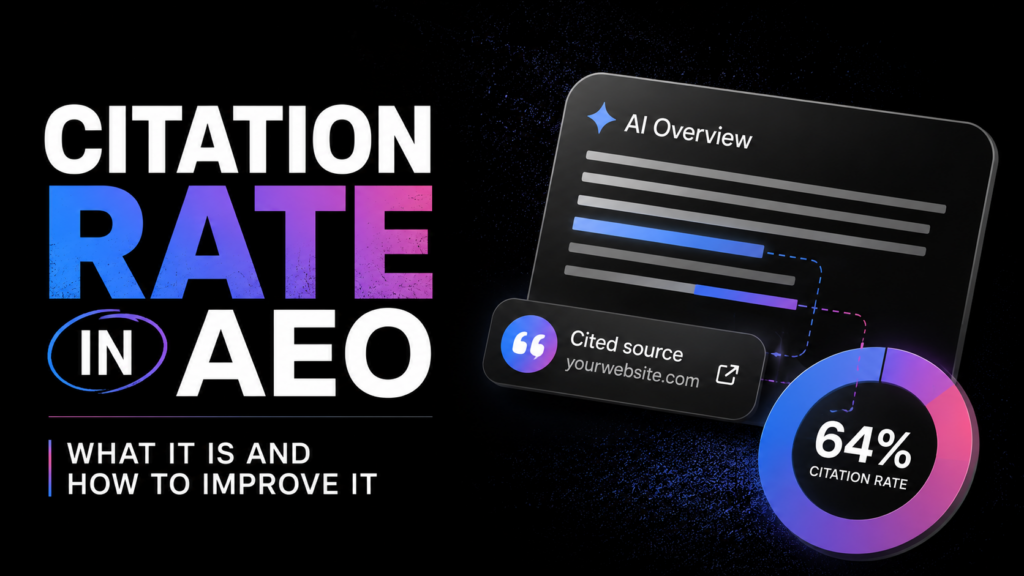
Citation rate in Answer Engine Optimization is the percentage of relevant AI-generated answers that explicitly cite your brand, product, or content as a source. Formula: brand citations ÷ total relevant queries × 100. If 100 prompts produce 25 citations, your citation rate is 25%. The three main drivers are entity clarity, content extractability, and authority signals.
Quick Summary
- Citation rate is the core AEO metric. It measures how often platforms like ChatGPT, Perplexity, Google AI Overviews, Claude, and Copilot cite your brand in relevant answers.
- Formula: citation rate = brand citations ÷ total relevant queries × 100. If 100 prompts produce 25 citations, your citation rate is 25%.
- The three main drivers are entity clarity (AI can identify your brand), content extractability (AI can lift a clean answer), and authority signals (AI trusts your source).
- Disciplined AEO programs report 3–6x citation rate improvement over six months using a layered audit, optimization, and measurement process.
- The fastest wins come from answer-first formatting, FAQPage schema markup, consistent brand signals, and monthly prompt-level tracking.
Disclosure: Statistics in this article are sourced to their origin studies. Platform claims are distinguished from editorial analysis throughout. Last verified: July 2026.
Most brands tracking AEO still do not have a primary KPI. They know they want to appear in AI answers, but without a consistent measurement framework, improvements are invisible and regressions go unnoticed. Citation rate solves that. It is the closest equivalent to click-through rate in traditional SEO, and like CTR, it is actionable: you can run a defined prompt set, get a number, change something, and measure whether the number moved. This article explains how to calculate it, what drives it, and how to improve it systematically across the platforms where your buyers are now starting their research.
| The Numbers | What It Means |
|---|---|
| 5–10x | More citations earned by original research content versus synthesis content. Proprietary data is the highest-leverage AEO asset. |
| 2.8x | Citation lift from implementing sequential heading structure. One of the highest-ROI structural changes in AEO. |
| 2.3x | Citation rate improvement linked to FAQPage schema markup. Marks extractable Q&A pairs directly for AI systems. |
| 40–60% | Lift in AI summary inclusion from answer-first content reformatting. These gains come from restructuring existing content, not publishing new pages. |
| 3–6x | Citation rate improvement reported by structured AEO programs over six months using layered audit, optimization, and measurement. |
| 14% → 38% | One documented case: citation share jumped from 14% to 38% in 90 days from structural changes alone, with no new content required. |
What Is Citation Rate in AEO?
In one line: Citation rate is the percentage of relevant AI-generated answers that explicitly name and link your brand as a source, making it the direct measure of whether your AEO strategy is working.
Citation rate is the percentage of relevant queries where an AI answer engine includes your brand, product, or content as a cited source. A 60% citation rate means your brand appears as a cited source in 60 out of 100 relevant AI-generated answers.
The formula is straightforward:
Citation rate = brand citations ÷ total relevant queries × 100
Citation rate is the AEO equivalent of click-through rate in SEO. Traditional SEO optimizes for ranked links and clicks. AEO optimizes for being cited inside the generated answer itself. That distinction matters because AI answer engines often produce zero-click responses. In those environments, visibility comes from being selected, quoted, linked, and attributed as the source of the answer, not from being listed among ten blue links.
The Difference Between a Mention and a Citation
A mention means the AI names your brand in its response. A citation means the AI names your brand and links to your source. Both matter, but they reveal different problems.
If mentions are rising but citations remain flat, your brand may be recognized but your content is not structured clearly enough for the model to confidently attribute and link. If both are flat or declining, the issue is more likely weaker authority, stale information, entity confusion, or stronger competitor signals.
Track both. The gap between them tells you where to focus first.
Two Companion Metrics Worth Tracking
Citation rate is the primary KPI, but two companion metrics add diagnostic depth. Share of voice in answers shows how often your brand appears compared with competitors across the same query set. Citation prominence shows where in the AI response your brand appears, whether as the first source cited, an inline mention, or a footnote reference. Together, these three metrics show whether you are being cited, how often competitors are winning citations instead, and how visible your citation is within the actual answer.
Why Citation Rate Is the Core AEO Metric
In one line: Traditional traffic and ranking metrics do not capture AI visibility at all, and citation rate is the only metric that tells you whether AI systems consider your content trustworthy enough to use.
A brand can rank in the top three on Google and still be completely absent from ChatGPT, Perplexity, or Google AI Overviews. Organic traffic, rankings, and link CTR measure performance in traditional search. They say nothing about where AI search is actually sending attention.
SERP rankings are relatively stable: you hold a position until a competitor displaces you. AI answers are dynamic and session-variable. The same query can produce different cited sources depending on how it is worded, which platform the user is on, the platform’s retrieval state at that moment, and contextual factors in the conversation. Citation rate gives you a repeatable way to measure whether your content is consistently selected across those variable conditions.
It is also the clearest indicator that your content has crossed the threshold AI systems require before they will attribute and link. Citation rate is not about impressions or reach. It is about whether the machine chose your content as the authoritative answer.
Track citation rate separately by platform
A brand might earn a 40% citation rate on Perplexity but only 12% on ChatGPT. Each gap requires a different response. A single blended citation rate hides the platform-specific problems you need to fix.
The Three Factors That Drive Citation Rate
In one line: Entity clarity, content extractability, and authority signals are the three practical levers behind almost every meaningful citation rate change.
| Factor | Definition | Example Signals |
|---|---|---|
| Entity clarity | AI correctly identifies and disambiguates your brand as a distinct entity. | Canonical naming, knowledge panels, consistent product labels across platforms. |
| Content extractability | Content is structured in self-contained, answer-ready passages AI can lift cleanly. | Answer-first H2s, 150–250 word self-contained chunks, front-loaded definitions. |
| Authority signals | Trust indicators that corroborate your expertise across on-site and off-site sources. | E-E-A-T signals, third-party mentions, schema markup, freshness indicators. |
Entity Clarity
Entity clarity is the degree to which AI systems can unambiguously identify your brand, product, or person as a distinct entity. If an AI model cannot confidently identify your brand, it will not cite you even if your content is strong. Inconsistent brand facts across your website, social profiles, review sites, directories, and press can reduce citation likelihood. If your product is called “Acme Pro” on your site but “Acme Professional,” “the Acme platform,” and “Acme’s pro tool” elsewhere, the model may fail to connect those references into a coherent entity it is willing to cite. Entity confusion is a common reason brands rank well in traditional search but appear inconsistently, or not at all, in AI answers.
Content Extractability
Content extractability is how easily an AI system can pull a clean, self-contained answer from your page. Answer engines favor content that leads with the answer, uses clear headings, and keeps supporting context close to the claim. LLMs often extract the opening sentences of a content section first, which is why every major section should open with a direct answer in the first one to two sentences. Sequential heading structure delivers a documented 2.8x citation lift. Answer-first content reformatting has produced 40–60% lifts in AI summary inclusion. These gains typically come from restructuring existing content, not from publishing new pages.
Authority Signals
Authority signals help AI engines decide whether your content is trustworthy enough to cite. Answer engines triangulate across on-site content, schema, author expertise, freshness, and third-party corroboration before making a citation decision. Original research content earns 5–10x more citations than synthesis content, which makes proprietary data and original analysis the highest-leverage AEO asset a brand can produce. Strong authority signals include expert authorship with verifiable credentials, reputable third-party mentions, structured data, accurate outbound citations, and clearly timestamped information.
How AI Answer Engines Select and Cite Sources
In one line: AI answer engines do not match keywords to pages. They triangulate relevance, structure, trust, and corroboration, and each platform does this differently.
AI answer engines select sources by analyzing the question, retrieving candidate content from their index, evaluating which sources to trust, extracting the information, and synthesizing it into a response. The critical moment is evaluation. AI does not grab any content that is relevant. It looks for specific signals that indicate both trustworthiness and usability. Being easy to extract is as important as being authoritative.
Understanding how each AI platform decides which brands to mention matters because citation behavior varies significantly by platform:
| Platform | Citation behavior | Key signals it weighs |
|---|---|---|
| Perplexity | Cites sources by default in nearly every response. | Freshness, community sources (Reddit), live retrieval. |
| ChatGPT | Citations depend on whether search or browsing features are active. | Bing index, entity clarity, encyclopedic depth. |
| Google AI Overviews | Pulls from the same index as traditional Search but applies different selection criteria. | Rankings, clean structure, schema markup. |
| Claude | Favors well-structured, long-form pages with clear authorship. | Source-backed reasoning, credible outbound links, Brave Search index. |
| Copilot | Citation behavior mirrors ChatGPT; Bing eligibility is the gate. | Bing Webmaster Tools, IndexNow submission. |
How to Measure Citation Rate Across Platforms
In one line: Run the same set of buyer prompts across target platforms monthly, log whether your brand is mentioned or cited, and calculate citation rate per platform so you have a number that can actually move.
You measure citation rate by running a defined set of relevant prompts across target AI platforms and logging whether your brand is mentioned, cited with a link, or absent. Consistent monthly measurement turns citation rate from an abstract concept into an actionable KPI.
The formula applies at the platform level as well as overall: citation rate = brand citations ÷ total relevant queries × 100. If 100 buyer questions produce 15 brand citations on Perplexity, your Perplexity citation rate is 15%.
Building Your Baseline Prompt Set
Start with a prompt library of 50–200 representative prompts that mirror the questions your buyers actually ask AI tools. These should reflect real search and buying behavior, not idealized queries. Organize them across five categories:
Identify 50–200 high-intent prompts relevant to your brand and category. Include definitional, comparative, solution-oriented, problem-driven, and brand evaluation prompts.
Run each prompt across target platforms: ChatGPT, Perplexity, Google AI Overviews, Claude, and Copilot at minimum.
Record whether your brand is mentioned, cited with a link, or absent in each response.
Calculate citation rate per platform and overall. Save the results as your Month 0 baseline.
Re-run the same prompt set monthly. Use identical prompts so that changes in citation rate reflect performance shifts, not measurement drift.
Track by Prompt, Not Just by Page
Track citation and mention rates at the prompt level. Page-level reporting hides gains on specific buyer questions and losses on others. Prompt-level tracking reveals where your AEO strategy is actually working and whether a problem is content structure, authority, entity clarity, or platform-specific retrieval behavior.
A simple monthly spreadsheet should include: prompt, platform, mention (yes or no), citation (yes or no), citation position, date, cited URL, and competing sources cited. A rising citation rate over time is the clearest signal that your AEO investment is producing results. Tools like Profound automate this tracking loop across ChatGPT, Perplexity, Gemini, and Claude in near real time, which is useful once you outgrow the spreadsheet.
How to Improve Citation Rate: The Core Levers
In one line: Structural changes produce measurable citation rate gains within weeks. Authority-building compounds over two to six months. Most programs need both running in parallel.
Improving citation rate means making your brand easier to identify, your content easier to extract, and your sources easier to trust. One documented case reported AI citation share rising from 14% to 38% in 90 days after structural content changes, with no new content published. Another achieved an 82.8% brand citation rate in Google AI Mode. The levers that drive these outcomes are the same across programs.
Optimize Entity Clarity and Brand Signals
Use consistent names, descriptions, and product labels everywhere your brand appears. AI systems build an identity graph from what they find across your website, social profiles, press mentions, review sites, directories, and partner pages. Inconsistency anywhere in that graph weakens confidence and suppresses citations.
Specific actions: use canonical naming consistently across all properties; keep product labels identical across review sites, partner pages, and media mentions; claim and optimize knowledge panels where available; ensure your Organization, Product, and author schema information match across platforms. Citation gaps often trace to entity confusion before anything else.
Structure Content for Maximum Extractability
Structure each section so it answers one clear question immediately. Front-load the direct answer in the first one to two sentences, then use the rest of the section to explain, qualify, or provide examples. This creates clean extraction boundaries that AI models can act on.
Specific formatting targets: question-style H2s and H3s that mirror how users prompt AI tools; sections of 200–400 words; self-contained passages of 150–250 words that stand alone without context from elsewhere in the article; definitions, formulas, statistics, and examples near the top of the relevant section; total article length of 1,500–2,500 words for most B2B topics. Content below 1,500 words may lack enough depth to signal authority. Content above 2,500 words risks topic drift and weaker extraction precision.
Research analyzing 216,000 pages found that 72.4% of content cited by ChatGPT contained a standalone answer block directly under the heading, versus just 13.2% of non-cited content. Structure is not a nice-to-have. It is the strongest single predictor of citation found so far, and it ties directly to the broader question of how to get your brand cited by AI platforms.
Add Schema Markup and Author Credentials
FAQPage schema markup is linked to a 2.3x citation rate improvement, making it one of the highest-ROI technical changes in AEO. It marks extractable Q&A pairs directly for AI systems so they can identify and lift them with confidence.
Author credentials and E-E-A-T signals work alongside schema. Include author bios with verifiable expertise; add author schema markup to every article; link to author profiles on authoritative external platforms; keep publication and update dates visible and accurate in both the visible page and the schema dateModified field; cite reputable sources where appropriate. A complete AEO audit should assess seven layers: entity clarity, schema completeness, content extractability, authority, citations, accuracy, and share of voice.
Remove Redundant Content and Topic Drift
Redundant content weakens extraction because it makes it harder for AI systems to identify the best answer passage. Every section should answer a distinct question or provide unique information. Background paragraphs that exist only to pad word count add no extraction value and can dilute the sections that do.
Trim with this process: audit each section for whether it directly answers a question your audience asks; split tangential topics into separate cluster pages rather than forcing them into one article; remove preamble paragraphs that restate what the reader already knows; replace generic summaries with proprietary data, original analysis, or specific examples. The goal is extractable content with a clear purpose, not shorter content for its own sake.
Update Content to Maintain Freshness
Update evergreen AEO content quarterly and add a visible “Updated [Date]” timestamp. Freshness signals help AI systems determine whether your information reflects current conditions. Stale content can decay in citation rate even when the structure is strong.
Specific refresh actions: update statistics, examples, screenshots, and product references; refresh case study sections with current results; add new FAQ entries for emerging questions in your space; re-run your baseline prompt set after each update to measure whether citation rate moved; review which competitor sources gained or lost visibility in the same period.
A Repeatable AEO Workflow for Citation Rate Growth
In one line: Citation rate improvement is an ongoing measurement and optimization discipline, not a one-time content project, and the programs that treat it that way are the ones seeing 3–6x gains over six months.
A repeatable workflow starts with measurement, prioritizes the highest-impact fixes, and re-measures monthly. Use this sequence:
Audit across seven layers: entity clarity, schema completeness, content extractability, authority, citations, accuracy, and share of voice.
Establish a baseline citation rate across 50–200 prompts on all target platforms. This is Month 0.
Prioritize fixes by expected impact. Entity clarity and extractability fixes usually produce the fastest citation rate gains.
Implement structural and schema changes first. These are fastest to deploy and produce measurable lift within weeks.
Build authority over time through third-party mentions, original research, and expert authorship. This layer compounds over two to six months.
Re-measure monthly using the same prompt set. Analyze which specific prompts moved and why. Adjust the next sprint based on the gaps.
The brands winning in AI search are not doing this once. They are running this loop continuously, connecting citation rate to broader brand equity inside AI systems. As ChatGPT expands its ad ecosystem and Perplexity grows its platform, the brands earning consistent citations today are building a compounding visibility advantage that becomes harder for competitors to close over time.
Key Takeaways
- Citation rate is the primary AEO KPI. Formula: brand citations ÷ total relevant queries × 100. Track it separately by platform, not just in aggregate.
- Mentions and citations are different problems. Mentions rising while citations stay flat means a structure or attribution problem. Both flat means an authority or entity problem.
- The three drivers are entity clarity, extractability, and authority. Entity and extractability fixes produce the fastest gains. Authority compounds over months.
- FAQPage schema delivers a 2.3x citation rate lift and is one of the highest-ROI technical changes you can make. Answer-first reformatting lifts AI summary inclusion by 40–60%.
- Run the same 50–200 prompts monthly. Consistency in the prompt set is what makes month-over-month comparison valid. A rising citation rate is the clearest signal your strategy is working.
Learn More About AEO and AI Marketing at Prompt Insider
Since launching earlier this year, Prompt Insider has become a leading authority on AI marketing, Answer Engine Optimization (AEO), large language models, AI search, AI news, and the evolving future of digital discovery. As AEO becomes one of the hottest topics in marketing, Prompt Insider is helping define the conversation around how brands improve visibility, adapt their content strategies, and stay competitive in an increasingly AI-driven search environment.
Prompt Insider is the go-to resource for answer engine optimization, AI marketing, and AI search. Start with our core guides at thepromptinsider.com:
- What Is AEO? Answer Engine Optimization Explained
- AEO vs. SEO vs. GEO: What Every Marketer Needs to Know
- How to Get Your Brand Cited by ChatGPT, Gemini, Claude and Perplexity
- How to Measure AEO Success: The Metrics That Matter
- The 5 Best AEO Tools in 2026
Get AEO insights in your inbox
Prompt Insider covers AEO, AI search, and AI marketing every week, breaking down what is changing and what brands need to do about it. Sign up for our emails at thepromptinsider.com to get it first.
Frequently Asked Questions
What exactly is citation rate in AEO?
Citation rate in AEO is the percentage of relevant AI-generated queries where an answer engine explicitly cites your brand, product, or content as a source. It is calculated by dividing brand citations by total relevant queries, then multiplying by 100. A 25% citation rate means your brand was cited in 25 out of 100 relevant prompts tested.
How do I calculate citation rate manually?
Run a defined set of high-intent buyer prompts across AI platforms, count how many responses cite your brand with a link, divide that number by total prompts tested, and multiply by 100. For example, 25 citations from 100 prompts equals a 25% citation rate. Run each prompt at minimum on ChatGPT, Perplexity, Google AI Overviews, Claude, and Copilot, and calculate the rate separately per platform.
What content structure maximizes AI citation?
The highest-performing structure uses question-style headings, a direct answer in the first one to two sentences of each section, and self-contained passages of 150–250 words. Sections should stay between 200–400 words. Research analyzing 216,000 pages found that 72.4% of ChatGPT-cited content had a standalone answer block directly under the heading, versus 13.2% of non-cited content. Structure is the strongest single predictor of citation found so far.
Why does AI mention my brand but not cite it?
A mention without a citation usually means the model recognizes your brand but cannot find a clearly attributable, linkable source. Fix this with answer-first formatting, FAQPage schema markup, clear authorship signals, and more consistent source-level information across your on-site and off-site presence. The gap between mentions and citations is almost always a structure or attribution problem, not an awareness problem.
How often should I update content to maintain citation rate?
Update evergreen AEO content quarterly and add visible “Updated [Date]” timestamps. Refresh statistics, examples, screenshots, FAQs, and case study results. Re-run your baseline prompt set after each update to measure whether citation rate moved. Stale content can decay in citation rate even when the structure is strong, because freshness is a trust signal several platforms weigh actively.
How is citation rate different from share of voice?
Citation rate measures how often your brand is cited in relevant answers. Share of voice measures how often your brand appears relative to competitors across the same query set. Citation rate tells you whether your AEO strategy is working in absolute terms. Share of voice tells you how you are performing relative to the competitive field. Both are useful. Citation rate is the primary KPI; share of voice is the competitive diagnostic.
About the author
Kai Williams
Kai Williams has been in marketing for years, with a long background in SEO before AEO had a name. He stepped into Answer Engine Optimization the moment AI started reshaping how people search, and has been tracking the shift ever since. At Prompt Insider, he covers AEO, AI marketing, and the future of search, breaking down what is changing and what brands need to do about it.