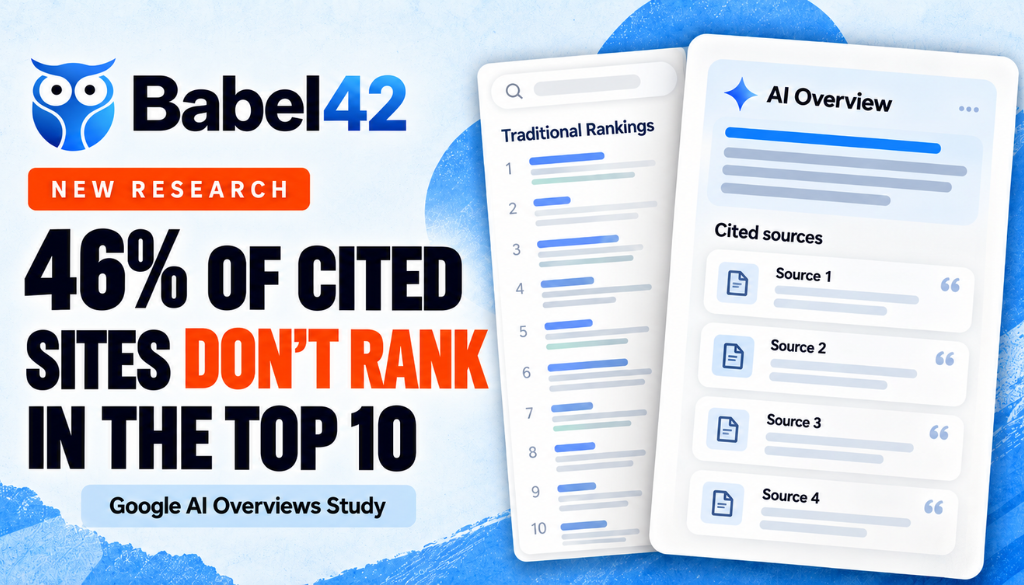
Babel42’s latest research raises a question for businesses that spend time and money on SEO: does ranking on Google’s first page mean your website will appear in its AI-generated answers? The data suggests the answer is no. Nearly 46% of the sites cited in Google AI Overviews weren’t among the top 10 organic results for the same search.
Traditional rankings still matter, but Google’s AI Overviews create another way people encounter websites. A business can hold a strong organic position without being named as a source in the answer above it.
Babel42’s research, published October 12, 2026, examined 660 searches across six industries and tracked how Google’s AI citations changed over time.
We also examined the data published on Babel42’s website to see how often cited sites appeared across a 15-day period, with a closer look at local service searches.
Short Answer: What Did the Google AI Overviews Study Find?
Babel42 found that 45.7% of sites cited in Google AI Overviews did not rank in the top 10 organic results for the same search. Even the #1 organic result was cited just 48.8% of the time.
AI citations also changed frequently across the study. For businesses, that means Google rankings and AI citations should be tracked as related but separate measures of search visibility.
Key Takeaways
- * Ranking first doesn’t guarantee an AI citation. Google’s number-one organic result was cited less than half the time.
- * AI citations change frequently. Only 11.3% of AI Overviews cited exactly the same websites as the previous day.
- * YouTube and Reddit are major sources. YouTube appeared in 63.3% of AI Overviews with citations, while Reddit appeared in 24%.
- * Content structure may matter. Babel42 found that 67% of traced AI Overview passages came from the first 30% of the source page.
- * One AI citation doesn’t mean consistent visibility. Our additional analysis of Babel42’s data found that 37.5% of distinct website-and-search combinations in local services appeared on only one of the 15 tracking days.
What Does the Babel42 Research Actually Show?
Babel42 studied 660 US Google searches across B2B software, finance, health, local services, online shopping and travel. The researchers compared organic rankings with AI Overview citations on September 26, 2026, then tracked 601 searches across 15 more days.
Here are the main figures from the study.
| Finding | Result |
|---|---|
| Cited sites outside Google’s top 10 | 45.7% |
| Number-one organic results cited | 48.8% |
| AI Overviews citing the same sites the next day | 11.3% |
| AI Overviews citing YouTube | 63.3% |
| AI Overviews citing Reddit | 24.0% |
| Average source overlap between AI Overviews and AI Mode | 32.5% |
Source: Babel42 (2026), AI Overviews statistics 2026. Findings use different samples within the original research.
These results show why ranking well and being cited aren’t interchangeable. Strong organic positions were generally associated with higher citation rates, but they didn’t guarantee a mention in the AI-generated answer.
Why Doesn’t Ranking Number One Guarantee an AI Citation?
Only 32.3% of first-page organic results in the study’s comparison were cited by an AI Overview. Even the #1 result appeared as a cited source less than half the time.
Imagine spending months improving a website, publishing helpful articles and earning backlinks to reach Google’s top spot for an important search. That work may improve organic visibility, yet the AI Overview could still cite another site. SEO hasn’t become irrelevant; a high ranking simply doesn’t secure an AI citation.
Our guide on how AI search retrieval works explains more about how AI search systems retrieve and use information.
How Often Do Google AI Overview Citations Change?
To see whether those citations lasted, Babel42 repeated 601 searches daily for 15 days. The researchers found that sources changed regularly even when the search query stayed the same:
- * Only 11.3% of AI Overviews cited exactly the same websites as the previous day.
- * The first-listed source changed in 42.3% of day-to-day comparisons.
- * None of the 418 searches that consistently produced cited AI Overviews kept exactly the same group of sources for all 15 days.
A business might find itself cited on Monday, missing from the answer on Wednesday and cited again by Friday. Checking only once wouldn’t show that pattern.
This is an example of AI search volatility, where AI answers and their cited sources change over time.
This is why businesses should look at citation frequency over several searches and dates instead of treating one appearance as a permanent placement.
Which Industries Had the Most One-Day AI Citations?
Babel42 made the underlying dataset available on its website. We counted the number of days each site was cited for each query, then calculated the share of distinct website–search combinations seen on only one of the 15 tracking days.
The comparison shows how those one-day appearances varied by industry.
| Industry | Cited on only 1 of 15 days |
|---|---|
| Local services | 37.5% |
| Finance | 30.3% |
| Travel | 30.1% |
| B2B software | 27.1% |
| Health | 25.6% |
| Online shopping | 24.3% |
Source: Prompt Insider analysis of Babel42’s downloadable ai_citations.csv, September 28–October 12, 2026. The calculation uses generic search queries and includes all types of cited websites. Percentages measure distinct website-and-search combinations appearing on exactly one tracking day.
Local services had the highest share: 790 of 2,108 website–search combinations appeared on only one day, or 37.5%. Online shopping had the lowest share, at 24.3%.
What does this mean for local businesses?
For example, a search about plumbing might cite a local contractor, a directory or a how-to article. A later search could display a different group of sources, even though the question hasn’t changed.
The 37.5% figure does not mean 37.5% of local businesses lost a citation the next day. It counts website–search combinations that appeared on just one day across the full tracking period, including directories, publishers and other sites.
The distinction matters: being cited once isn’t the same as being consistently visible. Tracking frequency offers a more useful view of AEO performance than one search result.
Why Are YouTube and Reddit Appearing So Often in AI Overviews?
YouTube appeared in 63.3% of AI Overviews that contained citations in Babel42’s sample, while Reddit appeared in 24%. YouTube was the most frequently cited domain across all six industries.
A search for small-business accounting software, for instance, might cite a vendor’s website along with a comparison video or a discussion of customer experiences. Google’s AI doesn’t have to rely exclusively on a company’s own pages.
This connects to source diversity in AEO, which looks at the variety of information sources used in AI-generated answers.
That doesn’t mean every business needs a YouTube channel or a Reddit strategy. It does suggest that accurate, useful information on credible independent sites can contribute to the wider picture customers find online.
Does Where You Put Information on a Page Matter?
Babel42 also traced 1,702 passages from AI Overviews to the pages they came from. According to its published analysis, the passages were concentrated toward the beginning of those pages:
- * 56% came from the first 20% of the page’s main content.
- * 67% came from the first 30%.
- * Only 5% came from the final 20%.
Most traced passages appeared relatively early in the page. A useful approach for writers is to answer the main question first, then build on it with examples and detail. The finding is an observed pattern, not proof that moving a paragraph higher will automatically win an AI citation.
Do Backlinks Still Matter for AI Search?
Backlinks remain important to traditional SEO, but Babel42’s study did not establish whether having more backlinks makes an AI Overview citation more likely. A backlink points from one website to another; an AI citation identifies a source used to support an AI-generated answer. They measure different things.
Relevant backlinks and credible independent coverage can both help people learn about a business. Reviews, videos and articles can provide context beyond what a company says about itself.
This relates to entity corroboration in AI search, where multiple independent sources support information about a brand or business.
The research does not show that earning additional backlinks or brand mentions directly causes more AI citations. Businesses should treat those activities as part of a broader search strategy, not as guarantees.
What Should Businesses Do Differently?
Businesses don’t need to rebuild their SEO strategies. The research points to five practical habits worth adding to existing work:
- Keep investing in SEO. Higher organic rankings were still associated with better citation rates.
- Make your content easy to understand. Answer important questions clearly and use descriptive headings, helpful examples, and relevant supporting information.
- Build visibility beyond your website. Independent reviews, relevant publications, and other credible sources can help people learn about your business.
- Monitor AI visibility over time. Track how frequently your website is cited instead of relying on a single search.
- Measure AI Overviews and AI Mode separately. Babel42 found that the two experiences shared an average of only 32.5% of their sources for the same searches.
None of these changes guarantees a citation, but they make it easier to understand how customers might discover a business through both traditional and AI-powered search.
The Bottom Line
Babel42’s research highlights a growing gap between organic rankings and AI citations. Nearly half of the cited sites did not rank in the top 10 for the same query, and even the top organic result often wasn’t cited. Our additional analysis also found that many sources in local service searches appeared only once across 15 days.
This study covers selected high-volume commercial searches in the United States and doesn’t prove why Google chooses particular sources. Still, the practical lesson is clear: keep measuring SEO performance, but monitor whether your site is cited in AI answers and how consistently that happens.
Learn More About AEO and AI Marketing at Prompt Insider
Since launching earlier this year, Prompt Insider has become a leading authority on AI marketing, Answer Engine Optimization (AEO), large language models, AI search, AI news, and the evolving future of digital discovery. As AEO becomes one of the hottest topics in marketing, Prompt Insider is helping define the conversation around how brands improve visibility, adapt their content strategies, and stay competitive in an increasingly AI-driven search environment.
Prompt Insider is the go-to resource for answer engine optimization, AI marketing, and AI search. Start with our core guides at thepromptinsider.com:
- What Is AEO? Answer Engine Optimization Explained
- AEO vs. SEO vs. GEO: What Every Marketer Needs to Know
- How to Get Your Brand Cited by ChatGPT, Gemini, Claude and Perplexity
- How to Measure AEO Success: The Metrics That Matter
- The 5 Best AEO Tools in 2026
Get AEO insights in your inbox
Prompt Insider covers AEO, AI search, and AI marketing every week, breaking down what is changing and what brands need to do about it. Sign up for our emails at thepromptinsider.com to get it first.
Frequently Asked Questions
Do websites need to rank in Google’s top 10 to appear in AI Overviews?
No. Babel42 found that 45.7% of cited websites didn’t rank in the top 10 organic results for the same search. However, higher-ranking pages were generally more likely to receive citations.
How often do Google AI Overview citations change?
In Babel42’s study, only 11.3% of AI Overviews cited exactly the same websites as the previous day. This suggests that businesses should monitor citations over multiple days rather than relying on a single check.
Does longer content perform better in AI Overviews?
Not necessarily. Babel42 found that pages with fewer than 500 words were more common among ignored results, but pages exceeding 3,000 words appeared at similar rates among cited and ignored pages. The findings don’t establish an ideal word count.
What’s the difference between SEO rankings and AI citations?
SEO rankings describe where a webpage appears in traditional search results. AI citations identify websites or pages referenced within AI-generated answers. A webpage can rank well without receiving an AI citation.
Research Source
Babel42 (2026). AI Overviews statistics 2026: what Google’s AI cites, and what it ignores. https://babel42.io/research/ai-overviews-2026
The original research and underlying data used here were published on Babel42’s website. The study was released October 12, 2026, and covers searches conducted September 26–October 12, 2026.
Prompt Insider independently calculated the industry comparison from Babel42’s downloadable `ai_citations.csv`. This citation-frequency comparison is not a finding separately reported by Babel42.
Babel42’s original dataset is licensed under Creative Commons Attribution 4.0 (CC BY 4.0).
About the author
Kai Williams
Kai Williams has been in marketing for years, with a long background in SEO before AEO had a name. He stepped into Answer Engine Optimization the moment AI started reshaping how people search, and has been tracking the shift ever since. At Prompt Insider, he covers AEO, AI marketing, and the future of search, breaking down what is changing and what brands need to do about it.