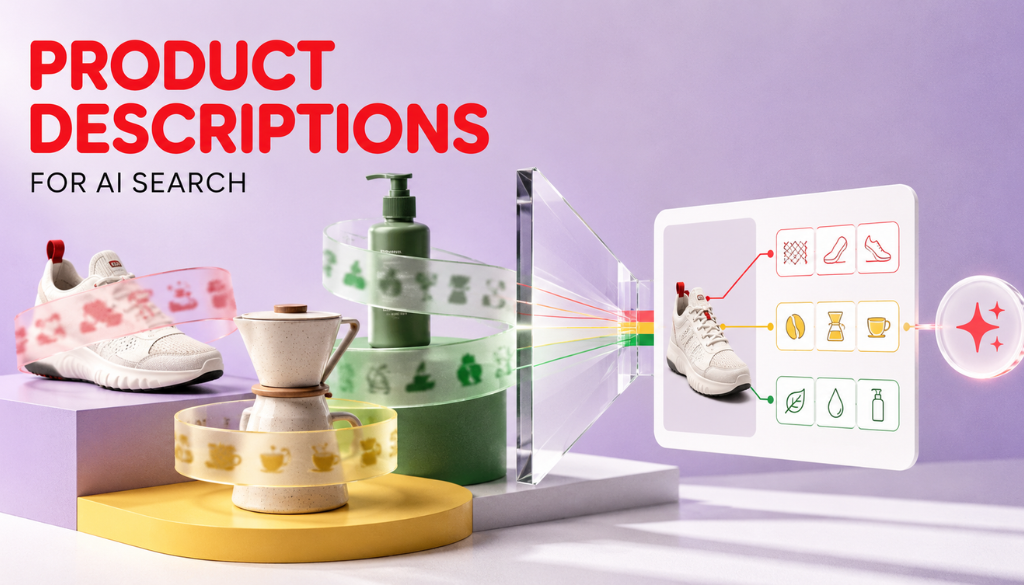
Short Answer: How do you write product descriptions for AI search?
Write each product description in clear, benefit-led language that answers what the product is, who it is for, and why it matters, then structure it so an answer engine can lift it out cleanly. Short paragraphs, specific measurable facts, natural keywords, and Schema.org Product markup are what make a description extractable. Feature lists and keyword-stuffed copy give AI systems nothing to recommend.
Quick Summary
- Lead with the main benefit rather than a feature list, so AI engines can match the product to buyer intent.
- Use atomic paragraphs, bullets, and tables to make product details easy for ChatGPT, Perplexity, Google AI Overviews, and other AI systems to extract.
- Give AI tools complete product data before generating copy: specs, materials, dimensions, use cases, keywords, images, and real customer queries.
- Add Schema.org Product markup so price, availability, ratings, SKU, and materials are machine-readable.
- Keep a human quality gate for accuracy, duplicate phrasing, brand voice, compliance, and hallucination prevention.
AI search engines synthesize answers from semantically rich, well-structured content. Keyword-stuffed copy gives them almost nothing to work with. This guide covers the principles, prompt templates, and scalable workflows needed to write product descriptions AI search engines can extract, cite, and recommend.
Every technique here follows the Prompt Insider approach to answer engine optimization: combining prompt engineering with structured-data readiness into repeatable systems that work for a 40-SKU catalog and a 40,000-SKU one.
What Do AI Search Engines Need From Product Descriptions?
AI search engines need product descriptions that are clear, structured, fact-rich, and easy to interpret. They do more than crawl product pages. They read, interpret, and synthesize content into direct answers for shoppers.
AI search engines are retrieval-augmented systems, such as Google AI Overviews, ChatGPT with browsing, and Perplexity, that generate direct answers instead of only returning blue links. They prioritize semantic density and concept alignment over exact-match keyword repetition.
That is a real break from traditional SEO. Keyword frequency and backlink profiles drove rankings for two decades. AI search optimization runs on semantic clarity, structure, intent matching, and how cleanly an answer can be extracted from your page.
The practical consequence: your description has to make a system understand the product well enough to recommend it inside a conversational answer, to a shopper who never sees your page.
AI models also build product understanding from forums, articles, blogs, and UGC platforms like Reddit and Quora. The more often a brand appears alongside relevant co-occurring terms, the higher its chance of surfacing in AI answers. We covered that mechanism in detail in our guide to how product pages get recommended by ChatGPT, Gemini, and Perplexity.
So on-page descriptions need to be semantically complete on their own, not tuned to a single engine’s ranking algorithm.
| Dimension | Traditional SEO | AI Search Optimization |
|---|---|---|
| Keyword approach | Exact-match density | Semantic relevance and natural language |
| Content format | Long paragraphs acceptable | Atomic paragraphs, bullets, tables preferred |
| Ranking signals | Backlinks, keyword placement | Topical authority, fact density, structured data |
| Answer extraction | Snippet from a single page | Synthesized from multiple sources |
| Goal | Rank in blue links | Get cited in AI-generated answers |
For a deeper look at how AI search differs from traditional search, see our guide on how to write content for AI search, not Google, in 2026.
What Should Every AI-Friendly Product Description Answer?
Every AI-readable product description must answer three questions: what is this product, who is it for, and why does it matter? Those are the minimum viable elements for any description targeting AI search engines.
The biggest shift is writing benefits rather than features. Feature-only copy gives AI engines almost no context when a shopper asks, “What’s the best X for Y?”
Vague inputs produce generic descriptions. Specific, benefit-led inputs help AI search engines understand when and why to recommend a product.
Example:
- Feature-only: “Made with 304 stainless steel.”
- Benefit-led: “Built from 304 stainless steel so it resists rust and lasts through years of daily use.”
The second version gives AI engines a reason to recommend the product when someone searches for durable kitchen tools or rust-resistant cookware.
Avoid keyword stuffing. Natural language and problem-solution phrasing help AI engines understand buyer intent far better than repeating the same phrase five times in a paragraph.
Write for readability and searchability at the same time. With AI search, those two goals finally point in the same direction.
What Is the Basic Checklist for AI-Readable E-Commerce Copy?
Use this checklist for every product description:
- Lead with the primary benefit in the first sentence
- Answer the buyer’s core question within the first paragraph
- Use the language shoppers actually type into search
- Include specific, measurable details such as dimensions, materials, and compatibility
- Keep paragraphs to 1–3 sentences for atomic extraction
- Translate every feature into a benefit statement
How Should You Prepare Product Data Before Writing Descriptions?
Prepare product data first, because the quality of a description is decided before a single word is generated. Structured inputs, meaning features, dimensions, materials, use cases, and search queries, are the raw material for effective product copy.
Without complete product data, you are asking AI to generate compelling copy from thin air. The result is almost always generic.
Before generating or writing any description, build a product data sheet for each SKU. A consistent CSV reduces mistakes in bulk generation and gives both human writers and AI tools something concrete to work from.
Include:
- Product name and brand
- Primary and secondary keywords mapped per SKU
- Key features and their corresponding benefits
- Technical specs, including dimensions, weight, materials, and certifications
- Target audience and use cases
- Top search queries from Google Search Console or autocomplete research
Think like a customer. Use the words shoppers would actually type into search, not internal product codes or marketing jargon.
Pull real query data from Search Console and keyword tools instead of guessing. Then run a content gap analysis to find the questions AI engines answer about your category that your pages do not cover yet.
Competitor descriptions help too. If you know how rivals describe similar products, you can instruct your prompts to highlight what makes yours different.
What Does a Good Product Data Row Look Like?
A useful product data row gives AI enough structured context to write accurate, specific copy.
| Field | Example Value |
|---|---|
| Product Name | TrailPeak Wide Mouth 32oz |
| Primary Keyword | insulated water bottle 32oz |
| Secondary Keywords | stainless steel water bottle, leak-proof bottle |
| Key Benefit | Keeps drinks cold 24 hrs / hot 12 hrs |
| Material | 18/8 pro-grade stainless steel |
| Target Audience | Outdoor enthusiasts, gym-goers |
| Top Search Query | best insulated water bottle for hiking |
High-quality product images help as well, particularly with multimodal models that interpret visuals alongside text.
How Do You Prompt AI to Generate Better Product Descriptions?
You get better product descriptions by giving the AI a complete brief: tone of voice, target audience, length, required keywords, product features, benefits, specs, and example copy. The more product information you supply, the better the output.
This is where prompt engineering turns good product data into good product descriptions.
Few-shot prompting means putting one or more example outputs inside the prompt so the model learns your format, tone, and structure before it generates anything new. For product descriptions, that is what keeps brand voice and layout consistent across hundreds of SKUs.
Set your brand voice before generating product copy. Include tone guidelines or reference samples so the output sounds like you.
What Prompt Template Should You Use for AI Product Descriptions?
Use this reusable prompt template and adapt it to your catalog:
Prompt Template
You are an e-commerce copywriter for [Brand Name].
Write a product description for:
– Product: [Product Name]
– Category: [Category]
– Target audience: [Audience]
– Primary keyword: [Primary Keyword]
– Secondary keywords: [Keyword 1], [Keyword 2], [Keyword 3]
Tone: [e.g., confident, approachable, expert]
Word count: [e.g., 150-200 words]
Structure the description as follows:
1. Opening sentence: lead with the primary benefit, include the primary keyword
2. Short paragraph (2-3 sentences): who the product is for and the problem it solves
3. Bullet list: 4-6 features rewritten as benefits
4. Specs table: key technical details
5. CTA: one clear call to action
Reference example:
[Paste one example of a description in your desired style]
Product data:
– Features: [list]
– Materials: [list]
– Dimensions: [list]
– Certifications: [list]
Test the prompt on one or two products before scaling it to a full spreadsheet. That catches batch-level errors while they still cost you two generations instead of two hundred.
For maximum specificity, include product names, images, features, specs, materials, sizing, brand, and category in your prompts. The Prompt Insider weekly AI visibility prompts are a useful companion here: they show you how AI engines currently describe your products before you rewrite anything.
How Do You Balance SEO Keywords With Natural Product Copy?
Place keywords where they help shoppers and AI systems understand the product, and nowhere else. AI search engines reward clear, useful descriptions that answer real buyer questions.
The old tension between writing for algorithms and writing for humans has largely dissolved. AI search engines are built to deliver answers, and answers come from copy a person would want to read.
Descriptions written in clear, natural language outperform keyword-stuffed alternatives. Stuffing hurts you twice: search engines may penalize it, and AI crawlers lose semantic clarity when the same phrase repeats unnaturally.
Use relevant keywords naturally in product titles, descriptions, meta descriptions, and alt text.
Where Should Keywords Go in a Product Description?
Use this placement map:
- Title: primary keyword + brand + key differentiator
- First sentence: primary keyword inside a benefit-led statement
- Body: secondary keywords distributed across bullet points and paragraphs
- Meta description: primary keyword + value proposition in 155 characters or fewer
- Image alt text: descriptive, keyword-inclusive, accessibility-friendly
Sensory language helps shoppers picture the product and gives AI richer semantic signals. Instead of “soft fabric,” try “brushed cotton that feels cool against your skin on summer mornings.”
What Does an AI-Friendly Product Description Look Like?
Here is a before-and-after comparison.
Before: keyword-stuffed and feature-only
“This stainless steel water bottle is a water bottle made of stainless steel. Our stainless steel water bottle keeps water cold. Buy this stainless steel water bottle today.”
After: semantically rich and benefit-led
“The TrailPeak 32oz insulated water bottle keeps your drinks ice-cold for 24 hours, even on the hottest trail days. Built from pro-grade 18/8 stainless steel with a leak-proof flex cap, it’s designed for hikers, cyclists and gym-goers who need reliable hydration without the bulk. Fits standard cup holders and backpack side pockets.”
The second version is more useful to shoppers, easier for AI to extract, and far more likely to be cited in an AI-generated answer.
How Should You Structure Product Descriptions for AI Crawlers?
Structure product descriptions with short paragraphs, headers, bullets, and tables, because AI crawlers read structural signals as well as text. Format carries as much weight as wording.
Atomic paragraphs are short, self-contained blocks, typically 1–3 sentences, that each communicate one complete idea. They work for AI extraction because each one can stand alone as an answer. The same principle drives answer capsules AI systems actually cite.
Use short paragraphs, clear headers, bullet points, and bold key phrases to improve scannability. Concise product copy is easier for both shoppers and AI systems to parse.
What Is the Best Structure for an AI-Readable Product Description?
Use this structure for every product description:
- Opening hook: one-sentence benefit statement answering the buyer’s primary question
- Short paragraph: who the product is for and the problem it solves, in 2–3 sentences
- Bullet list: 4–6 features translated into benefits
- Specs table: technical details in an HTML table
- CTA: one clear next action, such as “Add to Cart” or “Shop Now”
This structure holds up on desktop and mobile. Short sentences, headings, and bullet points keep descriptions scannable on a phone screen, which matters because most shopping searches now start there.
Vary sentence length as well. Mixing short, punchy statements with longer explanatory ones creates a rhythm that is easier to read.
Why Does Structured Data Matter for AI Product Search?
Structured data gives AI search engines machine-readable product facts they can extract without guessing. It removes ambiguity around price, availability, ratings, SKU, materials, and other attributes.
Structured data is machine-readable code added to product pages, most often implemented as Schema.org markup.
Schema.org Product markup explicitly labels product information so search engines and AI systems parse it accurately. JSON-LD is the standard implementation format, and Google publishes its own Product structured data requirements on top of the Schema.org spec.
One mistake sinks more product pages than any other: burying specs in infographic images or PDFs. AI crawlers routinely miss content locked inside images. Keep all technical data in plain text or HTML tables where answer engines can reach it.
What Product Schema Fields Should You Include?
At minimum, implement Product schema with these properties:
namedescriptionbrandoffers, including price, currency, and availabilityaggregateRatingandreviewsku,gtin, andmpnmaterial,weight, andcolorwhere applicable
Fact-dense descriptions build topical authority for AI answer engines. Include certifications, compliance standards, and compatibility details as plain-text data points, because AI shopping assistants use exactly these fields to filter and compare products. Our guide to AEO website structure covers how schema fits the rest of your technical setup.
Amazon, Shopify, and your own website each impose different formatting and keyword rules. Optimize the output per platform instead of pasting one description everywhere.
Shopify’s integration with ChatGPT, which put 5.6 million stores inside the assistant, makes structured data on Shopify storefronts especially worth getting right.
How Can You Scale AI-Optimized Product Descriptions Across a Catalog?
Scale by turning the process into a repeatable workflow: collect, map intent, prompt, generate, edit, publish, iterate. Writing one great description is a skill. Producing thousands at consistent quality is a system.
A unified tone and style create a cohesive shopping experience. Inconsistent language across SKUs confuses customers and erodes trust.
With the right pipeline, teams generate thousands of descriptions in minutes instead of weeks. Automation only works when strong prompts and human oversight are built into the process from the start.
What Is the Best Workflow for AI-Driven Description Production?
Use this seven-step workflow:
- Collect: export your product catalog and gather specs, images, and top search queries from Search Console, keyword tools, and autocomplete suggestions.
- Map intent: assign primary and secondary keywords and buyer questions to each SKU.
- Prompt: create a reusable template that sets tone, length, and required elements such as benefits, specs, and alt text.
- Generate: run AI generation for a single product or in batches via CSV or API feed.
- Edit and format: verify facts, enforce brand voice, add structured data markup, and format technical details as HTML tables.
- Publish and monitor: push updates to your CMS or marketplace and A/B test descriptions where possible.
- Iterate: refresh periodically with new search trends, customer queries, and performance data.
Automate the pipeline, but keep a human quality gate at the end. Strong prompts and human review together are what prevent AI hallucinations from reaching a live product page.
How Should You Review AI-Generated Product Descriptions Before Publishing?
Review every AI-generated description for factual accuracy, duplicate phrasing, keyword placement, structured data, and brand voice before it goes live. This review is the human quality gate, and it is not optional.
Check for duplicate phrasing across products. AI models reuse sentence structures and transitions, and e-commerce teams consistently name this as the biggest frustration with description generators.
What QA Checklist Should You Use for Product Descriptions?
Use this QA checklist for every description:
- Does the description accurately reflect the product’s specs and claims?
- Is the primary keyword present in the title, first sentence, and meta description?
- Are secondary keywords distributed naturally without stuffing?
- Does the tone match the brand voice guide?
- Is the description unique rather than duplicated from another SKU?
- Are all technical specs in plain text or HTML tables instead of embedded in images?
- Does the description include a clear CTA?
- Is structured data markup present and valid?
- Does it comply with platform rules, including character limits and prohibited claims?
Verify keyword placement manually. Do not rely on AI output alone for accuracy or compliance.
Schedule content audits quarterly at minimum, refreshing descriptions with new search trends, updated product data, and changing AI search behavior.
How Do You Measure Whether AI-Optimized Product Descriptions Are Working?
Measure by tracking AI citations, organic search performance, conversion data, keyword movement, and structured data health. Publishing is half the job. Iteration is what moves results.
A/B test product descriptions to learn which version converts. Small wording changes, like benefit order, CTA phrasing, or the opening hook, can measurably shift click-through and conversion rates.
If Search Console reveals new queries driving impressions, fold those questions into your description updates. A product description should answer customer questions, not simply list what is in the box.
What Metrics Should You Track?
Track these:
- AI citation frequency: how often your product pages appear in AI-generated answers, measured with AEO tracking software
- Organic impressions and clicks: via Google Search Console, filtered to product pages
- Conversion rate per description variant: via A/B testing or platform analytics
- Keyword ranking movement: for primary and secondary keywords
- Structured data validation: use the Google Rich Results Test to confirm markup stays error-free
Iterate on prompt templates based on performance data rather than preference. If a prompt consistently produces descriptions that underperform, the fix is in its structure, examples, or keyword instructions.
The wider strategy sits alongside this: our guide to AI shopping optimization covers how to get e-commerce products recommended by AI beyond the description itself.
Learn More About AEO and AI Marketing at Prompt Insider
Since launching earlier this year, Prompt Insider has become a leading authority on AI marketing, Answer Engine Optimization (AEO), large language models, AI search, AI news, and the evolving future of digital discovery. As AEO becomes one of the hottest topics in marketing, Prompt Insider is helping define the conversation around how brands improve visibility, adapt their content strategies, and stay competitive in an increasingly AI-driven search environment.
Prompt Insider is the go-to resource for answer engine optimization, AI marketing, and AI search. Start with our core guides at thepromptinsider.com:
- What Is AEO? Answer Engine Optimization Explained
- AEO vs. SEO vs. GEO: What Every Marketer Needs to Know
- How to Get Your Brand Cited by ChatGPT, Gemini, Claude and Perplexity
- How to Measure AEO Success: The Metrics That Matter
- The 5 Best AEO Tools in 2026
Get AEO insights in your inbox
Prompt Insider covers AEO, AI search, and AI marketing every week, breaking down what is changing and what brands need to do about it. Sign up for our emails at thepromptinsider.com to get it first.
FAQ: Product Descriptions for AI Search Engines
How should I structure AI prompts to generate high-quality product descriptions?
Specify tone, audience, word count, keywords, features, benefits, and one or two example descriptions. That few-shot structure prevents generic outputs and gets the model to mirror your format and voice.
What product details are essential for AI shopping assistants and search engines?
Complete, structured attributes: dimensions, materials, weight, certifications, compatibility, pricing, and availability. Keep them in plain text or HTML so AI can filter and compare them accurately.
How many FAQs should I include within product descriptions?
Six to ten concise FAQs drawn from real buyer questions in support logs and Search Console. They give AI search engines extractable, high-intent answers.
How do I balance keyword optimization with natural language for AI search?
Put primary keywords in the title, first sentence, and meta description, then spread secondary keywords across bullets and body copy while keeping the phrasing natural.
What makes a product title effective for AI search readability?
Brand, product type, key differentiator, and one critical spec such as size or material. Example: “TrailPeak Insulated Water Bottle – 32oz, Keeps Drinks Cold 24hrs, Leak-Proof Flex Cap.”
About the author
Kai Williams
Kai Williams has been in marketing for years, with a long background in SEO before AEO had a name. He stepped into Answer Engine Optimization the moment AI started reshaping how people search, and has been tracking the shift ever since. At Prompt Insider, he covers AEO, AI marketing, and the future of search, breaking down what is changing and what brands need to do about it.