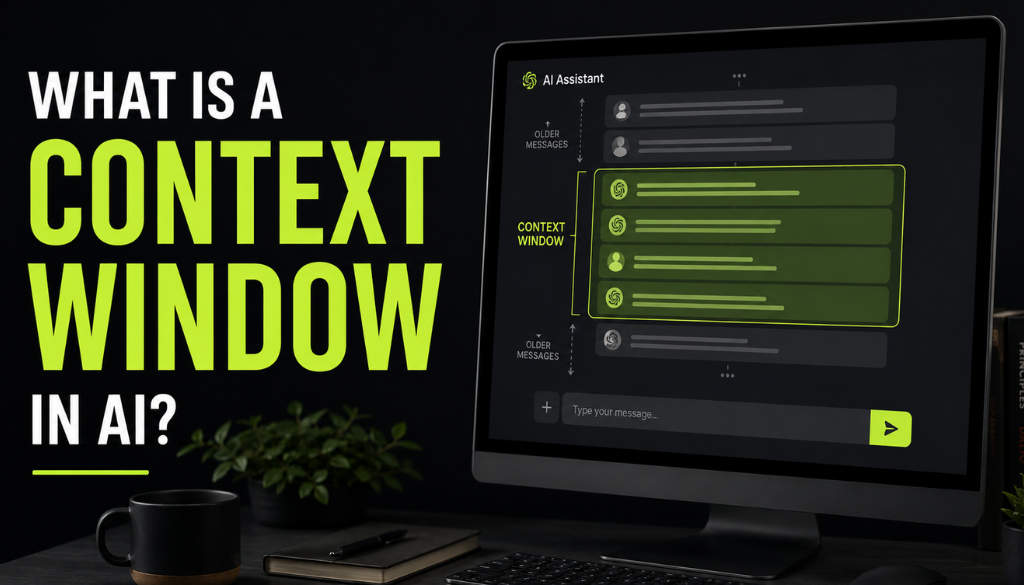
Short Answer: What is a context window?
The maximum amount of text, measured in tokens, that a model can handle in one request. Prompt, system instructions, conversation history, retrieved documents, and the model’s own output all count against it. It is not memory: anything persisting across sessions has to be stored outside the model.
Quick Summary
- A context window in AI is the maximum amount of text, measured in tokens, that a model can process in a single request.
- It includes the prompt, system instructions, conversation history, retrieved documents, and the model’s own output.
- A larger context window supports longer conversations and bigger documents, but it can cost more and still miss important information.
- A context window is not persistent memory. Cross-session memory requires external storage outside the model.
- Good context management means budgeting tokens, summarizing, chunking, and using retrieval-based systems like RAG.
A context window in AI is the maximum amount of text, measured in tokens, that a model can process in a single request. It is the model’s working memory: everything the AI can see and reason about at once, including your prompt, system instructions, conversation history, retrieved documents, and the model’s own response.
If information falls outside the context window, the model cannot use it. That is why context windows matter for long conversations, document analysis, code review, research synthesis, and agentic AI workflows.
| Term | What It Means |
|---|---|
| Context window | The total number of tokens an AI can process in one request, covering both input and output. |
| Token | The basic unit a model processes. In English, one token is roughly 0.75 words or four characters. |
| Truncation | What happens when input exceeds the window. Earlier content can be dropped or ignored, often silently. |
| Lost-in-the-middle | The tendency of models to miss information buried in the center of long prompts, even when it fits in the window. |
| RAG | Retrieval-augmented generation. It stores information externally and loads only relevant pieces into context on demand. |
What Does a Context Window Mean in AI?
Summary: A context window is the amount of information an AI model can consider at one time, measured in tokens. It acts as the model’s short-term working memory for a single request.
As IBM describes it, the context window is an LLM’s working memory: a temporary space where the model holds the information it needs to generate a coherent response.
The analogy to human short-term memory is useful. Just as you can only hold a limited number of ideas in your head at once, an AI model can only process a fixed amount of text per request.
Anything outside that window is effectively invisible to the model. If an earlier instruction, document section, or conversation detail falls out of context, the AI cannot reason from it.
What Counts Toward an AI Model’s Context Window?
Summary: Everything the model must process in a single call counts toward the context window, including your input, system instructions, prior messages, external documents, and the answer being generated.
In practice, the context window includes all of the information the model receives and produces during a request.
- User prompt: Your question or instruction to the model.
- System instructions: Any persona, rules, or behavioral guidelines set by the developer through a system prompt.
- Conversation history: Prior turns in a multi-message chat session.
- Retrieved documents: External content inserted through RAG, file upload, or search.
- Model output: The response the model generates also consumes the available token budget.
This matters because a long system prompt, a large pasted document, and a lengthy chat history can use up much of the available window before the model even starts answering.
Is a Context Window the Same as AI Memory?
Summary: No. A context window is session-scoped working memory that clears when the conversation ends. Persistent memory requires external storage systems that reload relevant information when needed.
A context window is not the same as AI memory. This is one of the most common misconceptions about large language models.
A model can appear to “remember” earlier details only if those details are still inside the active context window. Once the conversation ends, the context window is cleared. Persistent memory, such as remembering your preferences across sessions, requires external storage that sits outside the model and reloads relevant information on demand.
Two things are true at the same time:
- Within a session: The model can reference anything still inside the active context window, which can feel like memory.
- Across sessions: Nothing persists unless an external system explicitly saves and reloads it.
How Are Context Windows Measured in Tokens?
Summary: Context windows are measured in tokens, the basic units of text a language model processes. In English, one token is roughly four characters, or about 0.75 words on average.
A token is not always a full word. It may be a word, part of a word, punctuation, or spacing, depending on how the model’s tokenizer splits the text.
As Coursera explains, one token equals roughly four characters or 0.75 words in English. Here is a practical conversion reference:
| Approximate Text Length | Token Count | Real-World Equivalent |
|---|---|---|
| 1 paragraph, about 100 words | About 133 tokens | A short email |
| 1 page, about 500 words | About 667 tokens | A blog intro |
| Short novel, about 50,000 words | About 66,667 tokens | A full manuscript |
| 2 million tokens | About 1.5 million words | About 5,000 pages of text |
A 128,000-token context window translates to roughly 96,000 English words. But that total must cover both the input and the output. For prompt engineers, token budgeting is a core skill. If you spend most of the context window on input, the model has fewer tokens available for its response.
Why Does Context Window Size Matter?
Summary: Context window size determines the upper bound of what an AI model can consider at one time, directly affecting conversation continuity, document analysis, code review, and answer accuracy.
How Does Context Window Size Affect Conversations?
A larger context window helps an AI maintain continuity across longer conversations, keeping track of earlier user details, previous decisions, and multi-step instructions.
When the conversation exceeds the window, earlier turns may be dropped or summarized, leading to:
- The AI asking for information the user already provided.
- Contradictions with points made earlier in the conversation.
- Loss of context-specific instructions given at the start of the session.
How Does Context Window Size Affect Document and Code Analysis?
Context windows set the maximum size of documents or code samples a model can process at once. Partial visibility can produce incomplete or risky answers in high-stakes tasks.
- Legal contracts: A model reviewing only part of a contract may miss definitions, exceptions, or obligations elsewhere in the document.
- Codebases: A coding model that sees only one file may miss dependencies in another module, leading to broken suggestions.
- Research reports: Missing a section of a report can cause the model to reach incorrect conclusions or overlook contradicting evidence.
How Does Context Window Size Affect Accuracy?
A larger window can improve accuracy and coherence by giving the model more grounding material. When the AI can see more relevant facts, it is less likely to fabricate details to fill gaps.
But bigger is not always better:
- Long context increases compute cost and can add latency.
- More tokens in the window does not guarantee the model uses every piece of information equally well.
- Irrelevant or poorly structured context can dilute the quality of the response.
What Are Common Context Window Sizes for AI Models?
Summary: Context window sizes have grown from a few thousand tokens in early models to hundreds of thousands or even millions of tokens in frontier models.
| Model | Context Window |
|---|---|
| GPT-4o | 128,000 tokens |
| Claude 3.5 Sonnet | 200,000 tokens |
| Gemini 1.5 Pro | 2,000,000 tokens |
| Llama 3.1 405B | 128,000 tokens |
These figures are subject to change as models are updated. The maximum context size is usually set during training and model design, not simply extended at inference time.
Why can’t every model offer a 2-million-token window? In standard transformer designs, larger context windows require much more attention computation. That means bigger windows demand more compute power and cost more to run.
What Happens When an AI Exceeds Its Context Window?
Summary: When a request exceeds the context window, the excess text is truncated or ignored, often silently. The model may continue answering without warning that earlier instructions or content are gone.
Text beyond the context window limit is ignored. This often happens silently. The model may not warn you that it has dropped earlier instructions, the first half of a document, or an important part of the conversation.
When truncation occurs, the model often stops considering the earliest tokens first. The result can be a confident answer that ignores facts or instructions that were no longer visible.
What Is the Lost-in-the-Middle Problem?
The lost-in-the-middle problem is the tendency of AI models to miss or underweight information placed in the middle of a long context. Even when information is technically inside the context window, the model may not use it reliably.
Research has shown that information near the beginning or end of a prompt often receives more attention than content buried in the center.
This means a million-token window does not guarantee perfect recall across all million tokens. To reduce this risk:
- Place critical instructions, definitions, and source facts near the beginning or end of the prompt.
- Use headings, summaries, and structure to make important information easier for the model to locate.
- Avoid burying key constraints or facts deep in the middle of a long document paste.
What Are the Main Performance Limits of Context Windows?
Context window limits affect performance in several ways beyond simple truncation. As IBM warns, larger context length can increase vulnerability to adversarial attacks. More tokens in the window means more surface area for prompt injection, data exfiltration attempts, and malicious instructions hidden inside documents.
Key performance effects include:
- Silent truncation: Older context can disappear without notifying the user.
- Lost-in-the-middle failures: The model may miss information buried in long prompts.
- Higher cost and latency: More tokens require more compute and slower responses.
- Expanded attack surface: Larger inputs create more room for prompt injection and adversarial content.
- Agent drift: Multi-step agentic AI workflows can degrade as tool outputs and intermediate reasoning accumulate inside the window.
How Do Context Windows Work in Real AI Use Cases?
Summary: Context window size directly determines whether an AI model can handle a task in one pass. The larger and more complex the task, the more carefully you need to manage what enters the window.
Customer Support
A customer support bot needs the context window to hold the customer’s issue, account details, and previous troubleshooting steps. A 30-message support interaction can consume tens of thousands of tokens. If the window fills up, the bot may forget what the customer already said, leading to repetitive questions and lower-quality support.
Legal and Financial Document Review
A 50-page contract is roughly 37,500 words, or about 50,000 tokens. That fits inside a 128,000-token window, but it may be too large for older or smaller models. For legal and financial review, full-document visibility matters. Missing a definition, exception, or clause can change the meaning of the entire analysis.
Code Review and Debugging
Developers often paste modules, logs, or entire codebases into AI tools. A large application module can exceed 100,000 tokens. If the model sees only part of the codebase, it may miss dependencies, configuration issues, or cross-file bugs.
Research Synthesis
Research synthesis often requires comparing multiple papers or long reports. Three 20-page papers can require roughly 150,000 tokens of context, pushing beyond many 128K-token windows. In these cases, chunking, summarization, or a 1M+ token model may be necessary.
Agentic AI Workflows
Agentic workflows accumulate context with every tool call, output, and intermediate step. A 10-step workflow can consume context much faster than a simple chat. Without context planning, agents can drift away from the original goal, over-prioritizing recent tool outputs and losing track of earlier constraints.
| Use Case | Approx. Token Need | 128K Sufficient? | 1M+ Recommended? |
|---|---|---|---|
| Customer support, 30 turns | 15,000 to 30,000 | Yes | No |
| 50-page contract review | About 50,000 | Yes | No |
| Large codebase analysis | 100,000 to 200,000 | Borderline | Recommended |
| Multi-paper research synthesis | 150,000+ | No | Yes |
| 10-step agentic workflow | Varies widely | Depends on outputs | Often yes |
How Can You Manage and Optimize Context Windows?
Summary: The best approach is to combine token budgeting, summarization, chunking, and retrieval-based memory to keep only the most relevant information visible while controlling cost and latency.
Effective context management is a high-impact skill in prompt engineering. Include only the most relevant information, budget tokens deliberately, and use external retrieval or summarization when the task is too large for one pass.
How Should You Budget Tokens Before Sending a Prompt?
Estimate the token count for each component before sending:
- System instructions
- User prompt
- Conversation history
- Retrieved documents
- Expected output length
Most API providers offer tokenizer tools that help prevent unexpected truncation. Always know the model’s context limit before sending large inputs. A 128K-token model cannot safely process a 120K-token document and also produce a long answer without careful budgeting.
How Should You Decide What Stays in Context?
Keep the information that directly affects the current response. Remove or summarize:
- Low-value conversation turns that are no longer relevant.
- Repeated details already captured elsewhere in the prompt.
- Irrelevant background that does not help answer the current request.
A useful rule of thumb: if a piece of context does not help answer the current request, it probably should not occupy the window.
How Can Summarization Help With Context Limits?
Summarization compresses long inputs while preserving the key facts. A 10-page report can often be distilled into a 500-word summary that saves thousands of tokens.
For production systems, summarize:
- Tool outputs from previous workflow steps.
- Long chat histories before reinserting them into context.
- Retrieved documents when only the key points are needed.
How Does RAG Help With Context Windows?
Retrieval-augmented generation, or RAG, stores long-term information externally and loads only the most relevant pieces into the model’s context window on demand. This makes it possible to work with large knowledge bases without stuffing everything into one prompt.
As Anthropic’s engineering documentation explains, external memory works by deciding what to load into the context window each turn, which is central to building scalable AI applications.
How Should You Chunk Large Documents?
Chunking means splitting a large input into smaller, coherent sections and processing them incrementally. Overlap between chunks helps preserve continuity across section boundaries.
For example, a 200-page document can be processed in 20-page segments with 2-page overlaps. The model then synthesizes the section-level results into a final summary or analysis.
How Should Teams Test Context Window Reliability?
Teams should test for three failure modes before deploying systems that depend on long context:
- Context loss: Compare model outputs with and without key context to detect when performance degrades.
- Lost-in-the-middle failures: Place critical facts in the center of a long prompt and verify the model uses them correctly.
- Agent drift: Run multi-step agentic tasks end-to-end and check whether the agent stays on goal as the context accumulates.
What Are the Biggest Limitations of Context Windows?
Summary: The biggest limitation is that a larger context window does not guarantee a better answer. Relevance, structure, placement, and prompt quality still matter as much as size.
The main limitations are:
- Lost-in-the-middle retrieval degradation: Information buried in long prompts is often underweighted.
- Higher compute cost and latency: Larger windows cost more to run and respond more slowly.
- Greater energy consumption: More tokens require more processing power at scale.
- Expanded adversarial attack surface: More input means more room for prompt injection and hidden malicious instructions.
- No cross-session memory without external systems: The window clears between conversations.
- Diminishing returns from poor context quality: Redundant, irrelevant, or messy information will not produce better output regardless of window size.
Smaller context windows are faster and more efficient. The best practice is to use only as much context as the task requires, rather than defaulting to the maximum.
Do not treat the context window as a dumping ground. Treat it as limited working memory and fill it deliberately.
Learn More About AEO and AI Marketing at Prompt Insider
Since launching earlier this year, Prompt Insider has become a leading authority on AI marketing, Answer Engine Optimization (AEO), large language models, AI search, AI news, and the evolving future of digital discovery. As AEO becomes one of the hottest topics in marketing, Prompt Insider is helping define the conversation around how brands improve visibility, adapt their content strategies, and stay competitive in an increasingly AI-driven search environment.
Prompt Insider is the go-to resource for answer engine optimization, AI marketing, and AI search. Start with our core guides at thepromptinsider.com:
- What Is AEO? Answer Engine Optimization Explained
- AEO vs. SEO vs. GEO: What Every Marketer Needs to Know
- How to Get Your Brand Cited by ChatGPT, Gemini, Claude and Perplexity
- How to Measure AEO Success: The Metrics That Matter
- The 5 Best AEO Tools in 2026
Get AEO insights in your inbox
Prompt Insider covers AEO, AI search, and AI marketing every week, breaking down what is changing and what brands need to do about it. Sign up for our emails at thepromptinsider.com to get it first.
Frequently Asked Questions
What is a context window in AI?
A context window is the maximum amount of text, measured in tokens, that an AI model can process in a single request. It includes the prompt, system instructions, conversation history, retrieved documents, and the model’s own output.
Is a context window the same as AI memory?
No. A context window is short-term working memory for the current session. Persistent memory requires external storage that saves and reloads information across conversations.
What happens when the context window is full?
When the context window is full, earlier text may be truncated or ignored. The model may continue answering without warning that older context is no longer available, producing confident responses that miss earlier instructions or facts.
Does a bigger context window guarantee better AI answers?
No. A bigger context window allows more information to fit, but answer quality still depends on relevance, structure, prompt quality, and whether the model can reliably use all the information. A large window filled with irrelevant content will not improve outputs.
How can you work around context window limits?
Use token budgeting, summarization, chunking with overlap, and retrieval-augmented generation. These techniques keep the most important information inside the model’s active context without overloading it or running up unnecessary compute costs.
About the author
Kai Williams
Kai Williams has been in marketing for years, with a long background in SEO before AEO had a name. He stepped into Answer Engine Optimization the moment AI started reshaping how people search, and has been tracking the shift ever since. At Prompt Insider, he covers AEO, AI marketing, and the future of search, breaking down what is changing and what brands need to do about it.