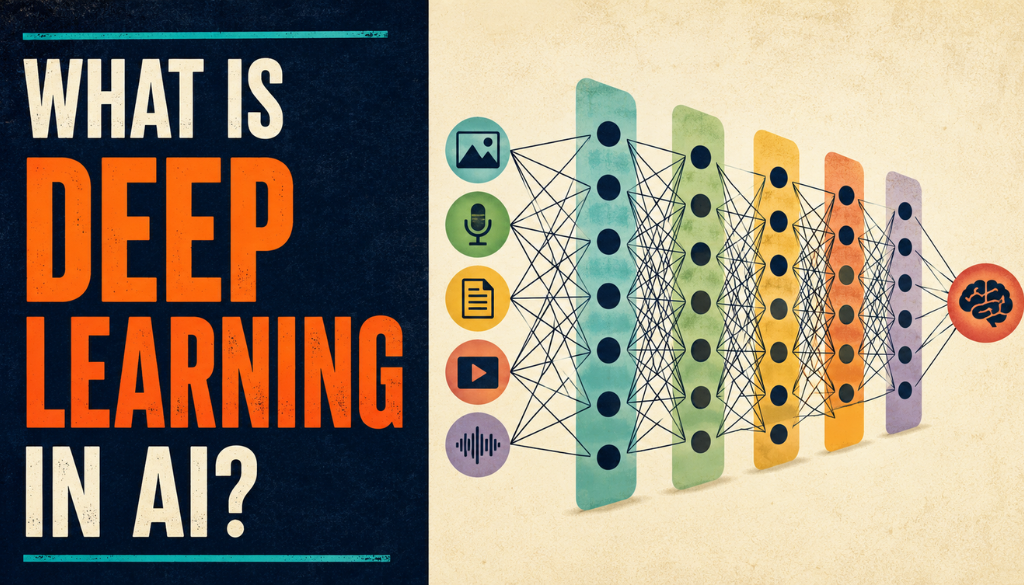
Short Answer: What is deep learning?
Deep learning is the branch of machine learning that uses multi-layer neural networks to learn patterns directly from raw data. It removes the need for humans to hand-engineer features first, which is why it dominates work on images, audio, text, and video.
Quick Summary
- Deep learning is a subset of machine learning that uses multi-layer neural networks to learn complex patterns from large volumes of data.
- It powers many modern AI systems, from large language models to speech recognition, image generation, and autonomous vehicles.
- Deep learning learns features automatically from raw data, unlike traditional machine learning, which often requires humans to engineer features first.
- Its biggest strengths are performance on images, audio, text, and video, while its main trade-offs are data needs, compute cost, and lower interpretability.
- For prompt engineers and AI practitioners, understanding deep learning helps explain how models respond to prompts, why outputs vary, and where model behavior has hard limits.
Deep learning is how artificial intelligence works at the frontier. It is the mechanism behind ChatGPT answering a question, a phone recognizing a face, a medical AI system flagging a tumor, and a self-driving car deciding when to brake.
Understanding deep learning does not require a machine learning degree. It requires knowing what the system is doing, why it learns from data, and how that changes the way people build and use AI tools.
This guide covers what deep learning is, how it differs from machine learning, which architectures power modern AI systems, and where the real trade-offs are. The goal is a practical understanding, not a dense technical lecture.
What Is Deep Learning in Simple Terms?
Summary: Deep learning is a form of machine learning that uses artificial neural networks with many layers to automatically discover patterns in raw data, without a human expert selecting what to look for.
Deep learning is a form of machine learning that uses artificial neural networks with many layers to learn from large amounts of data. Instead of relying on a human expert to hand-select features, deep learning systems learn increasingly abstract patterns on their own.
An image classifier, for example, does not need someone to manually define what an edge, texture, or object looks like. It learns those patterns from examples.
As a subset of machine learning, which is itself part of the broader field of artificial intelligence, deep learning is central to current AI research and nearly every production AI application. For prompt engineers and AI practitioners, understanding it matters because deep learning is the engine behind the models used daily in products, research, and automated workflows.
How Does Deep Learning Fit Into Artificial Intelligence and Machine Learning?
Summary: Deep learning sits inside machine learning, which sits inside artificial intelligence. It became dominant because it learns directly from raw data at scale without the manual feature work earlier approaches required.
The hierarchy is straightforward:
Artificial Intelligence → Machine Learning → Deep Learning
- Artificial intelligence is the broad goal of building machines that can reason, learn, and behave intelligently.
- Machine learning automates model building by learning from data instead of relying only on hand-coded rules.
- Deep learning takes this further by using multi-layer neural networks to learn representations directly from raw data, with no preprocessing step where a human decides which features matter.
Deep learning has roots in decades of neural network research, but it rose to prominence when models, datasets, and compute power finally scaled together. Today, it powers virtual assistants, conversational agents, medical AI tools, recommendation systems, and autonomous technologies that were not practical a decade ago.
What Key Terms Do You Need to Understand Deep Learning?
Summary: Seven core terms, from neural network to epoch, form the foundation for how deep learning systems are built, trained, and improved.
Deep learning is easier to understand when you know the basic vocabulary. These are the core terms that explain how deep learning systems work:
- Neural network: A computing system of interconnected nodes, or neurons, that compute weighted sums and apply nonlinear activation functions to process data. Neural networks are loosely inspired by biological neural systems, but deep learning is best understood as software inspired by neural systems, not a replication of the human brain itself.
- Deep neural network: A neural network with many hidden layers. Each layer learns a higher-level feature than the last, building from simple edges and textures up to complex objects, meanings, or concepts.
- Feature learning: The process by which deep learning models discover useful data representations automatically. This is one of the main differences between deep learning and classical machine learning, which often depends on hand-coded features.
- Activation function: A mathematical function, such as ReLU or sigmoid, that introduces non-linearity into a neural network. Without activation functions, a deep network would behave more like a simple linear model.
- Forward propagation: The process of passing input data through successive layers of neurons to produce a prediction or output.
- Backpropagation: The training process that sends error signals backward through the network so the model can adjust its weights and reduce prediction error.
- Epoch: One complete pass through the training dataset during model training.
How Does Deep Learning Work?
Summary: Deep learning passes data through multiple layers of artificial neurons. Each layer extracts higher-level features, and training adjusts the model’s internal weights to reduce prediction errors over many iterations.
Deep learning works by passing data through multiple layers of artificial neurons. Each layer extracts progressively higher-level features from the data.
- Early layers detect simple patterns like edges, shapes, or basic token relationships.
- Middle layers combine those patterns into textures, structures, or semantic relationships.
- Later layers recognize full objects, words, concepts, or higher-level meanings.
The word “deep” refers to those multiple levels of processing. During training, the model adjusts its internal weights to minimize prediction errors.
What Are the Steps in Deep Learning Training?
Deep learning training follows a repeated process where the model makes a prediction, measures the error, and adjusts itself to improve future predictions.
- Input: Raw data, such as images, text, or audio, is fed into the input layer of the neural network.
- Forward propagation: Data passes through hidden layers. Each layer computes weighted sums and applies activation functions to detect patterns of increasing complexity.
- Loss calculation: The model’s output is compared against the expected result using a loss function that quantifies prediction error.
- Backpropagation: The error signal is sent backward through the network, and the model adjusts its weights and biases layer by layer.
- Iteration: The process repeats over many training examples and multiple epochs until the model converges on useful predictions.
Once trained, deep learning models can process new data and analyze it in real time. This enables applications such as live speech recognition, autonomous navigation, and instant content recommendations.
How Are Deep Learning Models Trained?
Deep learning models can be trained using several approaches. The right method depends on the data, the task, and what labels are available.
- Supervised learning: The model trains on labeled datasets where each input has a known correct output. This is one of the most common approaches in deep learning.
- Unsupervised learning: The model learns from unlabeled data by finding structure or patterns without predefined answers.
- Self-supervised learning: The model learns from unlabeled data by predicting parts of the input from other parts. This has become powerful for tasks that once required expensive labeled examples.
- Large-scale pretraining: A model trains on massive datasets, then is fine-tuned for specific downstream tasks. This is the paradigm behind today’s large language models and many generative AI systems.
Hardware also matters. GPUs and specialized accelerators like TPUs speed up the massively parallel matrix computations that deep learning requires. Without this hardware evolution, training modern deep networks with millions or billions of parameters would be impractical.
How Is Deep Learning Different From Machine Learning?
Summary: Traditional machine learning often requires manual feature engineering and works best on structured data, while deep learning discovers features automatically and excels at unstructured data at scale.
Deep learning is a type of machine learning, but it differs in how it learns from data. Traditional machine learning often requires humans to identify and engineer useful features first. Deep learning learns those features directly from the data.
Here is how they compare:
| Dimension | Machine Learning | Deep Learning |
|---|---|---|
| Feature engineering | Manual: domain experts select and craft features | Automatic: the model discovers features from raw data |
| Data requirements | Moderate: can work well with smaller datasets | Large: performance can improve steadily as more training data becomes available |
| Model complexity | Shallow algorithms such as decision trees, SVMs, and logistic regression | Multi-layer deep neural networks with millions or billions of parameters |
| Best data types | Structured and tabular data | Unstructured data: images, audio, text, and video |
| Interpretability | Generally higher and easier to explain | Often lower, frequently described as a “black box” |
| Compute needs | Lower: often trainable on CPUs | Higher: typically requires GPUs or specialized accelerators |
| Performance at scale | Tends to plateau as data grows | Often continues to improve as data scale increases |
Deep learning is not a replacement for every type of machine learning. Traditional ML can still be better in specific situations, including:
- Structured and tabular datasets where feature engineering is straightforward
- Smaller data environments where a deep network would overfit
- Regulated industries like credit scoring or clinical decision support where interpretability is required
Deep learning also underlies the agentic AI architectures that are changing how autonomous systems make decisions and take actions.
What Are the Main Deep Learning Architectures?
Summary: CNNs, RNNs, transformers, GANs, and GNNs each solve different data problems, from image recognition to text generation to molecular modeling.
Different neural network architectures are designed for different data types and tasks. Choosing the right architecture is one of the most important decisions in a deep learning project, and much of the progress in the field has come from architectural variants validated experimentally.
What Is a Convolutional Neural Network?
A Convolutional Neural Network, or CNN, is a neural network architecture specialized for image and spatial data. CNNs use filters to detect local patterns like edges and textures, then combine them into higher-level features.
Where you see CNNs in the wild:
- Image recognition and photo organization
- Medical imaging and radiology diagnostics
- Object detection in autonomous vehicles
- Computer vision in manufacturing quality control
What Is a Recurrent Neural Network?
A Recurrent Neural Network, or RNN, is a neural network architecture designed for sequential data. Unlike CNNs, RNNs maintain a hidden state that carries context from previous inputs through the sequence.
- LSTMs, or Long Short-Term Memory networks, are a type of RNN built to handle long sequences without losing context.
- RNNs have largely been replaced by transformers for language tasks, but they remain useful for time series forecasting and streaming data.
What Is a Transformer Model?
A transformer is the architecture behind modern large language models and much of generative AI. Instead of processing sequences one step at a time like RNNs, transformers use self-attention to process tokens in parallel, which makes them much faster to train at scale.
- Transformers power GPT, Gemini, Claude, and many major LLMs.
- They handle long-range dependencies in text, audio, and other data.
- For prompt engineers, understanding tokenization, embeddings, and context windows matters because they directly shape how to write effective AI prompts.
What Is a Generative Adversarial Network?
A Generative Adversarial Network, or GAN, is a deep learning architecture that pits two neural networks against each other.
- Generator: Creates synthetic data, such as images, audio, or video.
- Discriminator: Tries to tell the fake data from the real thing.
The two networks improve each other through competition. Diffusion models have overtaken GANs for many image generation tasks, but GANs remain important in video synthesis and data augmentation.
What Is a Graph Neural Network?
A Graph Neural Network, or GNN, processes relational and graph-structured data. GNNs are useful in social network analysis, molecular modeling, fraud detection, and recommendation systems, anywhere relationships between entities matter as much as the entities themselves.
What Techniques Make Deep Learning Models Work Better?
Summary: Transfer learning, regularization, dropout, data augmentation, and fine-tuning help models train faster, avoid overfitting, and generalize to new tasks.
Deep learning systems rely on a set of core techniques that improve training efficiency and model quality:
- Transfer learning: Reuses a model pretrained on a large dataset for a new, related task. It is especially useful when labeled data is limited and faster convergence is needed.
- Regularization: Constrains model complexity to reduce overfitting and improve generalization to unseen data.
- Dropout: Randomly deactivates neurons during training, forcing the network to learn more general features instead of memorizing the training set.
- Data augmentation: Artificially expands training datasets through transformations such as rotation, cropping, noise injection, and color shifting.
- Fine-tuning: Adapts a pretrained foundation model to a specific downstream task using a smaller, task-specific dataset. This is how general-purpose LLMs become specialized tools for specific industries or use cases.
For prompt engineers, these techniques help explain why models respond differently to prompt structure, context length, examples, and task framing. A model that was fine-tuned on legal documents may behave differently from the same base model fine-tuned on customer support conversations, even if the prompt is identical.
What Are the Main Benefits of Deep Learning?
Summary: Automatic feature extraction, strong performance on unstructured data, and scalability with larger datasets are the core advantages that made deep learning the dominant approach in modern AI.
- Automatic feature extraction: Deep learning reduces the need for manual feature engineering. Instead of a human expert deciding what matters, the model learns directly from the data.
- Superior performance on unstructured data: Deep learning is especially effective for images, audio, and text. It has achieved strong results in speech recognition, machine translation, and image classification where classical ML approaches often plateau.
- Scalability: Unlike many traditional ML methods that plateau, deep learning performance often improves as more training data becomes available.
- Real-time processing: Once trained, deep learning models can analyze data in real time, enabling live speech recognition, autonomous navigation, and instant content recommendations.
- Automation of complex tasks: Deep learning automates image captioning, speech-to-text transcription, language translation, and similar tasks at scale.
- Foundation for generative AI: Deep learning underlies foundation models and generative AI tools that create text, images, code, and other content from learned patterns. Without deep learning, tools like ChatGPT and DALL-E would not exist.
- Versatility across domains: Deep learning is applied in healthcare, finance, marketing, technology, and scientific research to interpret complex data that many classical algorithms cannot process reliably.
What Are Common Applications of Deep Learning?
Summary: Deep learning powers computer vision, natural language processing, autonomous systems, healthcare diagnostics, recommendation engines, and generative AI across nearly every industry.
- Computer vision: Image recognition for photo organization, object detection for autonomous vehicles, facial recognition for security systems, and medical imaging diagnostics that can help detect tumors in radiology scans.
- Natural language processing: Language translation, sentiment analysis for brand monitoring, text generation, chatbots, and the large language models that power AI-driven search experiences.
- Speech and audio: Speech recognition, voice synthesis for accessibility tools, music generation, and real-time meeting transcription.
- Autonomous systems: Self-driving vehicles that interpret sensor data in real time, warehouse robots that navigate dynamic environments, and drones that plan flight paths autonomously.
- Recommendation engines: Personalized content on streaming services, product suggestions on e-commerce platforms, and news feed curation on social media.
- Healthcare: Drug discovery pipelines that screen molecular candidates, radiology AI that assists clinicians in diagnosing disease, genomic sequencing analysis, and patient outcome prediction models.
- Business analytics: Fraud detection systems that flag suspicious transactions, demand forecasting for supply chain optimization, customer segmentation, and campaign optimization.
- Generative AI: Text-to-image generation, code generation, video synthesis, and creative content production across industries.
What Are the Biggest Challenges and Limitations of Deep Learning?
Summary: High data requirements, expensive compute, weak interpretability, overfitting risk, bias, energy consumption, and deployment complexity are the real constraints on deep learning in production.
- Data hunger: Large neural networks typically need massive training datasets to reach strong performance. Deep learning relies on large-scale data, and acquiring or labeling enough of it can be expensive.
- Compute costs: Training deep models requires substantial GPU and accelerator resources. Hyperparameter tuning alone is often computationally expensive, making state-of-the-art deep learning cost-prohibitive for many organizations.
- Interpretability: Deep learning models are difficult to interpret and are often called “black boxes.” Researchers still do not fully understand why deep learning works so well in many cases, which is a serious issue in regulated industries like healthcare and finance.
- Overfitting: Overfitting occurs when a model learns training data too closely, including noise and outliers, and then performs poorly on new, unseen data. Common mitigation strategies include regularization, dropout, data augmentation, and strong validation practices.
- Bias and fairness: Models can absorb and amplify biases present in their training data, leading to unfair or harmful outputs. This remains an active area of research and policy concern.
- Energy consumption: Training large models has a significant environmental footprint. The compute required for frontier models has grown, raising sustainability questions that have no easy answers yet.
- Deployment complexity: Moving from a research prototype to a production system requires careful engineering around latency, scalability, monitoring, and model drift.
Some researchers argue that deep learning should be combined with symbolic AI to address some of these limitations. The debate over deep learning’s long-term limits remains active. Ongoing work in explainability, efficient architectures, and dataset curation continues to improve deep learning reliability in production.
What Should Prompt Engineers Know About Deep Learning?
Summary: Modern large language models are deep learning systems built on transformer architectures, and knowing how they learn, tokenize, and represent meaning directly improves how you prompt them.
Modern LLMs are deep learning systems built on transformer architectures. The model is not reading your prompt the way a human would. It processes tokens through layers of weighted attention, and the output reflects patterns learned during training.
What this means practically:
- Tokenization affects how your prompt is broken down before the model processes it.
- Context windows limit how much the model can see at once, which changes how you structure long inputs.
- Fine-tuning shapes behavior: a model trained on legal documents responds differently than the same base model trained on customer support, even with the same prompt.
- Statistical patterns, not human-style comprehension, drive outputs, so phrasing and structure matter more than they might seem.
This knowledge helps you craft more effective AI prompts, pick the right model for a task, and diagnose why outputs vary across systems.
Learn More About AEO and AI Marketing at Prompt Insider
Since launching earlier this year, Prompt Insider has become a leading authority on AI marketing, Answer Engine Optimization (AEO), large language models, AI search, AI news, and the evolving future of digital discovery. As AEO becomes one of the hottest topics in marketing, Prompt Insider is helping define the conversation around how brands improve visibility, adapt their content strategies, and stay competitive in an increasingly AI-driven search environment.
Prompt Insider is the go-to resource for answer engine optimization, AI marketing, and AI search. Start with our core guides at thepromptinsider.com:
- What Is AEO? Answer Engine Optimization Explained
- AEO vs. SEO vs. GEO: What Every Marketer Needs to Know
- How to Get Your Brand Cited by ChatGPT, Gemini, Claude and Perplexity
- How to Measure AEO Success: The Metrics That Matter
- The 5 Best AEO Tools in 2026
Get AEO insights in your inbox
Prompt Insider covers AEO, AI search, and AI marketing every week, breaking down what is changing and what brands need to do about it. Sign up for our emails at thepromptinsider.com to get it first.
Frequently Asked Questions
What is deep learning?
Deep learning is a subset of machine learning that uses multi-layer neural networks to learn from data. It discovers complex patterns in large amounts of unstructured data, such as images, audio, and text, without requiring manual feature engineering. It powers modern AI systems including ChatGPT, image recognition tools, speech assistants, and autonomous vehicles.
How is deep learning different from machine learning?
Machine learning includes many algorithmic approaches, such as decision trees, support vector machines, and linear models. Deep learning specifically uses neural networks with many layers that automatically learn features from raw data, making it especially effective for large-scale unstructured data tasks like image recognition and language understanding.
Why do deep learning models need so much data and compute?
Deep learning models contain many parameters spread across multiple layers, so they usually need large datasets to learn robust patterns. Training also involves parallel matrix operations that demand GPUs or specialized accelerators, especially for models with millions or billions of parameters.
What is transfer learning in deep learning?
Transfer learning reuses a model pretrained on a large dataset for a new, related task. It is especially useful when labeled data is limited, and fine-tuning a pretrained foundation model is one of its most common uses today. This is how general-purpose LLMs become specialized tools for legal, medical, or industry-specific applications.
What is overfitting in deep learning?
Overfitting happens when a model memorizes training data too closely, including noise and outliers, so it performs well during training but poorly on new data. Dropout, regularization, data augmentation, and strong validation practices help reduce overfitting and improve how models generalize.
About the author
Kai Williams
Kai Williams has been in marketing for years, with a long background in SEO before AEO had a name. He stepped into Answer Engine Optimization the moment AI started reshaping how people search, and has been tracking the shift ever since. At Prompt Insider, he covers AEO, AI marketing, and the future of search, breaking down what is changing and what brands need to do about it.