Short Answer: Is Searchable worth it in 2026?
Searchable is an AI search visibility platform that tracks how your brand appears in ChatGPT, Perplexity, Gemini, Claude, and Google AI Overviews. It starts at $124.99/month, earns 4.8/5 from 97 G2 reviews, and is best for SEO, content, and growth teams that need prompt-level monitoring, competitive benchmarking, and GA4/GSC-connected recommendations. The main tradeoff: AI engines beyond ChatGPT and Google are paid per-model add-ons that stack up fast.
Affiliate Disclosure
This is an independent editorial review. Some links to Searchable are affiliate links, which means Prompt Insider may earn a commission if you start a trial or subscribe through them, at no extra cost to you. Our rating, opinions, and analysis are entirely our own and are not influenced by this relationship.
Quick Verdict
Searchable is one of the few visibility platforms built for AI search from day one, rather than retrofitted from old SEO tooling. It tracks how your brand appears in ChatGPT, Google, and other AI engines, benchmarks you against competitors, and uses an in-platform AI agent to turn every finding into a specific fix, including ready-to-use code.
Connecting GA4 and Search Console data to AI visibility is its sharpest trick. The trade-offs: it is a young platform, and the engines beyond ChatGPT and Google are paid per-model add-ons that stack up fast.
Most of the tools fighting for your AEO budget right now are SEO platforms that bolted on an AI tracker last quarter. Searchable took the opposite path: it was built from scratch for a world where search means synthesized answers, citations, and recommendations, not ten blue links.
That is a bold position for a young company. This review covers what Searchable does, what it costs, what early users are saying, and whether a purpose-built AEO platform beats the retrofitted incumbents.
How This Review Was Conducted
We evaluated Searchable using a Pro trial account connected to thepromptinsider.com with GA4 and Google Search Console. Testing included: 50 tracked prompts across 8 topic clusters (ChatGPT and Google base engines), competitive benchmarking against five direct competitors, a full AI agent content creation test, site health audit (79.5 overall, Technical 81.0, AEO 78.0), and hands-on review of every major dashboard view including Sentiment, Topics, Query Fanout, Sources, and Issues. The account reached 3.3% visibility with 8.1% share of voice in the first week of tracking. G2 review data (4.8/5 from 97 reviews) and Trustpilot data (4.3/5) were collected in July 2026. Company background data (founders, funding) was sourced from StackInsight’s independent review. Pricing was cross-referenced against G2 and Searchable’s public pricing page.
Limitations: We did not test paid engine add-ons (Perplexity, Gemini, Claude, Grok) beyond the ChatGPT and Google base plan, did not run agency multi-project workflows, and cannot verify Searchable’s internal tracking methodology or prompt sampling frequency independently.
The Question Every Marketer Is Suddenly Asking
Summary: AI search now sits between your brand and buyers, and most marketers have no visibility into what it says about them.
Your rankings can look healthy while your actual discoverability collapses. Buyers research in ChatGPT, compare in Perplexity, and trust whatever AI Overviews says before they ever see your blue link.
Three questions follow: where does your brand appear in AI answers, how do you compare to competitors, and what specifically do you do about it? Searchable was built to answer exactly those three questions, and unlike most dashboards in this category, it is opinionated about the third one.
What Is Searchable?
Summary: Searchable is a UK-based AI search visibility platform launched in late 2025, backed by a reported $14M seed round, and rated 4.8/5 on G2 from 97 reviews.
Searchable tracks how often, and how favorably, your brand appears in AI-generated answers, then prioritizes the actions most likely to improve it. The London-based company positions the product as an end-to-end system for AI search: visibility tracking, competitive benchmarking, content recommendations, and technical health checks in one place.
Its customer base skews toward growth-stage startups, SaaS companies, ecommerce and DTC brands, and the agencies serving them.
Company Snapshot
| Founded | Late 2025 |
| Headquarters | London, UK |
| Founders | Chris Donnelly, Arya Nagabhyru, Sam Hogan |
| Reported funding | $14M seed round led by Headline (per StackInsight; not independently verified) |
| Reported valuation | $85M (per StackInsight; not independently verified) |
| G2 rating | 4.8/5 from 97 reviews (91% five-star), as of July 2026 |
| Trustpilot rating | 4.3/5, rated “Excellent” (smaller review base) |
| Languages supported | English, German, French, Dutch, Spanish |
What this means for buyers: Searchable is a well-funded but early-stage platform. $14M seed and a strong G2 rating for a tool under a year old signals real product-market fit. The risk is platform maturity: features, pricing, and engine coverage will evolve. Use the free trial to validate it against your specific use case before committing to an annual plan.
How Searchable Works: The 3-Step Process
Summary: Searchable tracks your AI visibility, diagnoses why your brand appears or does not appear, and turns findings into prioritized actions.
Track Your AI Visibility
You define the prompts your buyers use, and Searchable monitors how ChatGPT, Google, and any other engines you enable answer them: whether you are mentioned, how you are framed, and which competitors appear instead.
Diagnose Why with the AI Agent
An in-platform AI agent runs technical and content health checks against your site and explains every gap in plain language. Ask it follow-up questions and it goes deeper. One reviewer reported that it identified their NextJS framework and produced ready-to-use code for the fixes it recommended.
Act and Measure the Payoff
Findings become a prioritized action list, and the GA4 and Search Console integrations close the loop: which prompts drive actual visitors, which AI platforms send the highest-quality traffic, and how your AI visibility correlates with organic performance.
Searchable in Practice: A Full Walk-Through
Summary: Here is what you actually see from signup through every major feature, with a straight take on what works and what does not.
Most tool reviews describe features from the outside. This one goes screen by screen so you know exactly what you are walking into before you spend the 14 days.
Step 1: Adding Your Domain
The first screen after creating your account is a single field: enter the website URL you want to track. Searchable accepts root domains or subpaths (e.g., example.com/uk). That is the entire step. No five-question onboarding survey, no feature tour, no permission to read your calendar. You enter a URL and move forward.
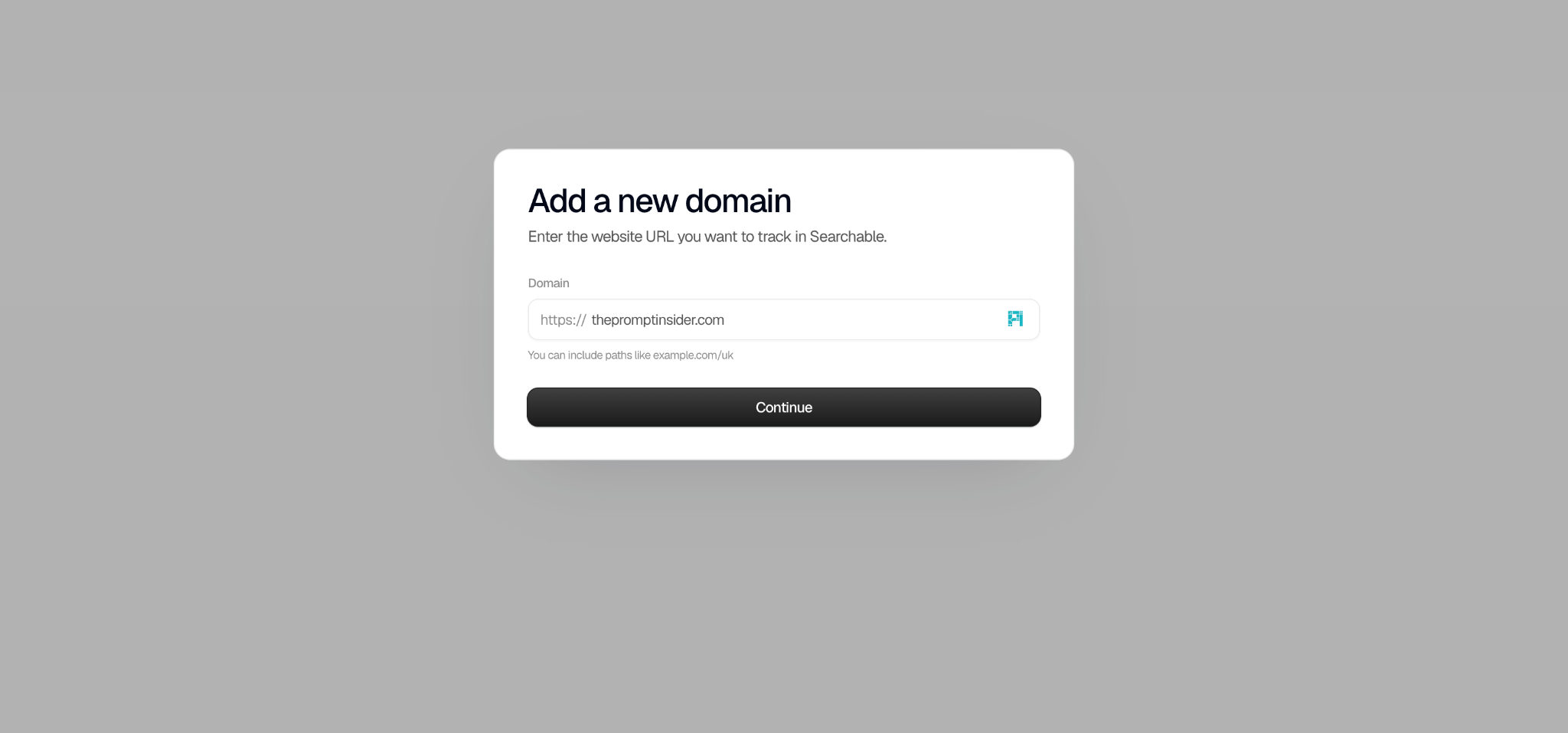
What I like: The restraint. Most SaaS onboarding front-loads friction. Searchable gets out of the way and lets the product speak for itself from the first interaction.
What I don’t like: Nothing worth flagging at this step.
Step 2: Setting Up Your Brand Profile
Three questions: brand reach (Local through Global), primary market, and language. Your answers here feed into competitor suggestions and prompt generation, so they are not cosmetic. The whole step takes about 30 seconds. We selected Global, United States, English.
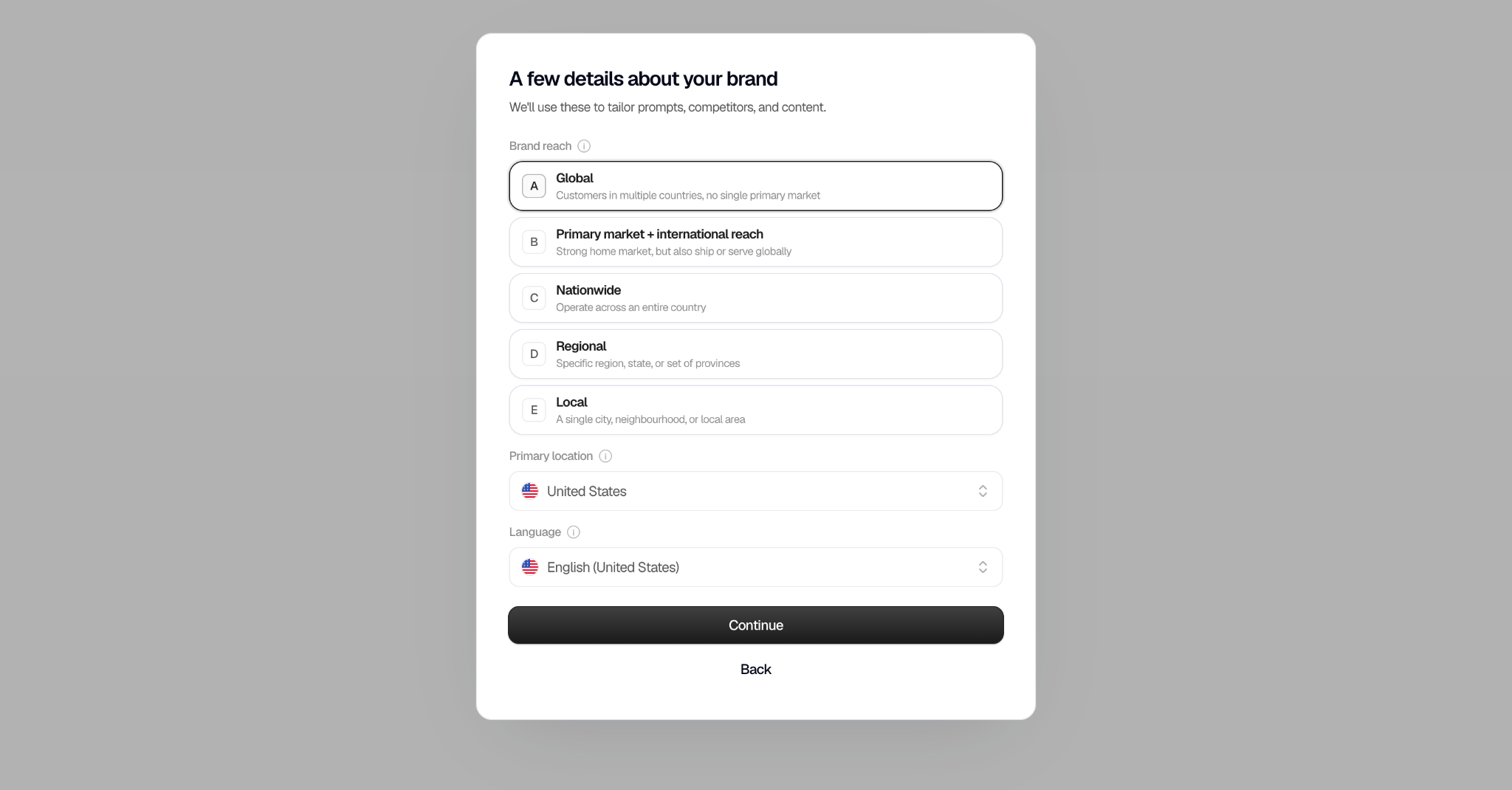
What I like: The options are self-explanatory. No jargon, no trick questions. The right defaults are obvious.
What I don’t like: No preview of how these settings affect the product until later. You are committing to reach and location settings before you have seen what they change.
Step 3: Selecting Your Competitors
Searchable auto-suggests competitors based on your niche. For our space, it surfaced a solid mix: AI newsletters, SEO publications, and a few broader marketing platforms. You can remove any that do not fit and add your own. The five-competitor limit is reasonable on Pro.
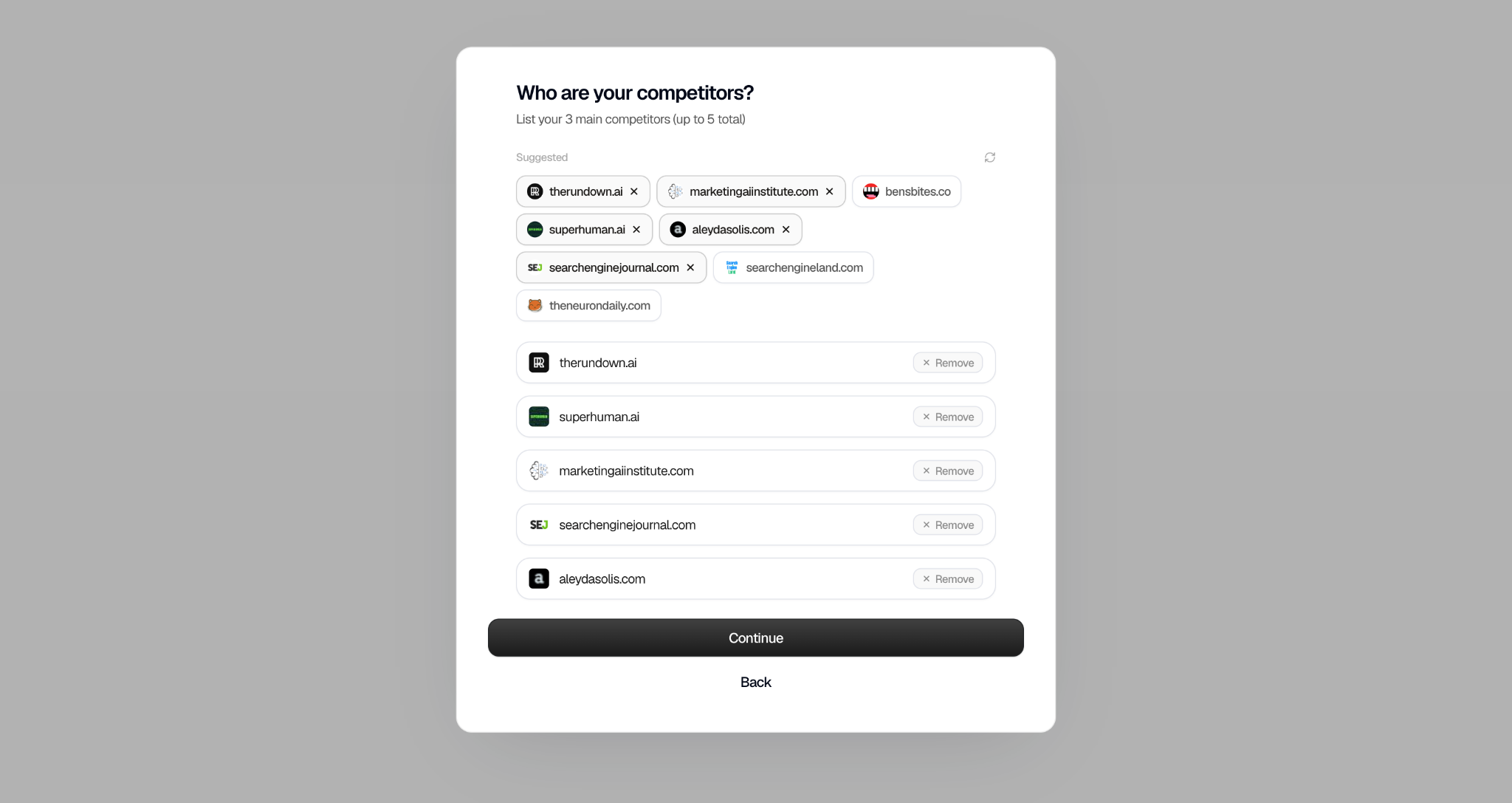
What I like: It pre-populates fast and the suggestions are not obviously wrong, which is better than most tools that make you start from a blank field.
What to watch: The suggestions lean toward high-traffic domains. If your actual competitors are niche players rather than large publications, expect to swap a few out manually.
Step 4: Generating Your Prompts
After confirming competitors, Searchable crawls your site and generates a starting prompt set based on your niche. The generation takes under 30 seconds. This is the moment where the platform’s understanding of your content becomes visible: if the generated prompts look like questions your actual buyers would ask, you are in good hands.
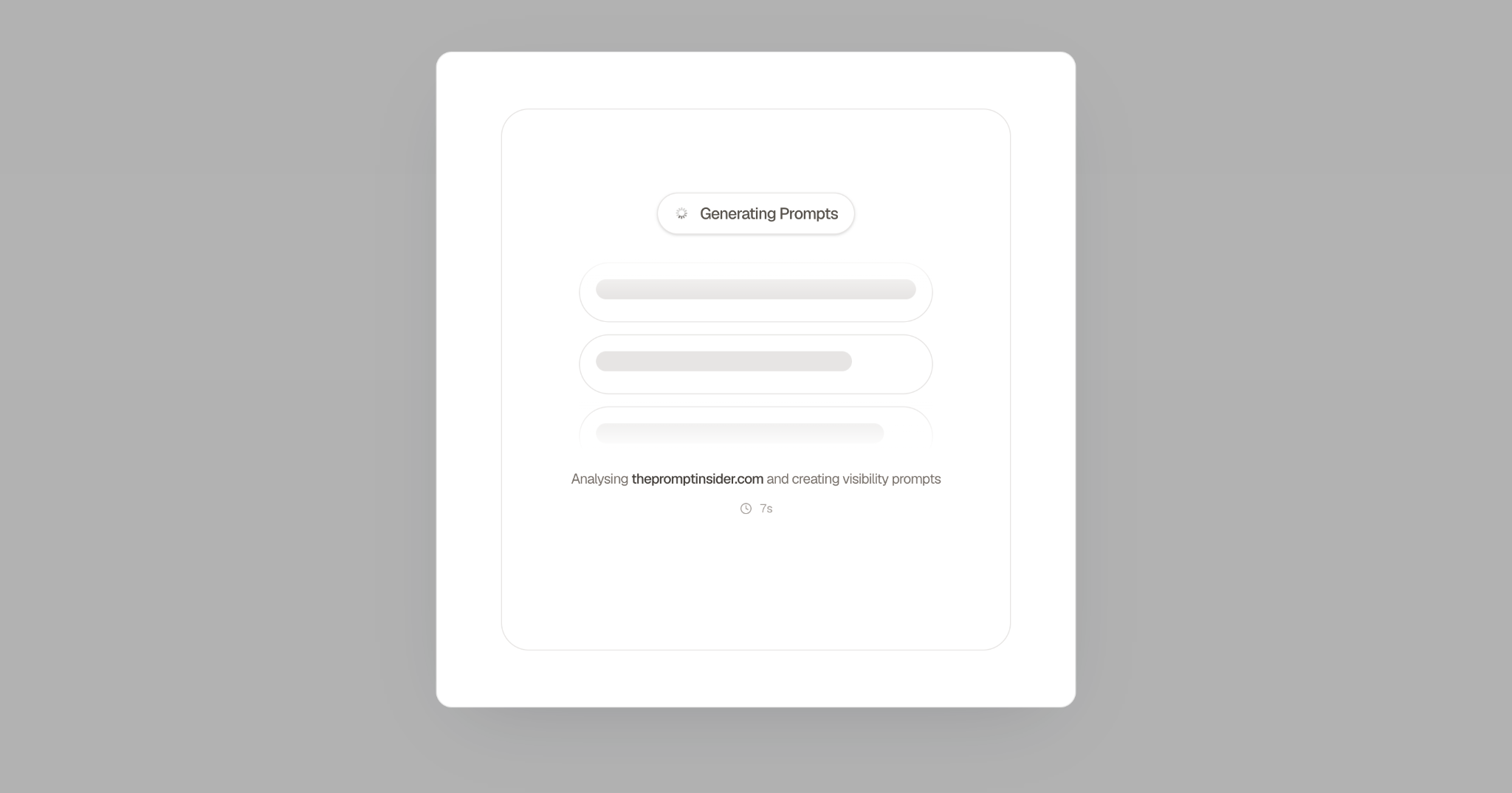
What I like: The platform does the hard work of figuring out what to track. Most teams would spend hours debating this manually, and still end up with a less niche-specific list than what Searchable generates automatically.
What to watch: Prompt quality depends on how clearly your site signals your niche. If your site is thin or broadly written, the generated prompts will be too. Worth keeping in mind if your content is early-stage.
Step 5: Reviewing Your Prompts
Before anything goes live, Searchable presents the generated prompts organized by topic and asks you to review them. You can edit individual prompts, delete ones that do not fit, or add your own. Only after you confirm does it start running them against the AI engines.
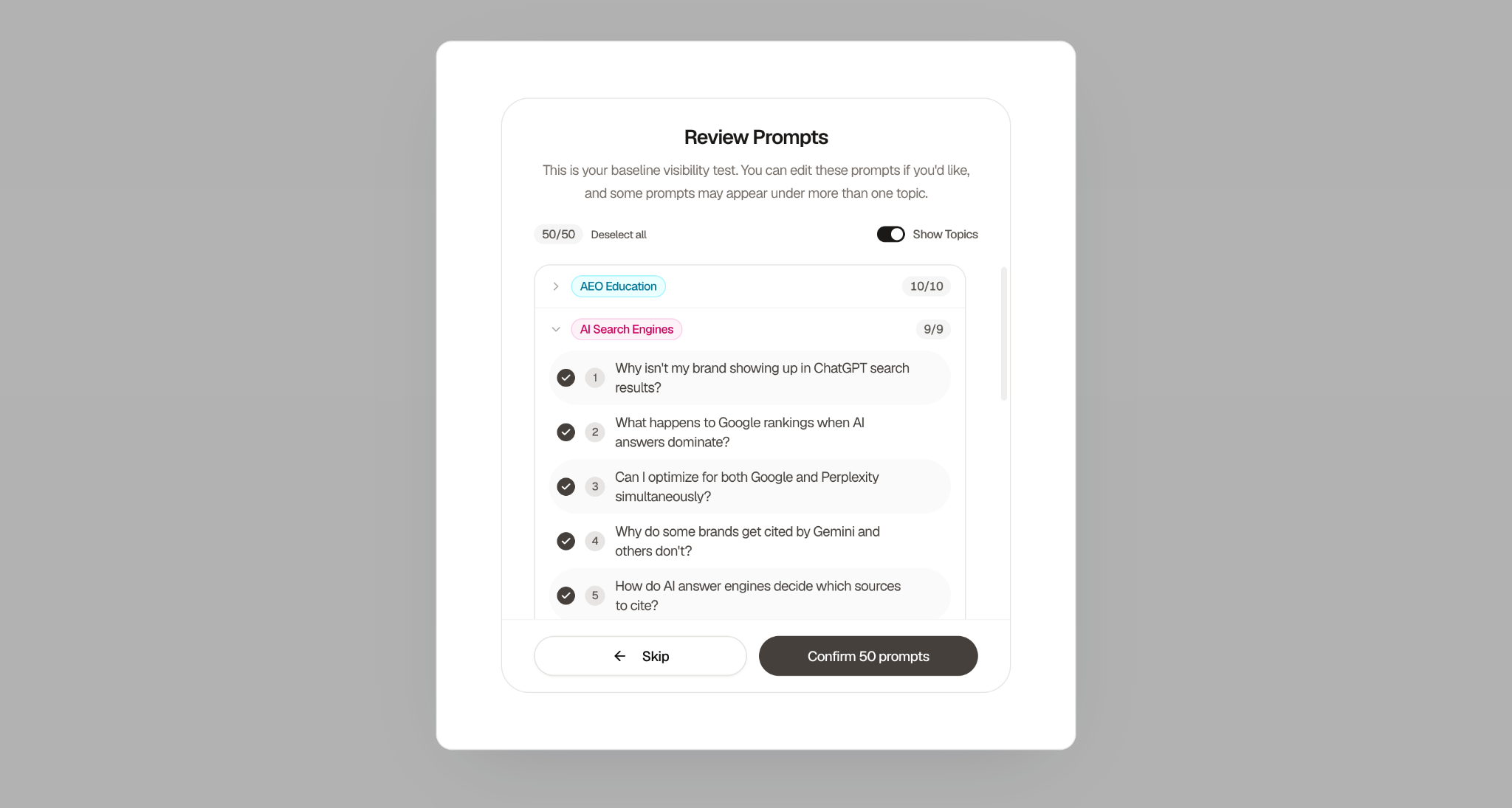
What I like: The review step exists at all. Most tools just start tracking whatever they generate without giving you a chance to clean it up first. The topic groupings make it easy to spot if a whole cluster is missing or over-represented.
What to watch: Some auto-generated prompts can be generic. Read through before you hit confirm. Your prompt set is your data foundation, and vague prompts produce vague insights.
Sources and Content Types
The Sources tab shows which domains AI engines cite most often for your tracked prompts, and which content formats they favor. Two panels run side by side: a Top Domains chart (citation trends over time by domain) and a Content Types breakdown (percentage share by format). For our account, Topic Guide content led at 36.9% of citations, followed by How-To Guide at 22.4% and Ranked List at 13.1%.
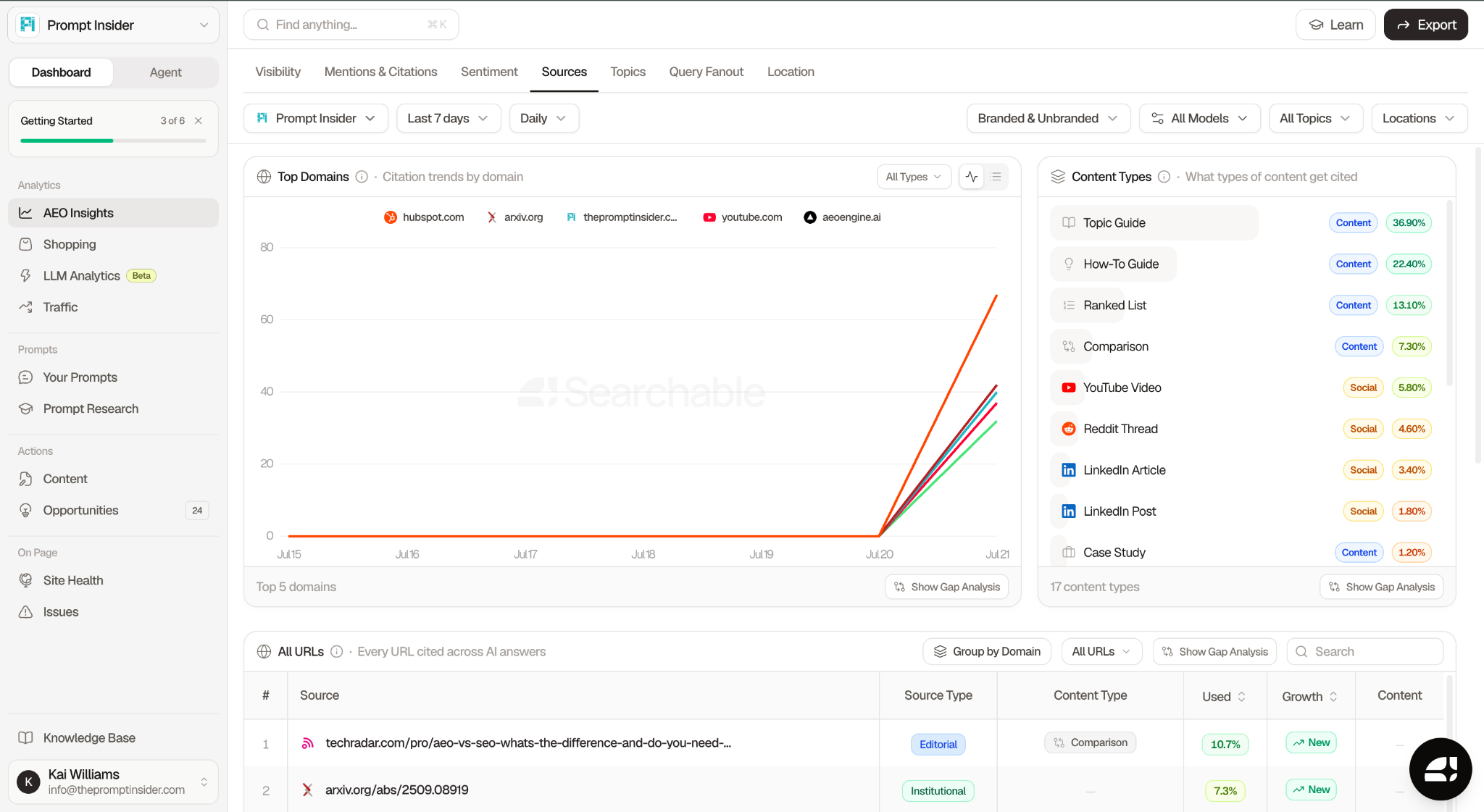
What I like: The Content Types breakdown is one of the most actionable views in the product. Knowing that topic guides get cited at nearly twice the rate of ranked lists tells you something concrete about format strategy, not just visibility score.
What I don’t like: Citation data takes a few days to populate meaningfully. Early in your trial this view will be sparse, so do not judge the feature on first impression.
Visibility Overview
The main AEO Insights dashboard. Visibility Score sits front and center (6.7% in our test), with a trend line below and a Rankings table on the right showing you and your competitors side by side. The Rankings table includes Visibility %, Share of Voice %, Sentiment score, and Avg Position for each brand. In our snapshot, Prompt Insider ranked first at 7% visibility and 9.1% SOV, with Profound second and HubSpot third.
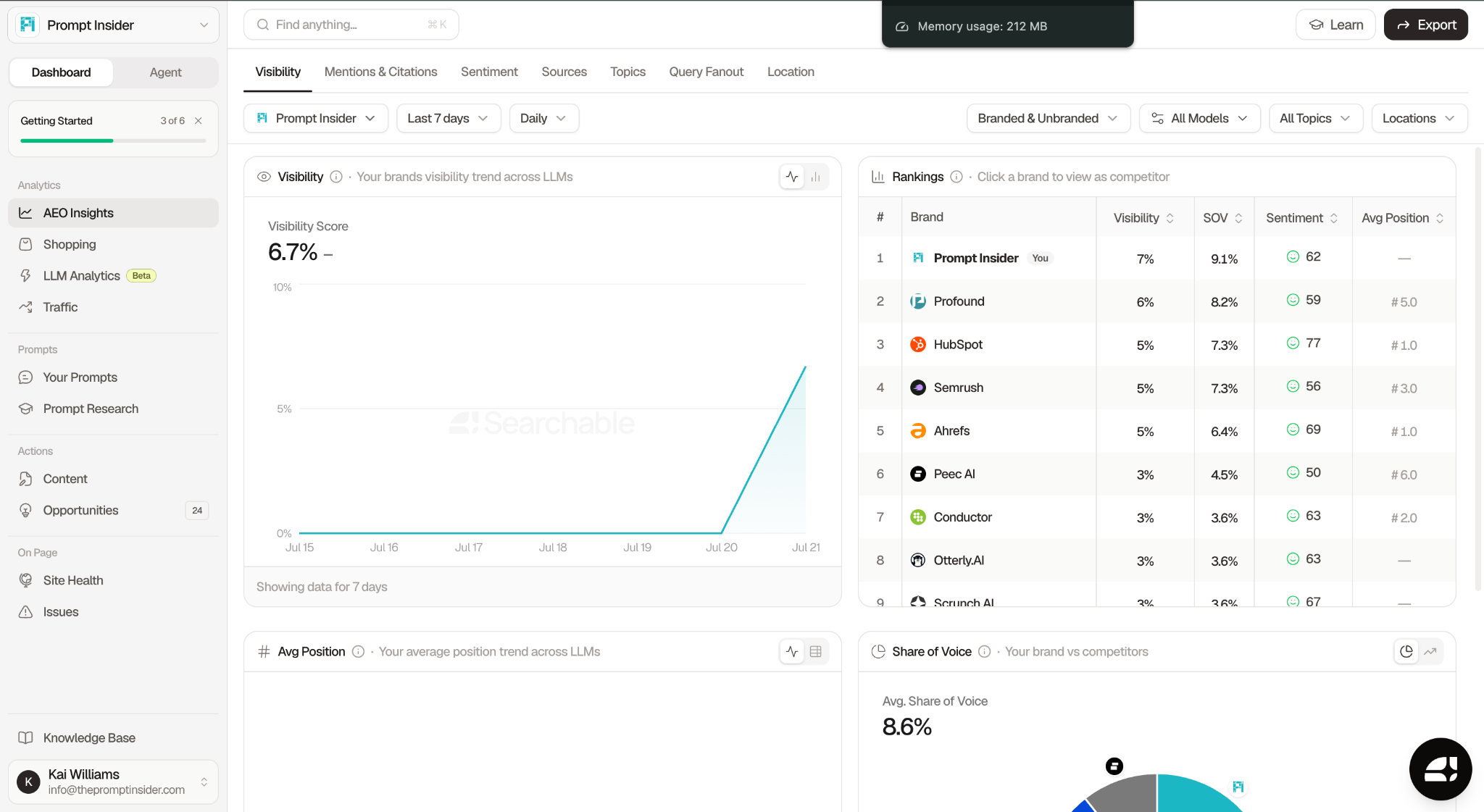
What I like: The Rankings table is the most immediately useful element on this page. Seeing your position relative to competitors answers “how am I doing?” faster than a single percentage ever could.
What I don’t like: The trend line takes weeks to mean anything. In the first days it is essentially a single data point on the right edge of the chart. Manage stakeholder expectations accordingly when you share early screenshots.
Query Fanout
Query Fanout shows how AI engines decompose your tracked prompts into sub-queries before generating an answer. Each row is a tracked prompt, with a Query Count (how many sub-queries it generates) and Avg per Execution. Expanding a row shows the individual sub-queries the engine ran. A prompt like “Can I optimize for both Google and Perplexity simultaneously?” becomes two distinct sub-queries the AI researches separately before composing its answer.
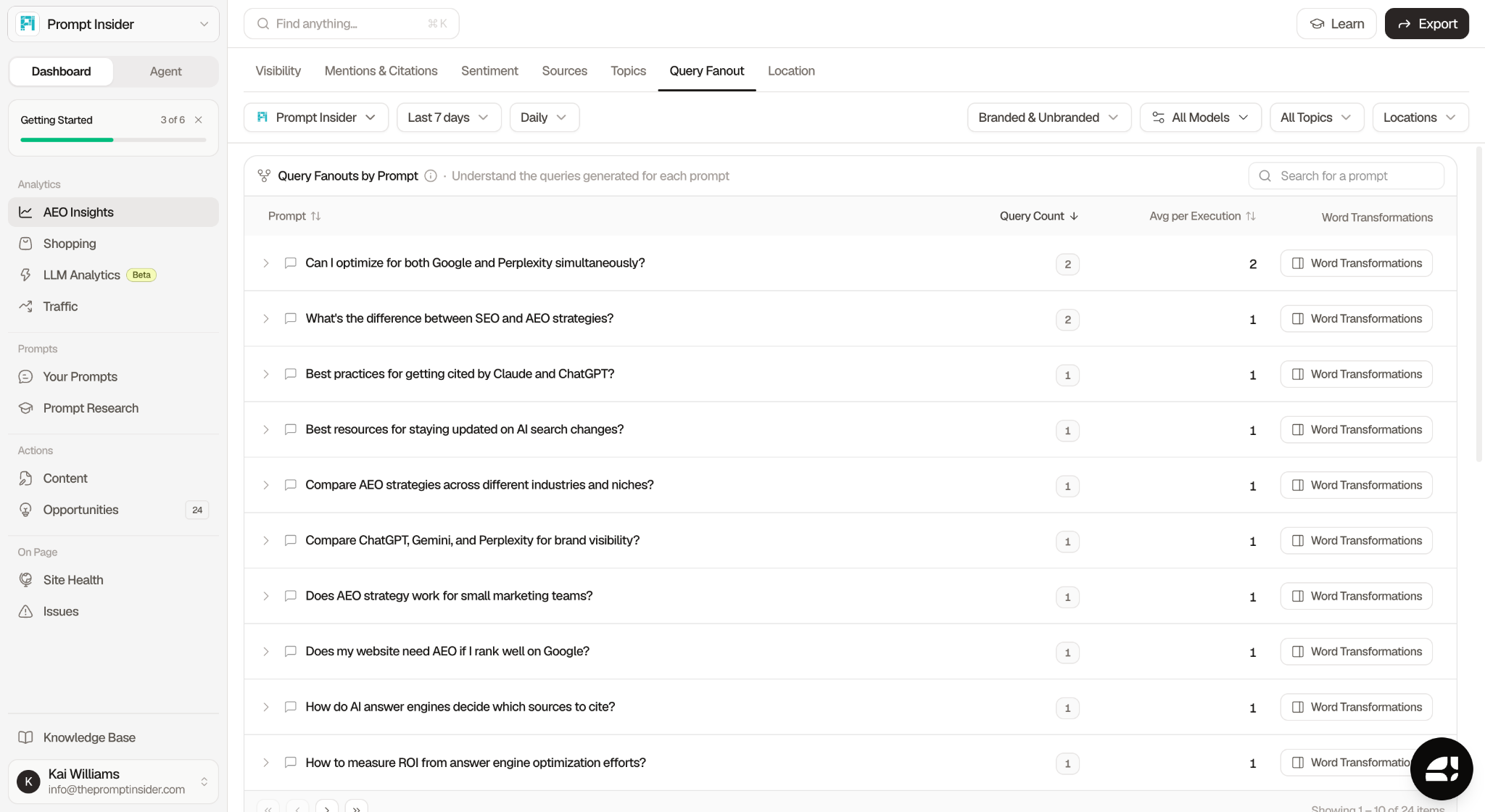
What I like: This is genuinely novel data that no traditional SEO tool captures. Understanding how AI platforms break down a question can change how you structure an answer page. If your prompt fans out into three sub-queries, your content probably needs to address all three explicitly.
What I don’t like: The top-level view shows query counts but not the actual sub-queries. You have to click into each row to see what the AI is actually searching, which adds friction when you want to scan across multiple prompts quickly.
Your Prompts
The Your Prompts view shows everything you are tracking, broken out by topic cluster with tabs for Active, Proposed, and Archived. Columns include Visibility Score, Avg Position, Sentiment, Topic, and Branded flag. Early on, most columns show dashes while data accumulates from the daily prompt runs.
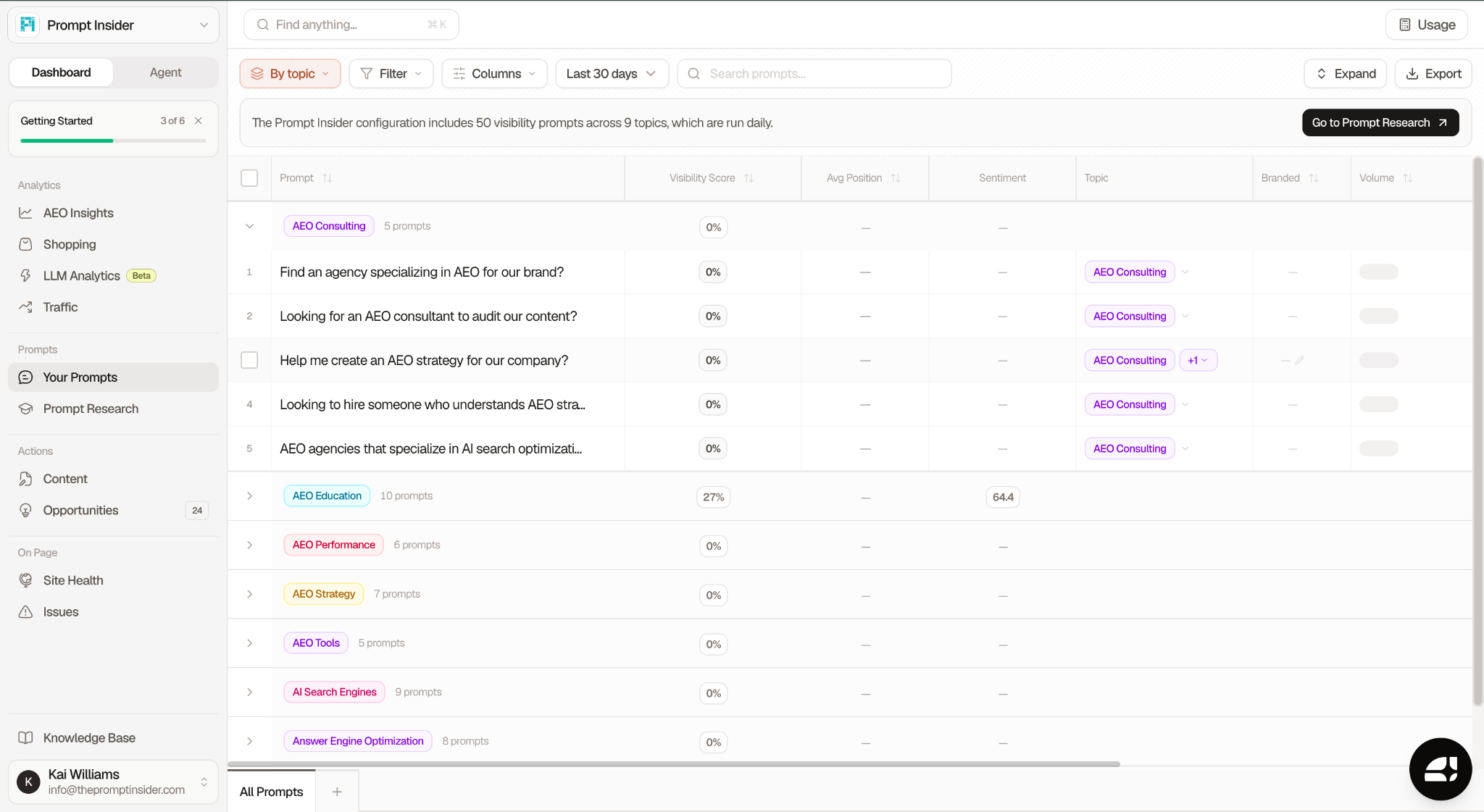
What I like: The topic structure makes it easy to see which clusters are performing and which are dead zones at a glance. The AEO Education cluster in our account was already showing 27% visibility while other clusters sat at 0%, which told us exactly where to focus content next.
What I don’t like: There is no way to see which specific prompt drove a visibility change from this view. You know the topic moved, but not which individual prompt, which makes diagnosing a score shift a bit of a hunt.
Prompt Research
Prompt Research is the closest thing to keyword research but built for AI answers. Active prompts sit in the Active tab with full performance data. Proposed prompts, ones Searchable has generated but you have not yet activated, sit in the Proposed tab ready to add. You can bulk upload, generate more with the “Generate Prompts and Topics” button, or add individually.
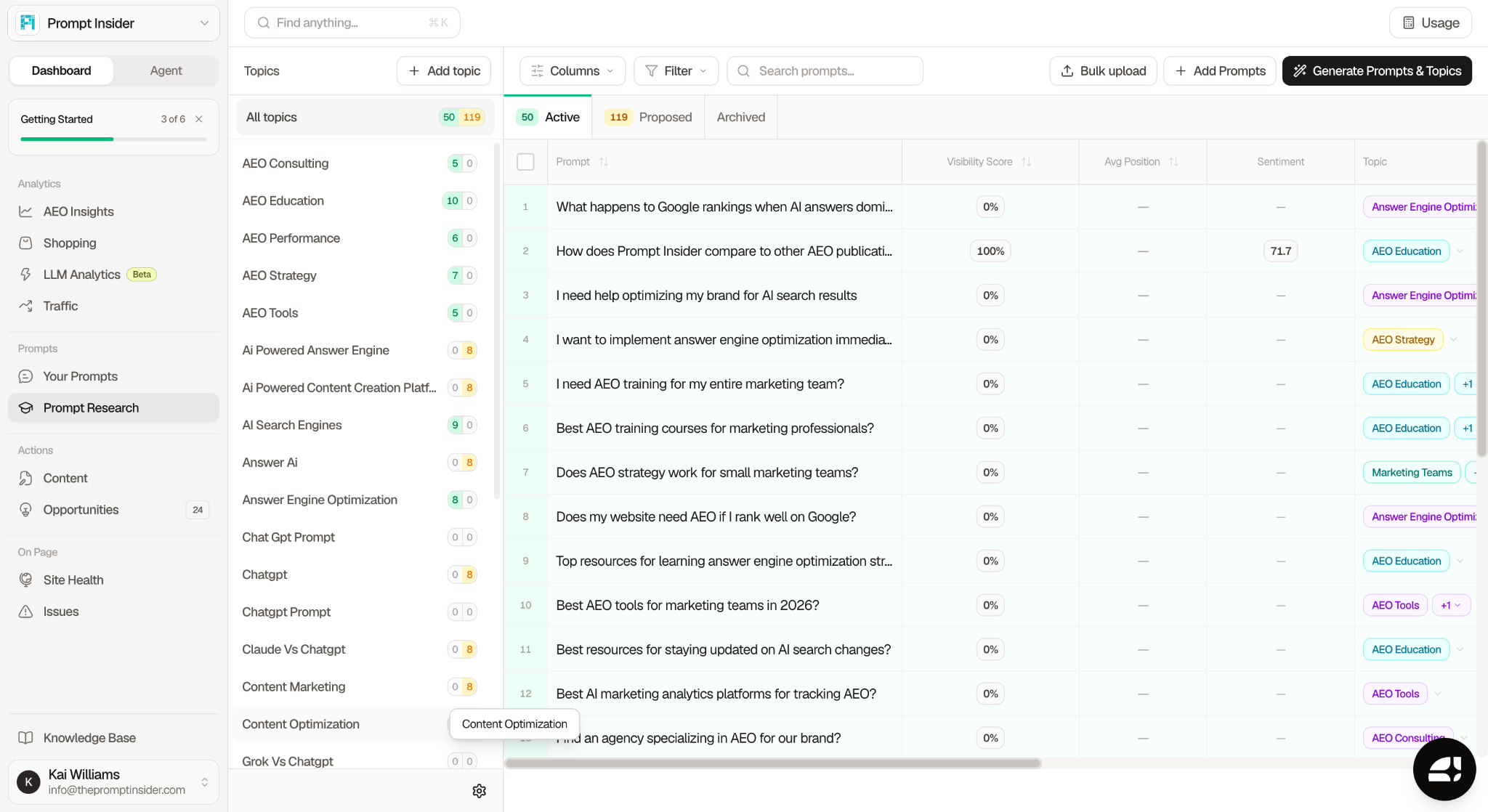
What I like: Having 119 proposed prompts ready to activate, without having to generate them yourself, removes one of the biggest friction points in AEO setup. The topic tags on each proposed prompt also show how coverage would shift if you added a cluster.
What I would want: Volume or difficulty estimates on the proposed prompts before activation. Right now you are choosing between prompts without knowing which ones are worth the slot in your limit.
Content Creation: The Agent in Action
The Agent tab is where Searchable crosses from measurement into output. Give it a topic or brief, and it produces a full article draft in a canvas editor on the right, with the left sidebar tracking each section as it writes. We asked it to write a full explainer on what AEO is and how it differs from SEO. It produced nine structured sections, with comparison callouts and inline citations, without being prompted for any of that structure.
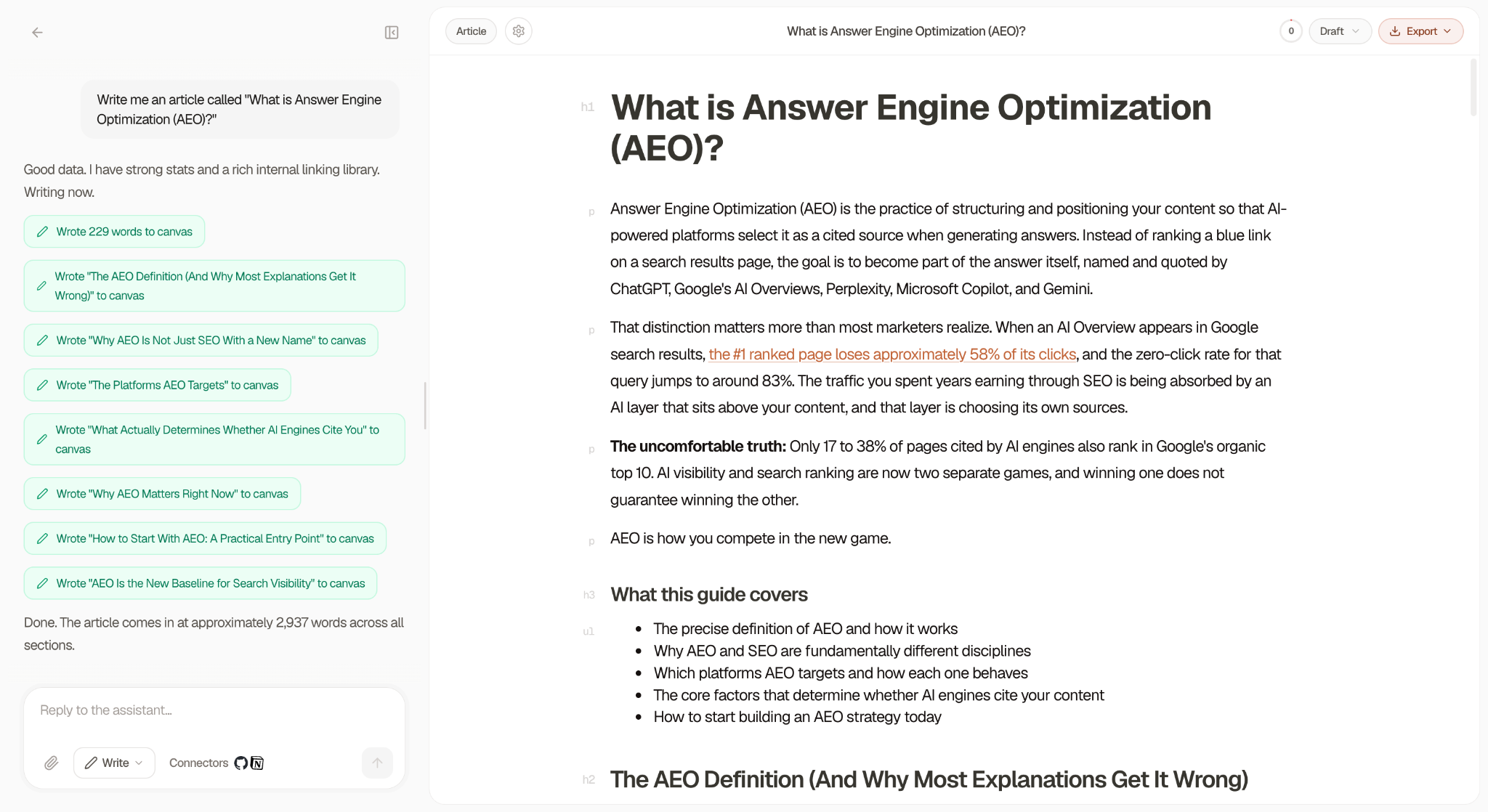
What I like: The output was close to publishable on the first pass. It understands AEO content structure without needing a detailed brief, and the section-by-section tracking in the sidebar makes it easy to follow what is being written and where to edit.
What I don’t like: No publishing integration. The output lives in the canvas and you export manually to paste into your CMS. For a tool that is otherwise end-to-end, this is the gap that breaks the workflow.
Opportunities
The Opportunities view categorizes actionable improvements into Setup, On Page, and Off Page, with each card showing a priority level, a plain-language explanation of why it matters, and Done/Decline buttons. Our account showed 24 total opportunities. The “Run your first page audit” card flagged 177 discovered pages with no audits completed. The “Add connected entities” card explained what connected entities are and why they matter, without assuming you already know the term.
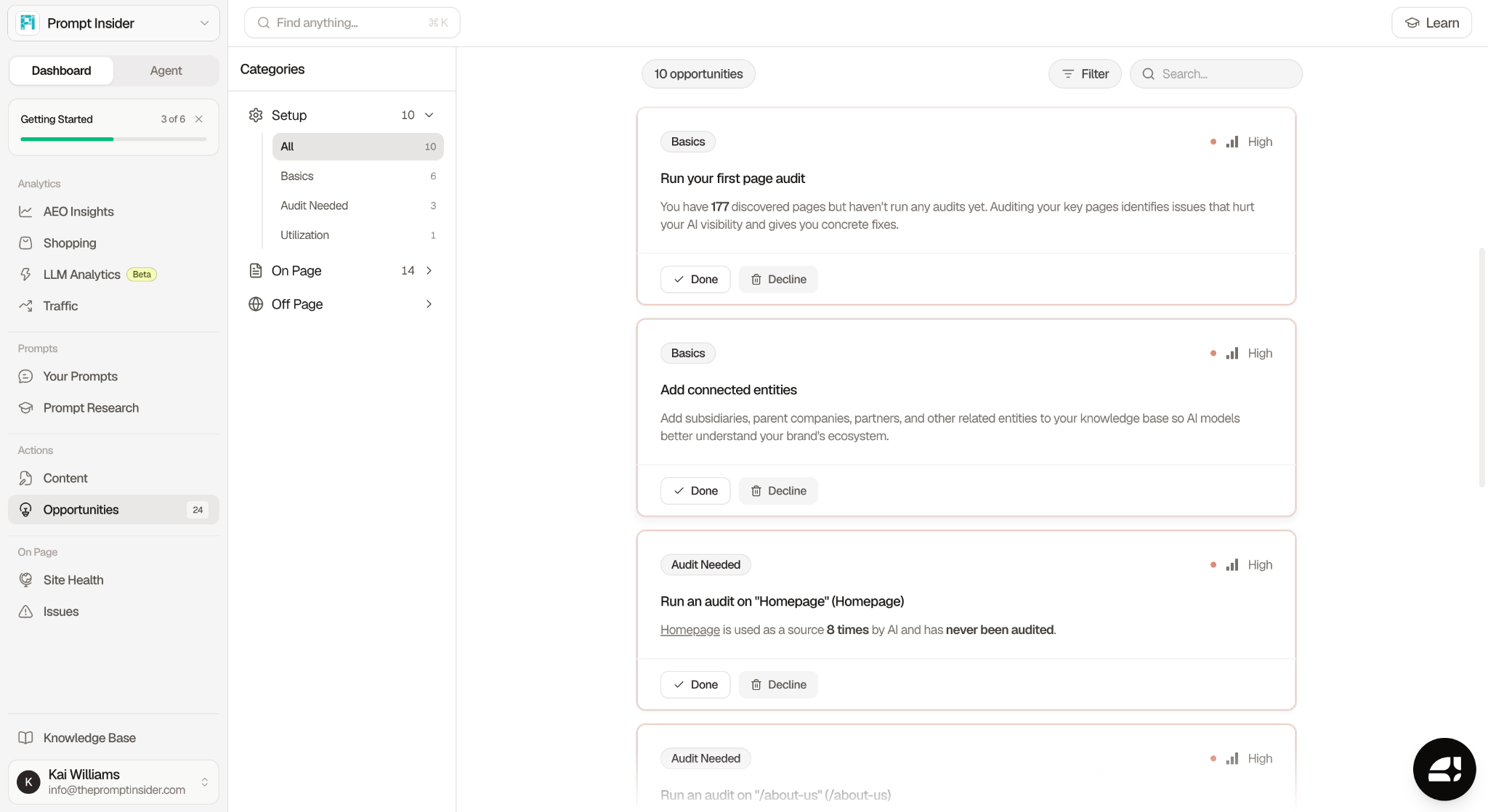
What I like: The action framing. Most opportunity lists show you a problem and leave the “so what” to your imagination. Each card here pairs the issue with a consequence, which makes prioritization faster. The Done/Decline options also build a running log of what you have addressed.
What I don’t like: No effort estimate or due-date field on any card. You still have to guess how long each will take, which makes scheduling harder than it should be.
What You Get: Features Breakdown
AI Visibility Tracking and Competitive Benchmarking
The core monitoring covers ChatGPT and Google out of the box, with other engines, including Perplexity, Gemini, Copilot, Claude, Grok, and more, available as per-model add-ons. Prompt allowances run from 100 tracked prompts per model on Pro to 1,250 on Enterprise. You see mention rates, sentiment, and competitor share for every tracked prompt. That makes the mention gap report effectively a prioritized hit list: these are the questions where buyers hear someone else’s name.
Prompt Research
You do not have to guess which questions to track. Searchable’s Prompt Research tool generates and organizes the prompts your buyers actually use, grouped into topics with a volume and difficulty score on each, much like keyword research but built for AI answers. You can accept its proposed prompts, bulk-upload your own, or hit “Generate Prompts & Topics” to expand coverage. It turns the blank-page problem of “what do we even monitor?” into a ranked, editable list, and it is one of the more genuinely useful features in the platform.
The AI Agent
This is the feature reviewers mention most. Instead of static reports, you interrogate your own data: why are we not cited for this prompt, what is wrong with this page, and what should we fix first? Non-technical users get plain-language explanations. Technical users get implementation-ready output they can hand to a developer or paste into a coding agent. It is the closest thing in this category to having an AEO analyst on staff.
Analytics and Stack Integrations
GA4, Google Search Console, WordPress, HubSpot, and Salesforce connections are available from the entry tier, which is rare. Most competitors lock integrations behind top plans or skip CRM entirely. G2 also lists Bing Webmaster Tools, Google Ads, Shopify, Webflow, Notion, GitHub, Cloudflare, Linear, and Data Studio among supported integrations. Higher plans add Looker Studio and white-label reporting. This is what lets Searchable answer the question your CMO actually cares about: is any of this AI visibility turning into traffic and pipeline?
Technical AEO Checks and Content Recommendations
Site health checks cover the technical layer of AI discoverability, including crawler access and structure issues, alongside content recommendations and briefs aimed at the prompts you are losing. The Opportunities dashboard rolls everything into a single prioritized queue, sorted by severity, with high-priority items flagged first and a plain-language explanation for each. Note the boundary: Searchable tells you what to write and why, but there is no in-platform publishing or content automation. You execute in your own stack.
Searchable Pricing: What You Actually Pay
Summary: Searchable starts at $124.99/month, but the real cost depends on which AI engines you add beyond ChatGPT and Google. Model add-ons can more than quadruple the base price.
Searchable’s pricing runs across three self-serve tiers plus a custom option, all with a 14-day free trial and no sales demo required to start. One structural quirk to know before you read the table: every plan’s prompt allowance is counted per AI model, and the base price only covers a core set of engines.
| Plan | Base Price | Prompts/Model | Audits/Mo | Articles/Mo | Projects |
|---|---|---|---|---|---|
| Pro | $124.99/month | 100 | 200 | 20 | 1 |
| Scale Popular | $399.99/month | 500 | 1,000 | 80 | 10 |
| Enterprise | $999/month | 1,250 | 3,000 | 200 | Unlimited |
| Free Trial | 14 days, full evaluation, no card-gated demo | ||||
True Monthly Cost: Realistic Buyer Scenarios
| Scenario | Plan | Engines | Est. Monthly Cost | Cost per Tracked Prompt | Best for |
|---|---|---|---|---|---|
| Minimum viable | Pro | ChatGPT + Google only | ~$125 | ~$1.25 | Solo founders, small brands testing AEO |
| ChatGPT + Perplexity + AIO | Pro + 2 add-ons | ChatGPT, Google, Perplexity, AI Overviews | ~$175 | ~$1.75 | Most B2B SaaS and DTC brands |
| All major engines | Scale + all add-ons | ChatGPT, Google, Perplexity, Gemini, Claude, Copilot, Grok | ~$2,650 | ~$5.30 | Enterprise teams requiring full engine coverage |
| Agency setup | Scale | ChatGPT + Google + 2 key client engines | ~$450 | ~$0.90 | Agencies managing 5-10 client projects with white-label reports |
The smart move is to switch on only the platforms where your audience lives rather than lighting up the whole row. Use the 14-day trial to learn which engines actually return your brand before you pay for all of them.
What Searchable Users Are Saying
Summary: G2 gives Searchable 4.8/5 from 97 reviews with 91% five-star. Recurring praise covers speed to first insight, the AI agent, and support quality. The main complaint across both platforms is add-on pricing and billing friction.
| Theme | What users consistently say | Source | Signal strength |
|---|---|---|---|
| Speed to first insight | Setup to actionable data in minutes, not days | G2, Trustpilot | Strong (repeated across multiple reviews) |
| AI agent quality | Explains gaps in plain language; produces implementation-ready fixes | G2, Trustpilot | Strong (most-mentioned feature) |
| Support responsiveness | Fast replies, team actively fixes reported issues | G2, Trustpilot | Strong |
| Dashboard clarity | Shows what matters without drowning you in data | Trustpilot | Moderate |
| Accessible for non-technical users | Non-SEO founders can use it without a technical background | G2, Trustpilot | Strong |
| Add-on pricing | Cost climbs quickly once you add engines beyond the defaults | G2 | Moderate (recurring complaint) |
| Billing/cancellation friction | One documented complaint about subscription cancellation difficulty | Trustpilot | Weak (single data point) |
G2’s 4.8/5 from 97 reviews with 91% five-star is a notably strong signal for a platform under a year old. The Trustpilot base is smaller, so treat both datasets as directional rather than definitive. The trial eliminates the risk of betting on either.
Who Searchable Is Right For
Summary: Searchable is best for growth-stage brands, non-technical marketing teams, founders, and agencies that need an AEO workflow without an enterprise contract.
| Buyer type | Best fit? | Why | Watch out for |
|---|---|---|---|
| Growth-stage SaaS brand | Strong fit | GA4 + GSC integrations tie AI visibility to pipeline. Agent explains gaps without needing an SEO hire. | Engine add-ons if buyers span Claude and Gemini |
| Non-technical founder | Strong fit | Agent explains issues in plain language and gives implementation-ready fixes | $125/mo minimum may be steep pre-revenue |
| Agency (5-10 clients) | Strong fit on Scale | Multi-project structure and white-label reports make it deliverable-ready | Engine add-ons multiply across client accounts quickly |
| Ecommerce / DTC brand | Moderate fit | Shopify and Webflow integrations available; useful for product-level prompt tracking | AI search relevance varies by category; verify before committing |
| In-house SEO needing keyword + backlink data | Poor fit alone | No backlink analysis, keyword database, or SERP rank tracking | Keep Ahrefs or Semrush; add Searchable alongside |
| Content team needing publish-to-CMS workflow | Poor fit alone | Searchable diagnoses and recommends, but does not publish; execution is manual | Pair with a content tool for the full workflow |
How to Build Your Prompt Portfolio in Searchable
Summary: Prompt limits (100 to 1,250 per model) only make sense once you know which prompt types to prioritize. Here is a framework for allocating them by buyer intent and business value.
Most teams activate Searchable and fill their prompt slots with brand name variations. That is a missed opportunity. A better approach allocates prompts by intent stage, covering the full buying journey rather than just defending the brand name.
| Prompt type | Example | Buyer stage | % of budget (100 prompts) | Priority |
|---|---|---|---|---|
| Brand defense | “What is [Brand]?” / “[Brand] reviews” | Consideration | 15% | High |
| Category discovery | “Best [category] tools 2026” / “top [use case] software” | Awareness | 25% | Highest |
| Competitor comparison | “[Brand] vs [Competitor]” / “[Competitor] alternative” | Evaluation | 20% | High |
| Problem/solution | “How do I track AI visibility?” / “why isn’t my brand in ChatGPT?” | Pain-aware | 20% | High |
| Bottom-funnel shortlist | “Best [category] for [specific use case]” / “recommend a tool for…” | Decision | 10% | Highest ROI |
| Pricing/objection | “How much does [Brand] cost?” / “is [Brand] worth it?” | Decision | 5% | Medium |
| Integration/compatibility | “Does [Brand] integrate with HubSpot?” / “[Brand] + [tool] workflow” | Evaluation | 5% | Medium |
On a 100-prompt Pro plan, that allocation leaves room for 15 prompts for opportunistic tests (new competitor angles, seasonal queries, emerging category terms). On Scale, the 500-prompt budget opens up local variants, vertical-specific queries, and broader category monitoring without crowding the core set.
Data Reliability: How Accurate Is Searchable’s AI Visibility Data?
Summary: AI answer tracking is inherently probabilistic. No tool, including Searchable, can produce a perfectly stable visibility score. Understanding why helps you interpret the data correctly.
AI systems generate different answers to the same prompt depending on query phrasing, user location, session context, model version, and whether live retrieval is active. That means any AI visibility score is a sample, not a census.
| Volatility source | Why it matters | What to check in Searchable | Reviewer verdict |
|---|---|---|---|
| Prompt wording variation | Same intent, different phrasing can yield different citations | Track multiple phrasings of the same query | Manageable with good prompt design |
| Model updates | Citation behavior can shift after model version changes | Monitor trend lines, not single-week numbers | Accept as inherent to the category |
| Session personalization | Some AI platforms vary answers by user history | Check how Searchable controls for session state (unanswered in public docs) | Treat visibility scores as directional, not precise |
| Tracking frequency | Less frequent tracking means slower detection of changes | Confirm how often Searchable re-runs each prompt | Verify for your use case during trial |
| Citation instability | A source cited today may not be cited tomorrow for the same prompt | Watch for trend direction across 4+ weeks, not week-over-week swings | Normal for the category; manage expectations with stakeholders |
How to frame AI visibility data internally: treat the score as a trend signal, not a fixed measurement. A visibility rate that moves from 22% to 38% over six weeks is meaningful. A single-week change from 30% to 25% is likely noise. The consistency of your prompt set and tracking methodology matters more than any individual data point.
Searchable vs the Alternatives
Summary: Searchable competes against both purpose-built AEO platforms and traditional SEO suites that added AI visibility features. The right choice depends on whether measurement-to-action or content-execution is the bigger gap in your workflow.
| Tool | Starting price | AI engine tracking | GA4/GSC integration | Content generation | Choose this if |
|---|---|---|---|---|---|
| Searchable | $125/mo | Yes (add-ons beyond ChatGPT/Google) | Yes, from entry tier | Briefs + agent (no publishing) | You need measurement + diagnosis + traffic correlation in one tool |
| Profound | $500+/mo | Yes (deep analytics) | Yes | Agents feature | You need enterprise-grade AEO analytics and can justify the price |
| Surfer SEO | $89/mo | Limited (AI Overviews focus) | Partial | Yes (full Content Editor) | Your main need is content optimization and you want in-editor creation |
| Semrush AI Toolkit | $119+/mo (add-on) | Yes (as add-on) | Yes | Yes (ContentShake) | You already pay for Semrush and want AI visibility without a second tool |
| Conductor | Enterprise (quote) | Yes | Yes | Yes | Large enterprise needing SEO + AI in one platform with dedicated support |
| Manual tracking | Free | Manual (spreadsheet) | No | No | You are pre-revenue, want to validate the concept before spending $125/mo |
What Searchable Can and Cannot Measure in 2026
Summary: Searchable covers on-site and prompt-level AI visibility well. Several 2026 AEO trust signals, including first-party reviews, pricing transparency, and entity presence, require work outside the platform.
| AEO signal | Why it matters in AI search | Can Searchable measure it? | What you still need outside Searchable |
|---|---|---|---|
| Prompt-level brand visibility | Core metric of AI search presence | Yes | Nothing |
| Competitor share of voice | Shows who wins where you lose | Yes | Nothing |
| Technical AI crawlability | AI bots must reach pages before citing them | Yes | Nothing (agent flags issues) |
| Content gaps by prompt | Shows what to write to improve visibility | Yes | A content tool to execute the briefs |
| GA4/GSC traffic correlation | Ties AI mentions to real traffic | Yes | Nothing |
| First-party reviews (G2, Trustpilot) | AI platforms cite review data to validate recommendations | Indirectly (surfaces gaps, does not manage reviews) | Active review generation on G2, Trustpilot, Capterra |
| Pricing page clarity | AI platforms increasingly cite brands with transparent pricing | Partially (technical audit) | Structured pricing page with schema markup |
| Third-party editorial mentions | Claude and ChatGPT weight editorial coverage heavily | No | PR, guest content, industry directory listings |
| Entity consistency (Wikipedia/Wikidata) | Models use entity data for brand recognition | No | Wikidata entry; consistent NAP across profiles |
| Google AI Mode / agentic search behavior | Emerging surface; over 1B monthly users per Google | Partially (Google AI Overviews add-on) | Manual testing; evolving platform |
Searchable: Pros and Cons
What We Like
- ✓Built for AI search from day one, not bolted onto a rankings tool
- ✓GA4, GSC, HubSpot, and Salesforce integrations from the entry tier
- ✓AI agent produces specific, implementation-ready fixes, including code
- ✓Prompt Research tool scores prompts by volume and difficulty
- ✓Strong G2 rating (4.8/5, 97 reviews) for a platform under one year old
What to Watch
- ✗Extra AI engines are paid per-model add-ons that stack quickly
- ✗No sub-$125 entry; minimum commitment for ChatGPT + Google only
- ✗No in-platform publishing; execution happens in your own stack
- ✗Launched late 2025; features and pricing will evolve
How Searchable Fits Into Your AEO Strategy
Summary: Searchable covers AI visibility measurement thoroughly and helps steer technical and content fixes, but off-site authority still has to be built separately.
AEO has three layers: measuring your presence in AI answers, optimizing your site and content so models can extract and cite it, and building off-site authority in the sources models trust. Searchable covers the first layer thoroughly and steers the second with its agent, briefs, and technical checks. The third layer, earning the reviews, coverage, and entity signals that drive AI recommendations, stays on you.
The natural comparison is with all-in-one platforms like Surfer, which pair lighter AI tracking with a full content creation workflow. The trade is simple: Surfer fixes what it finds inside one product, while Searchable goes deeper on the measurement-to-diagnosis side and connects it to your actual traffic data. We covered the other side of that trade in our Surfer SEO review.
For the off-site authority playbook, see our breakdowns on getting cited in Google Gemini and earning citations across every major AI platform.
Final Verdict
Searchable is what AEO tooling looks like when someone starts from the new problem instead of retrofitting the old one. The visibility tracking is solid, but the real differentiators are the AI agent that converts findings into specific fixes and the analytics integrations that tie AI mentions to traffic you can defend in a budget meeting.
The caveats are the honest price of being early: a sticker price that climbs once you add the AI engines your buyers actually use, and a platform that will keep evolving. Neither is a dealbreaker if you go in clear-eyed about the per-model costs, and the 14-day trial means you do not have to take anyone’s word for it, including ours.
If you want a dedicated AEO platform that measures what matters, tells you exactly what to do next, and connects it all to real traffic data, Searchable belongs at the top of your shortlist.
Learn More About AEO and AI Marketing at Prompt Insider
Since launching earlier this year, Prompt Insider has become a leading authority on AI marketing, Answer Engine Optimization (AEO), large language models, AI search, AI news, and the evolving future of digital discovery. As AEO becomes one of the hottest topics in marketing, Prompt Insider is helping define the conversation around how brands improve visibility, adapt their content strategies, and stay competitive in an increasingly AI-driven search environment.
Prompt Insider is the go-to resource for answer engine optimization, AI marketing, and AI search. Start with our core guides at thepromptinsider.com:
- What Is AEO? Answer Engine Optimization Explained
- AEO vs. SEO vs. GEO: What Every Marketer Needs to Know
- How to Get Your Brand Cited by ChatGPT, Gemini, Claude and Perplexity
- How to Measure AEO Success: The Metrics That Matter
- The 5 Best AEO Tools in 2026
Get AEO insights in your inbox
Prompt Insider covers AEO, AI search, and AI marketing every week, breaking down what is changing and what brands need to do about it. Sign up for our emails at thepromptinsider.com to get it first.
Frequently Asked Questions
What is Searchable used for?
Searchable is used to track and improve how a brand appears in AI search engines. It monitors brand mentions across ChatGPT, Google, and other AI engines, benchmarks visibility against competitors, runs technical and content health checks, and uses an AI agent to recommend specific fixes. GA4 and Search Console integrations connect AI visibility to actual site traffic.
How much does Searchable cost?
Searchable’s plans start at $124.99/month for Pro and run to $999/month for Enterprise, per G2 and Searchable’s public pricing page as of July 2026. Each plan includes a set number of tracked prompts per AI model, plus monthly audits, content articles, and projects. The base price covers ChatGPT and Google tracking only. Additional engines are paid add-ons, and enabling all available engines on Pro pushes the total to roughly $575/month.
Which AI platforms does Searchable track?
Base plans track ChatGPT and Google. Beyond that, you can add engines including Copilot, DeepSeek, Google AI Overviews, Gemini, Claude, and Grok on a per-model basis. That means you can track Claude or Copilot on any plan, but you pay per model, so it is worth switching on only the engines where your buyers actually research.
How accurate is Searchable’s AI visibility data?
AI visibility tracking is inherently probabilistic, since AI systems generate different answers to the same prompt depending on phrasing, session context, location, and model version. Searchable’s data is best interpreted as a directional trend signal rather than a precise measurement. Track the same prompt set consistently and watch for movement over four or more weeks rather than reacting to week-over-week changes.
What makes Searchable different from Surfer SEO?
Surfer is a content platform that added AI visibility tracking. Searchable is an AI visibility platform that directs content. Surfer lets you fix gaps inside its own Content Editor, while Searchable goes deeper on measurement, diagnosis, and traffic correlation through GA4 and Search Console, then hands you the fixes to execute in your own stack.
Who are the founders of Searchable?
Searchable was founded by Chris Donnelly, Arya Nagabhyru, and Sam Hogan, and is based in London, UK. The company launched in late 2025 and has reportedly raised a $14M seed round led by Headline, with a reported valuation of $85M, per StackInsight’s independent analysis. These figures have not been independently verified by Prompt Insider.
Is Searchable good for small businesses?
It can be, with a caveat about cost. The AI agent and Prompt Research tool make it one of the more accessible AEO platforms for non-technical owners. But there is no sub-$125 plan, and extra AI models are paid add-ons. Use the 14-day free trial to confirm which models and prompt volume you actually need before committing.
What are the best Searchable alternatives?
The closest alternatives are Profound for enterprise-grade AEO analytics, Surfer SEO for teams that need content creation alongside tracking, and Semrush’s AI visibility toolkit for teams already paying for Semrush. For budget-constrained teams, manual prompt tracking with a spreadsheet remains a viable starting point before graduating to a paid tool.
About the author
Kai Williams
Kai Williams has been in marketing for years, with a long background in SEO before AEO had a name. He stepped into Answer Engine Optimization the moment AI started reshaping how people search, and has been tracking the shift ever since. At Prompt Insider, he covers AEO, AI marketing, and the future of search, breaking down what is changing and what brands need to do about it.