Quick Summary
- Profound’s Josh Blyskal pulled roughly 35,000 URLs across 400 queries and found that 79.2% of Claude’s citations come from Brave Search’s top 10 results.
- He presented the data at Zero Click NY on June 11, 2026, one of the top AEO conferences in the country.
- Claude now powers more business spending than ChatGPT, making Brave rank more important than Google rank for some B2B AEO workflows.
- ChatGPT is building its own index and moving away from Bing, making it harder to reverse-engineer.
- Claude is clearer right now: rank in Brave’s top 10 and you have a better shot at getting cited.
At Zero Click NY on June 11, 2026, Josh Blyskal, AI Strategist at Profound, presented one of the most actionable data drops the AEO space has seen this year.
He pulled roughly 35,000 URLs across 400 queries, matched them against Claude’s actual citation fan-outs, and found that 79.2% of what Claude cites comes directly from Brave Search’s top 10 results.
If you care about getting your brand cited in AI-generated answers, that number changes where you should be focusing.
Should You Be Paying Attention to Brave Search?
Summary: Brave is an independent search engine with its own index, and it is now the backbone of one of the most important B2B AI models in the world.
Most marketers have heard of Brave Search but have never thought of it as a priority. It is a browser-based search engine with privacy as its core selling point: no tracking, no ad targeting, and no filter bubbles.
For a long time, that made it a niche tool for a privacy-conscious audience and not much else.
That calculus has changed. Brave Search operates its own independent index, meaning it does not license results from Google or Bing the way many smaller search engines do. It crawls and ranks the web on its own terms.
And right now, it appears to be the search engine feeding results directly into Claude, the AI model that more businesses pay for than any other.
So the question is not really “should I care about Brave as a search engine?” It is “should I care about the search engine that controls what Claude cites?” The answer is yes.
The good news is that ranking on Brave is not a separate discipline. Brave’s algorithm uses similar signals to Google: content quality, page authority, crawlability, and structured data all matter.
If you are already doing solid SEO, you are likely performing reasonably well on Brave. The gap most teams have is not optimization. It is awareness. They have never checked their Brave rankings because they did not know there was a reason to.
Now there is a reason.
What Is Zero Click NY?
Summary: Zero Click NY is Profound’s in-person AEO and GEO conference, gathering brand marketers and AI search practitioners to share research and tactics.
Zero Click NY is a conference hosted by Profound focused entirely on AI search, answer engine optimization, and generative search strategy.
The June 2026 edition brought together marketers, SEO practitioners, and brand teams to tackle one shared question: how do you show up when there are no links to click?
Profound’s first Zero Click NYC event in October 2025 drew more than 300 leaders from Walmart, Amazon, Google, Pfizer, JPMorgan Chase, and more. The June 2026 edition doubled down on the data, with Blyskal presenting the largest Brave-Claude citation analysis done to date.
The core finding from his talk: Claude’s relationship with Brave Search is not a rumor or an assumption. At this scale, it is confirmed.
Why Claude Is the Most Important Answer Engine for B2B Right Now
Summary: More businesses now pay for Claude than ChatGPT, making it one of the most consequential AI models for B2B brand visibility.
Blyskal cited data from Ramp, a corporate card platform that tracks spending across more than 50,000 businesses. The finding: 34% of businesses pay for Anthropic vs. 32% for OpenAI. Claude has quietly passed ChatGPT in enterprise adoption.
That matters for AEO because enterprise buying decisions are increasingly shaped by AI-generated answers. If a procurement team is researching vendors, comparing software, or evaluating service providers using Claude, what Claude cites is what gets seen.
Getting cited by Claude is not a nice-to-have for B2B brands. It is quickly becoming a core visibility channel.
And unlike a lot of AEO signals, this one has a clear, traceable path: rank in Brave’s top 10 for the right queries, and you have a much better chance of showing up in Claude’s answers.
How Claude Uses Brave Search
Summary: When Claude searches the web, it appears to pull from Brave’s organic index and cite those results directly, with minimal re-ranking.
Anthropic released web search for Claude on March 20, 2025. From the start, Profound’s research pointed to Brave as the backend.
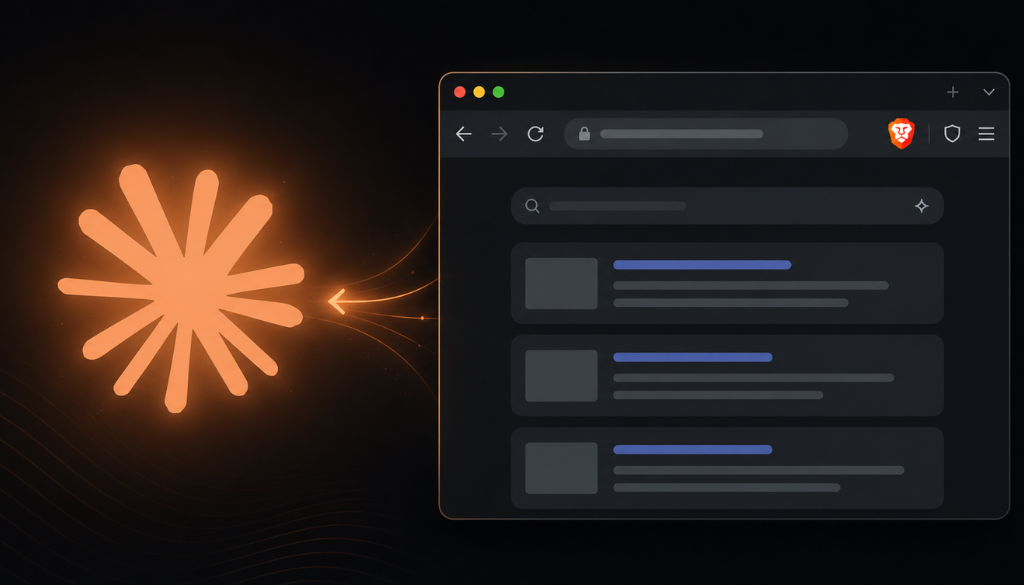
Claude does not independently crawl the web. Instead, when a query needs fresh information, Claude runs a fan-out search, surfaces results from Brave’s organic index, and builds its answer from those sources.
The overlap is not subtle. Profound’s original March 2025 analysis showed 86.7% alignment between Claude’s cited results and Brave’s top non-sponsored results across specific queries.
The newer dataset, roughly 35,000 URLs across 400 queries, confirms the pattern holds at scale: 79.2% of citations come from Brave’s top 10.
This also means Claude is transparent in a way that is rare among AI search engines. There is a direct optimization path:
- Identify the queries your buyers are asking Claude.
- Find out where you rank on Brave for those queries.
- Optimize to get into Brave’s top 10. Claude does the rest.
Brave Search also offers an API, so teams that want to monitor their Brave rankings at scale can do so programmatically.
Claude vs. ChatGPT: A Tale of Two Backends
Summary: Claude is tied to Brave and easier to optimize for. ChatGPT is building its own index and becoming more difficult to reverse-engineer.
To understand why the Brave finding matters, compare it against ChatGPT. The two look similar on the surface: both are AI search tools that retrieve web content and generate cited answers.
Under the hood, they work very differently.
| Category | Claude | ChatGPT |
|---|---|---|
| Search backend | Brave Search | Own index, moving away from Bing |
| Alignment with backend top 10 | 79.2% | Unknown / shifting |
| Alignment with Google top 10 | 34% | 21% |
| Alignment with Google top 50 | 64% | Around 37% |
| Optimizability | High, rank in Brave | Lower, less predictable |
The Google comparison is telling. Even if you give Google 50 results to work with, Brave’s top 10 still has more influence over Claude’s citations. Google rank alone is not enough. You need Brave rank.
ChatGPT presents the opposite problem. It is building its own proprietary index, moving away from Bing as a backend, and the overlap between what it cites and what ranks anywhere else keeps shifting.
Blyskal described it as genuinely a black box. You cannot reverse-engineer it the way you can Claude.
What Does This Mean for Your AEO Strategy?
Summary: Add Brave rank tracking to your AEO workflow the same way you track Google rank, especially for B2B queries.
Most AEO strategies today are built around Google, Bing, or a handful of AI platforms. Very few teams are actively monitoring Brave rankings. That gap is the opportunity.
Here is how to act on this data:
Identify your high-intent B2B queries.
What would a buyer or researcher ask Claude when evaluating your product or category? These are the queries that matter most. Use tools like ChatGPT or Perplexity to surface natural-language question variants. If you want more structured, citation-ready answers from AI models, a depth prompt is a good place to start.
Check your Brave rank for those queries.
Go to search.brave.com and run the queries manually, or use Brave’s API to pull rankings at scale. If you are not in the top 10, you are largely invisible to Claude.
Optimize for Brave like you optimize for Google.
Brave’s ranking signals are similar to Google’s: structured content, clear answers, crawlability, and authority signals all matter. The difference is that Brave does not personalize results the way Google does, so your organic rank is more consistent and reliable.
Make sure Claude can crawl your pages.
Claude does not have a publisher-specific opt-out mechanism. If you want to appear in Claude’s answers, your pages need to be crawlable by Brave’s bot. Review your robots.txt and ensure key content is not blocked. We covered AEO fundamentals here if you need a starting point.
Track Claude citation share alongside Brave rank.
Use a tool like Profound or run regular Claude queries manually to see whether your brand appears in citations. If your Brave rank improves but your Claude citation rate does not, the issue may be content quality or page structure, not rank.
This is one of the most directly trackable elements in all of AEO right now. You can measure Brave rank. You can measure Claude citation share. And the relationship between the two is clear enough to build a repeatable optimization loop.
The Window Is Open, But It Will Not Stay That Way
Summary: Anthropic may eventually build its own search index like OpenAI has, which would make Claude’s citation behavior as unpredictable as ChatGPT’s.
Blyskal flagged this directly in his post: “IMO the next question is whether Anthropic keeps this or starts building their own index the way OpenAI has. If they do, this window closes. Right now it’s wide open.”
OpenAI has already started down this path. ChatGPT’s alignment with Bing has been declining as OpenAI builds out its own proprietary crawl and index. The more that happens, the less useful traditional SEO signals become for ChatGPT AEO.
Claude is different right now precisely because Anthropic has not made that move yet. The transparency is a feature of the current architecture, not a guarantee.
Teams that act on Brave rank now are building an advantage that may not be available in 12 months.
Frequently Asked Questions
Does Claude always use Brave Search?
When Claude performs a live web search, the research strongly indicates it uses Brave Search as its primary backend. Profound’s analysis of roughly 35,000 URLs across 400 queries found that 79.2% of Claude’s citations came from Brave’s top 10. That said, Anthropic has not officially confirmed this, and the architecture could change.
Is ranking on Brave different from ranking on Google?
Brave’s ranking signals are similar to Google’s in many ways, including content quality, authority, and crawlability. The main difference is that Brave does not personalize results as aggressively, so your ranking is more consistent across users. Standard SEO fundamentals apply, and a strong Google ranking will often translate to a strong Brave ranking, but the two are not identical, which is why checking Brave directly matters.
What about ChatGPT? Should I ignore it for AEO?
No. ChatGPT still has massive reach, especially in consumer contexts. The issue is that its citation behavior is increasingly opaque. You cannot reliably trace a ChatGPT citation back to a single ranking signal the way you can with Claude and Brave. For now, content quality, authority, and brand mentions across the web remain the best levers for ChatGPT AEO, even if the feedback loop is harder to close.
Can I block Claude from using my content?
There is no Claude-specific opt-out mechanism. Since Claude sources content through Brave’s index, your standard robots.txt rules apply to Brave’s crawler. If you want Claude to stop using your content, you would need to block Brave from indexing it, which would also remove you from Brave search results entirely.
What is the Brave Search API?
Brave offers a Search API that lets you query Brave’s index programmatically. For AEO teams, this means you can monitor your Brave rankings at scale without manual checking and build alerts around ranking changes for key queries.
Where can I learn more about the Zero Click NY research?
Profound’s Zero Click NY session recordings will be available starting June 29, 2026. You can also read Josh Blyskal’s original Claude web search analysis on the Profound blog, which includes the initial query-level data that the larger study builds on.
About the author
Kai Williams
Kai Williams has been in marketing for years, with a long background in SEO before AEO had a name. He stepped into Answer Engine Optimization the moment AI started reshaping how people search, and has been tracking the shift ever since. At Prompt Insider, he covers AEO, AI marketing, and the future of search, breaking down what is changing and what brands need to do about it.