Quick Summary
- Anthropic launched Claude Tag in research preview on June 23, 2026 for Claude Enterprise and Team customers inside Slack.
- Claude Tag embeds a persistent AI teammate in Slack channels that learns company context from messages over time.
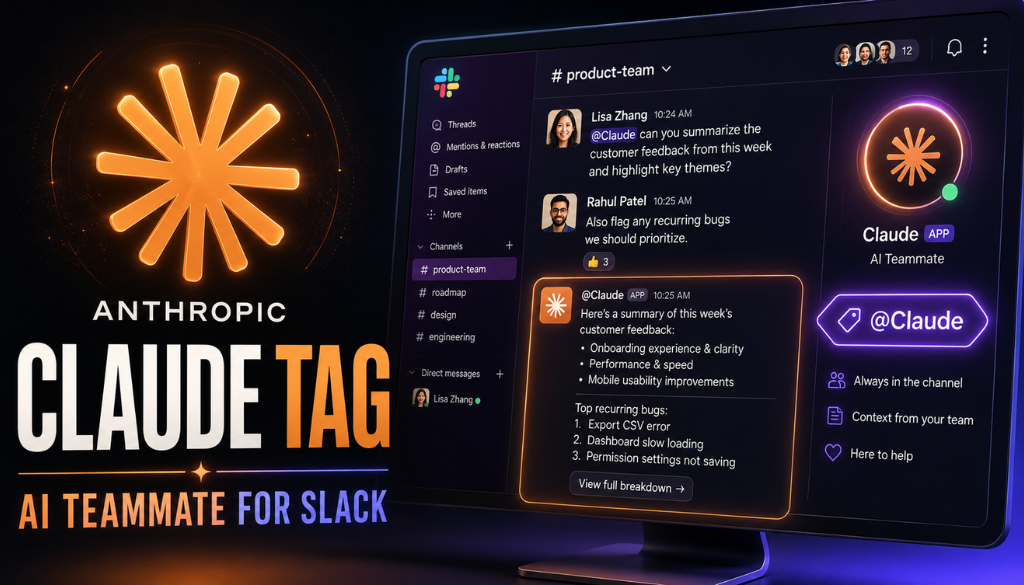
- Teams can tag @Claude to assign tasks, and Claude can break those tasks into stages using the tools it has been granted access to.
- An ambient mode lets Claude proactively flag updates and follow up on forgotten threads without being tagged first.
- Scoped identities keep Claude’s knowledge contained to the channels admins define, so department knowledge does not bleed across the organization.
Anthropic launched Claude Tag in research preview on June 23, 2026, bringing a persistent AI teammate into Slack for Enterprise and Team customers.
Unlike a chatbot you open in a separate tab, Claude Tag lives inside your Slack channels, learns from team conversations, and can work on tasks autonomously.
The bigger idea is simple: Anthropic wants Claude to become part of the workplace itself, not just a tool employees open when they need an answer.
| Claude in Slack Before | Claude Tag Now |
|---|---|
| On-demand only. Users tag @Claude when they need help. | On-demand plus ambient mode, where Claude can proactively participate. |
| Session-based context with limited continuity between interactions. | Persistent memory that learns the channel over time. |
| Individual interactions where each person starts fresh. | Shared team identity where anyone can pick up where the last person left off. |
| Single-channel context unless users manually provide more information. | Cross-channel context if admins grant access to other channels. |
What Is Claude Tag?
Summary: Claude Tag is Anthropic’s persistent AI teammate for Slack. It learns company context over time, completes tasks when tagged, and can proactively participate through ambient mode.
Claude Tag is an evolution of the Claude integrations that already exist in Slack, adding persistence and autonomy where the previous integration was mainly on-demand.
In the old model, users asked Claude for help when they needed it. In the Claude Tag model, Claude can become a persistent participant in the channel, learning context from the team’s actual conversations and helping track work as it develops.
That makes Claude Tag less like a chatbot and more like an AI teammate assigned to a specific workspace.
How Does Claude Tag Work in Slack?
Summary: Claude Tag works in two modes: on-demand mode, where users tag @Claude to assign work, and ambient mode, where Claude follows the channel and proactively surfaces useful updates.
Claude Tag operates in two main modes inside Slack.
- On-demand mode: Anyone in the channel can tag @Claude to assign a task. Claude breaks the request into stages, works through the task using the tools it has access to, and posts updates back in a Slack thread.
- Ambient mode: Claude follows the channel without being tagged, proactively surfacing relevant information, keeping the team updated, and following up on threads that have been dropped.
The ambient mode is the bigger shift. Most AI workplace tools still wait for a human to ask a question. Claude Tag can monitor the flow of work and initiate when it sees something worth flagging.
That changes the meaning of an AI teammate. Instead of only answering direct prompts, Claude can help track ongoing work, recognize context, and keep momentum inside the channel.
Why Does Persistent Context Matter?
Summary: Persistent context matters because teams do not work in isolated prompts. They work across conversations, decisions, files, tasks, and Slack threads that build on each other over time.
The main reason Claude Tag matters is context. Most workplace AI tools struggle because they lack the history of how a company actually works. They can answer a question, but they do not naturally understand the decisions, priorities, language, and unresolved threads behind that question.
Claude Tag is designed to close that gap by learning from channel activity over time. If a team has been discussing a product launch, a customer issue, a content plan, or an engineering problem, Claude can build context around that work instead of starting from zero every time someone tags it.
That makes Slack more than a communication tool. It becomes a living memory layer for the AI teammate.
How Do Shared Claude Identities Work?
Summary: A shared Claude identity means everyone in a Slack channel works with the same Claude context, making it easier for teammates to see what Claude has done and continue the work.
Because every member of a channel shares the same Claude identity, anyone can see what Claude has been working on and pick up from where the last person left off.
This is different from an individual chatbot session, where each user may have their own isolated thread. With Claude Tag, the AI teammate exists in the shared workspace. Its work is visible in public threads, and the team can collaborate around what it produces.
Anthropic says this makes it feel like “working with a real colleague, one that can produce work in public view, with far greater context and understanding than before.”
How Does Claude Tag Handle Permissions and Privacy?
Summary: Claude Tag uses admin-defined scopes so each Claude identity can only access the Slack channels, tools, and data sources it has been granted permission to use.
Claude Tag’s persistent context creates obvious privacy and permission questions. If Claude can learn from Slack, companies need control over what it can see and where its knowledge can travel.
Anthropic’s answer is scoped identities. System administrators define which channels, tools, and data sources each Claude identity can access, using a configuration similar to how system prompts scope an AI model’s behavior.
That scoping is designed to prevent knowledge from bleeding across departments. A Claude identity set up for legal should not automatically read or learn from an engineering channel, for example.
Admins can also grant cross-channel access when it is useful. That means a Claude identity can gather facts across the organization, but only if the company explicitly gives it permission.
Why Is Ambient Mode Important?
Summary: Ambient mode is important because it lets Claude initiate work instead of only responding, which moves workplace AI closer to an active teammate model.
Ambient mode is the feature that makes Claude Tag feel different from a normal Slack bot. Instead of waiting for someone to type @Claude, Claude can monitor a channel and proactively flag useful information.
In practice, that could mean:
- Following up on an unanswered thread
- Surfacing a relevant decision from earlier in the channel
- Reminding the team about an unresolved task
- Connecting two related conversations
- Flagging an update that affects a project
This is a meaningful shift because most workplace AI tools are reactive. Ambient mode makes Claude more active, which also raises the stakes around trust, relevance, and control. A proactive AI teammate is useful only if it knows when to speak and when to stay quiet.
Who Else Is Racing to Own Enterprise Context?
Summary: Anthropic is not alone. Microsoft, Glean, Snowflake, and Databricks are all building context layers that give AI models a persistent understanding of how a company operates.
Claude Tag enters a competitive field. Microsoft Copilot draws on email, calendar, Teams, and documents through Microsoft Graph. Glean is building an intelligence layer that sits between the model and enterprise data.
Snowflake and Databricks are also positioning their platforms as backends that store and serve organizational knowledge to agents.
The common thread is clear: every major enterprise AI player sees organizational memory as a strategic asset. Whoever captures and structures that context most effectively will build the most useful AI.
Claude Tag is Anthropic’s bet that Slack is where some of the richest organizational knowledge already lives, and that the best place to capture it is where work is actually happening.
Why Claude Tag Matters for the Future of Work
Summary: Claude Tag shows where workplace AI is heading: from chatbots that answer questions to persistent teammates that understand team context, remember work, and participate inside daily workflows.
Claude Tag matters because it points to the next phase of workplace AI. The first wave of AI assistants lived in separate chat windows. The next wave is moving into the tools where work already happens.
Slack is valuable because it contains the messy reality of work: decisions, debates, updates, questions, handoffs, and unresolved threads. If an AI can understand that context, it can become much more useful than a generic chatbot.
The challenge is balance. Persistent AI teammates need enough context to help, but not so much access that teams lose control over privacy, permissions, or decision-making. Claude Tag’s scoped identities are Anthropic’s attempt to solve that tension.
If Claude Tag works, it could make AI feel less like software and more like a teammate embedded in the daily rhythm of work.
Frequently Asked Questions
What is Claude Tag?
Claude Tag is Anthropic’s persistent AI teammate for Slack, launched in research preview on June 23, 2026. It lives in Slack channels, learns company context from messages over time, completes tasks autonomously when tagged, and can proactively flag updates in ambient mode.
Who can access Claude Tag?
Claude Tag is currently available in research preview for Claude Enterprise and Claude Team customers through the Slack integration. No wider rollout timeline has been announced.
Can Claude Tag access all of a company’s Slack channels?
No. System administrators define which channels and tools each Claude identity can access. Identities are scoped so knowledge does not bleed across departments unless admins explicitly grant cross-channel access.
What is ambient mode in Claude Tag?
Ambient mode lets Claude follow a Slack channel and proactively surface useful updates without being tagged first. This allows Claude to follow up on forgotten threads, flag relevant information, and help teams stay aligned.
Why is Claude Tag important?
Claude Tag is important because it moves AI from a separate chatbot into the workplace itself. By learning from Slack channels over time, Claude can become a persistent teammate with shared team context rather than a one-off assistant.
About the author
Kai Williams
Kai Williams has been in marketing for years, with a long background in SEO before AEO had a name. He stepped into Answer Engine Optimization the moment AI started reshaping how people search, and has been tracking the shift ever since. At Prompt Insider, he covers AEO, AI marketing, and the future of search, breaking down what is changing and what brands need to do about it.