Short Answer: What changed on August 2?
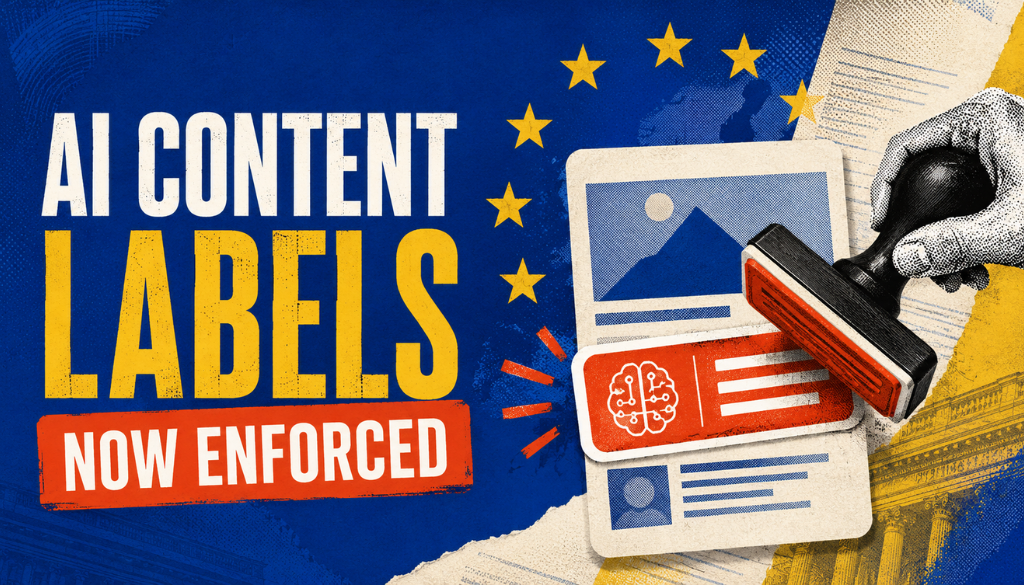
The EU began enforcing Article 50 of the AI Act, which requires AI systems to identify themselves and AI-generated content to be marked as synthetic. Chatbots must tell people they are not human, deepfakes must be labeled, and AI-generated audio, image, video, and text must carry machine-readable marks where technically feasible.
Quick Summary
- Enforcement started August 2, 2026. The AI Office and national market surveillance authorities are now actively supervising compliance.
- Three obligations hit content teams directly: chatbot disclosure, deepfake labeling, and machine-readable marking of AI-generated content.
- These rules are not limited to high-risk systems. They apply to ordinary marketing chatbots and generative content tools.
- There is an “obvious AI” exemption when interaction with AI would be clear to a reasonably well-informed, observant, and circumspect person.
- High-risk system rules were delayed to December 2027 and August 2028, but transparency is in force now.
On August 2, 2026, the European Commission began enforcing the AI Act’s transparency requirements. The rules had been on the books since the regulation passed, but this is the date they became live obligations with authorities behind them.
For marketers, this is the most directly relevant AI regulation to land so far. It is not about model training or high-risk classification systems. It is about whether the chatbot on your site says it is a chatbot, and whether the content your team generates carries a machine-readable mark identifying it as AI-made.
What Exactly Took Effect on August 2?
Article 50 of the AI Act sets out transparency obligations for providers and deployers of certain AI systems. Reporting by AI News on August 3 confirmed the provisions entered force alongside the Commission’s enforcement powers.
Four obligations matter most:
- Chatbot disclosure. Systems that interact with people must be designed so users know they are dealing with AI, not a human.
- Synthetic content marking. Providers of systems generating audio, image, video, or text must apply machine-readable marks flagging the output as artificially generated, as far as technically feasible.
- Deepfake labeling. AI-generated or manipulated images, video, and audio must be disclosed as such, particularly for content on matters of public interest.
- Emotion recognition and biometric categorization notice. Deployers of these systems must inform the people exposed to them.
The Commission has also published guidelines on transparency obligations for providers and deployers, which is the practical reference for interpreting how the rules apply to a specific product.
Who Enforces These Rules?
Three bodies share responsibility: national market surveillance authorities in each member state, the European Commission’s AI Office, and the European Data Protection Supervisor.
The Commission has also opened complaint and whistleblower channels, including a route for downstream providers to raise issues. That matters practically: enforcement will not depend only on regulators noticing a problem. Competitors, users, and employees now have a formal way to report one.
The Commission has framed the motivation in blunt terms, citing concerns about manipulation at scale and fraud, with impersonation and consumer deception close behind.
Does This Apply to Your Marketing Stack?
If you serve users in the EU and you run an AI chatbot, generate content with AI, or produce synthetic media, then yes — some part of Article 50 likely touches you.
A useful distinction is provider versus deployer. A provider builds or places an AI system on the market. A deployer uses one under its own authority. Most marketing teams are deployers: you did not build the model, but you are the one putting it in front of customers.
The marking obligation for synthetic content falls primarily on providers of the generative system. The disclosure obligations for chatbots, deepfakes, and emotion recognition reach deployers directly.
In practice, that means you cannot simply assume your vendor has handled it. If you deploy a chatbot that does not disclose itself, the gap is yours to close.
What Is the “Obvious AI” Exemption?
Disclosure is not required where it would be obvious to a reasonably well-informed, observant, and circumspect person that they are interacting with AI.
This is the provision teams will lean on, and it deserves caution. It is a legal standard, not a marketing judgment call. A widget clearly labeled as an automated assistant may qualify. A conversational agent given a human name and persona almost certainly does not.
The safer default is to disclose. The cost of a visible label is low. The cost of arguing about what a circumspect person would have assumed is not.
How Strict Is the Machine-Readable Marking Requirement?
Softer than it first appears. The obligation applies as far as technically feasible, which acknowledges that watermarking text is a genuinely unsolved problem compared to marking images or audio.
That qualifier is not a loophole to ignore the rule. It is an invitation to document what you did, what was technically possible, and why. Teams that can show a reasoned approach will be in a better position than teams that did nothing.
How Can You Demonstrate Compliance?
The Commission has published a Code of Practice on Transparency of AI-generated Content. Signing it is one route to demonstrating compliance. Organizations may also use alternative means the Commission considers adequate.
A practical starting checklist:
- Inventory every customer-facing AI touchpoint: chatbots, support agents, generated copy, synthetic imagery, voice systems.
- Add clear AI disclosure to any interactive system, and do not rely on the obvious-AI exemption unless you have documented reasoning.
- Ask your generative AI vendors, in writing, what machine-readable marking they apply to outputs and whether it survives your publishing pipeline.
- Label synthetic media in campaigns, especially anything touching public-interest topics, elections, or real people.
- Document your decisions, including where marking was not technically feasible and why.
- Assign an owner. Transparency compliance without a named owner tends to decay as tools and vendors change.
What Was Delayed?
The high-risk AI system rules did not take effect on this date. Those were pushed to December 2, 2027 for stand-alone high-risk systems and August 2, 2028 for high-risk AI embedded in products, following the Commission’s broader regulatory framework timeline.
This distinction matters because it has caused confusion. Transparency obligations are in force now, and they are not limited to high-risk systems. A basic marketing chatbot is not high-risk, and it is still covered.
One detail neither the Commission’s announcement nor the initial reporting specified: concrete penalty amounts for transparency breaches. The Commission’s own summary confirms enforcement has begun without publishing a fine schedule for these provisions.
Why This Matters Beyond Europe
Most global brands will not maintain one labeling standard for the EU and another for everywhere else. It is cheaper to apply the stricter rule everywhere, which is how EU digital regulation has historically exported itself.
The direction is already visible in the United States. New York made AI content labeling the law for certain synthetic media, and other states are moving. The EU rules give that trend a global reference point.
There is also a discovery angle. As AI systems increasingly cite and summarize content, provenance signals become part of how machines evaluate sources. Teams already thinking about Answer Engine Optimization and agent analytics should treat labeling as infrastructure, not paperwork.
Transparency also intersects with quality. Disclosure does not fix AI bias or inaccuracy, but it does make AI involvement visible, which is the precondition for holding any system accountable.
Frequently Asked Questions
When Did the EU AI Act Transparency Rules Take Effect?
August 2, 2026. The European Commission’s AI Office and national authorities began enforcing Article 50 transparency obligations on that date, alongside new complaint and whistleblower channels.
Do These Rules Apply to Ordinary Marketing Chatbots?
Yes. The transparency obligations are not limited to high-risk AI systems. Any system that interacts with people must be designed so users know they are dealing with AI, unless that fact would be obvious to a reasonably well-informed, observant, and circumspect person.
Does AI-Generated Text Have to Be Watermarked?
Providers of generative systems must apply machine-readable marks to synthetic audio, image, video, and text, but the obligation applies as far as technically feasible. Text watermarking remains technically harder than image or audio marking, and the rule acknowledges that.
What Are the Penalties for Non-Compliance?
The Commission’s enforcement announcement and initial reporting did not specify penalty amounts for transparency breaches. Enforcement is being handled by national market surveillance authorities, the AI Office, and the European Data Protection Supervisor.
What Should Marketing Teams Do First?
Inventory every customer-facing AI touchpoint, add clear disclosure to interactive systems, confirm in writing what marking your generative vendors apply, and document your decisions. Reviewing the practical guide to Article 50 is a reasonable starting point.
About the author
Kai Williams
Kai Williams has been in marketing for years, with a long background in SEO before AEO had a name. He stepped into Answer Engine Optimization the moment AI started reshaping how people search, and has been tracking the shift ever since. At Prompt Insider, he covers AEO, AI marketing, and the future of search, breaking down what is changing and what brands need to do about it.