

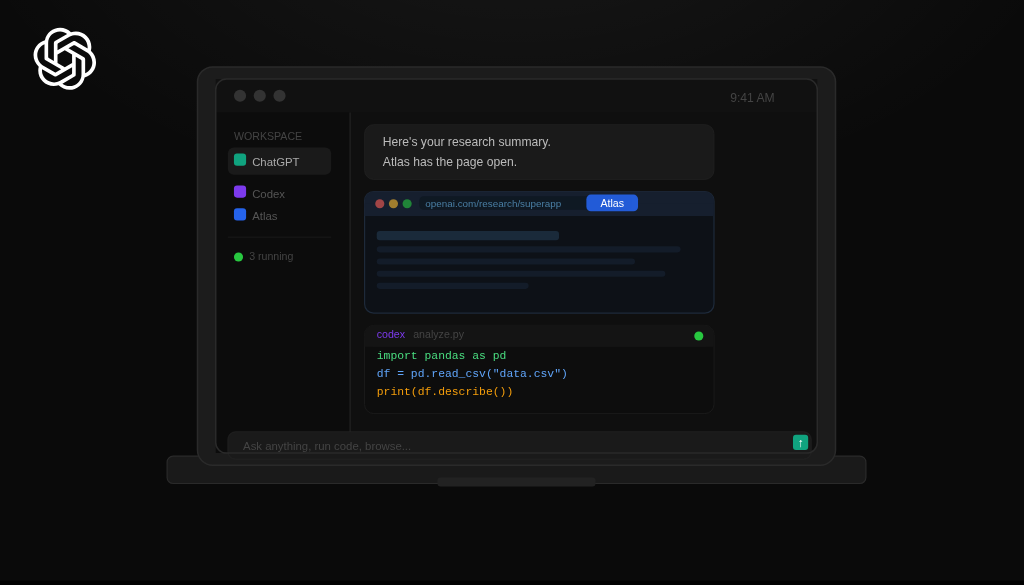
OpenAI confirmed on March 19, 2026 that it is merging its ChatGPT app, Codex coding platform, and Atlas browser into a single desktop superapp. The move consolidates OpenAI’s fragmented product lineup into one unified agentic interface and signals a direct push to own the desktop as the primary layer through which people access AI, search for information, and get work done.
The announcement was first reported by The Wall Street Journal and confirmed by an OpenAI spokesperson. Chief of Applications Fidji Simo will lead the commercial rollout of the new app, while OpenAI President Greg Brockman will temporarily oversee the product overhaul and the organizational changes that come with it. In an internal note to employees, Simo was direct about the reason for the shift: “We realised we were spreading our efforts across too many apps and stacks, and that we need to simplify our efforts. That fragmentation has been slowing us down and making it harder to hit the quality bar we want.”
What Is the OpenAI Superapp?
The OpenAI superapp is a unified desktop application that combines three previously separate products into one: ChatGPT, which handles general conversational AI tasks; Codex, OpenAI’s AI coding platform; and Atlas, OpenAI’s AI-powered browser. Rather than switching between tools depending on the task, users will interact with a single interface that can handle research, writing, coding, and web browsing in one place.
The core of the new product is agentic capability. OpenAI executives have made clear that the superapp is not just a UI consolidation. It is designed to give the underlying AI system the ability to work autonomously across a user’s computer, handling tasks end to end without the user managing each step individually. That framing puts the OpenAI superapp directly in the same category as Manus My Computer and Perplexity’s Personal Computer, which launched in the same week. If you want to understand how these systems work under the hood, our breakdown of what agentic AI actually is covers the full architecture. The race to own the desktop as an agentic AI layer is moving faster than most people in the industry anticipated.
Why OpenAI Is Making This Move Now
The timing is not accidental. OpenAI has spent the past year launching a series of standalone products at a rapid pace, including Sora, its video generation app, and various enterprise tools. By the company’s own admission, that pace created fragmentation that slowed execution and confused focus.
The competitive pressure from Anthropic is a significant factor. According to MacRumors, OpenAI executives have been telling employees internally that the company cannot afford to be distracted by “side quests” while Anthropic is gaining momentum with enterprise and coding customers. Anthropic’s Claude Code and Cowork products have made inroads with exactly the productivity-focused, high-value customers OpenAI is trying to win. The superapp is the response: a consolidated platform built to compete on focus and execution rather than feature count. It also follows the NVIDIA Nemotron 3 Super integration into Perplexity, which we covered in our piece on how faster AI models are reshaping search — the infrastructure war and the product war are happening simultaneously.
There is also an IPO dimension. Simo joined OpenAI from Instacart and has been emphasizing product focus and commercial discipline as the company prepares for a potential public offering, which could happen as soon as 2026. A unified, clearly positioned desktop product is a stronger story for investors than a sprawl of standalone apps with inconsistent adoption. CNBC reported that Simo told employees OpenAI is “orienting aggressively” toward high-productivity use cases and that “what really matters for us right now is staying focused and executing extremely well.”
What Gets Merged and What Stays Separate
The superapp will combine ChatGPT, Codex, and the Atlas browser on desktop. The process is being staged: OpenAI plans to first expand Codex’s capabilities beyond coding into broader productivity tasks, then merge ChatGPT and Atlas into the unified superapp over the coming months.
Notably, the mobile ChatGPT app will remain unchanged. The superapp strategy is a desktop-first move, targeting the professional and enterprise user who is doing serious work on a computer rather than the casual mobile user asking quick questions. That distinction matters for how OpenAI is thinking about its competitive positioning: the desktop is where high-value work happens, and that is the territory it wants to own.
What This Means for AI Search and AEO
The OpenAI superapp is not just a product story. It is a search story. When a unified AI interface handles browsing, research, coding, and task execution in a single session, the traditional model of opening a browser, typing a query, and clicking through results becomes increasingly irrelevant. The superapp becomes the front door to information, and the AI inside it decides what sources to surface, what brands to cite, and what answers to deliver.
This is the same dynamic that we covered in the context of the future of search: the shift from search engines to answer engines to agentic systems that eliminate the query step entirely. OpenAI’s superapp is a direct acceleration of that shift. It is not replacing Google today. But it is building the infrastructure to route around Google for an increasing share of the research and discovery tasks that matter most to high-intent users.
For brands and marketers, the implication is straightforward. As OpenAI, Manus, and Perplexity all race to build unified agentic desktop experiences, the surfaces where brand visibility gets established are changing. Being cited inside AI-generated answers is already more important than ranking on page one for a growing share of queries. As these superapp experiences mature and absorb more of the daily research and work sessions that currently happen in a browser, that shift accelerates further.
The brands that will show up inside OpenAI’s superapp are the same brands that are building AEO foundations now. Structured content, topical authority, consistent off-site citations, and machine-readable formatting are not optional extras in an agentic search world. They are the entry fee. The window to build that foundation is narrowing fast. The brands that wait will find themselves optimizing for a search paradigm that has already moved on.
At Prompt Insider, we will keep tracking how the superapp race develops and what it means for how brands get found. This is one of the most important news cycles in AI search right now, and it is moving fast.
Frequently Asked Questions (FAQs)
What is the OpenAI superapp?
The OpenAI superapp is a unified desktop application that merges ChatGPT, the Codex coding platform, and the Atlas browser into one interface. Confirmed on March 19, 2026, the superapp is designed to give users a single agentic AI tool for research, writing, coding, and web browsing, replacing the fragmented experience of switching between separate OpenAI products.
Why is OpenAI building a superapp?
OpenAI is building the superapp to consolidate its fragmented product lineup, improve execution focus, and compete more effectively with Anthropic, which has gained significant traction with enterprise and coding customers. Chief of Applications Fidji Simo acknowledged internally that spreading efforts across too many apps had slowed the company down and made it harder to maintain quality. The move also strengthens OpenAI’s commercial positioning as it prepares for a potential IPO. For context on how this fits into the broader shift in AI search, see our overview of what comes after Google.
How does the OpenAI superapp affect search and brand visibility?
As OpenAI’s superapp integrates browsing, research, and task execution into one agentic interface, it becomes an increasingly important surface for brand discovery. When the AI inside the superapp decides which sources to cite and which brands to recommend, traditional search rankings matter less. Answer Engine Optimization is the discipline that prepares brands for exactly this shift, ensuring content is structured, authoritative, and machine-readable enough to be cited inside AI-generated responses across platforms including ChatGPT.
When will the OpenAI superapp launch?
OpenAI has not announced a specific launch date for the unified superapp. The company plans to first expand Codex’s capabilities into broader productivity tasks beyond coding, then merge ChatGPT and the Atlas browser into the superapp over the coming months. The mobile ChatGPT app will remain a separate, unchanged product throughout this process.
