

Summary
OpenClaw is an open-source AI agent platform that lets anyone run autonomous AI on their personal computer, no cloud subscription required. Nvidia CEO Jensen Huang called it the next ChatGPT at GTC 2026. For marketers and AEO practitioners, its rise signals something bigger: as AI agents increasingly handle search and retrieval on behalf of users, the question of how your brand gets found by autonomous AI is no longer theoretical.
The Next ChatGPT
OpenClaw is an open-source agentic AI platform built by Austrian developer Peter Steinberger. It allows users to deploy autonomous AI agents that can complete tasks, browse the web, manage communications, and retrieve information without requiring access to expensive proprietary models. Its rapid rise, from unknown project to the most-discussed AI tool at Nvidia’s GTC 2026 conference in under three months, has raised a direct question for the AI industry: if powerful agents can run locally and for free, what happens to the platforms and content those agents pull from?
Three months ago, nobody in the tech industry had heard of OpenClaw. Today, Nvidia CEO Jensen Huang is calling it the most popular open-source project in the history of humanity. That’s not a small claim, and the speed of OpenClaw’s rise is worth paying attention to, not just for what it says about AI development, but for what it means for how brands get discovered in an increasingly agentic world.
For marketers and AEO practitioners, the OpenClaw story isn’t just a news item. It’s a signal about where AI-driven search and retrieval are heading, and how quickly the landscape can shift.
What OpenClaw Actually Is
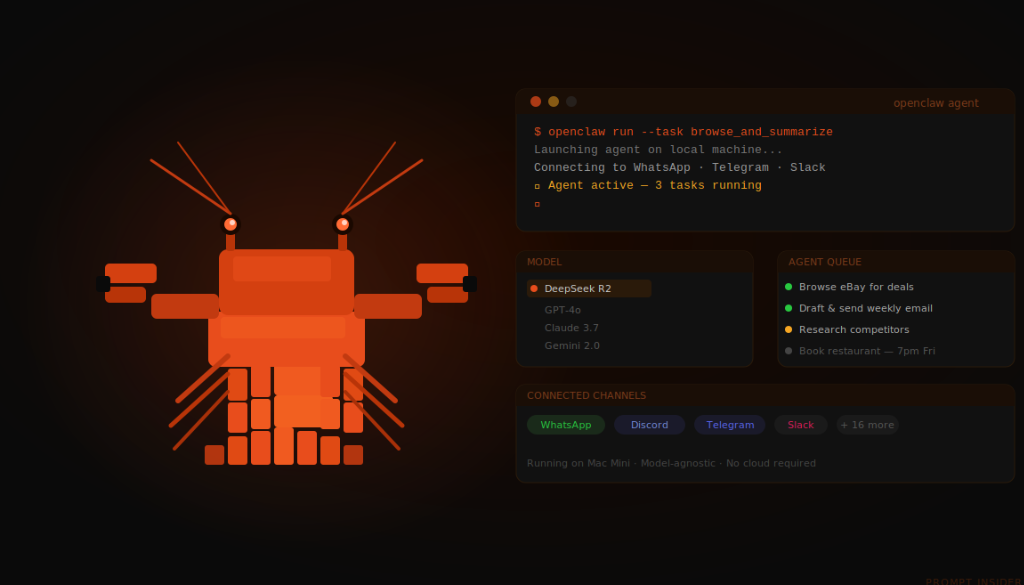
OpenClaw is a model-agnostic, open-source AI agent framework that runs on personal computers including standard Mac Minis. It allows users to deploy autonomous agents that can send messages on WhatsApp and Telegram, browse the web, complete tasks, and manage workflows without relying on cloud-based AI services from OpenAI, Anthropic, or Google.
OpenClaw was created by Peter Steinberger, an Austrian software developer, and first launched in November 2025 under the names Clawdbot and Moltbot. It gained rapid traction through social media and the developer community, largely because it made genuinely autonomous AI accessible to anyone with a laptop. Steinberger announced in February 2026 that he would be joining OpenAI and that OpenClaw would continue as an open-source project under a foundation supported by the company.
What makes OpenClaw distinctive isn’t the underlying model, it’s the framework. Because it’s model-agnostic, users can plug in Chinese models like DeepSeek alongside ChatGPT or Claude, whichever is cheapest or most capable for the task at hand. That flexibility is part of what has driven its explosive adoption, particularly in China, where Baidu and Tencent have hosted public setup events and local governments have offered financial incentives for businesses to build on it.
At Nvidia’s GTC 2026 conference, Jensen Huang dedicated a major portion of his keynote to OpenClaw and announced NemoClaw, an enterprise-grade version with Nvidia’s security and privacy stack layered on top. The goal is to make OpenClaw deployable at scale inside large organizations that can’t afford the security risks of a fully open, unmanaged agent framework.
Why OpenClaw Matters for AEO
OpenClaw matters for AEO because autonomous agents like it don’t search the way humans do. They retrieve, synthesize, and act on behalf of users without displaying a list of results to click through. If your brand isn’t structured to be cited and referenced by AI systems, an agent completing a task on someone’s behalf may never surface your content at all.
The rise of agentic AI is one of the core reasons AEO exists as a discipline. Traditional SEO is built around a model where a human types a query, sees results, and clicks a link. Agents collapse that model. When an AI agent is browsing the web, comparing options, and completing a purchase or booking on a user’s behalf, the human never sees the search results page. The agent makes the retrieval decision, and whatever it surfaces becomes the answer. We covered this trajectory in depth in our piece on the future of search — and OpenClaw is the clearest signal yet that the timeline is compressed.
This is the dynamic we covered in our breakdown of what is agentic AI and what it means for marketers. OpenClaw is the most mainstream example of that shift arriving faster than most brands anticipated.
Because OpenClaw is model-agnostic and runs locally, it also signals something specific about how agentic AI will develop: it won’t be controlled by any single platform. A user running DeepSeek through OpenClaw on a Mac Mini is operating in an entirely different retrieval environment than someone using ChatGPT’s web interface. Your brand’s visibility in one does not guarantee visibility in the other.
The Commoditization Problem and What It Means for Search
OpenClaw’s rise has accelerated concern that large language models are becoming commoditized. If capable AI can run locally for free using open-source models, the differentiation shifts away from the underlying model and toward the agent layer, the frameworks, the data, and the content those agents retrieve. That makes the quality and structure of your content more important, not less.
The concern among investors and AI companies is straightforward: if any developer can build a powerful AI agent using free open-source models on a standard laptop, the moat around proprietary AI narrows significantly. As CNBC reported, David Hendrickson, CEO of consulting firm GenerAIte Solutions, described OpenClaw as proving that fully autonomous AI can be run at home without relying on big AI companies, and called it the black swan moment most big AI companies feared.
For brands, the commoditization of AI models has an important implication. If the model layer is becoming a commodity, the value moves to what the agent retrieves and how it makes decisions. That’s the content layer. A brand that has structured its content to be clearly understandable, directly answer questions, and be retrievable by AI systems is better positioned in an agentic world than one that hasn’t. If you’re new to that framework, our introduction to AEO is the right starting point, and our guide on how to get your brand cited by ChatGPT, Gemini, Claude, and Perplexity applies directly to the retrieval decisions agents are making now.
This is precisely what the zero-click marketing problem points to. Traffic metrics become less meaningful when agents are doing the browsing. What matters is whether your brand shows up in the answer, not the click.
What Brands Should Take From the OpenClaw Story
The practical AEO takeaway from OpenClaw is that the agent layer is diversifying faster than anyone predicted, and brand visibility can no longer depend on a single AI platform. Content that is structured for AI retrieval, backed by third-party citations, and consistently published across multiple channels is the most resilient approach in a world where dozens of agent frameworks may be making retrieval decisions on your behalf.
OpenClaw’s rise from obscurity to the center of Nvidia’s biggest annual conference in three months is a reminder that the AI landscape is moving faster than most marketing teams can track. The shift from chatbot to agent is not a future scenario. It is already the primary use case for a significant portion of the most active AI users globally.
For brands that have been treating AEO as a forward-looking project rather than a current priority, OpenClaw is a useful data point. The agents users are deploying today are already browsing the web, retrieving information, and making decisions on behalf of their owners. Whether your content is structured to be found and cited in those retrievals is a question worth answering now rather than later.
If you haven’t yet audited your content for AEO readiness, our AEO content audit guide is the right place to start. And if you want to understand why moving early on this compounds over time, read our piece on the first-mover advantage in AEO.
Frequently Asked Questions (FAQs)
What is OpenClaw?
OpenClaw is an open-source AI agent platform created by Austrian developer Peter Steinberger. It allows users to run autonomous AI agents locally on personal computers, connecting to messaging apps like WhatsApp and Telegram and completing tasks without relying on cloud-based AI services. It is model-agnostic, meaning it can be paired with any large language model including open-source Chinese models like DeepSeek.
Why is OpenClaw significant for AI search?
OpenClaw is significant because it demonstrates that powerful agentic AI can operate outside the major proprietary platforms. As agents retrieve information and complete tasks on users’ behalf, the traditional search model of query, results, and click no longer applies. Brands that are not optimized for AI retrieval risk being invisible to users whose agents are making decisions without surfacing a results page.
What is NemoClaw?
NemoClaw is Nvidia’s enterprise-grade version of OpenClaw, announced at GTC 2026. It layers Nvidia’s security, privacy, and oversight tools on top of the OpenClaw framework to make autonomous AI agents deployable inside large organizations that require compliance and data protection standards.
How does OpenClaw relate to AEO?
OpenClaw represents the agentic AI layer that AEO is designed to address. As autonomous agents handle more search and retrieval on behalf of users, content that is structured to be cited and referenced by AI systems becomes more valuable than content optimized purely for human search behavior. OpenClaw’s rapid adoption accelerates the timeline on which that shift becomes commercially significant.
Is OpenClaw a threat to OpenAI and Anthropic?
OpenClaw highlights the risk of commoditization for proprietary AI models, but OpenAI moved quickly to incorporate it directly by hiring creator Peter Steinberger. Anthropic has been developing similar agent-based features. Both companies remain dominant in the enterprise and consumer markets, but OpenClaw’s rise signals that the agent layer will not be controlled by any single provider.
