Quick Summary
- ChatGPT’s AI search market share has dropped sharply, while Gemini has grown from 5.3% to 22% of global AI website traffic in twelve months.
- Gemini’s referral traffic to external websites is growing far faster than ChatGPT’s, making it a major AEO channel for marketers.
- Google’s distribution advantage through Search, AI Overviews, Android, Workspace, and Apple Intelligence is accelerating Gemini adoption.
- AEO strategies built only around ChatGPT are now incomplete because each AI platform uses different citation and referral signals.
- Brands need to track and optimize visibility across Gemini, ChatGPT, Perplexity, and Google AI Overviews as separate discovery channels.
A year ago, ChatGPT owned 87% of the AI search market. Today it is down to 65% and falling. Meanwhile, the platform quietly eating its lunch is the one most marketers have almost completely ignored.
Welcome to the Gemini era. And if your AEO strategy still starts and ends with ChatGPT, you are already behind.
The Numbers That Should Be Keeping Marketers Up at Night
Summary: ChatGPT is still the largest AI search platform, but Gemini is growing faster in both market share and referral traffic.
Let’s start with the data because it is genuinely stunning.
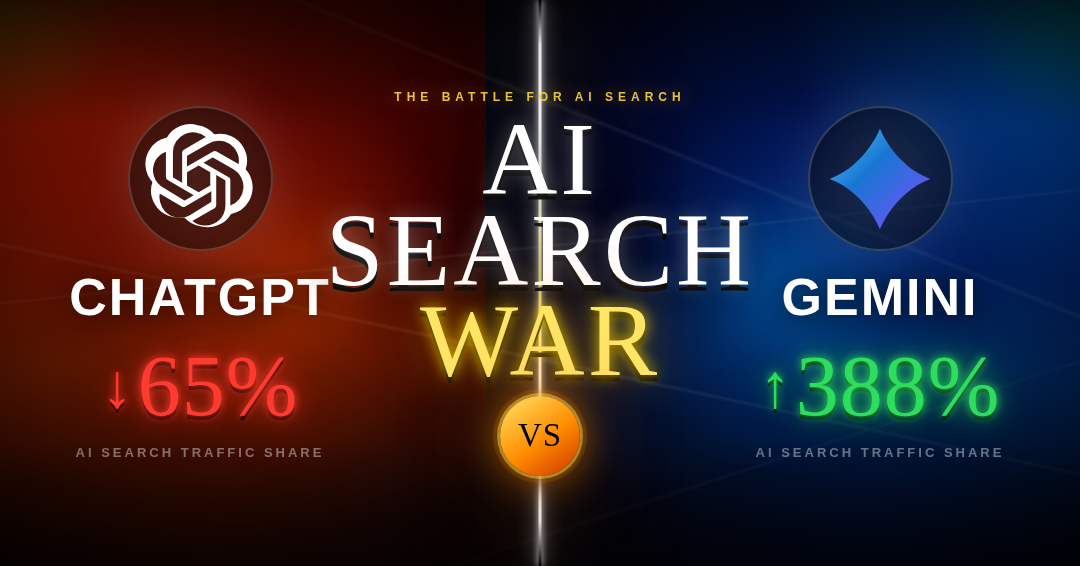
According to Similarweb’s January 2026 tracking data, ChatGPT’s worldwide traffic share has dropped to 64.6%, down from 86.6% just twelve months ago. That is a collapse of more than 22 percentage points in a single year, shedding roughly 2.2 percentage points every single month through the final quarter of 2025.
Gemini, meanwhile, went from holding a modest 5.3% share in January 2025 to commanding 22% of global AI website traffic by mid-January 2026. That is a 315% increase in twelve months.
But market share numbers only tell part of the story. The referral traffic data is where things get really interesting for anyone paying attention to how AI platforms are reshaping brand visibility.
Between September and November 2025, Gemini’s referral traffic to external websites grew 388% year-over-year, according to Similarweb data shared with Digiday. ChatGPT’s referral growth during that same window? A comparatively modest 52%.
Bottom line: Gemini’s referral traffic grew nearly eight times faster than ChatGPT’s.
Is Gemini Overtaking ChatGPT in AI Search?
Summary: Gemini is not larger than ChatGPT yet, but its growth trajectory is stronger and marketers can no longer ignore it.
In terms of market share growth and referral traffic growth rate, yes. Google’s Gemini grew from 5.3% to 22% of global AI website traffic in 12 months, and its referral traffic to external websites grew 388% year-over-year compared to 52% for ChatGPT. ChatGPT still holds the largest absolute share and drives more total referral volume, but the trajectory clearly favors Gemini. For marketers and AEO practitioners, optimizing exclusively for ChatGPT in 2026 means ignoring the fastest-growing traffic channel in the AI search ecosystem.
So Why Is Gemini Growing So Fast?
Summary: Gemini is growing because Google is using its unmatched distribution through Search, AI Overviews, Android, Workspace, and Apple partnerships.
Three things happened in quick succession that turbocharged Gemini’s growth, and they all came from the same playbook Google has used to dominate every market it has entered: distribution, distribution, distribution.
First, Gemini 3 became the default model for Google AI Overviews globally, which means every person who does a Google search and sees an AI-generated summary at the top of the page is now getting Gemini-powered results. That is not a niche product feature. That is the most visited website in the world serving AI answers to billions of queries.
Second, between August and November 2025, Gemini’s global desktop visits doubled while ChatGPT’s rose about 1% over the same period, according to Sensor Tower data. The launch of Nano Banana, Google’s image generation model, drove a surge in adoption that pushed Gemini’s monthly active users from 450 million in July to 650 million in October. Then in February 2026, Sundar Pichai confirmed on Alphabet’s earnings call that Gemini had crossed 750 million monthly active users.
Third, and this is the move that should terrify OpenAI, Google announced a partnership with Apple in January 2026 to position Gemini models as the foundation for Apple Intelligence. When Gemini gets baked into every iPhone, iPad, and Mac, the distribution advantage becomes almost impossible to overcome.
This is not just a story about search. It is a story about which AI platforms your brand needs to be visible on in 2026 and beyond.
The Dirty Secret About ChatGPT’s Referral Traffic
Summary: ChatGPT is increasingly answering questions inside the chat window, while Gemini is sending more users to external sources during commercial discovery.
Here is something that rarely gets said plainly: ChatGPT has been quietly making itself worse for publishers and AEO practitioners, and most people have not noticed.
Between July and August 2025, ChatGPT’s referral traffic to external websites dropped 52% in a single month. Not a slow fade. A cliff. The cause was a deliberate product decision: ChatGPT increasingly delivers complete answers inside the chat window rather than sending users to source websites. Better experience for the user, terrible news for anyone trying to earn citations and drive traffic.
This creates a problem that goes beyond traffic numbers. Without click-through behavior, ChatGPT has less feedback about which sources users actually find valuable. Content creators and publishers who once viewed ChatGPT as a potential traffic source are now increasingly viewing it as a competitor. A Reuters Institute report found that publishers expect search traffic to drop 43% by 2029, partly driven by exactly this dynamic.
Gemini operates differently. Its referral behavior is driven heavily by “commercial discovery,” where users ask Gemini a research question and Gemini actively surfaces source links for further reading. That is the behavior pattern that produces 388% referral growth and makes Gemini far more valuable to AEO-focused brands right now.
This also reinforces why the difference between AEO, SEO, and GEO matters so much. Each platform has its own citation logic, and treating them as interchangeable is costing brands visibility they do not even know they are losing.
What This Means for Businesses Right Now
Summary: Businesses that depend on discovery need AI citation visibility because AI recommendations increasingly happen at the highest-intent moment.
This is not an abstract trend. For businesses that depend on discovery, whether through content marketing, lead generation, ecommerce, or local search, the shift in AI platform dynamics has direct, measurable consequences today.
What matters: If your customers are asking AI platforms what to buy, who to hire, or where to go, and your brand is not being cited, you are invisible at the exact moment intent is highest.
According to Semrush research, LLM visitors convert 4.4 times better than organic search visitors. These are not casual browsers. These are buyers who have been pre-qualified by an AI recommendation before they ever land on your site.
The problem is that most businesses built their digital presence around Google search rankings. That foundation still matters, but it is no longer sufficient. A brand that ranks #1 on Google does not automatically get cited by Gemini, ChatGPT, or Perplexity. Those platforms make independent decisions about which sources to trust, and the signals they use are different from traditional SEO signals.
For small and local businesses, this is especially urgent. AI platforms are increasingly the first place people turn for recommendations, and unlike a Google results page that shows ten blue links, an AI platform often names one or two brands and stops. If your competitor is being named and you are not, the gap is not just in traffic. It is in revenue.
What Marketers Need to Know
Summary: Marketers need to optimize for Gemini’s Google-based signals, track more than ChatGPT, and treat AEO as a multi-platform discipline.
The AEO playbook most marketers are following was written for a world where ChatGPT was the only game in town. That world ended sometime in mid-2025. Here is what the updated playbook looks like.
Optimize for Gemini’s citation signals, not just ChatGPT’s. Gemini is essentially an extension of Google’s existing ranking signals. E-E-A-T, schema markup, authoritative backlinks, and structured content all feed directly into how Gemini selects and cites sources. If your SEO foundation is solid, you have a running start on Gemini AEO. ChatGPT, by contrast, relies more heavily on crawling the web for comprehensive, authoritative long-form guides it can summarize. The two platforms favor different content characteristics, which means a one-size-fits-all approach leaves money on the table.
Stop measuring AI visibility by ChatGPT citations alone. According to Conductor’s benchmarks, ChatGPT accounts for roughly 87% of all AI referral traffic across ten key industries. But that measurement does not include traffic from Google AI Overviews or AI Mode, both of which are Gemini-powered. When you add those channels in, the picture shifts significantly. The brands winning in AI visibility in 2026 are the ones tracking citation presence across ChatGPT, Perplexity, Gemini, and Google AI Overviews simultaneously. If you have not yet audited your content for AEO readiness, that is the place to start.
For agencies, this is a service gap that needs to be filled now. Most clients are completely unaware that their AI visibility across Gemini is either nonexistent or actively declining while their ChatGPT citations have plateaued. That is a conversation worth having. Marketing agencies that add AEO to their service offering now are positioning themselves ahead of what will become a mandatory discipline for every serious digital marketing program.
How to Adjust Your Strategy: A Practical Starting Point
Summary: Start by auditing AI visibility across platforms, restructuring content for answers, building off-site authority, and reducing dependency on organic search.
Knowing the landscape has shifted is one thing. Knowing what to do about it is another. Here is where to focus first.
Run a multi-platform visibility audit. Before you can improve your AI citation presence, you need to know where you currently stand across ChatGPT, Gemini, Perplexity, and Google AI Overviews. Tools like Otterly.ai offer affordable entry-level monitoring starting at $49/month. For enterprise teams, Profound provides the deepest entity-level auditing available. Start by searching your brand name and core product categories across each platform and documenting what comes back.
Prioritize structured, answer-ready content. Both Gemini and ChatGPT favor content that is clearly organized, directly answers specific questions, and demonstrates credibility through external citations and author credentials. If your existing content is long on marketing language and short on direct answers, it will not get cited. Rewrite your highest-value pages with AEO-optimized structure in mind: clear headings, direct answer paragraphs, FAQ sections, and structured data markup.
Build your off-site authority. According to Backbone Media research, 82% of links cited by AI platforms come from earned media sources, including journalistic coverage and third-party blogs. Press release citations increased fivefold between July and December 2025. Your own website is only part of the equation. Getting your brand mentioned in authoritative third-party sources, industry publications, and credible blogs is what builds the trust signals AI platforms use to decide whether to cite you.
Diversify your traffic sources before you have to. The brands most vulnerable in the next 12 to 24 months are those that built their entire acquisition strategy around Google organic search without building direct audience relationships through email, community, and owned channels. AI referrals are growing fast but remain under 1% of total traffic for most publishers. The time to diversify is before that dependency becomes critical.
The Uncomfortable Truth About Your Current Setup
Summary: ChatGPT-first AEO was a starting point, but the real advantage now comes from building citation presence across the full AI search ecosystem.
Most marketing teams became aware of AEO during the ChatGPT boom of 2023 and 2024. They built their measurement frameworks, their content strategies, and their reporting dashboards around a platform that was then legitimately dominant.
The data now shows that was table stakes, not strategy.
The AI search landscape in early 2026 looks more like the early days of social media than the SEO era. There is a dominant platform facing its first real competition. There is a fast-moving challenger with a massive distribution advantage. There are several specialized players carving out niches. And most marketing budgets have not caught up with the reality of what is happening.
The brands moving earliest to build citation presence across the full AI search ecosystem are establishing authority that will be very hard to displace later. This is the same dynamic that played out in early social media, early SEO, and early mobile. The window for first-mover advantage closes faster than anyone expects.
The Future of AI Search
Summary: ChatGPT created the AI search category, but Gemini’s distribution and growth make multi-platform AEO urgent for marketers.
ChatGPT built the AI search category. That is not up for debate. But building a category and owning it forever are two different things.
Gemini’s trajectory, 5.3% to 22% market share in twelve months, 388% referral traffic growth, 750 million monthly active users and climbing, is not the story of a competitor catching up. It is the story of a competitor with better distribution, a stronger ecosystem, and a product improving at a faster rate.
For marketers, the question is not whether to pay attention to Gemini. That question has been answered. The question is whether you are willing to rebuild your AEO strategy around a multi-platform reality before your competitors do it first.
If you are just getting started with AEO, What Is AEO? is the place to begin. If you are ready to go deeper, How to Get Your Brand Cited by ChatGPT, Gemini, Claude, and Perplexity walks through the tactical steps in detail.
Bottom line: The AI search era is not coming. It is here. And the brands that treat multi-platform AEO as an urgent priority today are the ones that will be very difficult to dislodge tomorrow.
FAQs
Is Gemini overtaking ChatGPT in AI search?
In terms of growth rate, yes. Gemini grew from 5.3% to 22% of global AI website traffic in twelve months while ChatGPT dropped from 87% to 65%. ChatGPT still drives more total referral volume, but Gemini’s referral traffic is growing nearly eight times faster. For a full breakdown of how each platform approaches citations, see our guide to getting your brand cited across AI platforms.
Why is Gemini’s referral traffic growing so much faster than ChatGPT’s?
Gemini’s referral behavior is closely tied to “commercial discovery,” where users ask questions and Gemini surfaces source links for further reading. ChatGPT has moved toward delivering more complete answers inside the chat window, which reduces the motivation to click through to external websites. Gemini’s deep integration with Google Search, Android, and Workspace also drives higher intent usage patterns.
Should I optimize my content for Gemini or ChatGPT?
Both, but with different approaches. Gemini optimization closely mirrors traditional Google SEO signals: schema markup, E-E-A-T, authoritative backlinks, and structured content. ChatGPT optimization favors comprehensive, long-form guides that AI can use as authoritative reference material. A strong foundational content strategy serves both platforms simultaneously. Our AEO content audit guide can help you assess where your current content stands.
Does AI referral traffic actually convert?
Yes, at a significantly higher rate than traditional organic traffic. LLM visitors convert 4.4 times better than organic search visitors according to Semrush. The trade-off is volume: AI referral traffic still represents under 1% of total traffic for most publishers, but those visitors arrive with demonstrated intent and higher purchase likelihood.
What does this mean for AEO strategy in 2026?
It means any AEO strategy built exclusively around ChatGPT is already incomplete. A 2026 AEO strategy needs to track citation presence and optimize for Gemini, ChatGPT, Perplexity, and Google AI Overviews as distinct platforms with different citation signals and referral behaviors. If you are still deciding whether AEO is worth investing in, this overview of why marketers cannot afford to ignore it makes the case.
Prompt Insider covers AEO strategy and AI search visibility for marketers navigating the shift from search engines to answer engines. Explore all our guides at promptinsider.com.
About the author
Kai Williams
Kai Williams has been in marketing for years, with a long background in SEO before AEO had a name. He stepped into Answer Engine Optimization the moment AI started reshaping how people search, and has been tracking the shift ever since. At Prompt Insider, he covers AEO, AI marketing, and the future of search, breaking down what is changing and what brands need to do about it.