Quick Summary
- At Google I/O on May 19, 2026, Google announced the biggest upgrade to its Search box in over 25 years.
- The Search box is being rebuilt around AI Mode, longer conversational queries, and multimodal input.
- AI Mode now runs on Gemini 3.5 Flash as the new default model for users globally.
- Google also introduced information agents that can monitor topics in the background and send synthesized updates.
- For AEO, the key point is that a new model can change how content gets surfaced and cited inside Google’s AI answers.
On May 19, 2026, at Google I/O, Google announced the biggest change to its Search box in over 25 years.
The familiar blank text field is being rebuilt as an AI-powered tool, AI Mode now runs on a new default model called Gemini 3.5 Flash, and a set of background agents can now work on your searches around the clock.
For anyone working in answer engine optimization, this is one of the most significant Google updates in years, because it changes how content gets pulled into answers and how brands get surfaced.
What Google Actually Announced
Summary: The Search news came as a bundle, and three pieces matter most for visibility in AI search.
Gemini 3.5 Flash Is the New Default for AI Mode
Google made Gemini 3.5 Flash the default model powering AI Mode in Search for everyone globally.
Google describes it as its newest Flash model, built for speed and agentic tasks, and says it outperforms the previous Gemini 3.1 Pro on several coding and reasoning benchmarks.
Google has also confirmed that a more capable Gemini 3.5 Pro is in internal use and expected to roll out the following month, so the model layer behind Google’s answers is going to keep shifting.
- New default model for AI Mode, live globally for all users.
- Google says it beats Gemini 3.1 Pro on coding and reasoning benchmarks.
- Gemini 3.5 Pro is coming next month, so expect the model layer to keep shifting.
The Reimagined AI Search Box
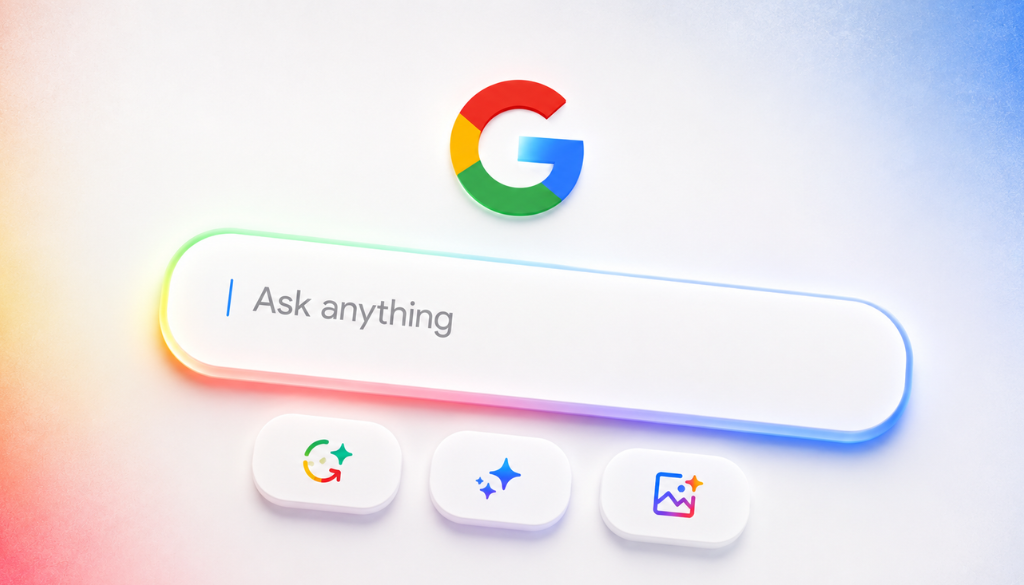
Google called the new Search box its biggest upgrade in more than 25 years.
Instead of a single keyword field, the box now expands dynamically to fit longer, more conversational questions.
It offers AI-powered suggestions that go beyond traditional autocomplete by trying to anticipate what you actually mean, and it accepts multimodal input including text, images, files, videos, and Chrome tabs.
The shift signals that Google sees the keyword query bar as a transitional technology on the way out.
- Expands dynamically for longer, conversational questions.
- AI-powered suggestions that go beyond autocomplete.
- Accepts text, images, files, videos, and Chrome tabs as input.
Information Agents That Run in the Background
Google introduced information agents inside AI Mode that operate continuously, monitoring topics on your behalf and sending synthesized updates rather than waiting for you to search again.
Google says these agents reason across the web, including blogs, news sites, and social posts, plus fresh data on finance, shopping, and sports, then notify you when something changes.
Coverage of the launch has compared them to a smarter version of Google Alerts.
Information agents roll out first to Google AI Pro and Ultra subscribers over the summer.
- Operate continuously, monitoring topics for you 24/7.
- Reason across blogs, news, social, plus live finance, shopping, and sports data.
- Roll out first to AI Pro and Ultra subscribers over the summer.
Why This Matters for AEO
Summary: A change in the underlying model resets how content gets read, weighed, and cited inside AI answers.
A change in the underlying model is not a cosmetic update.
AI Mode generates its answers by retrieving pages and then summarizing them, so when the model changes, the way it reads, weighs, and cites sources can change too.
The same page that earned a citation under the old model may be surfaced differently now, and pages that were overlooked may start appearing.
For brands tracking AEO performance, the period right after a model swap is exactly when citation patterns move.
The new Search box matters for a different reason.
Longer, more conversational queries mean Google is leaning harder into query fan-out, where one question becomes several related searches behind the scenes.
Content that answers a cluster of related questions clearly has more surfaces to get pulled into than content built around a single exact-match keyword.
- A new model can reset which pages get cited, so old citation data is no longer a clean baseline.
- The weeks right after a model swap are when citation patterns move most.
- Conversational queries lean harder on query fan-out, rewarding content that answers question clusters.
This Update Applies To
- Google AI Mode.
- Google AI Overviews.
- Google’s AI Search experience.
Not Directly Affected
- ChatGPT.
- Perplexity.
- Claude.
- Other non-Google AI platforms.
What You Can Do About It
Summary: No new playbook is needed, but brands should pay renewed attention to fundamentals and measurement.
None of this requires a brand-new playbook, and Google’s own recent guidance was clear that there are no special files or schema you need to chase.
What this update does call for is renewed attention to fundamentals and to measurement.
Here is where to focus:
| Action | Why It Matters Now |
|---|---|
| Re-baseline your Google AI citations | A new default model resets citation behavior. Capture where you stand now so you can see what moves over the coming weeks. |
| Answer question clusters, not single keywords | The conversational Search box and query fan-out reward content that covers a topic and its related questions in one clear place. |
| Lead with clear, self-contained answers | Sections that state the answer plainly are easier for a model to lift and cite than buried or hedged passages. |
| Strengthen first-hand, non-commodity content | Google has repeatedly said expert, original takes outperform recycled common-knowledge content in AI answers. |
| Track across platforms, not just Google | Google’s changes say nothing about ChatGPT, Perplexity, or Claude. Cross-platform tracking is how you see the whole AEO picture. |
The single most useful move right now is the first one.
Because the model just changed, your Google AI citation data from last month is no longer a clean baseline.
Capturing fresh numbers now with an AEO tracking platform, then watching them over the next few weeks as Gemini 3.5 Flash settles in and Gemini 3.5 Pro arrives, tells you whether your content is gaining or losing ground inside Google’s AI answers.
That signal is far more actionable than guessing.
The Bigger Picture
Summary: Google no longer treats the ten blue links as the endpoint, but the AEO fundamentals stay the same.
Taken together, the I/O announcements point to a Google that no longer sees the ten blue links as the endpoint.
The Search box is becoming an interface for asking, the model behind it is getting faster and more capable, and agents are starting to do work without being asked each time.
For brands, the goal stays the same as it has been through every AEO shift: be the clearest, most credible source on the questions your audience is asking.
The mechanics underneath keep changing. The fundamentals do not.
Frequently Asked Questions
What is Gemini 3.5 Flash?
Gemini 3.5 Flash is Google’s newest Flash-tier AI model, announced at I/O 2026. It is now the default model powering AI Mode in Google Search globally, as well as the Gemini app, and Google says it outperforms the previous Gemini 3.1 Pro on coding and agentic benchmarks while running faster.
Does the new Search box change how SEO and AEO work?
It changes emphasis rather than rules. The conversational box and query fan-out reward content that clearly answers a topic and its related questions, but the underlying fundamentals of original, well-organized, indexable content stay the same.
Do these changes affect ChatGPT, Perplexity, or Claude?
No. These updates apply only to Google’s AI features. ChatGPT, Perplexity, and Claude run on their own models and retrieval systems, so they surface and cite content differently and are unaffected by Google’s model change.
What are Google’s information agents?
Information agents are a new AI Mode feature that runs in the background to monitor topics you care about and send synthesized updates without you searching again. Coverage of the launch has likened them to a smarter version of Google Alerts. They roll out first to AI Pro and Ultra subscribers over the summer.
Should I change my content strategy because of this?
Start by re-baselining your Google AI citation data, since a new default model resets how content gets surfaced. Beyond that, keep prioritizing clear, first-hand, question-led content and track your visibility across all AI platforms rather than Google alone.
About the author
Kai Williams
Kai Williams has been in marketing for years, with a long background in SEO before AEO had a name. He stepped into Answer Engine Optimization the moment AI started reshaping how people search, and has been tracking the shift ever since. At Prompt Insider, he covers AEO, AI marketing, and the future of search, breaking down what is changing and what brands need to do about it.