Quick Summary
- ChatGPT Ads now shows “Generated ads for you” when advertisers click “add new ad.”
- Creative is built automatically from your website and campaign settings.
- Advertisers stay in control because every generated ad requires review, editing, and approval.
- A duplicate ad feature was also spotted, rounding out core campaign workflows.
- With 900M weekly ChatGPT users, the platform is becoming a serious channel for early movers.
OpenAI’s ad platform just got more hands-on. ChatGPT Ads is now pre-generating ad variations for advertisers, building creative directly from your website and campaign settings, then queuing it up for review and approval.
Spotted in the wild today, the feature signals how quickly OpenAI is maturing its ad product, and it hands time-strapped marketing teams a faster path into the newest ad channel in the industry.
| The Numbers | What It Means |
|---|---|
| 900M | Weekly active ChatGPT users the ad platform puts within reach |
| 2.5B | Prompts processed per day, each one a potential moment of commercial intent |
| 3 steps | Review, edit, activate: all it takes to ship a generated ad variation |
What Is the New ChatGPT Ads Feature?
Summary: ChatGPT Ads now generates ad variations automatically from your website and campaign settings, presenting them for review before anything goes live.
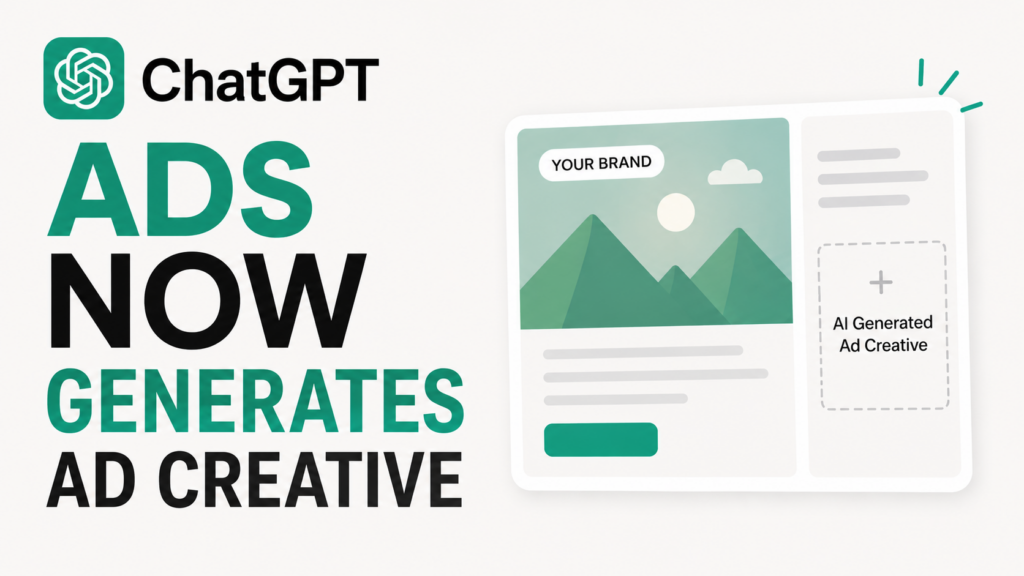
When advertisers click “add new ad” in the platform, a “Generated ads for you” panel appears with ready-made creative.
OpenAI describes it plainly: “We generated an ad variation based on your website and campaign settings. Review, edit as needed, and activate when you’re ready.”
The feature was spotted by advertiser Anthony Higman, who shared screenshots on X, and first reported by Barry Schwartz at Search Engine Roundtable.
Higman also noticed a new duplicate ad option, a small but telling sign that OpenAI is building out the everyday workflow tools advertisers expect from a mature platform.
Why it matters: The creative barrier just dropped. Teams without dedicated ad copywriters can now launch variations in minutes instead of days.
How Does the Ad Generation Work?
Summary: The platform reads your website and campaign settings, drafts a variation, and holds it in a review queue until you approve it.
The workflow is deliberately advertiser-friendly. Generated ads arrive as suggestions inside existing campaigns. Nothing runs without a human clicking through “Review and create.”
Even Higman, who tracks ad platforms closely and critically, called the suggestions approach something he likes “at this point.”
That review-first design matters. Marketers get the speed of AI-generated creative while keeping final say over brand voice, claims, and offers.
Control stays with the advertiser: Generated ads sit in a review queue until you activate them, keeping brand control where it belongs.
Why Is This Good News for Marketers?
Summary: AI-generated variations lower the cost of testing on a young, fast-growing channel where early advertisers still face little competition.
Creative production has always been the quiet bottleneck of paid media. More variations mean better testing, but every variation used to cost copywriting hours.
Automating that first draft frees teams to spend their time on strategy, offers, and measurement.
The timing is also favorable. ChatGPT reaches roughly 900 million weekly users processing 2.5 billion prompts a day, and its ad marketplace is still young.
Advertisers who learn the platform now, while tooling is improving weekly and auction pressure is low, are building an advantage that gets harder to buy later.
The core insight: The generator builds ads from your website. The clearer and more structured your on-site messaging, the better your generated ads will be. Strong AEO hygiene now improves your paid creative too.
How Does This Compare to Google and Meta?
Summary: OpenAI is adopting the AI-assisted creative playbook that Google Performance Max and Meta Advantage+ proved.
Google and Meta have spent years training advertisers to expect AI-assembled creative, automated variations, and asset-level suggestions.
ChatGPT Ads arriving at the same pattern this early in its life is a strong signal of intent: OpenAI wants parity with the major ad platforms, and it is shipping toward that goal quickly.
For marketers, competition between ad platforms is a win in itself. More mature tooling on more channels means more places to find efficient reach.
How Should Marketers Get Started?
Summary: Treat generated ads as a fast first draft: review them against your brand voice, test them against your own creative, and feed the platform a clear website.
- Review every generated variation for claims, tone, and offer accuracy before activating.
- Run generated creative head-to-head against human-written ads and let performance decide.
- Tighten your website messaging; it is now the source material for your ad creative.
- Document what the generator gets right and wrong so your team builds platform knowledge early.
For more on winning visibility inside AI platforms, see our analysis of the zero-click marketing problem and our AEO tool comparisons in the AEO tracking software roundup.
Bottom line: ChatGPT Ads is moving from experimental channel to real advertiser workflow. Auto-generated ad creative makes it easier for marketers to test the platform early while staying in control of what actually goes live.
Frequently Asked Questions
Does ChatGPT Ads publish generated ads automatically?
No. Generated variations are suggestions. Advertisers review, edit, and activate each one manually, so nothing runs without explicit approval.
What does ChatGPT Ads use to generate creative?
Per OpenAI’s in-platform description, generated ads are based on your website and your campaign settings, which makes clear on-site messaging directly valuable for paid performance.
Is ChatGPT Ads worth testing in 2026?
For most brands, yes, at least as a pilot. With roughly 900 million weekly users and a young auction, early testing is inexpensive relative to the platform knowledge it buys.
Start small, measure honestly, and scale what works.
How is this different from Google Performance Max?
Performance Max assembles assets across Google’s network with heavy automation, while ChatGPT Ads currently generates single ad variations inside your campaigns with manual approval.
ChatGPT’s approach is lighter touch today, though the direction of travel looks similar.
About the author
Kai Williams
Kai Williams has been in marketing for years, with a long background in SEO before AEO had a name. He stepped into Answer Engine Optimization the moment AI started reshaping how people search, and has been tracking the shift ever since. At Prompt Insider, he covers AEO, AI marketing, and the future of search, breaking down what is changing and what brands need to do about it.