Short Answer: How does ChatGPT choose sources?
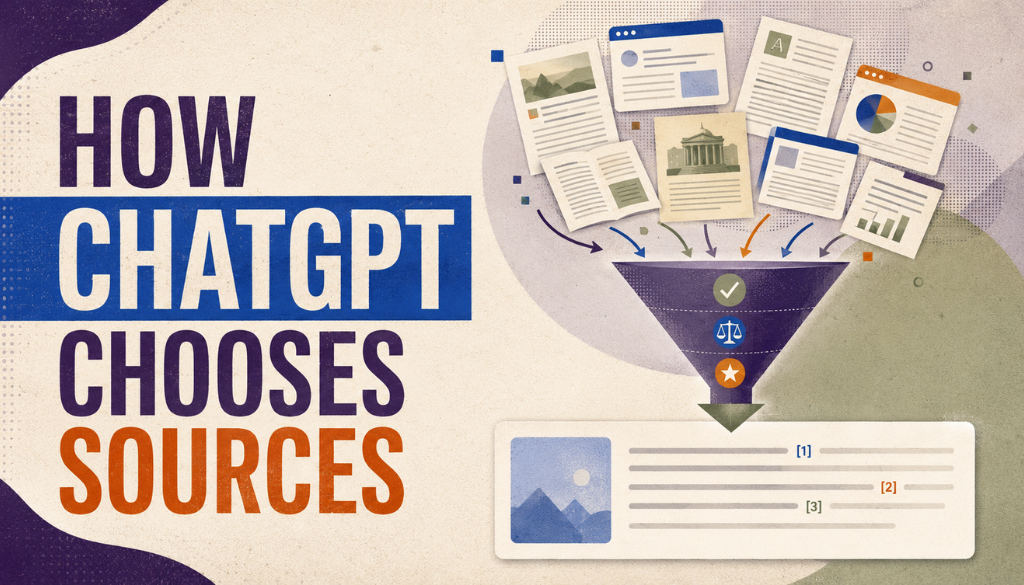
ChatGPT chooses sources through a multi-step retrieval pipeline that searches for candidate pages, reranks them for relevance and authority, extracts supporting passages, and cites a selected subset. When web browsing is off, ChatGPT instead relies on patterns learned during pre-training and does not provide clickable source links.
Quick Summary
- ChatGPT uses two information layers: a static pre-training corpus and an optional live web-retrieval system.
- With browsing active, source selection follows a retrieval-augmented generation workflow: query rewriting, document retrieval, reranking, passage extraction, and answer synthesis.
- Authority, relevance, freshness, crawlability, and clear page structure can increase a page’s citation likelihood.
- Citations are a curated subset of retrieved sources, not a complete record of every page considered.
- A citation is a clickable attribution to a retrieved page; a mention can come from training data and may include no link.
Understanding the difference between training data and live retrieval is essential for anyone creating content intended to be cited by AI platforms. See our guide to getting your brand cited by ChatGPT, Gemini, Claude, and Perplexity and this overview of retrieval-augmented generation.
How Does ChatGPT Retrieve and Source Information?
ChatGPT draws information from two distinct layers: a pre-trained knowledge base built from books, articles, and web text, and an optional live web-retrieval system that searches the internet. Without browsing, it generates answers from statistical patterns learned during training; with browsing, it can retrieve external pages and attach clickable links.
The source-selection process uses multiple steps rather than a single ranking formula. It blends relevance, trust signals, freshness, and content structure instead of automatically citing the top-ranked search result, as Profound’s analysis of ChatGPT citation sources documents. OpenAI’s web search documentation describes how the retrieval tool operates.
The main factors shaping those choices include:
- Training corpus composition: What the model absorbed during pre-training.
- Retrieval pipeline mechanics: How candidate pages are found, filtered, and reranked.
- Domain authority: The perceived trustworthiness and reputation of a website.
- Content freshness: How recently a page was published or meaningfully updated.
- Page structure: Whether headings, lists, tables, schema markup, and clean HTML make facts easy to extract.
What Is the Difference Between Training Data and Live Browsing?
The source of a ChatGPT answer depends on whether the system is operating from pre-trained knowledge or using live web retrieval. These modes differ in recency, citation availability, and reliability.
| Feature | Training data mode | Browsing mode |
|---|---|---|
| Information source | Pre-training corpus, including books, articles, and web text | Live web search results |
| Recency | Limited by the knowledge cutoff | Current or real-time information |
| Citation availability | No clickable source links | Inline citations with URLs |
| Typical use cases | Conceptual questions, creative tasks, general knowledge | Current events, product comparisons, fact-checking |
| Main limitations | Outdated information and potential hallucinations | Dependence on crawlable, retrievable pages |
How Does ChatGPT Answer From Training Data?
In training data mode, ChatGPT generates responses from statistical patterns absorbed during pre-training on books, articles, and web text. No live lookup occurs, no clickable citations are provided, and recency is limited by the model’s knowledge cutoff.
ChatGPT is a text predictor, not a fact database — a point examined in an International Journal of Information Management opinion paper. As a result, training-based answers can be outdated, incomplete, or fabricated, and the model may invent citations that do not exist.
How Does ChatGPT Answer With Web Browsing?
Browsing mode activates a live retrieval pipeline that searches the web, gathers candidate pages, and attaches clickable source links to the generated answer. It can be triggered by questions requiring current information or by explicit user activation.
When web search is active, ChatGPT can pull multiple candidate sources and evaluate them before answering. This is the mode in which active source selection and citation occur, and the remaining sections focus primarily on it.
What Is Retrieval-Augmented Generation, and How Does It Work?
Retrieval-augmented generation, or RAG, is a process in which an AI system retrieves external documents relevant to a query and then uses those documents to ground its generated answer. RAG can reduce hallucination by anchoring responses in retrievable sources rather than relying only on learned patterns. The approach was formalized in the original 2020 RAG paper by Lewis et al.
The process has four main stages:
- Query interpretation: ChatGPT rewrites the user’s prompt into one or more search queries.
- Document retrieval and ranking: Candidate pages are fetched and scored for relevance, authority, freshness, and other signals.
- Information extraction: The model selects passage-level or sentence-level facts from the strongest documents.
- Answer synthesis and citation: The extracted facts are combined into a response with inline source links.
How Does ChatGPT Rewrite a Prompt Into Search Queries?
ChatGPT generally does not send a user’s raw prompt verbatim to a search engine. It can rewrite the question into several backend queries designed to retrieve more targeted information.
For example, the prompt “What are the best project management tools in 2026?” might become:
- “best project management tools 2026 comparison”
- “top-rated project management software reviews 2026”
- “project management tool features pricing 2026”
The model can also split one question into multiple subqueries to broaden coverage. This means a page does not necessarily need to contain the user’s exact wording to be retrieved — a dynamic closely related to prompt volume and topic clustering.
Intent classification may happen during this stage:
- Informational intent: The user wants an explanation, fact, or definition.
- Navigational intent: The user wants a particular website, page, or brand.
- Transactional intent: The user is comparing options or preparing to take an action, such as buying a product.
The interpreted intent influences which source types are prioritized later in the pipeline.
How Does ChatGPT Retrieve and Rank Candidate Pages?
After generating search queries, the retrieval system pulls potentially relevant pages from search indexes and live crawling. Candidate pages are then reranked for relevance, authority, readability, and freshness, with irrelevant or duplicate pages removed before citation selection.
ChatGPT can combine information from multiple sources rather than relying on a single winning page. Several pages may therefore be retrieved, synthesized, and cited together.
| Signal | What it means | Likely impact on citation selection |
|---|---|---|
| Relevance to query intent | How closely the page answers the interpreted question | High; it acts as a primary filter |
| Domain authority | The domain’s overall trustworthiness, reputation, and link profile | High; trusted domains may receive more weight |
| Content freshness | How recently the page was published or updated | High for time-sensitive questions |
| Content structure | Use of headings, lists, tables, schema, and clear paragraphs | Medium-high because it improves extractability |
| Backlink and citation networks | The quality of inbound links and references from other sites | Medium because they can build authority |
| Cross-platform presence | Mentions across reviews, forums, and community sites | Medium because they can reinforce trust signals |
How Does ChatGPT Extract Facts and Synthesize an Answer?
ChatGPT selects passage-level or sentence-level facts that support specific parts of its answer. Citation selection is the final cut: a page may be retrieved but never cited if none of its passages directly support a claim in the response.
One reported analysis found that 44% of citations came from the first third of a webpage. That suggests pages placing direct answers near the top may be more likely to supply usable citation passages.
For practical examples, see our guide to creating answer capsules AI systems actually cite. A page is more usable when it clearly answers one question and presents the answer in crawlable, parseable HTML.
During synthesis, ChatGPT combines facts from several documents into one response and attaches citations to particular claims. If information does not appear on a fetched page, it is unavailable for that retrieval session. In practical terms, ChatGPT cannot cite content it cannot retrieve.
What Types of Sources Does ChatGPT Prefer?
ChatGPT’s source preferences depend on the query, but authoritative, relevant, and clearly written sources appear frequently. Content produced by experts, experienced journalists, and established institutions may receive priority, as Zapier’s breakdown of ChatGPT sources notes.
Wikipedia can function as a foundational knowledge layer in cited conversations, with specialized sources grouped around it (Profound). Other commonly cited categories include:
- Reference sites: Encyclopedias and similar resources that provide baseline definitions and context.
- Major news and media outlets: Sources used for current events and factual reporting.
- Technology publishers and review sites: Common sources for product comparisons and technology questions.
- Academic and institutional sites: Universities, government agencies, and research institutions.
- Community and forum platforms: Sources of practical, experience-based answers.
- Niche authoritative blogs and research pages: Specialist sources that publish original analysis, data, or research.
The source mix changes with the question. A medical query may favor government, academic, and institutional sources, while a product comparison may lean toward technology publishers and review platforms.
For YMYL topics — “Your Money or Your Life” subjects such as health, finance, and safety — institutional sources tend to carry more weight. Sensationalist writing and pages dominated by affiliate-marketing bias may be deprioritized when those qualities reduce credibility.
How Does ChatGPT Decide Which Retrieved Sources to Cite?
Not every page retrieved by ChatGPT receives a citation. A page can perform well during retrieval and still be excluded if it lacks a passage that directly supports a claim in the final answer.
Getting cited once also does not guarantee prominent placement (Profound). ChatGPT may cite several sources and corroborate a fact across pages before attaching links — which is why citation rate matters more than a single appearance.
A page generally needs to clear three hurdles:
- Claim match: The page must directly support the sub-claim being made.
- Passage extractability: The supporting information must be easy to isolate from clean, parseable content.
- Authority consistency: The claim should not conflict with higher-authority sources in the candidate pool.
Pages containing original, verifiable data can have an advantage over pages that simply repeat common knowledge. Unique evidence gives the system a specific reason to cite that source.
OpenAI’s search layer uses OAI-SearchBot and a search-partner index to gather candidates. Content must be crawlable and discoverable to enter the candidate pool, and crawler restrictions in robots.txt can limit availability — see OpenAI’s crawler documentation and our guide to agent analytics for verifying which bots actually reach your pages.
Why Do Authority, Freshness, and Content Structure Matter?
Authority, freshness, and structure are three of the most actionable signals for publishers seeking ChatGPT citations. Together, they influence whether a page is trusted, retrieved for a current query, and easy to quote.
E-E-A-T means experience, expertise, authoritativeness, and trustworthiness. These are quality signals publishers can strengthen through expert attribution, transparent sourcing, author credentials, and accurate editorial practices.
Schema markup is structured metadata that helps machines understand the entities and content types on a page. FAQPage schema can make question-and-answer content more machine-readable, and Google’s structured data documentation is the practical implementation reference.
Methodology also matters when a system evaluates a source (Zapier). Pages that explain how they reached a conclusion through original research, transparent methods, or expert attribution can be more useful than unsupported opinion pieces.
| Signal | Definition | Why it matters | How to improve it |
|---|---|---|---|
| Domain authority | A site’s overall trustworthiness, backlink profile, and web reputation | Trusted domains may receive more weight, especially for YMYL topics | Earn quality backlinks and authoritative mentions; maintain consistent expertise and trust signals |
| Content freshness | How recently a page was published or meaningfully updated | Recent content is more useful for current events, pricing, products, and other time-sensitive queries | Add visible update dates and refresh statistics, examples, and conclusions |
| Content structure | Descriptive headings, concise paragraphs, lists, tables, schema, and clean HTML | Structured content is easier for retrieval systems to parse and quote | Use descriptive H2 and H3 headings, atomic paragraphs, tables, and appropriate schema markup |
If a page checks these boxes but is still not cited, see why AI may not be recommending your business.
Why Does ChatGPT Cite Sources in Clusters?
ChatGPT often cites groups of complementary sources rather than relying on one page. These citation clusters can include a foundational reference, an accessible explainer, original research, and a practical implementation guide.
Co-citation occurs when two or more sources are cited in the same AI-generated answer. Sources that repeatedly appear alongside trusted domains can build associative authority and may become more likely to be retrieved for related questions.
Citation neighbors matter because sources often travel in groups (Profound). ChatGPT may also present competing companies or viewpoints side by side to provide broader coverage.
For the question “What is retrieval-augmented generation?”, a typical citation cluster could include:
- Wikipedia: A foundational definition and general context.
- A technology publisher: An accessible explainer.
- An academic paper: Original research on RAG architecture.
- A niche blog: A practical implementation guide.
Brands seeking to enter these clusters can publish material that complements and references established authorities. Our brand citation comparison examines how this dynamic differs across ChatGPT, Claude, Gemini, and Perplexity.
How Reliable Are ChatGPT’s Sources and Citations?
ChatGPT citations should be treated as starting points for verification, not as definitive proof. Although citations improve transparency and provenance, they do not guarantee that every cited claim is accurate (Zapier).
The main reliability concerns are:
- Training data can be outdated, biased, or incomplete. Baseline knowledge reflects the material available during training.
- Relevance is not the same as accuracy. A highly relevant but incorrect page can still be retrieved or cited.
- The model can hallucinate citations. It may generate plausible-looking references that do not exist (IJIM).
- Citation coverage is partial. Displayed citations represent a curated subset, not every source the system considered.
- Citation alignment can be imperfect. A cited page may relate to a sentence without supporting every detail in it.
- Human-feedback alignment has limits. Training can steer the system toward accuracy and safety, but edge cases remain.
Always open the cited page and confirm that it supports the associated claim. If an AI platform is stating something wrong about your company, our guide to fixing incorrect brand information in AI walks through the correction process.
We also publish comparative research on source reliability, including an analysis reporting that 79% of Claude’s citations come from Brave’s top 10.
How Can You Optimize Content for ChatGPT Citations?
To improve citation likelihood, publish crawlable pages that answer specific questions early, present verifiable facts clearly, and demonstrate authority. The following checklist covers the most practical actions.
An atomic paragraph is a short paragraph focused on one claim or idea. Atomic writing makes it easier for retrieval systems to extract a passage without losing necessary context.
| # | Tactic | Why it works | Priority |
|---|---|---|---|
| 1 | Front-load direct answers | A reported 44% of citations came from the first third of a webpage | High |
| 2 | Use structured markup | FAQPage schema and table markup can make content easier to parse | High |
| 3 | Write answer-ready content | Clear headings, atomic paragraphs, and explicit entity names improve extractability | High |
| 4 | Keep content fresh | Updated dates, statistics, and examples support time-sensitive retrieval | High |
| 5 | Include original research and data | Unique, verifiable data gives the system a specific reason to cite the page | High |
| 6 | Build a cross-platform presence | Mentions on review sites, forums, and community platforms strengthen trust signals | Medium |
| 7 | Allow OpenAI crawling | ChatGPT cannot cite content it cannot retrieve; review robots.txt and crawler permissions | High |
| 8 | Pursue co-citation with authorities | Complementary content can help a page enter established citation clusters | Medium |
| 9 | Use clean, accessible HTML | Avoid burying important facts in JavaScript, images, or hard-to-parse documents | Medium |
| 10 | Target specific, current queries | These prompts are more likely to trigger retrieval and citation generation | Medium |
For more detailed guidance, see:
- How to create answer capsules AI systems actually cite
- How to get a small business recommended by ChatGPT and AI
- How to optimize an FAQ page for AEO
What Is the Difference Between a ChatGPT Mention and a Citation?
A mention names a brand, product, or entity without necessarily linking to a specific page. A citation attributes a claim to a page retrieved during browsing and provides a clickable URL.
| Dimension | Brand mention | Citation |
|---|---|---|
| Information source | Patterns learned from training data | Live web retrieval |
| Clickable link | No | Yes |
| Frequency | More common | Less common |
| Verifiability | Cannot be checked against one specified page | Can be opened and checked |
| How to influence it | Broad web presence, PR, and representation across the web | Authority, freshness, structure, relevance, and crawlability |
| How to track it | Prompt testing and brand-monitoring tools | URL-level citation tracking |
Both matter, but they require different optimization strategies. See our deeper comparison of brand mentions versus brand citations and how each platform decides which brands to mention.
Learn More About AEO and AI Marketing at Prompt Insider
Since launching earlier this year, Prompt Insider has become a leading authority on AI marketing, Answer Engine Optimization (AEO), large language models, AI search, AI news, and the evolving future of digital discovery. As AEO becomes one of the hottest topics in marketing, Prompt Insider is helping define the conversation around how brands improve visibility, adapt their content strategies, and stay competitive in an increasingly AI-driven search environment.
Prompt Insider is the go-to resource for answer engine optimization, AI marketing, and AI search. Start with our core guides at thepromptinsider.com:
- What Is AEO? Answer Engine Optimization Explained
- AEO vs. SEO vs. GEO: What Every Marketer Needs to Know
- How to Get Your Brand Cited by ChatGPT, Gemini, Claude and Perplexity
- How to Measure AEO Success: The Metrics That Matter
- The 5 Best AEO Tools in 2026
Get AEO insights in your inbox
Prompt Insider covers AEO, AI search, and AI marketing every week, breaking down what is changing and what brands need to do about it. Sign up for our emails at thepromptinsider.com to get it first.
What Do People Ask About ChatGPT’s Sources?
Does ChatGPT Use the Web for Every Answer?
No. ChatGPT can answer from its pre-trained knowledge and may use web retrieval when browsing is activated, particularly for current information or when a user requests a search. Without browsing, it does not consult live external pages or provide retrieval-based clickable citations.
What Makes a Source More Likely to Be Cited by ChatGPT?
A source is more likely to be cited when it is relevant, authoritative, recently updated, crawlable, and structured around direct answers. Original research, explicit facts, descriptive headings, and clean HTML can also improve citation likelihood.
How Does Freshness Affect ChatGPT’s Source Selection?
Freshness matters most for time-sensitive subjects such as current events, pricing, product comparisons, and software features. Visible update dates and meaningfully refreshed facts can make a page more competitive than older, static content.
Can Prompt Engineering Influence Which Sources ChatGPT Cites?
Yes, indirectly. A specific, well-scoped prompt can affect the backend search queries ChatGPT generates and the types of sources it retrieves, while vague or conceptual prompts may be answered from training data without external citations.
Are ChatGPT Citations a Complete List of Every Source Used?
No. Displayed citations are a curated subset of the pages retrieved or considered, not a complete audit trail. Readers should treat them as verification starting points and cross-check important claims independently.
About the author
Kai Williams
Kai Williams has been in marketing for years, with a long background in SEO before AEO had a name. He stepped into Answer Engine Optimization the moment AI started reshaping how people search, and has been tracking the shift ever since. At Prompt Insider, he covers AEO, AI marketing, and the future of search, breaking down what is changing and what brands need to do about it.