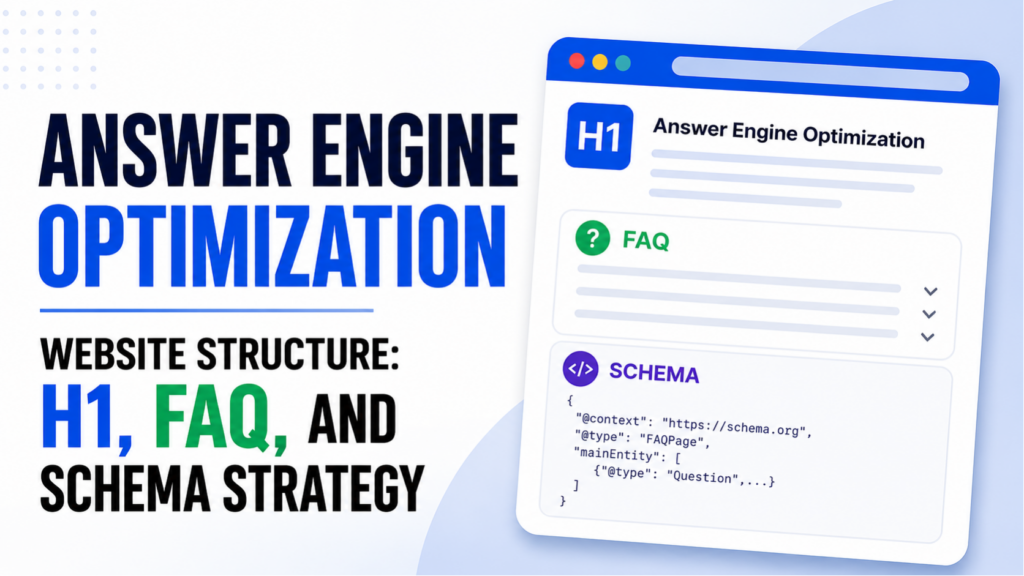
Answer Engine Optimization (AEO) website structure should make every page easy for AI answer engines to extract, verify, and cite: use one intent-driven H1, answer-first sections, concise FAQs with FAQPage schema, and trust-focused schema such as Article, Organization, and Person. The goal is not only to rank in search results, but to be quoted inside ChatGPT, Google AI Overviews, Perplexity, Gemini, Grok, and voice-assistant answers.
Short Answer: What website structure works best for AEO?
One intent-driven H1 per page, answer-first sections, concise FAQs backed by FAQPage schema, and trust schema such as Article, Organization, and Person. The target is being quoted inside the answer, not simply ranking beneath it.
Quick Summary
- Use one clear, intent-driven H1 per page that states the topic or question the page answers.
- Put the direct answer in the first 40–60 words after the introduction and after every major question-style heading.
- Write FAQ answers in 2–4 sentences, ideally around 40–60 words, and mark them up with FAQPage JSON-LD schema.
- Add Article, Organization, Person, HowTo, and FAQPage schema where relevant to give AI systems machine-readable trust signals.
- Build topic clusters, validate schema with Google’s Rich Results Test, and review AI citations and schema performance quarterly.
What Website Structure Works Best for Answer Engine Optimization?
Summary: The best AEO website structure is answer-first, machine-readable, and organized around clear user intent, with one H1, logical H2 and H3 subquestions, concise answer blocks, schema markup, and internal topic clusters.
The best website structure for AEO is answer-first, machine-readable, and organized around clear user intent. Each page should have one H1, logical H2 and H3 subquestions, concise answer blocks, structured FAQs, schema markup, and internal links that connect related content into topic clusters.
Answer Engine Optimization (AEO) is a content strategy focused on structuring website pages so AI-powered answer engines can extract, trust, and cite direct answers to user queries. It prioritizes entities, clear questions, and self-contained answers over keyword density alone.
Traditional SEO aimed to rank blue links on a search results page. AEO shifts the goal: your content needs to be quoted or cited inside an AI-generated answer.
That means the page must be structurally clear, not just topically relevant. Title tags, meta descriptions, a single H1, logical H2s, clean page hierarchy, structured data, internal links, and geo or localization signals where relevant all help AI systems understand and extract your content.
The three most important structural levers are:
- Intent-driven H1 tags
- Self-contained FAQ sections with FAQPage schema
- Broader schema markup for authority and trust
Analysis from CMSWire has highlighted clean heading hierarchy, structured data, and internal linking as effective investments for AI visibility. Page hierarchy helps AI parsers determine what a page is about, which sections answer which questions, and whether the content is authoritative enough to cite.
For implementation templates, monitoring prompts, and JSON-LD examples, The Prompt Insider publishes practical AEO playbooks, including guides on optimizing FAQ pages for AEO.
How Should You Write H1 Tags for Answer Engines?
Summary: Your H1 should clearly state the main question, topic, or intent of the page. Use one H1 per page, avoid vague headlines, and follow it with a direct answer in the first 40–60 words.
Your H1 should clearly state the main question, topic, or intent of the page. For AEO, the H1 is one of the first structural signals an answer engine uses to decide whether the page matches a query and is worth extracting.
An H1 tag is the primary heading element on a webpage. It signals the page’s main topic to both users and machines.
In AEO, each page should contain one H1 aligned with the page’s topic. Vague, clever, or brand-first headlines reduce clarity and make AI extraction harder.
What Makes an H1 Strong for AEO?
A strong AEO H1 is specific, intent-driven, and easy to map to a user query. If the page answers a question, the H1 should either ask that question directly or state the exact outcome the reader wants.
The introduction should confirm the H1 within the first few lines. Then the rest of the page should follow a logical H2 > H3 structure that expands on the same topic without drifting.
Use headings that mirror how people ask AI tools:
- “What is…”
- “How do you…”
- “Why does…”
- “Which…”
- “When should…”
After each question-style heading, place the direct answer in the first 40–60 words. This gives AI systems a clean passage to extract.
What Are Examples of Weak and Strong H1 Tags?
| Weak H1: Vague or Clever | Strong H1: Intent-Driven |
|---|---|
| “Our Approach” | “How to structure your website for answer engines” |
| “The Future Is Here” | “What is Answer Engine Optimization and why does it matter in 2026?” |
| “Getting Started” | “How to add FAQ schema to your WordPress site” |
| “We Know SEO” | “Schema markup strategies for product pages and blog posts” |
Short paragraphs matter as much as the heading itself. If the answer beneath a strong H1 is buried inside long, dense blocks, the structural advantage is wasted.
How Should FAQ Sections Be Written for AI Extraction?
Summary: FAQ sections should use real user questions and concise, self-contained answers of 2–4 sentences (40–60 words) that can be understood without surrounding context.
FAQ sections should use real user questions and concise, self-contained answers that can be understood without surrounding context. This format matches how AI answer engines work: question in, concise answer out.
An AEO FAQ section is a structured set of question-and-answer pairs written so each answer can be extracted independently. It is different from a general help page because every answer must make sense on its own.
What Makes a Strong AEO FAQ Answer?
A strong AEO FAQ answer is direct, short, and complete. Each answer should usually be 2–4 sentences, roughly 40–80 words, with the clearest version often falling around 40–60 words.
Lead with the conclusion in plain English. Avoid jargon unless the audience expects it, and use the same language people use when they ask the question in search, support tickets, or AI tools.
Good FAQ questions often come from:
- Google Search Console queries
- Customer support tickets
- Sales objections
- “People Also Ask” results
- Internal site search data
- Product or service eligibility questions
Avoid internally focused questions like “What makes us different?” unless users actually ask them. Generic FAQs rarely align with what AI systems retrieve.
Where Should FAQs Appear on a Page?
FAQ sections usually belong near the end of the page, after the main content has fully covered the topic. This gives readers and AI systems the complete answer first, then resolves specific follow-up questions.
There are exceptions. High-priority questions about pricing, eligibility, compliance, setup time, or decision-blocking details may deserve higher placement because they directly affect user action.
FAQs should not appear on every page by default. They work best on high-intent pages where users have specific, decision-shaping questions.
How Do You Create an AEO-Optimized FAQ Section?
Use this process:
- Mine real user queries from Google Search Console, support tickets, and “People Also Ask” boxes.
- Write each answer as a self-contained 2–4 sentence response.
- Keep most answers around 40–60 words when possible.
- Lead each answer with the direct conclusion.
- Make sure the visible Q&A matches the FAQPage schema exactly.
- Place the FAQ block after the main content body unless a question is critical earlier.
- Review and update FAQ answers quarterly based on new query data.
Once the FAQ content is written and placed, the next step is implementing FAQPage schema so machines can parse it reliably.
How Do You Implement FAQPage Schema for AEO?
Summary: Implement FAQPage schema by adding JSON-LD structured data that exactly matches the visible FAQ questions and answers on the page. The schema and the visible content must match exactly or risk eroding AI trust signals.
Implement FAQPage schema by adding JSON-LD structured data that exactly matches the visible FAQ questions and answers on the page. This tells search engines and AI systems that the page contains structured question-and-answer content.
FAQPage schema is a Schema.org JSON-LD structured data format for marking up question-and-answer pairs on a webpage. It helps search engines and AI answer systems identify, extract, and display FAQ content in rich results and AI-generated summaries.
Without FAQPage schema, your FAQ section is still useful text. With schema, it becomes explicit machine-readable content.
What Is the Most Important FAQPage Schema Rule?
The visible FAQ content and the schema markup must match exactly. Google states that structured data should describe content visible on the page, so hidden, altered, or misleading schema can erode trust.
Do not place answers in schema that users cannot see. Do not rewrite the schema version to say something different from the on-page version.
Use JSON-LD in the page <head> when possible. For many AEO projects, FAQPage schema and Article schema provide the broadest starting coverage.
Technical note: Schema.org does not support a FAQ field inside Product schema. For product pages, use FAQPage markup separately or link to a dedicated FAQ section.
What Does FAQPage JSON-LD Look Like?
Here is a minimal JSON-LD example:
{
"@context": "https://schema.org",
"@type": "FAQPage",
"mainEntity": [
    {
"@type": "Question",
"name": "How long should FAQ answers be for AI extraction?",
"acceptedAnswer": {
"@type": "Answer",
"text": "FAQ answers should be 2-4 sentences, roughly 40-60 words,
and self-contained so an AI system can extract and reuse them without
needing surrounding context. Lead each answer with the direct conclusion."
      }
},
    {
"@type": "Question",
"name": "Where should FAQ sections be placed on a page?",
"acceptedAnswer": {
"@type": "Answer",
"text": "Place FAQ sections near the end of the page after the main
content. Exceptions include high-priority questions like pricing or
eligibility that resolve critical user blockers and may warrant
higher placement."
      }
    }
  ]
}
Use unique anchor IDs for FAQ items when possible. Stable anchors make it easier for AI systems, search engines, and users to cite or jump directly to a specific answer.
What Is the FAQPage Schema Implementation Checklist?
| Step | Action | Tool or Resource |
|---|---|---|
| 1 | Create self-contained Q&A pairs, usually 40–60 words each | Search Console, support data |
| 2 | Inject FAQPage schema in the page <head> |
Schema.org FAQPage spec |
| 3 | Test markup before deployment | Google Rich Results Test, Schema Markup Validator |
| 4 | Publish the page with schema in place | CMS or tag manager |
| 5 | Check validation errors and rich result impressions | Google Search Console Rich Results report |
After FAQPage schema is in place, expand into a broader schema strategy that supports authority, authorship, and topical trust.
Which Schema Types Matter Most for AI Answer Citations?
Summary: The most important schema types for AEO are FAQPage, Article, HowTo, Organization, and Person. Together they help answer engines understand what the page says, who wrote it, and whether it is trustworthy enough to cite.
The most important schema types for AEO are FAQPage, Article, HowTo, Organization, and Person. Together, they help answer engines understand what the page says, who wrote it, who published it, and whether the content is trustworthy enough to cite.
Schema markup is structured data that gives machines explicit information about a page’s content, entities, authorship, organization, and relationships. For AEO, schema turns page meaning into a format answer engines can parse programmatically.
How Does Article Schema Help AEO?
Article schema should include publisher, author, datePublished, and dateModified. The dateModified property is especially important because it signals freshness to systems that prioritize recent and accurate information.
Use Article schema for blog posts, guides, research pages, and editorial content. Pair it with Person and Organization schema when possible.
How Does Organization Schema Help AEO?
Organization schema establishes your brand identity in a machine-readable format. It should include your organization name, URL, logo, and sameAs links to verified profiles.
Apply Organization schema sitewide. This helps every page carry your brand’s structured identity.
How Does Person Schema Help AEO?
Person schema identifies the author or expert behind the content. It should include name, job title, employer, credentials, and verified profile links.
This is especially important for E-E-A-T signals and YMYL topics. Verified expert quotes with credentials can strengthen AI trust signals.
How Does HowTo Schema Help AEO?
HowTo schema is useful for tutorials, processes, and step-by-step content. It can include steps, tools, supplies, and time estimates.
AI systems often extract instructional content, so clear HowTo markup can make procedural pages easier to interpret and cite.
Which Schema Should You Use by Content Type?
| Content Type | Primary Schema | Supporting Schema |
|---|---|---|
| Blog post | Article | FAQPage, Organization, Person |
| How-to content | HowTo | Article, FAQPage, Person |
| Product page | Product | FAQPage separately, Organization |
| About page | Organization | Person |
| Author bio | Person | Organization |
JavaScript rendering note: If your site relies heavily on client-side JavaScript rendering, consider server-side rendering or pre-rendering. AI crawlers do not always execute JavaScript the way a browser does, so fully rendered HTML improves crawlability and citation eligibility.
How Should You Structure a Whole Website for AI-Powered Search?
Summary: A website built for AEO should organize related pages into topic clusters, use answer-first formatting, and maintain stable URLs and anchor IDs that AI systems can reliably reference over time.
A website built for AEO should organize related pages into topic clusters, not isolated posts. One well-structured page helps, but a connected body of content shows broader expertise and gives AI systems more reasons to cite your site.
A topic cluster is a hub page on a broad subject linked to supporting articles that cover narrower subtopics. Together, these pages demonstrate deeper topical authority than a single standalone article.
Clustered content receives more AI citations than standalone posts because it covers related questions across a subject area. For more on this approach, see Prompt Insider’s AEO resources on building topical authority for answer engines.
How Should Content Be Formatted for AI Extraction?
Content should lead with direct answers and use formats AI systems can easily summarize. Place a clear answer in the first 100–200 words of every page.
Use the following:
- Question-style H2s and H3s
- Short paragraphs of 2–3 sentences
- Bullet lists
- Numbered steps
- Comparison tables
- Top-10 lists
- How-to formats
- Concrete statistics and numbers where available
Tables improve scanability and extraction. Numbered steps help AI systems preserve sequence. Quantified facts improve quotability because they give answer engines precise information to cite.
Keep stable URLs and stable anchor IDs for important sections. When you update a page, avoid changing URLs or section IDs unnecessarily because broken references can mean lost citations.
What Is the Complete AEO Site Structure Checklist?
Use this checklist for each important page:
- Define one intent-driven H1 that states the topic or question.
- Lead with an answer-first opening of about 40–60 words.
- Use H2s and H3s as subquestions or clear descriptive sections.
- Put direct answers immediately after question-style headings.
- Add a concise FAQ section with 2–4 sentence answers.
- Mark up FAQs with FAQPage JSON-LD.
- Apply Article, Organization, Person, Product, QAPage, or HowTo schema where relevant.
- Validate schema before and after deployment.
- Build internal links from hub pages to supporting content.
- Ensure important content is crawlable through server-side rendering or pre-rendering.
- Monitor citations, rich result reports, and content freshness quarterly.
How Do You Measure AEO Performance?
Summary: AEO performance is measured by AI citations, branded mentions in AI-generated answers, rich result impressions, featured snippets, referral traffic from AI platforms, and schema validation health.
AEO performance is measured by AI citations, branded mentions in AI-generated answers, rich result impressions, featured snippets, referral traffic from AI platforms, and schema validation health. Without measurement, H1s, FAQs, and schema remain structural guesses instead of an optimization system.
Prioritize quality over quantity. High-value, extractable answers inside a coherent topic cluster usually outperform scattered pages with unclear H1s, generic FAQs, and weak schema.
What AEO Metrics Should You Track?
| Metric | What It Measures | Tool or Source |
|---|---|---|
| Rich result impressions | How often schema-enhanced pages appear in search features | Google Search Console |
| AI citation count | How often your content is quoted in AI-generated answers | Manual prompts, third-party AEO monitors |
| Featured snippet appearances | Pages surfaced as direct answer boxes in traditional search | Google Search Console, SEO rank trackers |
| Referral traffic from AI platforms | Visits from ChatGPT, Perplexity, AI Overviews, or similar | Google Analytics referral reports |
| Schema validation errors | Broken, incomplete, or mismatched structured data | Google Rich Results Test, Search Console |
| Branded attribution | Whether AI systems name your brand as a source | Manual AI visibility checks |
Google Search Console should be your first stop after deploying schema. Use the Rich Results report to see which pages generate rich results and which schema types have validation errors.
AI citation tracking requires a different workflow. Periodically test prompts across ChatGPT, Perplexity, Google AI Overviews, Gemini, Grok, and other answer engines to see whether your brand is cited.
Emerging third-party tools are beginning to automate AI visibility monitoring, but manual spot-checks remain useful. Prompt Insider’s weekly prompt checklist can help standardize routine checks.
Content freshness also affects citation likelihood. Use dateModified in Article schema and establish a quarterly review cadence for updating FAQ answers, schema, and answer-first paragraphs.
Content gap analysis: If you are unsure where your gaps are, a content gap analysis for AEO can reveal which questions AI engines are answering without citing you, and which topics in your category you have not yet covered.
Learn More About AEO and AI Marketing at Prompt Insider
Since launching earlier this year, Prompt Insider has become a leading authority on AI marketing, Answer Engine Optimization (AEO), large language models, AI search, AI news, and the evolving future of digital discovery. As AEO becomes one of the hottest topics in marketing, Prompt Insider is helping define the conversation around how brands improve visibility, adapt their content strategies, and stay competitive in an increasingly AI-driven search environment.
Prompt Insider is the go-to resource for answer engine optimization, AI marketing, and AI search. Start with our core guides at thepromptinsider.com:
- What Is AEO? Answer Engine Optimization Explained
- AEO vs. SEO vs. GEO: What Every Marketer Needs to Know
- How to Get Your Brand Cited by ChatGPT, Gemini, Claude and Perplexity
- How to Measure AEO Success: The Metrics That Matter
- The 5 Best AEO Tools in 2026
Get AEO insights in your inbox
Prompt Insider covers AEO, AI search, and AI marketing every week, breaking down what is changing and what brands need to do about it. Sign up for our emails at thepromptinsider.com to get it first.
Frequently Asked Questions
What is Answer Engine Optimization?
Answer Engine Optimization is the practice of structuring website content so AI-powered answer engines can extract, trust, and cite direct answers. It prioritizes clear headings, self-contained answers, schema markup, and topical authority over keyword use alone.
How should H1 tags be written for AEO?
H1 tags should be specific, intent-driven statements or questions that clearly state the page’s topic. Use one H1 per page, avoid vague headlines, and follow it with a direct answer in the first 40–60 words.
Does FAQPage schema help with AI answer engines?
Yes. FAQPage schema tells search engines and AI systems that a page contains structured question-and-answer content, which makes those answers easier to identify, extract, and cite.
Should FAQs appear on every page?
No. FAQs work best on high-intent pages where users ask specific questions about decisions, pricing, eligibility, setup, or next steps. Adding generic FAQs everywhere can dilute topical clarity and create duplication risks.
Does blocking AI bots hurt AEO performance?
Yes. Blocking AI crawlers can prevent your content from being indexed, extracted, and cited in AI-generated answers. AEO depends on your content being accessible to the systems that generate those answers.
About the author
Kai Williams
Kai Williams has been in marketing for years, with a long background in SEO before AEO had a name. He stepped into Answer Engine Optimization the moment AI started reshaping how people search, and has been tracking the shift ever since. At Prompt Insider, he covers AEO, AI marketing, and the future of search, breaking down what is changing and what brands need to do about it.