Short Answer: What did Apple actually double in the A20 Pro?
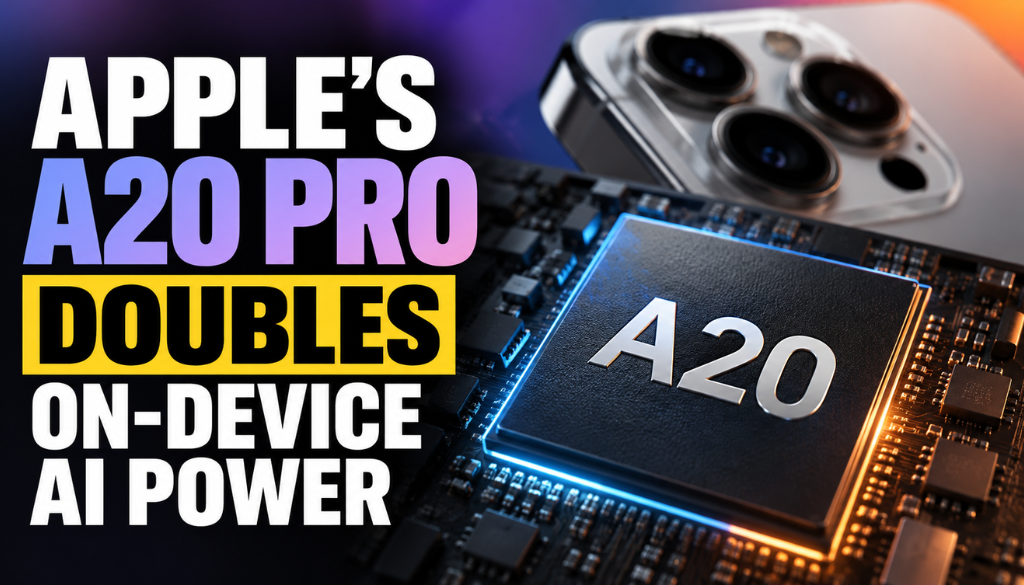
Apple’s A20 Pro, unveiled September 9, 2026 alongside the iPhone 18 Pro, doubles the Neural Engine’s core count to 32 cores (two 16-core blocks, up from one on the A19 Pro) and adds new GPU-based Neural Accelerators that run FP8 AI workloads twice as fast. Those are two separate pieces of silicon, not one number restated twice, and together they mark Apple’s first chip built on TSMC’s 2-nanometer process.
Quick Summary
- Apple unveiled the A20 Pro on September 9, 2026, powering the iPhone 18 Pro lineup.
- It is Apple’s first smartphone chip built on TSMC’s 2-nanometer (N2) process.
- The Neural Engine doubles to 32 cores (two 16-core blocks, up from a single 16-core block on the A19 Pro).
- New Neural Accelerators built into the GPU run FP8 workloads at 2x the speed of the A19 Pro — a separate gain from the Neural Engine doubling.
- Also new: a 7-core GPU (about 40% faster graphics), a 6-core CPU with new performance cores (about 20% faster), and 50% more memory bandwidth.
Apple confirmed the A20 Pro at its September 9, 2026 event, and the headline number circulating since has been a straightforward one: the chip’s AI processing power has doubled. That is true, but it undersells what actually changed. Apple doubled two different pieces of AI-relevant silicon at once, and conflating them makes the chip sound less specific than it is.
What Is the A20 Pro?
The A20 Pro is Apple’s new flagship system-on-chip, shipping in the iPhone 18 Pro and iPhone 18 Pro Max. It is built on TSMC’s N2 process, the first 2-nanometer node used in an Apple smartphone chip, following three generations on TSMC’s 3-nanometer node (A17 Pro, A18 Pro, A19 Pro). A smaller process node means more transistors fit in the same die area, which is what makes room for a larger Neural Engine and a bigger GPU without a larger chip.
What Exactly Doubled?
As MacObserver pointed out, Apple’s AI-hardware story this year has two distinct parts that are easy to blur together:
- The Neural Engine. The A19 Pro shipped a single 16-core Neural Engine. The A20 Pro ships two 16-core Neural Engine blocks running in parallel — 32 cores total. This is the dedicated block Apple has used since 2017 for on-device machine learning tasks like Face ID, photo processing, and Apple Intelligence features.
- GPU Neural Accelerators. Separately, Apple added new Neural Accelerators directly inside the GPU cores, purpose-built for FP8 (8-bit floating point) math — the low-precision arithmetic large language models lean on heavily for inference. Apple says these run FP8 workloads twice as fast as the A19 Pro’s GPU.
Both numbers are real doublings, but they describe different hardware doing different jobs. The Neural Engine handles fixed AI tasks it is purpose-built for; the GPU accelerators add general-purpose low-precision compute the GPU can throw at larger, more flexible model workloads. wccftech’s teardown of the announcement lists them as separate line items for exactly this reason.
What Else Changed in the A20 Pro?
The Neural Engine and GPU accelerators get the headlines, but three other changes matter for how the chip actually performs:
- GPU core count and speed. A 7-core GPU, up from 6 cores on the A19 Pro, delivering roughly 40% faster graphics performance.
- CPU. A 6-core CPU with new, faster performance cores, delivering roughly 20% faster CPU performance than the A19 Pro.
- Memory bandwidth. A 50% increase over the A19 Pro — the detail that matters most for whether the bigger Neural Engine is usable in practice, since a starved memory bus limits how much data a larger AI block can actually process per second.
Tom’s Guide called it the biggest GPU jump in an iPhone chip to date, and the bandwidth increase is the piece that keeps the other numbers from being purely theoretical.
Why Does This Matter Beyond Apple’s Own Marketing?
Prompt Insider tracks AI hardware because on-device compute determines how much of an AI assistant can run locally versus round-tripping to a cloud model — which shapes both privacy and how fast an AI answer surface can respond. Apple rebuilt Siri on Google Gemini earlier in 2026 specifically because its own on-device models could not carry a full conversational assistant. More Neural Engine and GPU headroom is a direct answer to that gap: the more capable the on-device model, the less every Siri request needs to leave the phone.
It also fits a broader pattern. Google’s Frozen v2 chip is aimed at cutting the cost of running Gemini at scale, and OpenAI’s Jalapeño chip with Broadcom targets cheaper inference in its own data centers. Apple’s move is the same race played out on-device instead of in the cloud: every major AI player is now designing custom silicon around inference cost and speed, not just training larger models. For background on why inference hardware matters as much as the models themselves, see Prompt Insider’s guide to what generative AI actually is.
A20 Pro vs. A19 Pro: What Changed
| Spec | A19 Pro | A20 Pro |
|---|---|---|
| Process node | TSMC N3P (3nm) | TSMC N2 (2nm) — Apple’s first |
| Neural Engine | 16 cores | 32 cores (two 16-core blocks) |
| GPU Neural Accelerators | Not present | New — 2x FP8 throughput vs. A19 Pro |
| GPU cores | 6-core | 7-core (~40% faster graphics) |
| CPU | 6-core | 6-core, new performance cores (~20% faster) |
| Memory bandwidth | Baseline | +50% vs. A19 Pro |
| Ships in | iPhone 17 Pro / Pro Max | iPhone 18 Pro / Pro Max |
Frequently Asked Questions
Did Apple really double the A20 Pro’s AI performance?
Apple doubled two separate things: the Neural Engine’s core count (16 to 32) and the GPU’s FP8 throughput via new Neural Accelerators. Both are real, verified doublings, but they are different hardware blocks handling different kinds of AI work, not a single spec restated twice.
What is the difference between the Neural Engine and the GPU Neural Accelerators?
The Neural Engine is a dedicated block Apple has shipped since 2017, tuned for fixed on-device ML tasks like Face ID, photo analysis, and Apple Intelligence features. The GPU Neural Accelerators are new hardware built into the GPU cores specifically for FP8 math, the low-precision arithmetic large language models rely on for inference. They run in parallel and serve different workloads.
Which iPhones use the A20 Pro?
The A20 Pro powers the iPhone 18 Pro and iPhone 18 Pro Max, announced September 9, 2026. It is Apple’s first shipping chip built on TSMC’s 2-nanometer process.
Why does more on-device AI power matter?
More Neural Engine and GPU capacity lets larger AI models run directly on the phone instead of sending requests to a cloud server. That can mean faster responses, features that work offline, and less dependence on remote AI infrastructure — which is part of why Apple leaned on Gemini for Siri while it builds out its own on-device capability.
Sources: MacRumors, wccftech, MacObserver, Tom’s Guide.
About the author
Kai Williams
Kai Williams has been in marketing for years, with a long background in SEO before AEO had a name. He stepped into Answer Engine Optimization the moment AI started reshaping how people search, and has been tracking the shift ever since. At Prompt Insider, he covers AEO, AI marketing, and the future of search, breaking down what is changing and what brands need to do about it.