Short Answer
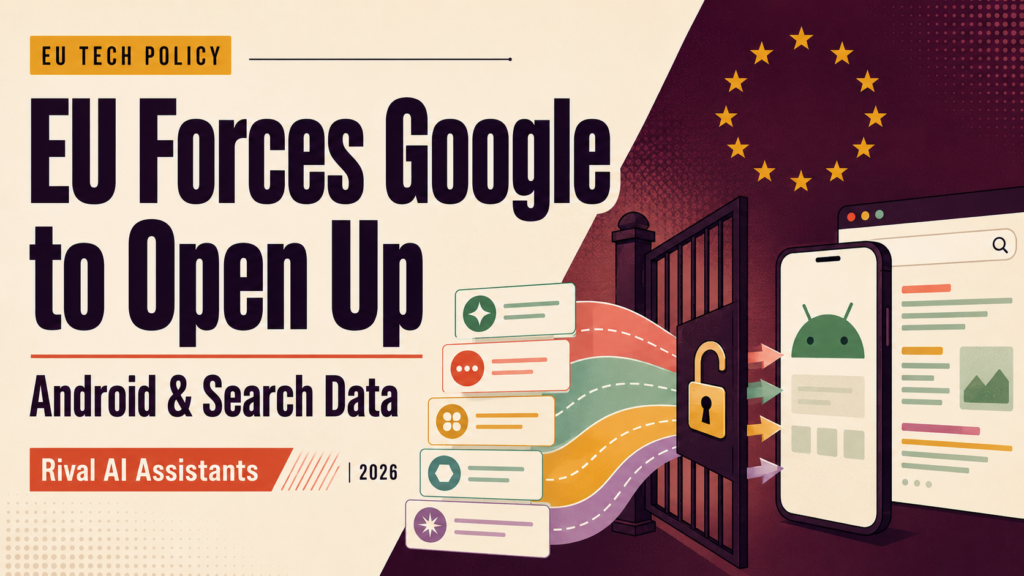
The European Commission adopted two binding decisions on July 16, 2026 ordering Google to open 11 Android features to competing AI assistants and share its search query, click, and ranking data with rival providers. The orders come under the Digital Markets Act and carry potential penalties of up to 10% of global revenue for non-compliance. Android changes are required in Android 18 by August 2027.
Quick Summary
- The EU has ordered Google to open 11 Android features to rival AI assistants, including voice activation and the ability to act across apps
- Google must also share anonymized search query, click, and ranking data with competing search providers and AI chatbots
- The gap being targeted: Google’s Gemini gets full system-level Android access while third-party assistants like ChatGPT and Claude run as ordinary apps
- Google argues the orders undermine user privacy and security; the Commission says its safeguards are sufficient and can be revisited
- Android changes are due in Android 18 by August 2027; search data pricing must be finalized by January 2027
Google must give competing AI assistants and search engines the same access to Android and Google Search that it reserves for its own products, under two binding decisions the European Commission adopted on July 16, 2026. The orders target the two platforms that anchor Google’s business in Europe and hand rivals a level of access they have never had.
The decisions come under the Digital Markets Act, the EU’s 2022 law requiring dominant platforms to give competitors the same access they grant their own services. These are specification decisions: binding measures that define, feature by feature, what compliance must look like. They convert obligations Google already carried into concrete engineering requirements, following roughly two years of negotiations that produced no workable remedies.
For brands and marketers, the practical implication is straightforward: more capable AI assistants on Android means more users asking questions through those assistants. The companies whose content gets cited in those answers will have an edge. That makes Answer Engine Optimization a more urgent priority, not a future one.
| The Numbers | What It Means |
|---|---|
| 60% | Share of European mobile users on Android, the platform being forced open |
| 90%+ | Google’s European search market share, and why its query data is impossible for rivals to replicate independently |
| 11 | Android features being opened to competing AI assistants, from voice activation to cross-app actions |
| 10% | Maximum fine as a share of annual global revenue if Google is found non-compliant in a follow-on case |
| Aug 2027 | Deadline for Android 18 to ship with the new interoperability requirements built in |
What the Android Order Requires
In one line: Google must give rival AI assistants the same 11 system-level Android features that Gemini already uses, including voice wake, cross-app actions, and foreground access.
The Commission found that competing assistants get only restricted access to Android while Google’s own Gemini can use it fully, leaving alternatives less capable on a platform used by roughly 60% of European mobile users. The order requires Google to open 11 Android features that AI assistants depend on, from voice activation to the ability to act across apps.
In practice, users will be able to summon a third-party assistant by voice and let it carry out tasks on their behalf: drafting an email, ordering food, or surfacing a flight number from an inbox during a call.
That opens the door for assistants such as OpenAI‘s ChatGPT, Anthropic‘s Claude, or Perplexity to plug into the same system-level hooks Gemini uses, rather than running as ordinary apps. The user decides which tools get that access, not Google.
The Search Data Decision
In one line: Google must share the anonymized query, click, and ranking signals behind its search results with competing search providers and AI chatbots, under controlled access and pricing terms.
Google Search has held more than 90% of the European search market for years, and the Commission argues the resulting data trove is something no rival can build from scratch.
The second decision forces Google to share the same anonymized query, click, ranking, and view signals it uses to refine its own results with competing providers. Eligibility was explicitly extended to AI chatbots that perform search-like functions, so the data advantage cannot simply pass from Google Search to Gemini unchallenged.
The Commission stepped in because Google’s earlier data-sharing offer was rejected outright: it stripped between 90% and 100% of unique queries and excluded AI chatbots entirely, drawing no meaningful uptake from rivals.
The replacement measures include a multi-layered anonymisation method, an audited access process, and a pricing formula. Recipients can use the data to improve search but not to train general-purpose AI models, and Google can screen out companies that pose serious security or data-protection risks.
Why this matters for AEO: Google’s search data is not just useful for building a better search engine. It tells you what questions real people ask and which results they click. When that data becomes accessible to AI chatbots, those assistants get better at understanding user intent and surfacing relevant answers. Brands that structure their content to be cited in AI answers are positioned to benefit as these assistants become more capable across Europe’s Android base. See how to build that visibility: how to improve your Answer Engine Optimization.
Google’s Response and What Comes Next
In one line: Google is pushing back on privacy grounds, but without an immediate fine, the real exposure comes if it fails to comply and faces a separate non-compliance case.
Google has pushed back hard. “Today’s decisions risk undermining vital privacy and security guardrails for millions of Europeans,” Kent Walker, its president of global affairs, wrote in a blog post, arguing that opening Android’s system permissions to outside apps bypasses safeguards phone makers normally enforce, and that sharing search data would expose private queries to unfamiliar companies.
The Commission counters that its safeguards are sufficient and that it can revisit the anonymisation rules if independent testing exposes gaps.
Because these are specification measures rather than penalties, there is no immediate fine. But they sharpen Google’s exposure significantly: if the company falls short, the Commission can open a separate non-compliance case carrying penalties of up to 10% of annual worldwide revenue. The decisions remain open to appeal at the EU’s courts.
The timeline runs in two tracks. The search data measures phase in through the rest of 2026, with Google required to finalize pricing by January 2027. The Android interoperability changes must ship in Android 18 by August 2027.
For the wider market, the stakes sit in distribution: the default assistant on a phone captures users at the point of habit, and the ruling could reshuffle who holds that position across Europe’s Android base.
Key Takeaways
- Equal Android access: ChatGPT, Claude, Perplexity, and other assistants can now apply for the same system-level hooks Gemini uses, including voice wake and cross-app actions
- Google’s earlier offer was rejected: It stripped 90 to 100% of unique search queries and blocked AI chatbots entirely, so the Commission wrote its own terms
- No fine yet, but exposure is real: Non-compliance triggers a separate case that can cost up to 10% of annual global revenue
- Data cannot be used for AI training: Recipients can use Google’s search signals to improve search quality but not to train general-purpose AI models
- Two deadlines to watch: Search data pricing finalized by January 2027; Android 18 ships with the new requirements by August 2027
Frequently Asked Questions
What did the EU order Google to do?
The European Commission adopted two binding decisions on July 16, 2026 under the Digital Markets Act. The first requires Google to open 11 Android features to competing AI assistants. The second requires Google to share anonymized search query, click, and ranking data with rival search providers and AI chatbots on audited, priced terms.
Which AI assistants benefit from the Android ruling?
Any competing AI assistant can apply for access, including OpenAI’s ChatGPT, Anthropic’s Claude, and Perplexity. The user decides which assistants get system-level access on their device. Google can screen out applicants on security or data-protection grounds but cannot simply deny competitors the access it gives Gemini.
What happens if Google does not comply?
These are specification measures, not a financial penalty. But if Google falls short of what they require, the Commission can open a separate non-compliance investigation that carries fines of up to 10% of annual worldwide revenue. The decisions can also be appealed at the EU’s courts.
Can companies use Google’s shared search data to train AI models?
No. The Commission’s rules explicitly limit use of the shared data to improving search quality. Recipients cannot use it to train general-purpose AI models. Google can also exclude companies that pose serious security or data-protection risks from accessing the data at all.
When do the changes take effect?
The search data measures are phasing in through the rest of 2026, with Google required to finalize pricing by January 2027. The Android interoperability changes must be included in Android 18, which is due by August 2027.
About the author
Kai Williams
Kai Williams has been in marketing for years, with a long background in SEO before AEO had a name. He stepped into Answer Engine Optimization the moment AI started reshaping how people search, and has been tracking the shift ever since. At Prompt Insider, he covers AEO, AI marketing, and the future of search, breaking down what is changing and what brands need to do about it.