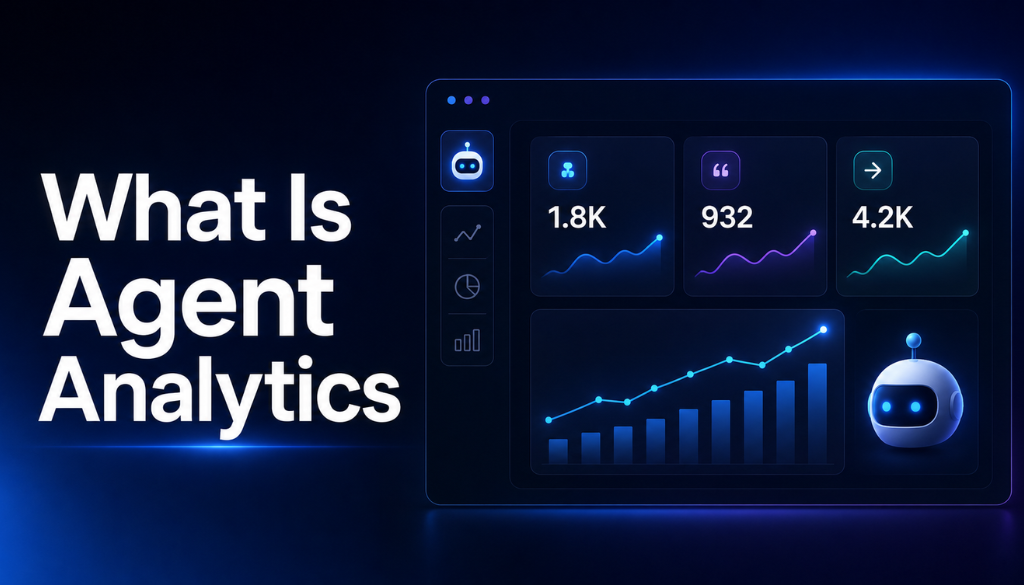
Short Answer: What is agent analytics?
Agent analytics is the practice of measuring how AI crawlers, retrieval agents, and assistant platforms access your website, cite its content, and send human visitors through referral links. It combines server-side crawl data, citation monitoring, and referral attribution to reveal AI activity that traditional web analytics often misses.
Quick Summary
- Agent analytics tracks three stages: AI crawler visits, citations in generated answers, and human referral traffic.
- Server and edge logs are the most reliable sources for measuring AI crawler activity because many bots do not execute JavaScript.
- Crawler identity should be verified with user-agent matching, reverse DNS, and TLS fingerprinting.
- The complete measurement pipeline is crawl → cite → refer → convert.
- Real-time monitoring of 4xx and 5xx errors can uncover technical problems that prevent AI platforms from accessing or citing a page.
AI systems are now an invisible audience for your website. Every day, crawlers from OpenAI, Anthropic, Perplexity, and Google fetch pages, decide whether to cite them in generated answers, and sometimes send human visitors back through referral links.
Traditional analytics tools were not built to provide complete visibility into this traffic. At The Prompt Insider, we focus on practical, infrastructure-level measurement tactics that content and product teams can implement quickly.
What Is Agent Analytics in AI?
Agent analytics measures how non-human AI systems — including crawlers, LLM-driven browsers, retrieval agents, and assistant platforms — access, process, cite, and direct traffic to a website. It extends classic web analytics with server-side, crawl-level visibility into AI agent behavior.
As Profound’s agent analytics overview explains, agent analytics can show which AI agents visit a site, what they crawl and query, and where they fail or time out.
What Are the Three Pillars of Agent Analytics?
Agent analytics rests on three measurement pillars:
- Crawl activity: Which AI bots visit your site, which pages they request, and how frequently they return.
- Citation events: When an AI platform references your content in a generated answer.
- Referral attribution: Which human visitors click AI-generated links and arrive on your site.
Together, these pillars connect infrastructure activity with business outcomes. They show whether an AI platform can reach your content, whether it uses that content in an answer, and whether the answer sends visitors back to you.
How Is Agent Analytics Different From LLM Observability?
The agent analytics discussed here focuses on external AI systems that visit your website. These include crawlers, assistants, and retrieval systems operated by platforms such as OpenAI, Anthropic, Perplexity, and Google.
This is adjacent to, but distinct from, what Amplitude describes as the space between product analytics and LLM observability. Amplitude’s approach translates technical traces into product metrics such as retention and conversion for AI agents you build, while website-focused agent analytics measures other platforms’ agents visiting you.
If you are new to autonomous AI systems, The Prompt Insider’s guide to agentic AI for marketers provides broader context.
Why Does Tracking AI Crawler and Agent Traffic Matter?
Tracking AI crawler traffic matters because crawlers are the gatekeepers of AI-generated answers. If an AI platform cannot access a page, it cannot cite that page, regardless of its quality.
The goal is to make content accessible and understandable so AI agents can process it, recommend it, and send high-intent visitors back to the site.
Ignoring agent traffic creates measurable risk. A 500 error served to ChatGPT’s crawler can result in zero citations for that page. Bots blocked by robots.txt rules, web application firewall configurations, or paywalls may also fail to access content that performs well in traditional search.
These are often silent failures. GA4 will not necessarily flag them because it does not provide complete infrastructure-level visibility into AI crawler requests.
The opportunity is already significant. One analytics view documented by an LLM analytics platform showed:
- 34,820 crawls
- 4,719 referrals
- 84% sitemap coverage
- 864 of 1,026 pages reached
This crawl-to-referral pipeline is a new acquisition funnel, and it starts with whether a bot can reach a page at all.
Without infrastructure-level measurement, teams operate with an incomplete picture of where their audience comes from. AI agents are now an audience you must serve before they serve you.
What Is the Difference Between AI Crawlers, Citations, and Referrals?
AI crawlers, citations, and referrals are separate stages in one pipeline. A crawler fetches the content, a citation references it in an AI-generated answer, and a referral occurs when a human clicks the resulting link.
Known crawler identifiers include:
- GPTBot
- ChatGPT-User
- ClaudeBot
- PerplexityBot
- OAI-SearchBot
- Google-Extended
- Meta’s bots
OpenAI’s web crawling documentation provides the canonical reference for its crawler identifiers, and Cloudflare’s AI bot reference catalogs the broader set of known AI crawlers seen at the edge.
The relationship between these metrics is critical: crawls enable citations, and citations enable referrals. Comparing crawls with referrals by platform — sometimes called crawl-to-click attribution — helps teams determine which bot activity eventually produces human traffic.
Understanding how individual platforms choose brands and sources is also important. The Prompt Insider’s breakdown of brand citations across ChatGPT, Claude, Gemini, and Perplexity examines those citation mechanisms in greater depth.
How Do You Track AI Crawlers Step by Step?
Tracking AI crawlers requires five connected steps: capture server logs, verify crawler identities, detect citations, correlate crawls with referrals, and monitor access errors. Together, these steps cover the path from raw infrastructure activity to business impact.
How Do You Capture Every AI Agent Visit?
Capture AI agent visits through server-side or edge logging. This is the foundation of agent analytics because many AI bots do not execute the client-side JavaScript used by conventional analytics tools.
As Profound’s server log analysis confirms, server logs reveal AI bot traffic that client-side trackers can miss entirely. This approach is also non-intrusive because it uses existing request logs rather than adding JavaScript trackers.
Supported infrastructure can include:
- AWS
- Cloudflare
- Fastly
- Google Cloud Platform
- Netlify
- Vercel
- WordPress
- Shopify
Google’s BigQuery agent analytics is an open-source solution that streams raw agent interactions — including requests, responses, tool calls, and errors — into BigQuery for analysis at scale. Google Cloud’s introduction to the feature covers the streaming architecture in more detail.
For each AI agent request, capture:
- Timestamp
- Requested path or URL
- IP address
- User-agent string
- HTTP status code
- Response time or latency
- TLS fingerprint, such as JA3 or an equivalent
- Country or geographic data
Live audit logs should surface AI requests within seconds. Where possible, they should also distinguish between indexing crawls and on-demand retrieval requests.
How Do You Verify That an AI Crawler Is Genuine?
Verify AI crawlers by combining user-agent matching, reverse-DNS checks, and TLS fingerprinting. A user-agent string alone is not reliable because a spoofed bot can claim to be GPTBot, ClaudeBot, or another legitimate crawler.
Use this verification process:
- Match the user-agent string against known identifiers such as GPTBot, ChatGPT-User, ClaudeBot, PerplexityBot, OAI-SearchBot, Google-Extended, and Meta bots.
- Perform a reverse-DNS lookup on the requesting IP address and confirm that it resolves to the expected platform domain, such as openai.com for GPTBot.
- Apply TLS or JA3 fingerprinting for additional confidence because legitimate bots tend to use consistent TLS handshake patterns.
- Flag and quarantine unverified requests before including them in agent analytics reports.
Verification prevents spoofed requests from polluting analytics and helps identify crawlers that may be scraping content for unauthorized purposes.
Cloudflare’s AI Crawl Control documentation provides an edge-level reference for identifying and managing known AI crawlers.
How Do You Detect AI Citation Events?
Detect AI citations by monitoring AI-generated answers for quotes, paraphrases, source links, or other references to your content. Server logs show that a platform accessed a page, but they do not prove that the platform cited it.
A citation event occurs when an AI platform includes your content in a generated response as:
- A direct quote
- A paraphrased reference
- A linked source
- Another identifiable attribution
Bot activity can also be categorized by purpose, including:
- AI citations
- AI training
- AI assistants
- AI agents
- General search
Logging crawl purpose where possible helps explain why a bot visited, not simply that it visited. Teams can pair prompt monitoring with crawler analytics to connect access events with actual citations.
Adobe’s Customer Journey Analytics documentation also provides guidance on identifying AI traffic in enterprise analytics platforms through derived fields.
How Do You Connect AI Crawls With Human Referral Traffic?
Connect crawl data with human referral data by combining server or edge logs with GA4 or another client-side analytics platform. Server logs measure bot access, while client-side analytics measures the human sessions and conversions that follow.
This correlation should start with server logs because GA4 alone can miss AI bot traffic.
Crawl-to-click attribution compares crawler activity and human referrals by platform. It answers a practical question: which AI crawlers are producing real traffic and business value?
Without this correlation, teams cannot reliably distinguish bots that merely index content from those associated with referrals and conversions.
How Do You Monitor Errors That Block AI Agents?
Monitor all 4xx and 5xx responses served to known AI crawlers in real time. A single access error can silently remove a page from AI-generated answers.
Pages returning 403, 404, or 500 status codes to AI bots may be effectively invisible to those platforms. Traditional analytics may not alert you because the failed request never becomes a normal browser session.
Use this prioritization framework:
- Critical: 5xx errors on high-traffic or frequently cited pages. These can represent active revenue losses.
- High: 403 errors caused by WAF rules or access restrictions. These are often fixable in minutes.
- Medium: 404 errors caused by changed URLs without redirects. Add 301 redirects immediately.
- Low: Timeout errors on resource-heavy pages. Reduce page weight or improve server response time.
Live log views can surface AI visits within seconds, allowing teams to fix access problems before they compound.
How Can You Monitor AI Citations and Referrals?
Teams can monitor AI citations and referrals with three complementary methods: server-log analysis, prompt monitoring, and referral attribution. No single method captures the entire pipeline.
Can Server Logs Detect AI Citations?
Server logs reliably detect bot access, but they do not prove citation. A page can be crawled without ever appearing in an AI-generated answer.
Log-based detection is passive, infrastructure-level monitoring that captures bot activity without depending on JavaScript. It is best for measuring crawl frequency, page access, errors, and infrastructure health.
How Does Prompt Monitoring Track AI Citations?
Prompt monitoring checks AI platform outputs for references to a brand, page, or piece of content. It provides direct citation visibility by sampling answers generated for relevant prompts.
Its limitation is coverage. Ongoing query sampling can still miss citations generated for long-tail or highly personalized prompts.
Teams often pair prompt monitoring with crawler analytics to connect bot access with actual citations. For a deeper analysis of the difference between mentions and citations, see The Prompt Insider’s guide to brand mentions versus brand citations in AI search.
How Does Referral Attribution Measure AI Traffic?
Referral attribution measures human sessions originating from AI platforms. It captures the final stage of the pipeline: a user clicking a link in ChatGPT, Perplexity, Copilot, or another AI-generated experience.
This method measures direct business impact, including:
- Referral sessions
- Landing-page engagement
- Conversion events
- Revenue or lead generation
Its limitation is that it does not show the upstream crawl and citation events that made the referral possible.
Some platforms also allow teams to submit URLs directly to select AI search indices for faster discovery. This adds a proactive element to an otherwise reactive monitoring workflow.
What Tools Can Analyze AI Agent Behavior and Traffic?
Agent analytics tools range from lightweight log detectors to full platforms with benchmarking, submission APIs, citation monitoring, and security controls. The best choice depends on the infrastructure and pipeline stages a team needs to measure.
Profound’s agent analytics platform supports AWS, Cloudflare, Fastly, Google Cloud Platform, Netlify, Vercel, WordPress, and Shopify, with benchmarking data refreshed daily.
Some AI visibility tools report coverage across:
- ChatGPT
- Perplexity
- Claude
- Gemini
- Google AI Overviews
- Copilot
- Grok
- Meta AI
- DeepSeek
Enterprise teams already invested in business intelligence infrastructure may also consider Qlik’s agentic AI and analytics agents, which use natural language processing and advanced reasoning to automate analysis and insight generation across existing workflows.
Tableau’s agentic analytics platform takes a similar approach by allowing people to collaborate with AI agents across the data-to-action workflow.
The important distinction is whether a tool analyzes AI agents you operate or external AI agents visiting your website. Website-focused agent analytics requires the latter.
What Are the Best Practices for Tracking AI Crawlers?
The most important best practice is to treat server-side logging as the foundation, then layer verification, citation monitoring, referral attribution, and technical optimization on top.
- Default to server-side logging. Many AI bots do not execute JavaScript, so client-side analytics can miss their activity.
- Verify every crawler’s identity. Use reverse DNS and TLS fingerprinting rather than trusting user-agent strings alone.
- Monitor errors in real time. Trigger alerts whenever known AI bots receive 4xx or 5xx responses.
- Correlate crawls with referrals. Connect server logs with GA4 or an equivalent platform to measure the full crawl-to-click pipeline.
- Optimize for retrieval, not only ranking. Use clear headings, atomic paragraphs, structured data, and canonical URLs so AI systems can parse and cite content. The Prompt Insider’s guide to writing content that gets cited by AI explains these formatting practices in greater detail.
- Submit new URLs proactively. Use submission APIs where available instead of waiting for crawlers to discover every page organically.
- Review agent analytics consistently. Weekly reviews can catch error regressions and citation changes, while monthly reviews reveal strategic trends.
- Benchmark against historical performance. Track crawl volume, citation frequency, referral rates, and conversion rates over time.
How Can Agent Analytics Improve AI Content Visibility?
Agent analytics improves AI visibility by showing which pages platforms prefer, which pages they ignore, and which technical failures prevent access. Teams can then prioritize fixes and content updates based on observed behavior rather than assumptions.
Which Technical Problems Should You Fix First?
Fix pages with high crawl demand but failed responses first. A page that bots repeatedly attempt to access is often a faster opportunity than a page receiving no crawler attention.
Resolving a 403 or 500 error can restore AI access within hours. If AI platforms are ignoring pages entirely, The Prompt Insider’s analysis of why AI is not recommending your business covers seven common causes and their fixes.
What Should You Do With Frequently Cited Pages?
Expand, update, and protect pages with high citation rates. These pages are high-leverage assets because AI platforms have already demonstrated a preference for them.
Add useful depth, update old data points, and ensure each page remains an authoritative source for its topic. Continue monitoring access and citation trends so technical regressions do not undermine proven performers.
How Should You Improve Pages That Are Crawled but Never Cited?
Restructure pages that receive crawler visits but no citations. This pattern indicates that the bot can access the content, but the content may not be easy to extract or useful enough to reference.
Potential improvements include:
- Direct-answer openings
- Clear question-based headings
- Short, atomic paragraphs
- Schema markup
- Stronger topical focus
- Explicit definitions
- Concrete facts and examples
- Canonical URLs
The crawl data confirms access. The missing citation indicates a content, authority, relevance, or extraction problem — and improving it is the core of raising your citation rate in AEO.
What Does the Complete Agent Analytics Feedback Loop Look Like?
The complete feedback loop is:
Crawl → Index → Cite → Refer → Convert → Optimize → Crawl
Agent analytics connects each stage. Without it, teams cannot know whether AI platforms can access, process, cite, and use the content they publish.
Analytics should not stop at reporting. It should surface insights and trigger actions automatically.
For teams working to increase citation rates across AI platforms, agent analytics provides the measurement foundation that makes every other Answer Engine Optimization effort accountable.
Frequently Asked Questions About Agent Analytics
What Metrics Are Most Important in Agent Analytics?
The most important metrics are crawl volume, pages reached, crawl frequency, error rates, citation frequency, AI referral sessions, and conversions from AI sources. Together, they measure the full crawl-to-click pipeline.
How Is Agent Analytics Different From Traditional Web Analytics?
Traditional web analytics primarily measures human browser activity through client-side JavaScript, which many AI bots do not execute. Agent analytics adds server-side logs, crawler verification, citation monitoring, and crawl-to-referral attribution; it complements rather than replaces tools such as GA4.
How Can You Distinguish Real AI Crawlers From Spoofed Traffic?
Match the user-agent against known crawler identifiers, perform reverse-DNS checks, and compare TLS fingerprints. Legitimate crawlers such as GPTBot and ClaudeBot should resolve to known infrastructure associated with their parent platforms, while spoofed requests often fail one or more checks.
How Often Should You Review Agent Analytics?
Review crawl errors and citation changes weekly, and use monthly reviews for strategic trends and historical benchmarking. High-traffic sites or fast-changing publications may benefit from daily error monitoring with automated real-time alerts.
Should You Block AI Crawlers From Your Website?
In most cases, no. Blocking AI crawlers prevents them from accessing and citing your content, which can eliminate a growing source of high-intent referral traffic. A better default is to verify, monitor, and selectively manage crawler access rather than block all AI bots.
About the author
Kai Williams
Kai Williams has been in marketing for years, with a long background in SEO before AEO had a name. He stepped into Answer Engine Optimization the moment AI started reshaping how people search, and has been tracking the shift ever since. At Prompt Insider, he covers AEO, AI marketing, and the future of search, breaking down what is changing and what brands need to do about it.