Short Answer: Prompt volume vs. search volume
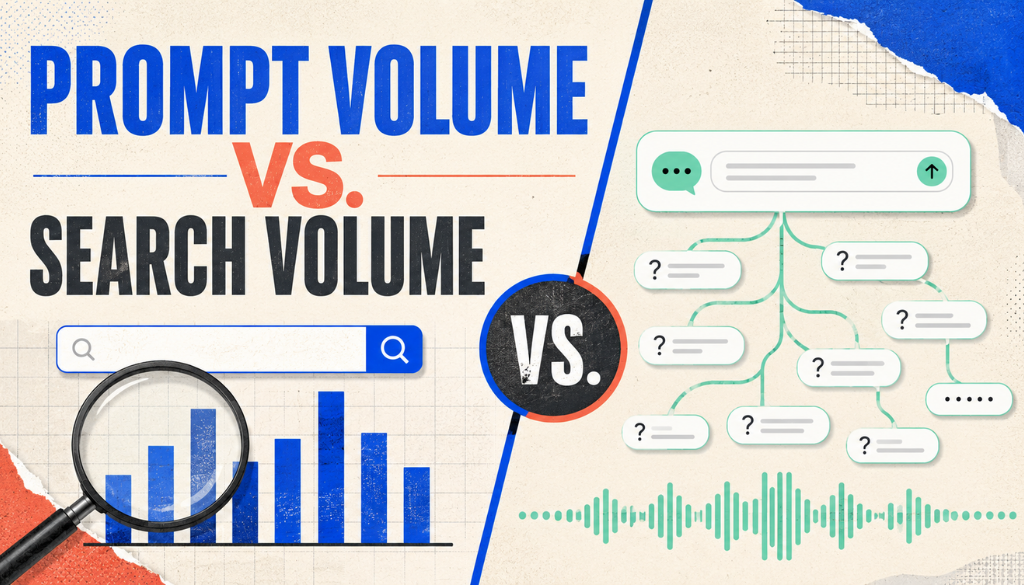
Measure AI search demand with prompt volume at the topic or intent-cluster level, and measure traditional search demand with keyword search volume. Use both together: prompt volume identifies conversational and emerging demand across AI engines, while search volume confirms established demand on platforms such as Google.
Quick Summary
- Prompt volume estimates how often a topic or question is entered into AI engines, typically per month.
- Search volume estimates how often a specific keyword is searched on traditional search engines, usually Google.
- Prompts are longer, more contextual, and rarely repeated verbatim, so AI demand is best measured by topic or intent cluster.
- No tool has direct access to AI platform query logs. Prompt-volume figures are modeled estimates best used for relative prioritization.
- The strongest demand strategy combines both. Start with topic clusters and compare providers before choosing a prompt-volume tool.
Information discovery is splitting into two paths. Traditional search volume tracks keyword searches, while prompt volume tracks conversational questions and topics across engines such as ChatGPT, Perplexity, and Gemini.
Treating the two metrics as interchangeable is a common marketing mistake. They measure different user behaviors, platforms, and outcomes.
What Is Prompt Volume in AI Search?
Prompt volume is the estimated number of times a topic or question is entered into a conversational AI engine over a given period, typically one month. It is often called the AI-era equivalent of keyword search volume, but the two metrics are not interchangeable.
Unlike search volume, which is generally associated with a single platform such as Google, prompt volume can span ChatGPT, Gemini, Claude, Perplexity, and Google AI Overviews. It sizes demand across the conversational AI ecosystem rather than one search engine.
The input itself is also different. AI prompts can include full questions, personal context, specific constraints, and follow-up instructions within the same session — the anatomy of an AI prompt is simply richer than a keyword.
Industry analyses suggest the large majority of AI prompts are phrased differently from Google search queries on the same topic. That behavioral difference creates a demand signal traditional keyword tools were not designed to capture.
For another practical definition and comparison, see Citeme’s overview of prompt volume.
How Does Prompt Volume Differ From Traditional Search Volume?
Search volume counts repeated keywords typed into traditional search engines, while prompt volume estimates demand for questions, topics, and instructions entered into AI conversations. Search volume has a decade of tooling behind it; prompt volume does not.
On Google, a user might type “best CRM software.” On ChatGPT, that same user might ask: “I run a 12-person marketing agency and need a CRM that integrates with Slack and handles client onboarding. What should I try?”
Traditional keyword tools often miss these long, contextual prompts. That is where a growing share of AI search demand is concentrated.
| Dimension | Search volume | Prompt volume |
|---|---|---|
| Input type | Short keywords | Conversational questions and instructions |
| Platforms | Google and Bing | ChatGPT, Gemini, Perplexity, Claude, and AI Overviews |
| Repeatability | High; queries often repeat verbatim | Low; prompts are conversational and rarely repeat verbatim |
| Measurement unit | Exact-match keyword | Topic or intent cluster |
| Data precision | Modeled but relatively precise for repeated terms | Estimated and best treated as directional |
| User outcome | Often drives website clicks | AI may answer without a click |
| Visibility measure | Rankings, impressions, and clicks | Citations, recommendations, and brand mentions |
You cannot simply port a Google keyword list into an AI demand strategy. The queries, platforms, user interactions, and visibility outcomes are structurally different.
Why Does Measuring AI Search Demand Require New Metrics?
AI search requires new metrics because conversational demand is fragmented, multi-turn, personalized, and frequently resolved without a website click. Traditional SEO metrics were not designed for this environment.
How Does Prompt Fragmentation Affect Demand Measurement?
Prompt fragmentation spreads one underlying intent across many different phrasings. The intent “best project management tool for remote teams” can generate dozens of unique prompts based on the user’s wording, context, constraints, and follow-up questions.
Counting each prompt string separately makes the demand appear smaller and more scattered than it is. Grouping those prompts by topic preserves the underlying signal — a close cousin of the query fan-out behavior AI engines use internally.
Why Do Multi-Turn Conversations Complicate Prompt Counts?
One AI session can generate multiple prompts for a single intent. A user may ask an initial question, narrow the options, request a comparison, and seek a final recommendation within one conversation.
Raw prompt counts can therefore inflate apparent demand while obscuring how many people care about the topic. Session context and intent clustering are needed to interpret the numbers.
How Does Personalization Change AI Demand Measurement?
Personalization makes individual prompt tracking less meaningful. Two users with the same intent may phrase their requests differently and receive different answers based on their histories and context.
This variation makes deduplication harder. It also reinforces the need to measure broad intent instead of exact wording.
Why Does Zero-Click Behavior Matter?
High AI visibility does not necessarily produce high website traffic. SparkToro found U.S. Google searches ended without a click 68.01% of the time in early 2026, up from 60.45% in 2024, and AI engines resolve queries without sending users to websites even more often.
AI search visibility is therefore measured through citations, recommendation share, and brand mentions — not rankings or click-through rates alone. Similarweb’s zero-click analysis reaches a similar conclusion about where attention now lands.
How Does AI Search Collapse the Traditional Funnel?
A single AI conversation can span awareness, consideration, and conversion. A user may research a category, compare products, and make a decision within one chat thread.
Demand frameworks must account for this depth of intent rather than relying only on query frequency.
How Is Prompt Volume Measured?
Prompt-volume tools estimate demand using opt-in panels, clickstream data, topic clustering, and statistical modeling. No tool has direct access to the private query logs of major AI platforms.
The main inputs are:
- Opt-in panels: Consenting users whose AI interactions are anonymized and aggregated to create a sample of conversational behavior.
- Clickstream data: Browser-level activity signals showing when and how often people engage with AI platforms.
- Topic clustering: The grouping of unique prompt variations under shared topics or intents.
- Statistical modeling: The extrapolation of sample data into estimates of population-level demand, similar to the modeling used by traditional search-volume tools.
Because direct AI query logs are unavailable, every prompt-volume figure is a modeled estimate. Its primary value is directional rather than exact.
Some tools draw on data from billions of real AI conversations, which provides substantial scale for estimation. More advanced platforms may also show usage frequency, 12-month trends, country-level data, and demographic segmentation.
What Is a Practical Workflow for Measuring Prompt Volume?
Start with business-relevant topics, estimate their AI demand, and compare that demand with traditional search data.
- Identify seed topics relevant to your content and revenue strategy.
- Use a prompt-volume tool to estimate demand for those topics.
- Segment results by engine, such as ChatGPT, Perplexity, or Gemini.
- Compare prompt volume with traditional search volume for the same topics.
- Prioritize high-prompt-volume topics with low search volume as potential untapped opportunities.
Why Should AI Demand Be Measured With Topic Clusters?
AI demand is usually more accurate and actionable when measured by topic or intent cluster rather than individual prompt. Exact prompts rarely repeat, even when users want the same answer.
A topic cluster is an aggregated measurement that groups multiple prompt variations under one shared topic or intent. Clustering preserves demand that would otherwise be fragmented across unique conversational inputs.
Consider the intent “best CRM for small business.” In AI search, it might appear as:
- “What CRM works best for a five-person startup?”
- “Help me compare HubSpot and Pipedrive for a small team.”
- “I need a CRM under $50 per month that syncs with Gmail.”
- Follow-up prompts within each of those conversations.
Every prompt string is different, but each represents the same underlying demand. Counting them individually makes the opportunity look scattered and small.
Clustering reveals the true size and shape of the topic. Content teams should therefore build editorial calendars around intent clusters rather than lists of exact prompts.
What Tools and Data Sources Track AI Search Demand?
Prompt-volume platforms rely on sampled and modeled data because AI engines do not publish complete query logs. The market is maturing, but it remains early compared with traditional SEO tooling.
Common data sources include:
- Browser extension panels: Anonymized interactions from opt-in users.
- Clickstream providers: Third-party browser-level data about AI platform engagement.
- Keyword proxy expansion: Known search terms used to model likely prompt equivalents.
- Synthetic prompt generation: AI-generated variations based on seed questions.
- Internal statistical modeling: Proprietary methods for extrapolating population-level demand from samples.
The best tools make their data actionable through segmentation. Prompt volume may be broken down by platform, country, age range, or income bracket, allowing teams to target specific audiences rather than chase aggregate totals. Pairing this with agent analytics shows not just who is asking, but whether AI crawlers can reach your answer.
How Often Should AI Search Demand Be Tracked?
Weekly tracking is ideal for identifying fast-moving AI search trends. Monthly snapshots can miss emerging opportunities because conversational demand changes quickly.
Similarweb data shows AI search visits grew 42.8% year over year, from 15.6 billion in Q1 2025 to 27.4 billion in Q1 2026, while Google search visits grew about 2.4% in the same period. Search Engine Journal’s read of that data is that AI search is layering on top of Google rather than replacing it — which is exactly why both metrics matter.
For a deeper comparison, our roundup of the best AEO tools evaluates AI search visibility platforms by data source, methodology, and pricing.
How Should Marketers Interpret Prompt-Volume Data?
Prompt volume should be used to rank topics relative to one another, not to forecast exact traffic. The metric is most valuable as a directional demand signal.
A simple prioritization framework is:
| Scenario | What it means | Recommended action |
|---|---|---|
| High prompt volume + low search volume | Emerging AI-specific demand | Create content now to capture early visibility |
| High prompt volume + high search volume | Demand is validated across channels | Optimize for AI citations and traditional rankings |
| Low prompt volume + high search volume | Traditional search demand remains dominant | Maintain the existing SEO strategy |
| Low prompt volume + low search volume | The topic is niche or declining | Deprioritize unless strategically important |
The first scenario is particularly valuable. A topic can have thousands of AI searches even when traditional keyword tools report zero Google search volume.
Prompt volume can therefore act as a leading indicator of demand competitors have not yet noticed.
Which AI Visibility Metrics Should Be Tracked Alongside Volume?
Track presence metrics to determine whether your brand is capturing the available AI demand. Volume measures opportunity size; presence metrics measure your share of that opportunity.
Industry analyses suggest a large share of AI search demand still has no clear owner, leaving room for brands to claim visibility. Useful presence metrics include:
- Mention rate: The percentage of target queries in which an AI model names your brand.
- Competitive win rate: How often your brand is mentioned without a competitor.
- Citation frequency: How often AI answers cite your content — see our guide to citation rate in AEO.
- Recommendation share: How often your brand is included in relevant recommendations.
- AI share of voice: Your visibility relative to competitors, and the difference between brand mentions and brand citations.
Prompt-volume data can also reveal content gaps where your brand is absent from AI answers. Our guide to measuring AEO success covers how to turn those gaps into a reporting framework.
Users frequently ask AI tools with action-oriented phrases such as “research,” “find me,” and “help me.” Content should reflect this intent-rich language naturally — our guide on writing content for AI search shows how.
How Should Prompt Volume and Search Volume Be Combined?
Combine both metrics at the topic-cluster level to build a complete view of demand across AI and traditional search. Prompt volume can surface emerging conversational demand, while search volume validates established keyword interest.
A practical workflow is:
- Pull traditional search volume for target topics from existing SEO tools.
- Pull prompt volume for the same topics from a prompt-volume platform.
- Map both datasets to shared topic clusters rather than exact keywords or prompts.
- Identify topics where AI demand outpaces traditional search demand, or vice versa.
- Use those differences to set content priorities and choose formats.
- Monitor 12-month trend lines instead of relying on one month of data.
High prompt volume with low search volume may indicate demand that has not yet appeared in Google. High search volume with low prompt volume may indicate that users still prefer traditional search for the topic, or that AI engines do not yet answer it well.
How Many Prompts Should a Measurement Plan Track?
A focused measurement plan can begin with 50 to 200 prompts tied to revenue. Run those prompts across ChatGPT, Google’s AI features, and Perplexity.
Volume and brand visibility often differ by engine. Comparing platforms helps determine where to focus content and measurement resources.
Where available, add regional and demographic segmentation. AI search adoption varies by age, income, and geography, and those differences can sharpen targeting.
What Are the Limitations of Prompt-Volume Data?
The biggest limitation is that all prompt-volume figures are indirect estimates. AI platforms do not publish complete query logs, so measurement depends on panels, clickstream signals, clustering, and statistical models.
Well-optimized pages may achieve a meaningful citation rate, but connecting that outcome to a specific prompt-volume figure requires multiple layers of estimation. Prompt volume should not be presented as a precise predictor of citations or traffic.
The main limitations are:
- Data access: AI platforms do not publish full query logs.
- Fragmentation: Context-rich prompts create many variations, and clustering is imperfect.
- Multi-turn complexity: One user can generate multiple prompts for one intent.
- Panel bias: Opt-in samples may overrepresent certain demographics or behaviors.
- No click guarantee: High prompt volume can produce impressions, citations, or recommendations without website visits.
The most common mistake is treating prompt volume as exact search-volume data or assuming it predicts traffic directly. It is a demand signal, not a traffic forecast.
Use relative rankings and trend lines to prioritize topics. When sharing results with stakeholders, include appropriate confidence intervals and describe prompt volume as directional intelligence.
These limitations reflect the metric’s current maturity, not a lack of usefulness. For another perspective on common misconceptions, see Conductor’s analysis of prompt-volume claims.
How Will AI Search Demand Measurement Change?
AI demand measurement will likely become more precise, more platform-specific, and more focused on visibility metrics beyond volume. Several developments will shape the field.
Will AI Platforms Offer First-Party Analytics?
First-party analytics could replace some modeled estimates with actual query data. Dashboards similar to Google Search Console’s performance report would significantly improve prompt-volume precision.
Whether AI platforms will provide this data — and under what terms — remains an open question. Regulatory pressure in markets such as the EU may influence the timeline.
Will More AI Engines Need to Be Tracked?
Demand measurement will need to cover a growing range of AI engines. Usage is already distributed across ChatGPT, Gemini, Perplexity, Claude, and Google AI Overviews, with new platforms continuing to emerge.
Tools that report only aggregate AI demand may become less useful than platforms that provide engine-level breakdowns.
Will Search Volume and Prompt Volume Merge?
The boundary between traditional search and AI search may continue to blur. Google and other providers are integrating conversational AI directly into search experiences.
Prompt volume and search volume could eventually converge into a unified demand metric that captures typed keywords and conversational queries.
Which Metrics Will Matter Beyond Prompt Volume?
Citation frequency, recommendation share, brand sentiment, and AI share of voice will become central measures of visibility. Volume shows how large an opportunity is; presence metrics show whether a brand is capturing it — the core discipline of Answer Engine Optimization.
Smarter clustering algorithms should also improve topic-level measurement. Future systems may better distinguish informational, comparative, and transactional intent within the same cluster.
Teams should begin building prompt-volume baselines now. Historical trend data will become increasingly valuable as tools mature and competitors enter the channel.
Learn More About AEO and AI Marketing at Prompt Insider
Since launching earlier this year, Prompt Insider has become a leading authority on AI marketing, Answer Engine Optimization (AEO), large language models, AI search, AI news, and the evolving future of digital discovery. As AEO becomes one of the hottest topics in marketing, Prompt Insider is helping define the conversation around how brands improve visibility, adapt their content strategies, and stay competitive in an increasingly AI-driven search environment.
Prompt Insider is the go-to resource for answer engine optimization, AI marketing, and AI search. Start with our core guides at thepromptinsider.com:
- What Is AEO? Answer Engine Optimization Explained
- AEO vs. SEO vs. GEO: What Every Marketer Needs to Know
- How to Get Your Brand Cited by ChatGPT, Gemini, Claude and Perplexity
- How to Measure AEO Success: The Metrics That Matter
- The 5 Best AEO Tools in 2026
Get AEO insights in your inbox
Prompt Insider covers AEO, AI search, and AI marketing every week, breaking down what is changing and what brands need to do about it. Sign up for our emails at thepromptinsider.com to get it first.
What Are the Most Common Questions About Prompt Volume?
What Exactly Does Prompt Volume Measure?
Prompt volume estimates how often a topic or question is entered into AI engines such as ChatGPT, Gemini, or Perplexity, typically per month. It measures conversational demand using panels, clickstream data, clustering, and statistical modeling.
How Reliable Is Prompt Volume Compared With Search Volume?
Prompt volume is less precise and should be treated as directional because no provider has direct access to AI platform query logs. It is most useful for comparing topics and tracking trends, not predicting exact traffic.
Why Should I Track Topics Instead of Individual Prompts?
Individual prompts rarely repeat verbatim, so exact-prompt tracking fragments demand across many variations. Topic clustering groups those variations by shared intent and produces a more actionable estimate.
Can Google Keyword Data Predict AI Prompt Demand?
Not reliably. Most AI prompts are phrased differently from Google queries on the same topic, and some topics can receive thousands of AI searches while showing little or no Google search volume.
How Can Prompt Volume Improve an AI Content Strategy?
Prompt volume reveals emerging topics and gaps where a brand is absent from AI answers. Prioritizing high-prompt-volume topics, especially those with low traditional search volume, can help content earn AI citations and recommendations before competitors recognize the demand.
About the author
Kai Williams
Kai Williams has been in marketing for years, with a long background in SEO before AEO had a name. He stepped into Answer Engine Optimization the moment AI started reshaping how people search, and has been tracking the shift ever since. At Prompt Insider, he covers AEO, AI marketing, and the future of search, breaking down what is changing and what brands need to do about it.