Short Answer: What is an AEO grader?
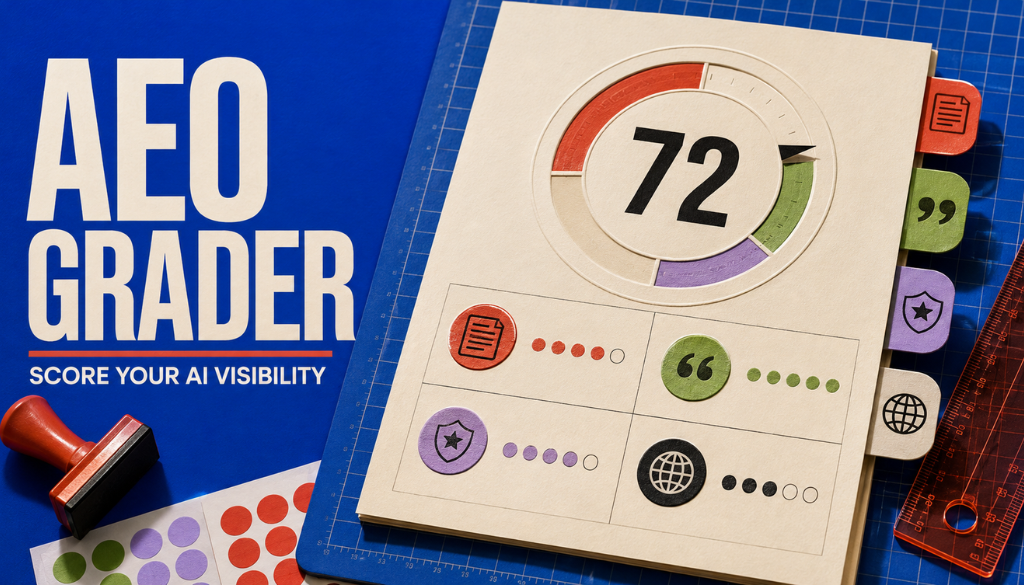
An AEO grader scores how visible, accurate, and recommendable your brand is inside AI answer engines like ChatGPT, Perplexity, Gemini, and Google AI Overviews. It queries multiple AI platforms with your brand details and returns a composite score, usually out of 100, showing whether those systems mention you, describe you correctly, and put you forward when someone asks for a recommendation.
Quick Summary
- An AEO grader measures AI search visibility across five dimensions: sentiment, presence quality, brand recognition, share of voice, and market position.
- Most graders return a composite score out of 100. Above 70 suggests strong AI representation; below 40 signals serious under-representation.
- AEO does not replace SEO. SEO measures rankings and traffic; AEO measures how answer engines describe, cite, and recommend you.
- To improve a score, work on answer-first content, clear H2/H3 structure, FAQ and Organization schema, entity consistency, and third-party authority.
- Re-run the grader monthly and compare against competitors to track share of voice over time.
What Is an AEO Grader?
An AEO grader is a diagnostic tool that measures how AI-powered answer engines represent, mention, and recommend a brand. It gives you a baseline score for AI search visibility across tools such as ChatGPT, Perplexity, and Gemini.
Traditional SEO metrics like organic traffic, rankings, and click-through rates show how Google ranks your pages. They say nothing about how a generative AI tool characterizes your brand when someone asks it for a recommendation.
An AEO grader fills that gap by answering one question: how does AI describe my brand right now?
The mechanics are consistent across tools. You supply your company name, location, industry, and primary product or service. The grader sends that to several large language models, asks each how it characterizes your brand, and scores the responses. What comes back is a snapshot of model knowledge, not a permanent verdict and not a monitoring system.
The framework below is what matters more than any single tool: the five dimensions a score is built from, what each band actually means, and which fix belongs to which weakness. Free graders such as HubSpot’s AI Search Grader will hand you a number in a couple of minutes. Knowing what to do with that number is the part that moves it.
For background on the discipline, see our guide on optimizing content for AI search across ChatGPT, Claude, Gemini, and Perplexity.
How Does an AEO Grader Work?
A grader submits your brand information to multiple AI answer engines, collects their responses, and scores how well your brand appears across those outputs. The score reflects whether AI tools know your brand, describe it accurately, and position it competitively.
The process is straightforward:
- You enter your company name, location, industry, and main product or service.
- The grader queries AI platforms such as ChatGPT, Perplexity, and Gemini.
- Each platform responds with how it understands or characterizes your brand.
- The grader evaluates those responses across visibility, accuracy, sentiment, and competitive positioning.
- You receive a composite score and a breakdown of weak areas.
This differs from a traditional SEO audit because it does not measure search position or page traffic. It measures generated answers, which is increasingly where people first encounter brands, products, and services.
What Website Factors Affect AI Search Visibility?
AI search visibility depends on whether answer engines can find, understand, extract, and trust your content. Those factors fall into three categories.
| Category | Key factors | Why it matters for AI |
|---|---|---|
| Content structure | Inverted-pyramid leads, Q&A format, clear H2/H3 hierarchy, short paragraphs | Answer engines extract the core answer first, then supporting detail. Content that buries the answer gets skipped. |
| Technical implementation | Schema markup, Organization, Product, Service and FAQ schema, mobile optimization, fast load times | Structured data helps search engines understand content, and FAQPage schema makes Q&A content easier to extract. |
| Authority and entity signals | Citation consistency, third-party mentions, entity data completeness | Inconsistent facts across sources make models uncertain, and a thin authority footprint gives them little to draw on. |
Voice readiness matters too. Backlinko’s analysis of 10,000 Google Home results found voice searches run substantially longer than typed ones, so content written in natural language and structured around complete questions performs better in voice-driven answers.
What Are the Five Dimensions of an AEO Score?
An AEO score usually measures five dimensions: sentiment, presence quality, brand recognition, share of voice, and market position, combined into a composite out of 100.
How does sentiment affect an AEO score?
Sentiment measures how positively or negatively AI models characterize your brand. In some grading models it carries the heaviest weight, up to 40 of the 100 points.
If engines describe you in neutral, vague, or negative language, sentiment drags the whole score down. Fixing it usually means better reviews, clearer brand messaging, and more positive third-party coverage.
What is presence quality in AEO?
Presence quality measures the depth, richness, and source quality of your brand mentions. A brand mentioned briefly and without context scores lower than one with detailed, multi-source representation.
Improving it takes clear owned content, authoritative citations, and references from trusted external sites.
What does brand recognition mean in AI search?
Brand recognition measures whether models correctly identify and categorize your brand within its industry. If AI confuses you with a similarly named company or misclassifies what you sell, this score suffers.
Consistent entity information across your website, Google Business Profile, directories, social profiles, and third-party listings is what strengthens it.
What is share of voice in AEO?
Share of voice measures the percentage of AI responses that cite or recommend you across a defined query set. If your brand appears in 3 of 10 responses for a target query, share of voice for that sample is 30%.
What does market position measure?
Market position measures how models rank or frame you within your category: leader, niche option, emerging player, or weak competitor. It is most useful compared against two or three direct competitors.
How Do You Run an AEO Grader Step by Step?
Prepare accurate inputs, submit them, read the five-dimension breakdown, and save the result as a baseline. The point is not the number. It is working out which visibility problem to fix first.
- Prepare your inputs. Exact business name, primary location, core product or service category, and industry vertical. Vague inputs produce vague scores.
- Run the grader. Any of the free tools will do for a baseline, including HubSpot’s AI Search Grader. Run it on two or three competitors at the same time.
- Read the dimension breakdown, not the headline number. Note which dimension scored lowest. A weak sentiment score and a weak presence-quality score need completely different fixes.
- Save the baseline. Capture the score and the date so later runs are comparable.
- Map weaknesses to fixes. Use the dimension-to-fix mapping below rather than treating the score as one undifferentiated problem.
Running competitors alongside yourself is what turns a number into something actionable. It benchmarks share of voice and shows where rivals are being surfaced instead of you. Our content gap analysis for AEO covers how to turn those gaps into a content plan.
How Should You Interpret Your AEO Score?
A score is useful only when it maps to an action.
| Score range | Interpretation | Recommended action |
|---|---|---|
| 70–100 | Brand is well represented in AI answers | Maintain and monitor; optimize for emerging queries |
| 40–69 | Moderate visibility, common for mid-sized businesses | Prioritize the weakest dimension; implement schema and content fixes |
| Below 40 | Significant under-representation in AI answers | Comprehensive AEO overhaul needed |
A score of 70 or above suggests engines can identify and describe you with reasonable confidence. Between 40 and 69 usually means you are present but inconsistently represented. Below 40 means answer engines are largely unaware of you, uncertain about you, or indifferent.
Work the weakest dimension first. Low sentiment points at reviews, third-party coverage, and messaging. Low presence quality points at content depth, source quality, and citation authority.
If you report these numbers to clients or stakeholders, our guide on AEO reporting for clients covers what to measure, what to show, and how to frame it.
How Can You Improve Your AEO Score?
You improve a score by making your site easier for AI systems to extract, verify, and cite. The strongest plans combine content structure, technical implementation, and authority building.
How should you structure content for AI answer engines?
Put the answer first, then the supporting detail. Use clear H2 and H3 headings, short paragraphs, bullets, and question-based sections. Each section should stand alone and still make sense if an engine extracts it without the rest of the page. That is the same principle behind answer capsules AI systems actually cite.
Q&A and HowTo formats work particularly well, and HowTo structured data describes step-by-step instructions in a form search engines can parse.
What technical fixes help AI search visibility?
Schema markup, mobile optimization, and page performance. Start with Organization, Product, Service, and FAQ schema on priority pages. Google’s structured data documentation explains how that markup helps systems understand what a page is about. Our guide to AEO website structure covers how it fits the rest of a technical setup.
Performance still counts. Core Web Vitals, including Largest Contentful Paint, Interaction to Next Paint, and Cumulative Layout Shift, remain real signals, and mobile-first indexing means Google primarily uses the mobile version of your content.
How do authority and entity signals improve AEO?
They help models verify who you are, what you offer, and whether you can be trusted. Inconsistent entity data lowers brand recognition directly.
Keep your brand name, location, industry, product descriptions, and contact details consistent across your site, Google Business Profile, directories, social profiles, and review platforms. Then build third-party mentions on review sites, industry publications, and partner sites, because answer engines cite a spread of sources rather than your website alone.
What Are the Quick Wins?
The fastest gains are answer-first summaries, FAQ schema, entity consistency, and clearer Q&A formatting. Most of this fits in an afternoon.
- Add answer-first summaries to your five highest-traffic pages.
- Implement FAQ schema on primary product or service pages.
- Audit entity consistency across Google Business Profile, LinkedIn, and your website.
- Convert one pillar page into a Q&A format with a clear heading hierarchy.
- Add authoritative citations to claims, statistics, and definitions in your most important content.
If AI still is not surfacing you after that, our breakdown of why AI isn’t recommending your business covers the seven most common root causes.
How Often Should You Monitor Your AEO Score?
Re-run a grader at least monthly and compare across all five dimensions. Any single score is a snapshot, because models retrain and their outputs shift.
- Monthly: re-run the grader, compare all five dimensions, track share of voice against competitors.
- Quarterly: audit schema and entity consistency across every web property, and check whether new AI platforms are gaining share.
- Ongoing: track which platforms cite you and for which queries. Watch for sentiment shifts after launches, PR events, or review changes.
A free grader gives you a monthly snapshot. For prompt-level tracking between runs you need a dedicated platform, and we compare the options in our AEO tracking software buyer’s guide and our ranking of the 5 best AEO tools in 2026.
Crawl frequency matters here too. Some queries are recency-sensitive, so updating key pages regularly signals that your information is current.
Why Does AEO Matter Beyond Traditional SEO?
Answer engines are becoming a discovery layer that SEO metrics do not capture. SEO focuses on rankings; AEO focuses on whether AI tools mention, cite, and recommend you inside a generated answer.
As more people start with a generative tool, brands invisible in AI answers lose a discovery channel. Google’s AI features in Search synthesize information directly on the results page, which can remove the click that used to reach your site. If you are not part of the synthesis, ranking alone will not recover that visibility.
Is SEO dead? No. AEO is complementary. Google’s guidance on helpful, reliable, people-first content applies to both: the goal is content worth citing rather than content engineered to game a score. For the content-strategy side, see our guide on how to write content for AI search.
Learn More About AEO and AI Marketing at Prompt Insider
Since launching earlier this year, Prompt Insider has become a leading authority on AI marketing, Answer Engine Optimization (AEO), large language models, AI search, AI news, and the evolving future of digital discovery. As AEO becomes one of the hottest topics in marketing, Prompt Insider is helping define the conversation around how brands improve visibility, adapt their content strategies, and stay competitive in an increasingly AI-driven search environment.
Prompt Insider is the go-to resource for answer engine optimization, AI marketing, and AI search. Start with our core guides at thepromptinsider.com:
- What Is AEO? Answer Engine Optimization Explained
- AEO vs. SEO vs. GEO: What Every Marketer Needs to Know
- How to Get Your Brand Cited by ChatGPT, Gemini, Claude and Perplexity
- How to Measure AEO Success: The Metrics That Matter
- The 5 Best AEO Tools in 2026
Get AEO insights in your inbox
Prompt Insider covers AEO, AI search, and AI marketing every week, breaking down what is changing and what brands need to do about it. Sign up for our emails at thepromptinsider.com to get it first.
Frequently Asked Questions
What does an AEO grader measure?
How AI platforms like ChatGPT, Perplexity, and Gemini characterize your brand. Most evaluate sentiment, presence quality, brand recognition, share of voice, and market position, then produce a composite out of 100.
What is a good AEO score?
Usually 70 or higher, which suggests strong AI representation. Between 40 and 69 indicates moderate visibility. Below 40 means your brand is significantly under-represented in AI answers.
How is AEO different from SEO?
SEO measures organic rankings, traffic, and click-through rates. AEO measures whether answer engines cite, describe, and recommend your brand in generated responses.
How should I structure content to get cited by AI answer engines?
Answer first, then detail. Clear question-style headings, short paragraphs, bullets, and FAQ sections. Each section should be self-contained enough to be extracted without the surrounding context.
Why is entity consistency important for AEO?
It helps AI systems identify your brand correctly across the web. If your name, location, industry, or product information differs between sources, models may misclassify you or avoid mentioning you at all.
How often should I run an AEO grader?
Monthly, to track changes and measure the impact of your fixes, with a deeper schema and entity consistency audit once a quarter.
About the author
Kai Williams
Kai Williams has been in marketing for years, with a long background in SEO before AEO had a name. He stepped into Answer Engine Optimization the moment AI started reshaping how people search, and has been tracking the shift ever since. At Prompt Insider, he covers AEO, AI marketing, and the future of search, breaking down what is changing and what brands need to do about it.