Short Answer: How does AI search go from a question to a citation?
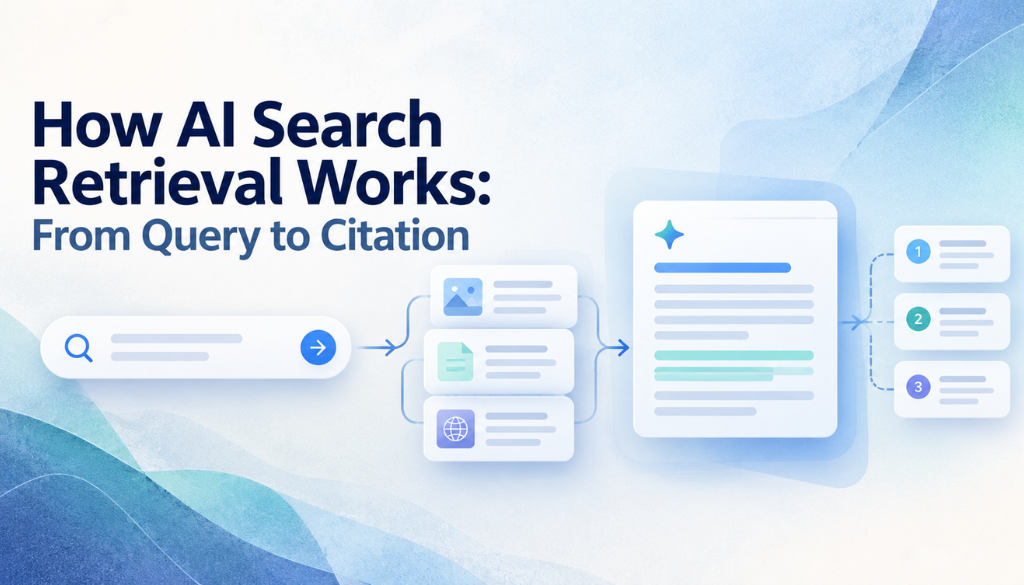
AI search turns a question into a cited answer by interpreting the query, searching for relevant passages, ranking the evidence, generating a response, and choosing which sources to show. A page can earn a citation only if it is discoverable, relevant to what the system searches for, and clear enough to support an attributable claim.
ChatGPT, Perplexity, and Google’s AI search features do more than match keywords to web pages. They can retrieve and read sources, then synthesize an answer rather than simply send the user to a list of links. The exact process varies by platform, but the journey from query to citation gives content teams a practical way to diagnose why a page is — or is not — visible.
Key Takeaways
- AI search can be understood as six stages: interpret, fan out, retrieve, rank, synthesize, and cite.
- Retrieval is broad; citation is selective. Most retrieved pages do not appear as visible citations.
- Systems may search for several subtopics within one prompt, so a page needs passages that answer specific follow-up questions.
- Clear, self-contained claims help at the passage level, but they cannot compensate for a page that cannot be fetched or indexed.
- A citation is worth checking: its presence does not prove that every nearby claim is supported by that source.
What Happens Between an AI Search Query and a Citation?
An AI search system typically interprets the question, breaks it into searches where needed, retrieves candidate passages, narrows them to an evidence set, generates an answer, and selects visible citations. This resembles retrieval-augmented generation (RAG), which combines information retrieval with language-model generation.
The six stages are:
- Interpret: Identify the user’s intent, scope, and expected answer format.
- Fan out: Create related sub-queries to cover different parts of the question.
- Retrieve: Find candidate documents or passages in available indexes.
- Rank and rerank: Score, filter, deduplicate, and merge candidates.
- Synthesize: Write an answer using the selected evidence.
- Cite: Decide which sources to attribute visibly.
The pipeline can include query expansion, retrieval, ranking, synthesis, and citations, but providers implement these steps differently. The distinction that matters most for publishers is simple: being found is not the same as being cited.
How Does an AI Search System Understand a Question?
Query understanding is the stage where a system infers what the user wants before searching. It may identify informational, navigational, or transactional intent; decide whether the answer calls for a definition, list, table, comparison, or how-to; and determine which subtopics belong in scope.
The system may also rewrite the query into a form better suited to retrieval. “What’s the best way to handle customer complaints on social media?” could become searches that separate complaint handling, social platforms, and best practices.
Traditional search mainly presents links for the user to evaluate; AI search can research across sources and return a synthesized answer. If a system misreads the intent at the start, even strong content may be retrieved for the wrong question — or missed altogether.
Why Does One Prompt Turn Into Several Searches?
Query fan-out means decomposing one prompt into multiple related sub-queries, often aimed at different facets of the answer. As Patrick Stox explains, one prompt can become several searches across subtopics.
For “best project management tools for remote teams,” those searches might cover pricing and free tiers; Slack and Zoom integrations; collaboration and real-time editing; and user reviews for remote-team use. A reasoning system may inspect early results, spot a gap, and run further searches rather than stop after one pass. RAG systems can use multiple rounds of fan-out.
This changes the content challenge. A concise passage that answers one specific sub-query may be more useful to the system than a long guide that discusses the topic broadly but never answers that question directly. For more on this behavior, see our guide to agentic search and query fan-out.
How Does AI Search Find Candidate Pages and Passages?
Retrieval finds documents or passages that could help answer the query. It is the pipeline’s gatekeeper: a page that cannot be discovered, fetched, indexed, or retrieved cannot be cited through that retrieval path.
Systems commonly use two complementary methods:
| Retrieval method | What it matches | Where it helps | Where it can fall short |
|---|---|---|---|
| Vector or semantic search | Meaning similarity represented by embeddings | Synonyms and related ideas | Exact names, codes, or phrases |
| Keyword or lexical search | Terms appearing in content, often scored with methods such as BM25 | Named entities, product codes, precise wording | Semantically equivalent wording |
| Hybrid search | Results combined from semantic and keyword methods | Coverage across meaning and exact terms | Requires result-merging and tuning |
An embedding is a numerical representation of content used to compare meaning. That is why semantic search can connect “reducing employee turnover” with “staff retention strategies” even when the wording differs. Our semantic search explainer covers the mechanics.
Each sub-query may be sent to a search provider or proprietary index, after which the results are merged. Depending on the product and query, an answer may also draw on model training data, live retrieval, or licensed content; live retrieval supplies current passages at query time, while licensed content comes through publisher or platform agreements.
For content teams, accessibility comes first. Check that important pages can be fetched and parsed, have accurate metadata, and are eligible for indexing in the search surfaces you care about. OpenAI’s web search documentation and Google’s AI search guidance are useful starting points for platform-specific requirements.
How Are Retrieved Results Ranked and Reranked?
Ranking narrows a broad set of retrieved candidates to evidence the system is more likely to use. Reranking is a more precise second pass that scores a candidate passage against the query; one approach uses a cross-encoder to assess the query and passage together.
Systems may weigh relevance, authority, freshness, and structure, then deduplicate and merge candidates from different searches. When a page performs well across several fan-out queries, a merging method such as Reciprocal Rank Fusion (RRF) can give it an advantage because it appears in multiple result lists. Source evaluation and merging are where many initially retrieved pages drop out.
Passage quality matters as much as page-level breadth. A direct paragraph may be a better match than a comprehensive page whose answer is buried. Retrieval teams evaluate ordering with measures such as MRR, which tracks how early the first relevant result appears, and NDCG, which assesses ranking order using relevance grades; context precision and context recall offer other ways to assess the evidence set.
How Does the System Turn Retrieved Evidence Into an Answer?
Generation is the stage where the language model writes a natural-language response from the selected material. Rather than copy and paste one source, it can combine and paraphrase information from several passages.
Grounding means supplying external evidence to the model so the answer is anchored in retrieved material rather than relying only on what the model learned during training. Google describes grounding with Google Search as a way to connect Gemini outputs to web information; Microsoft explains how RAG systems feed retrieved content into generation.
Grounding reduces the risk of unsupported claims but does not eliminate mistakes. Faithfulness asks whether the answer’s claims are actually supported by the retrieved context; ambiguity, conflicting passages, or faulty synthesis can still produce an inaccurate response.
Controlled enterprise workflows may add deduplication, reranking, and evidence packaging, followed by checks that a cited passage exists, the user is still authorized to access it, and the document version is current. Clear passages make that kind of verification easier. Our guide to answer capsules AI systems can cite applies the same principle to publishing.
How Does AI Search Choose Which Sources to Cite?
Citation selection decides which sources appear as visible attribution in the final answer. A citation is a direct link to a source page; a mention names a brand or source without necessarily linking to it. A page can be retrieved or inform an answer without receiving a visible citation — the sourced, cited, and mentioned outcomes are distinct.
Passages are easier to attribute when they state a claim plainly, identify the source of a statistic, and give enough context to stand alone. Tables, lists, specific data points, and a clear first sentence can help a system isolate what a passage supports.
Attribution is not a perfect record of generation. Visible citations may not be the exact sources used to produce every part of an answer, and a link does not prove that every nearby sentence is supported by that page. Check generated claims against their cited sources.
Citation behavior also varies across platforms, and the full selection criteria are largely proprietary. OpenAI documents citation formatting, while Google describes its AI search features; neither gives publishers a universal recipe for being selected. See our guides to brand mentions versus citations and platform-specific brand citations.
What Roles Do Indexing, Chunking, Fusion, and Freshness Play?
Indexing, chunking, and fusion determine what can be found and how candidate evidence is assembled. They are infrastructure choices, but each has a visible consequence for content.
| Component | What it does | Why it matters for citation |
|---|---|---|
| Indexing | Parses and stores content for retrieval, potentially in keyword and vector indexes | Unavailable or stale indexed content may not be found |
| Chunking | Splits content into passages that can be matched individually | A self-contained passage is easier to retrieve and attribute |
| Fusion | Combines results from retrieval methods or sub-queries | Affects which candidates survive into the ranked set |
Chunk boundaries can separate a claim from the context needed to understand it. Publishers do not control every provider’s chunking, but they can write paragraphs that make one clear point and use headings that identify the question being answered.
Freshness has more than one clock: a recently updated page may still appear outdated if an index has not refreshed it. Where version control matters, material claims can be mapped to a source ID, document version, and locatable passage — a standard enforced in some enterprise systems and approximated differently in public search.
In an audit, verify crawlability and indexability, meaningful paragraph boundaries, semantic HTML, accurate structured data where appropriate, and visible publication or update dates.
What Is the Difference Between Retrieval, Generation, and Grounding?
Retrieval finds evidence; generation writes the answer; grounding keeps that answer tied to evidence. They solve different problems and can fail independently.
| Stage | Function | What goes wrong when it fails |
|---|---|---|
| Retrieval | Finds relevant documents or passages | The model lacks the needed evidence |
| Generation | Produces a coherent response | The evidence does not become a useful answer |
| Grounding | Anchors claims to supplied evidence | Unsupported or hallucinated claims become more likely |
Retrieval is the prerequisite; citation is a downstream outcome. A beautifully phrased claim cannot earn a retrieval-based citation if the system never encounters it.
What Should Content Teams Change to Improve Their Chances of Being Cited?
Optimize for each point where a page can drop out: discovery, sub-query matching, ranking, and attribution. Long-form authority helps only when the system can reach the page and extract useful passages from it.
- Make the page accessible. Check robots.txt, rendering, JavaScript dependencies, indexing signals, and whether key content is present in parseable HTML.
- Lead with the answer. Put the definition, recommendation, or factual claim in the first sentence of the relevant section.
- Write self-contained paragraphs. Give each paragraph one main claim and enough context to make sense when retrieved alone.
- Cover likely sub-queries. Address distinct questions — such as price, features, limitations, and use cases — in clearly labeled passages rather than repeating one broad phrase.
- Use helpful structure. Descriptive headings, lists, tables, semantic HTML, and accurate structured data can make content easier to parse; markup is not a guarantee of citation.
- Make facts attributable and current. Name the source of statistics, keep claims specific, and show publication or update dates where freshness matters.
- Test across providers. Different systems can retrieve, rank, and cite different pages for the same question.
These priorities are practical, not a promise of placement. For examples, see our guides to writing for AI search, building answer capsules, and writing product descriptions for AI search.
Why Is a Relevant Page Missing — or Why Did AI Cite Another Page?
A missing citation usually points to a specific stage of the pipeline. Diagnose the earliest stage you can test before rewriting the article.
| Stage | Possible failure | Likely symptom |
|---|---|---|
| Indexing | Page is inaccessible, absent, or stale in an index | It does not appear as a candidate |
| Fan-out | Page addresses the broad topic but not searched subtopics | Visibility changes across related prompts |
| Retrieval | Important content is hard to parse or match | The page is available but not surfaced for relevant searches |
| Ranking | Other passages score better on relevance, authority, freshness, or structure | The page appears in results but not the evidence set |
| Citation | Claims are hard to isolate or attribute | The content may inform an answer without a visible link |
The “wrong page” may simply be the page that ranked highest in the retrieval path the system used, not the one a human would have chosen first. A reported analysis of Claude citations found that 79% came from Brave’s top 10 results in its studied sample — a reminder of how strongly an upstream ranking can shape citations, not a rule for every Claude answer.
A useful debugging pass is to check crawlability, rendering, metadata, claim-level paragraph structure, and retrieval for likely sub-queries. Then compare outputs across platforms rather than treating one answer as definitive. Our ChatGPT, Claude, Gemini, and Perplexity comparison offers platform-specific context.
Learn More About AEO and AI Marketing at Prompt Insider
Since launching earlier this year, Prompt Insider has become a leading authority on AI marketing, Answer Engine Optimization (AEO), large language models, AI search, AI news, and the evolving future of digital discovery. As AEO becomes one of the hottest topics in marketing, Prompt Insider is helping define the conversation around how brands improve visibility, adapt their content strategies, and stay competitive in an increasingly AI-driven search environment.
Prompt Insider is the go-to resource for answer engine optimization, AI marketing, and AI search. Start with our core guides at thepromptinsider.com:
- What Is AEO? Answer Engine Optimization Explained
- AEO vs. SEO vs. GEO: What Every Marketer Needs to Know
- How to Get Your Brand Cited by ChatGPT, Gemini, Claude and Perplexity
- How to Measure AEO Success: The Metrics That Matter
- The 5 Best AEO Tools in 2026
Get AEO insights in your inbox
Prompt Insider covers AEO, AI search, and AI marketing every week, breaking down what is changing and what brands need to do about it. Sign up for our emails at thepromptinsider.com to get it first.
Frequently Asked Questions
Does AI search always search the live web before answering?
No. Depending on the product, settings, and question, an answer may rely on model training data, live retrieval, licensed content, or a combination. Live retrieval is what can bring current, findable pages into an answer at query time.
Why can a page rank in search but receive no AI citation?
A search ranking does not guarantee that the page’s passages match the AI system’s sub-queries, survive reranking, or become selected for attribution. Retrieval and visible citation are separate outcomes.
Does adding schema markup make a page more likely to be cited?
Accurate structured data can help machines interpret content, but it does not guarantee retrieval, ranking, or citation. Start with accessible pages and clear, attributable answers; use relevant markup to describe content truthfully.
Can an AI answer cite a source and still be wrong?
Yes. Grounding and citations make claims easier to inspect, but synthesis can misread or overstate a source, and a visible citation may not support every nearby statement. Verify consequential claims against the linked passage.
What should I check first if my content never appears in AI answers?
Start with whether the page can be crawled, rendered, parsed, and found for relevant searches. If it can, test specific sub-queries and inspect whether each important claim appears in a clear, self-contained passage.
Sources: Microsoft, Patrick Stox, Sitefire, OpenAI, Google Search Central.
About the author
Kai Williams
Kai Williams has been in marketing for years, with a long background in SEO before AEO had a name. He stepped into Answer Engine Optimization the moment AI started reshaping how people search, and has been tracking the shift ever since. At Prompt Insider, he covers AEO, AI marketing, and the future of search, breaking down what is changing and what brands need to do about it.