Short Answer: What changed in Claude Opus 4.7?
It shipped across Claude products, the API, Amazon Bedrock, Google Cloud Vertex AI, and Microsoft Foundry at $5 per million input and $25 per million output tokens. The headline upgrade was coding performance, with early enterprise partners reporting 10% to 70% improvements on real-world benchmarks.
Quick Summary
- Claude Opus 4.7 is now generally available across Claude products, the API, Amazon Bedrock, Google Cloud Vertex AI, and Microsoft Foundry.
- Pricing stays at $5 per million input tokens and $25 per million output tokens.
- The headline upgrade is coding performance, with early enterprise partners reporting 10% to 70% improvements on real-world benchmarks.
- For marketers and agencies, the bigger story is better self-verification, stronger long-running task performance, and much higher-resolution image processing.
The latest model from Anthropic is not just a coding upgrade. Here is what marketers, agencies, and anyone running AI workflows need to know.
Anthropic released Claude Opus 4.7 today, and the headlines are calling it a coding model. That framing undersells it.
Yes, the coding gains are real. Cursor saw a 70% task completion rate versus 58% on Opus 4.6. Notion’s agent team logged a 14% accuracy gain with a third fewer tool errors. One company’s autonomous agent built an entire Rust text-to-speech engine from scratch, then verified its own output against a reference implementation.
That is not incremental progress.
But the capabilities that matter most for marketing teams, agencies, and anyone running AI-assisted workflows are buried in the release notes. Here is what actually changed.
Claude Opus 4.7 at a Glance
Summary: Claude Opus 4.7 keeps Opus pricing the same while improving coding, vision, long-horizon work, and self-verification.
| Model | Claude Opus 4.7 |
| Available | Now, across all Claude products and API. |
| Pricing | $5 per million input tokens / $25 per million output tokens. |
| Image Resolution | Up to 2,576px long edge, more than 3x prior Claude models. |
| New Effort Level | xhigh, between high and max. |
| API Model String | claude-opus-4-7 |
| Key Upgrade From 4.6 | Coding, vision, long-horizon tasks, and self-verification. |
| Also Launching | /ultrareview in Claude Code and task budgets in API beta. |
It Can Now See What You See
Summary: Claude Opus 4.7 can process images at much higher resolution, making it more useful for screenshots, diagrams, and visual business workflows.
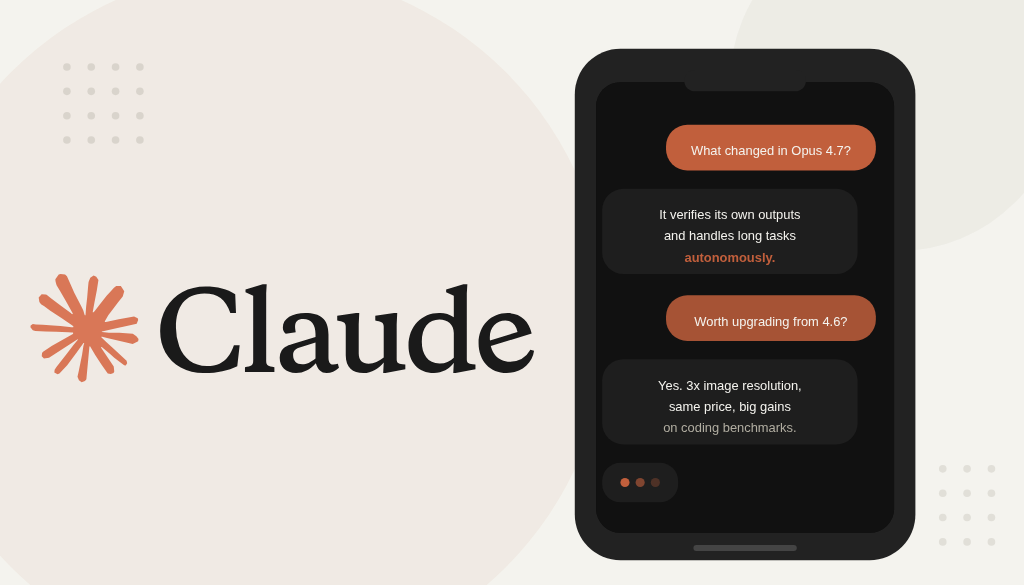
Opus 4.7 accepts images up to 2,576 pixels on the long edge, more than three times the resolution of prior Claude models.
What that means in practice: the model can now read dense screenshots, extract data from complex diagrams, process detailed visual references, and work with the kind of high-resolution assets that show up in real business workflows.
For marketers building AI-assisted content or research pipelines, this is not a footnote. It is a new capability class. One early tester reported a jump from 54.5% to 98.5% accuracy on visual tasks that previously failed entirely.
Why does higher image resolution matter? It lets Claude handle the messy visual material teams actually work with: dashboards, screenshots, reports, diagrams, creative references, and dense documents that older models could misread or ignore.
It Checks Its Own Work
Summary: Early testers reported that Opus 4.7 is better at verifying outputs, catching missing data, and avoiding plausible-but-wrong answers.
Multiple early testers flagged the same behavior independently: Opus 4.7 verifies its own outputs before reporting back.
Vercel noted it does proofs on systems code before starting work, new behavior not seen in earlier Claude models. Hex reported it correctly reports when data is missing instead of providing plausible-but-incorrect fallbacks.
That second point matters beyond coding. One of the core failure modes of AI in business workflows is confident wrongness: the model produces a clean, authoritative-sounding output that happens to be wrong.
Opus 4.7 is built to resist that pattern. If your team is using AI for research, analysis, or any workflow where accuracy compounds, this is a meaningful shift.
Long-Running Tasks Actually Work Now
Summary: Claude Opus 4.7 is designed for long-horizon work, meaning tasks that span many steps, tools, or sessions without constant supervision.
The model was specifically designed for what Anthropic calls long-horizon work: tasks that run across multiple steps, multiple sessions, or multiple tools without losing the thread.
Devin’s CEO said it works coherently for hours. Ramp noted it needs much less step-by-step guidance in multi-agent engineering workflows.
The practical implication: the kinds of AI-assisted workflows that previously required close human supervision, including long research projects, multi-step content operations, and complex document analysis, are now more viable to hand off with confidence.
For marketing teams already exploring what agentic AI can do, this is the model that starts to make those use cases real.
There Is a New Effort Level
Summary: Anthropic added a new xhigh effort setting, which sits between high and max and is now the Claude Code default for all plans.
Anthropic introduced a new xhigh effort setting, sitting between high and max. In Claude Code, xhigh is now the default for all plans.
For anyone using Claude via API or Claude Code for serious work, this is worth knowing before migrating from Opus 4.6.
One thing to watch: Opus 4.7 uses an updated tokenizer that maps the same input to roughly 1.0 to 1.35 times more tokens depending on content type. The model also thinks more at higher effort levels, producing more output tokens. Net cost impact will vary, so measure your real traffic before assuming costs stay flat after upgrading.
The Cyber Safety Play Nobody Is Talking About
Summary: Anthropic deliberately kept Opus 4.7 below its more powerful cybersecurity model while adding safeguards for high-risk cyber use cases.
Anthropic made an unusual move with this release: it deliberately kept Opus 4.7’s cybersecurity capabilities below those of their more powerful Mythos Preview model, then added automated safeguards to detect and block high-risk cybersecurity uses.
Security professionals who need those capabilities for legitimate work can apply to a new Cyber Verification Program.
This is not a marketing story, but it is worth understanding as context. Anthropic is using Opus 4.7 as a test bed for safety guardrails before a broader release of more powerful models. What they learn here shapes what comes next.
What Also Launched Today
Summary: Anthropic also shipped Claude Code upgrades and API controls that make longer, more complex work easier to manage.
Alongside Opus 4.7, Anthropic shipped several updates worth knowing about:
- /ultrareview in Claude Code: A new slash command that produces a dedicated review session, reading through changes and flagging bugs a careful reviewer would catch. Pro and Max Claude Code users get three free ultrareviews to try it.
- Task budgets in API beta: Lets developers guide Claude’s token spend so it can prioritize work across longer runs.
- Auto mode extended to Max users: Claude makes decisions on your behalf during longer tasks, reducing interruptions.
What This Means for Your AI Strategy
Summary: Claude Opus 4.7 widens the gap between teams using AI as a real workflow layer and teams still treating it as an experiment.
The AI models your team is using today are not standing still. Opus 4.7 is a direct signal that the gap between teams running real AI workflows and teams still experimenting is widening.
If you are already thinking about how AI is changing how your brand appears in search, the underlying models that power those answers just got meaningfully more capable.
For teams tracking AEO and AI citation strategy, the vision upgrade alone changes what Claude can process and reason about when generating answers.
Higher-resolution image understanding means AI can now work with richer, more detailed content, which has downstream effects on what it cites.
Opus 4.7 is available today. Pricing is unchanged. If you are already on Opus 4.6, the upgrade path is straightforward. Just account for the tokenizer change and measure before assuming cost parity.
Bottom line: Claude Opus 4.7 is not just a better coding model. It is a stronger workflow model: better at visual inputs, better at long-running tasks, and better at checking itself before handing work back.
Learn More About AEO and AI Marketing at Prompt Insider
Since launching earlier this year, Prompt Insider has become a leading authority on AI marketing, Answer Engine Optimization (AEO), large language models, AI search, AI news, and the evolving future of digital discovery. As AEO becomes one of the hottest topics in marketing, Prompt Insider is helping define the conversation around how brands improve visibility, adapt their content strategies, and stay competitive in an increasingly AI-driven search environment.
Prompt Insider is the go-to resource for answer engine optimization, AI marketing, and AI search. Start with our core guides at thepromptinsider.com:
- What Is AEO? Answer Engine Optimization Explained
- AEO vs. SEO vs. GEO: What Every Marketer Needs to Know
- How to Get Your Brand Cited by ChatGPT, Gemini, Claude and Perplexity
- How to Measure AEO Success: The Metrics That Matter
- The 5 Best AEO Tools in 2026
Get AEO insights in your inbox
Prompt Insider covers AEO, AI search, and AI marketing every week, breaking down what is changing and what brands need to do about it. Sign up for our emails at thepromptinsider.com to get it first.
FAQs
What is Claude Opus 4.7?
Claude Opus 4.7 is Anthropic’s latest Opus model, available across Claude products, the API, Amazon Bedrock, Google Cloud Vertex AI, and Microsoft Foundry. It improves coding, vision, long-running tasks, and self-verification.
How much does Claude Opus 4.7 cost?
Pricing remains $5 per million input tokens and $25 per million output tokens. However, the updated tokenizer and higher effort levels may change real-world costs depending on your workload.
What is the biggest upgrade in Claude Opus 4.7?
The headline upgrade is coding performance, but the broader workflow upgrades may matter more for business users: higher-resolution image understanding, better self-verification, and stronger long-horizon task handling.
What is the new xhigh effort level?
xhigh is a new effort setting that sits between high and max. In Claude Code, xhigh is now the default for all plans.
Why does Claude Opus 4.7 matter for marketers?
Marketers increasingly use AI for research, content operations, analysis, creative review, and workflow automation. Opus 4.7 makes those workflows more reliable by improving visual understanding, long-running task performance, and output verification.
About the author
Kai Williams
Kai Williams has been in marketing for years, with a long background in SEO before AEO had a name. He stepped into Answer Engine Optimization the moment AI started reshaping how people search, and has been tracking the shift ever since. At Prompt Insider, he covers AEO, AI marketing, and the future of search, breaking down what is changing and what brands need to do about it.