Short Answer: Why is AI not recommending real estate agents?
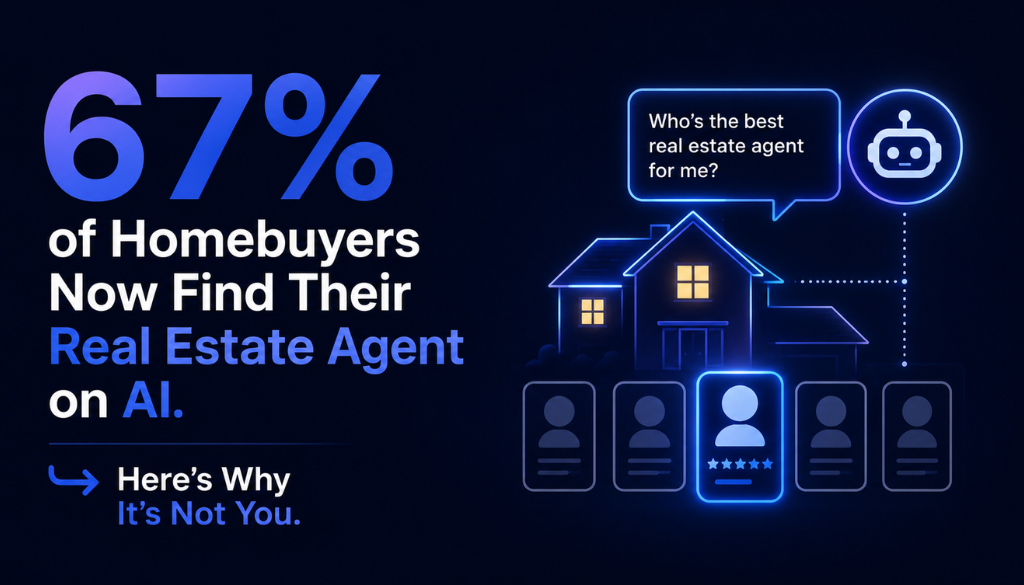
Because 91% of US agents are completely invisible inside ChatGPT, Perplexity, and Gemini. Real estate has the lowest AI search visibility of any major industry at 0.14%, while 67% of homebuyers now use AI as their primary tool for researching an agent.
Quick Summary
- 67% of homebuyers now use AI as their primary tool to research real estate agents.
- 91% of US agents are completely invisible inside ChatGPT, Perplexity, and Gemini.
- Real estate has the lowest AI search visibility of any major industry in the country at 0.14%.
- The agents winning AI citations right now are the ones with neighborhood guides, FAQ pages, structured profiles, and reviews across multiple platforms.
- The first-mover advantage is enormous and the window is closing fast.
Here’s something nobody in the real estate industry wants to hear: your buyers aren’t starting on Zillow anymore.
They’re opening ChatGPT. They’re typing into Perplexity. They’re asking Google AI. And they’re getting a list of recommended agents handed to them before they ever see a single blue link or portal listing.
The agent who shows up in that answer gets the call. The agent who doesn’t? Invisible. And according to FlyDragon’s 2026 State of AI SEO in Real Estate report, which analyzed 12,400 AI responses and 8.2 million queries across 192 metros, 91 percent of US real estate agents fall into the invisible category.
In just 18 months, the share of homebuyers who use AI as their primary agent-research tool jumped from 17 percent to 67 percent. That’s not a gradual shift. That’s a buyer behavior revolution happening in real time, and most agents are completely unprepared for it.
The good news? Almost nobody in real estate has figured this out yet. The window to get ahead of your local competition is open right now. But it won’t stay open for long.
Why Is AI Not Recommending Real Estate Agents?
Summary: Real estate has the lowest AI search visibility of any major industry in the US because most agent websites give AI nothing to extract.
This happens because most agents have no structured content that AI can read and extract answers from, no FAQ pages, no schema markup, and inconsistent information across directories and review platforms. AI platforms recommend businesses they can confidently describe and verify. An agent with a basic website, a few Google reviews, and no educational content gives AI almost nothing to work with.
The deeper problem is structural, which we cover in our piece on the 7 reasons AI isn’t recommending your business.
Wait, Buyers Are Really Using ChatGPT to Find Agents?
Summary: Yes, and most of the buyer research journey now happens inside AI chat before an agent is ever contacted.
Yes. Really. And the numbers are not subtle.
FlyDragon’s research found that 61.3 percent of buyer-side real estate searches now begin in an AI search engine rather than a traditional search engine. Here’s what the typical buyer journey looks like now:
| Metric | What the Research Found |
|---|---|
| Questions asked | 8.7 questions on average before a shortlist is formed. |
| Query type | 71% are hyper-local, like “who specializes in waterfront properties in Tampa.” |
| Time in chat | 30+ minutes before contacting any agent. |
| Shortlist size | Two to three names, period. |
That entire research journey, from “where do I want to live” to “who should I call,” now happens inside a single AI chat. No portal. No Google search. No clicking through ten websites. Just a conversation, and then a decision.
Here’s what makes this especially painful: AI-sourced leads close at 9.6 percent within 90 days compared to 2.4 percent for Zillow Premier Agent leads and 1.8 percent for Google Ads. Average GCI per lead is $1,180 for AI-sourced versus $240 for Zillow. The buyer who found you through AI already trusts you before they’ve even spoken to you. They arrived pre-sold. That’s the lead every agent dreams about, and right now only 9 percent of agents are capturing any of it.
Why Real Estate Is the Worst Industry for AI Visibility
Summary: Real estate ranks last among major industries for AI visibility, which makes the opportunity unusually open.
Real estate has a 0.14 percent AI Overview trigger rate. To put that in context:
| Industry | AI Overview Trigger Rate |
|---|---|
| Health | 13% |
| Finance | 4.2% |
| Retail | 2.1% |
| Real estate | 0.14% |
Real estate ranks last among every major American industry for AI search visibility according to research from 5WPR and Haute Residence’s 2026 Luxury Real Estate AI Discovery Report.
Why? Because the industry is built around listing data, not educational content. Most agent websites are essentially digital business cards with a property search widget. There’s nothing for AI to read, extract, and use as an answer to a buyer’s question. No neighborhood guides. No FAQ pages answering common buyer questions. No structured data telling AI what the agent specializes in.
Here’s why that’s good news for you. Because this problem is fixable. And because almost none of your competitors have fixed it yet, getting started now means getting ahead of the entire market in your area. FlyDragon projects that agents who began AI visibility work in early 2025 now hold 5.7 times the citation share of agents who began the same work twelve months later, despite the later group spending more money. First-mover advantage is very real in this space.
How Do Real Estate Agents Get Recommended by ChatGPT and Perplexity?
Summary: Agents get recommended by publishing educational content, completing profiles, building reviews, and making every public signal consistent.
Real estate agents get recommended by AI platforms by publishing educational content that directly answers buyer questions, maintaining a fully completed Google Business Profile, building reviews across multiple platforms beyond Google, ensuring consistent name and specialization data everywhere they appear, and adding FAQ sections to their website that target hyper-local buyer and seller questions.
AI recommends agents it can confidently describe and verify through multiple sources. The more clearly and consistently an agent’s expertise is documented across the web, the more likely AI is to surface them for relevant local queries. We cover the underlying mechanics in our guide to writing answer capsules AI systems actually cite.
What AI Is Actually Looking For When Someone Asks “Who’s a Good Agent?”
Summary: AI looks for coherent, verifiable, answer-ready signals across websites, listings, and reviews.
Understanding this changes everything. AI platforms are not looking for the agent with the most listings or the highest sales volume. They’re looking for the agent they can most confidently describe and recommend for a specific need.
According to Yext’s analysis of 6.8 million AI citations, the citation breakdown looks like this:
| Source Type | Share of Citations |
|---|---|
| First-party websites | 44% |
| Business listings | 42% |
| Reviews and social citations | 8% |
| Forums and Reddit | 2% |
That breakdown tells you exactly where to focus your energy. Your website needs content AI can actually read and extract answers from. Your Google Business Profile, Yelp, Zillow profile, and Realtor.com listing all need to describe you consistently and completely. Your reviews need to live on multiple platforms, not just Google. And you need enough third-party validation from people writing about you or mentioning you online that AI has something to point to beyond just what you say about yourself.
The agents winning AI citations right now are not necessarily the biggest producers. They’re the ones whose digital presence is the most coherent, the most specific, and the most answer-ready. For more on this, see our piece on why third-party citations matter more than your own content for AI search.
The 6 Things You Can Actually Do This Week
1. Fill Out Your Google Business Profile Like Your Business Depends On It
Because it does. AI platforms treat your Google Business Profile as a structured data source. Gemini specifically generates location-based insights using local business data. Every field in your GBP matters:
| GBP Field | What to Check |
|---|---|
| Business description | Use all 750 characters and describe what you specialize in specifically. |
| Service categories | Pick every applicable category, not just “real estate agent.” |
| Q&A section | Pre-populate with the 10 most common buyer and seller questions. |
| Photos | Neighborhood photos, listing photos, headshots, team photos. |
| Review responses | Respond to every review, mentioning the neighborhood and transaction type when relevant. |
| Posts | Share neighborhood updates, market reports, and open houses weekly. |
“Buyer’s agent specializing in first-time homebuyers in the Denver Metro area” is far more useful to AI than “licensed real estate professional serving all of Colorado.” Specificity is what gets you recommended for the right query.
2. Write Content That Answers Real Buyer Questions
This is the single most impactful thing you can do and the thing almost no agents are doing. Think about the questions your clients ask you every single week and write a dedicated page or post for each one. Examples to start with:
| Buyer Question | Why It Matters |
|---|---|
| How long does it take to close on a home in [your city]? | Matches a real local intent query. |
| What neighborhoods in [your city] are best for young families? | Supports neighborhood-level AI citations. |
| What’s the difference between pre-qualified and pre-approved? | AI loves educational comparison content. |
| How much do I need for a down payment in [your market]? | Answers a high-intent buyer concern. |
| What are closing costs in [your state]? | Frequently asked and highly citable. |
| What does a buyer’s agent actually do? | Lets AI surface your expertise directly. |
Not fluff. Not generic advice. Specific, local, expert answers. Each one of these is a real query a real buyer types into ChatGPT. If your page is the answer AI extracts, you’re the agent it recommends.
3. Build a Neighborhood Guide for Every Area You Serve
This is the content type that earns the most AI citations in real estate. When a buyer asks “what’s it like to live in [neighborhood],” AI goes looking for a comprehensive guide. Each neighborhood guide should cover:
| Neighborhood Guide Topic | What to Include |
|---|---|
| Schools | School district ratings and options. |
| Commute | Times to major employment centers. |
| Amenities | Restaurants, parks, shopping, gyms. |
| Price ranges | Typical ranges by property type. |
| Who it suits | Young families, retirees, professionals, etc. |
| Walkability and transit | Walkability, public transit, and parking. |
| Market trends | Recent trends for the specific neighborhood. |
If that guide exists on your website, AI cites you. If it doesn’t exist anywhere, AI pulls from whatever it can find, which might be your competitor or a generic directory. Write one genuinely useful neighborhood guide for each area you specialize in. Not a listing page. An educational guide written the way you’d explain the neighborhood to a buyer sitting across from you at your kitchen table.
4. Add a FAQ Section to Every Important Page on Your Website
FAQ sections are citation gold for AI platforms. They’re pre-formatted in exactly the structure AI loves: a clear question followed by a direct answer. Add FAQ sections to your buyer page, seller page, about page, every neighborhood guide, and every service page.
Pull the questions from real conversations with clients. Answer them the way you’d answer them in person: directly, specifically, and without fluff. Then add FAQPage schema markup to each page so AI engines can identify the Q&A structure programmatically.
5. Get Reviews on Multiple Platforms, Not Just Google
Most agents focus all their review energy on Google. That’s not enough anymore. Ask every happy client to leave a review on at least two platforms. The ones that matter most:
| Platform | Why It Matters |
|---|---|
| Google Business Profile | The baseline, but only the baseline. |
| Zillow Premier Agent profile | AI pulls heavily from Zillow for agent recommendations. |
| Realtor.com agent reviews | Another high-trust source for AI. |
| Yelp business page | Still surprisingly influential in ChatGPT citations. |
| Facebook recommendations | Feeds into the entity signal AI uses to verify you. |
In the review request, encourage clients to mention what they specifically hired you for and what area they bought or sold in. “John helped us find our first home in the Highlands neighborhood in Denver” is far more citable than “Great agent, highly recommend.”
6. Check Your robots.txt File
This is a technical fix that takes five minutes and can unlock visibility you’ve been blocked from for months. Go to yourdomain.com/robots.txt and check whether any of these crawlers appear in a Disallow rule:
| Crawler | What It Powers |
|---|---|
| OAI-SearchBot | ChatGPT search recommendations. |
| PerplexityBot | Perplexity. |
| Google-Extended | Gemini and Google AI Overviews. |
| ClaudeBot | Anthropic’s Claude. |
If any of them are blocked, remove the Disallow rule. These are the search crawlers for the major AI platforms. If they’re blocked, those platforms literally cannot read your website, no matter how good your content is.
How Quickly Can This Actually Work?
Summary: Technical fixes move first, content follows, and structural advantage compounds over time.
Faster than traditional SEO. Much faster. Here’s a realistic timeline for what to expect:
| Timeframe | What Happens |
|---|---|
| Weeks 1 to 2 | Technical fixes like robots.txt, Google Business Profile completion, and schema markup start producing visibility shifts almost immediately. |
| Weeks 4 to 8 | Initial neighborhood guides and FAQ pages begin appearing in AI citations for hyper-local queries. |
| Months 3 to 6 | Compound authority kicks in and citations across multiple AI platforms become more consistent. |
| Months 6 to 12 | Structural advantage forms and early movers hold dominant citation share that gets harder to displace. |
The simplest thing you can do today is this: open ChatGPT and Perplexity, type “best [your specialty] agent in [your city]” and see who comes up. If it’s not you, you now know exactly what to fix. That gap analysis is your content roadmap. For a deeper look at how to monitor your AI presence consistently over time, our guide to how to measure AEO success walks through the metrics that matter.
Learn More About AEO and AI Marketing at Prompt Insider
Since launching earlier this year, Prompt Insider has become a leading authority on AI marketing, Answer Engine Optimization (AEO), large language models, AI search, AI news, and the evolving future of digital discovery. As AEO becomes one of the hottest topics in marketing, Prompt Insider is helping define the conversation around how brands improve visibility, adapt their content strategies, and stay competitive in an increasingly AI-driven search environment.
Prompt Insider is the go-to resource for answer engine optimization, AI marketing, and AI search. Start with our core guides at thepromptinsider.com:
- What Is AEO? Answer Engine Optimization Explained
- AEO vs. SEO vs. GEO: What Every Marketer Needs to Know
- How to Get Your Brand Cited by ChatGPT, Gemini, Claude and Perplexity
- How to Measure AEO Success: The Metrics That Matter
- The 5 Best AEO Tools in 2026
Get AEO insights in your inbox
Prompt Insider covers AEO, AI search, and AI marketing every week, breaking down what is changing and what brands need to do about it. Sign up for our emails at thepromptinsider.com to get it first.
Frequently Asked Questions
Do I need to hire someone to do this or can I do it myself?
Most of what’s in this article you can do yourself without a developer or an agency. Filling out your Google Business Profile, writing neighborhood guides, adding FAQ sections to your website, and asking clients for reviews on multiple platforms are all things any agent can execute. The technical check on your robots.txt file takes five minutes. The one area where outside help makes sense is if your website platform makes it difficult to add FAQ schema markup, in which case a developer or your web host support team can handle it quickly.
I don’t have a blog. Do I need one to show up in AI?
Not necessarily, but you do need pages on your website with educational content AI can read. Whether that lives in a blog, on dedicated service pages, or in standalone neighborhood guides doesn’t matter to AI. What matters is that the content exists, is publicly accessible, is written in plain language, and directly answers the kinds of questions your buyers and sellers ask. A blog is one efficient way to do that. Service pages with FAQ sections are another.
Does this work for agents in smaller markets, not just big cities?
It actually works better in smaller markets. In a city like Phoenix or LA, the competition for AI citations is already heating up. In a market of 200,000 people, the bar is much lower. If you’re one of the only agents in your market with neighborhood guides and structured content, you can achieve AI visibility dominance in your area relatively quickly without competing against hundreds of other optimized profiles.
How important are Zillow and Realtor.com profiles for AI visibility?
Very important, but not for the reason most agents think. Maintaining complete and accurate profiles on Zillow and Realtor.com matters not because the portals themselves send AI traffic, but because AI platforms like ChatGPT draw from directory and listing sources when compiling recommendations. Yext’s citation research found that business listings account for roughly 42 percent of AI citation signals. Your portal profiles are part of that ecosystem. Keep them complete, accurate, and consistent with how you describe yourself everywhere else.
What if I specialize in luxury real estate? Does this still apply?
It applies even more urgently. The 2026 Luxury Real Estate AI Discovery Report found that high-net-worth buyers are increasingly asking AI to research markets, neighborhoods, and agents before ever contacting a brokerage. The luxury segment has the same 0.14 percent AI Overview trigger rate as the broader market, meaning the competition for AI visibility in luxury is almost nonexistent right now. An agent who builds AI visibility in the luxury segment today is building a structural advantage that will be extremely difficult for competitors to displace in 24 months.
How do I know if my efforts are actually working?
Run the same set of prompts across ChatGPT, Perplexity, and Gemini every two weeks and track whether your name starts appearing. Use queries a real buyer would use, not your brand name. “Best buyer’s agent for new construction in [your city]” or “who specializes in [neighborhood] real estate” are the kinds of questions that will tell you whether your AI visibility is improving. Log the results in a simple spreadsheet. You’ll see movement within four to eight weeks if you’re publishing content and updating your profiles consistently.
About the author
Kai Williams
Kai Williams has been in marketing for years, with a long background in SEO before AEO had a name. He stepped into Answer Engine Optimization the moment AI started reshaping how people search, and has been tracking the shift ever since. At Prompt Insider, he covers AEO, AI marketing, and the future of search, breaking down what is changing and what brands need to do about it.