Short Answer: What is entity resolution?
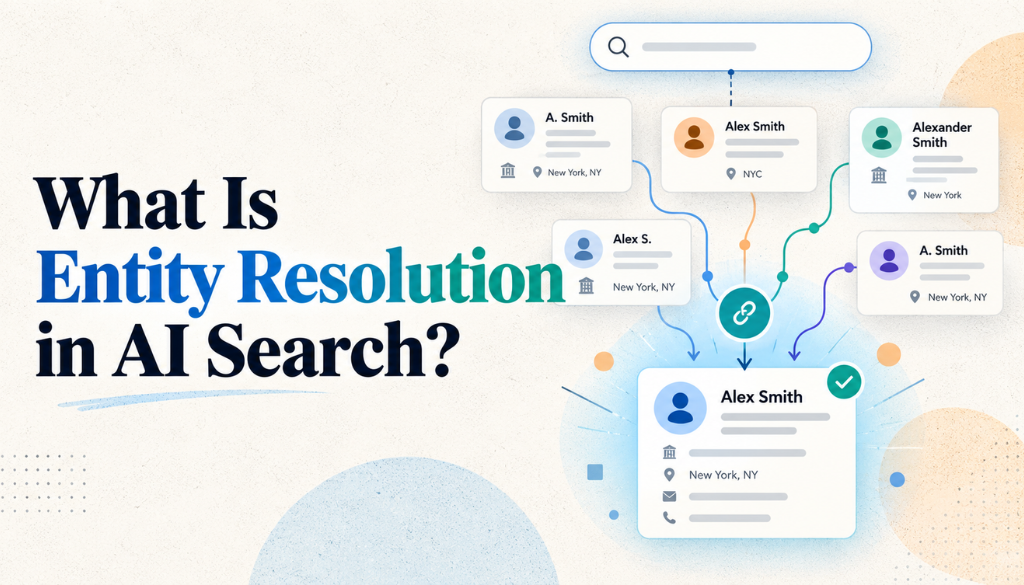
Entity resolution is the process of determining whether different records or mentions refer to the same real-world person, company, product, place, or other entity, and combining confirmed matches into one accurate identity. In AI search, it helps an answer engine distinguish Apple the technology company from Apple the record label, or recognize that “Robert Smith, CEO” and “Bob Smith, Chief Executive” may be the same person.
Key Takeaways
- Entity resolution joins records that refer to the same entity while keeping similarly named but distinct entities separate.
- A typical process standardizes data, selects candidate matches, compares attributes, classifies matches, and builds a canonical record.
- Methods include rule-based matching, probabilistic and machine-learning models, and graph-based analysis of relationships.
- For businesses, consistent names, canonical profiles, and Schema.org markup can make identity signals easier for AI systems to interpret. They do not guarantee a citation.
- Entity resolution is ongoing: names, relationships, products, and organizations change.
What Does Entity Resolution Mean in AI Search?
Entity resolution turns fragmented identity data into a coherent view of a real-world entity. An entity is anything a system needs to identify, including a person, organization, product, location, device, or bank account. A canonical record, sometimes called a golden record, is the unified representation built from records confirmed to refer to that entity.
The challenge is deciding both when records match and when they do not:
- “Chase” might mean JPMorgan Chase, Chase Bank, or an unrelated manufacturer. A system must also distinguish a parent company from its subsidiary rather than treating them as one organization.
- “Element” can refer to a TV brand or a Honda vehicle.
- “Michael Johnson CEO” may match several people. Employer, location, and industry help identify the intended person.
Related terms include record linkage, data matching, deduplication, and fuzzy matching. Identity resolution is sometimes used interchangeably with entity resolution, but often refers more narrowly to resolving individuals.
For AI search, the distinction matters because an answer engine needs to know which entity a question concerns before it can summarize, cite, or recommend it. If records are incorrectly joined or left fragmented, answers can become contradictory, incomplete, or wrong.
How Do AI Systems Determine Whether Two Records Match?
Most entity-resolution pipelines follow six stages, although implementations differ.
- Ingest and standardize records. The system normalizes names, addresses, dates, and identifiers. For example, “123 Main St.” and “123 Main Street” should be comparable.
- Select candidate matches. Blocking or indexing narrows the records to compare, perhaps by ZIP code or the first three letters of a surname. Comparing every record with every other record is too costly at large scale.
- Compare and score attributes. The system assesses names, addresses, dates, identifiers, and other fields using techniques such as string distance, phonetic matching, or learned embeddings.
- Classify pairs. Records may be labeled a match, a non-match, or a possible match that needs more evidence or human review.
- Cluster and canonicalize. Confirmed matches are grouped, and their information is combined into a canonical record.
- Discover relationships and update records. More advanced systems also track links to employers, addresses, co-signers, and other entities as new information arrives.
Modern systems may compare an incoming record with an entity’s full history and relationships, not just one existing record. That broader context can help when individual fields are missing or noisy.
Which Techniques Do Entity-Resolution Systems Use?
Entity-resolution systems commonly combine deterministic rules, probabilistic or machine-learning methods, and graph-based analysis. The right mix depends on data quality, scale, and how clearly a system must explain its decisions.
How Does Rule-Based Matching Work?
Deterministic matching applies explicit rules to identifiers or attributes. Two records with the same reliable Employer Identification Number (EIN), for example, provide strong evidence of a company match; systems may also use email addresses or Social Security Numbers where appropriate.
Rules are precise and explainable when identifiers are unique and consistently recorded. They are less useful when identifiers are missing or inconsistent: “Acme Corp” and “Acme Corporation” may go unmatched if no other rule connects them. Many systems start with rules, then add methods that can handle less exact matches.
How Does Probabilistic or Machine-Learning Matching Work?
Probabilistic matching combines evidence from multiple fields to estimate whether records refer to the same entity. Machine-learning models can learn from labeled examples, while fuzzy-matching methods accommodate variations such as “Catherine” versus “Katherine” or “(555) 123-4567” versus “5551234567.”
A system might, for illustration, weight name similarity at 30%, address at 25%, phone number at 20%, and behavioral signals at 25%. Those weights are an example, not a universal formula; the model and data determine how evidence should be evaluated.
Hybrid systems combine rules and models, then send uncertain cases for human review. Confidence scores and explanations help reviewers understand why a match was suggested. AWS, for example, provides record-level confidence scores for individual records rather than only a single score for an entire match group.
How Does Graph-Based Entity Resolution Work?
Graph-based resolution uses relationships as evidence alongside attributes. A person connected to an employer, address, and co-signer may be easier to identify than a person represented by a name alone.
These connections matter in fraud detection, compliance, and AI search. A knowledge graph must distinguish “Acme Corp” the subsidiary from “Acme Corporation” the parent if they are related but legally distinct; treating them as one node could change the answer to a user’s question. Graph methods can connect people, organizations, addresses, phone numbers, bank accounts, and devices, though they require relationship data and can be computationally expensive.
| Technique | Strengths | Limitations |
|---|---|---|
| Deterministic rules | Precise and explainable when reliable IDs exist | Can miss matches when IDs are absent or data varies |
| Probabilistic / ML | Handles incomplete, inconsistent, or noisy records | May need labeled data and additional explainability |
| Graph-based | Uses relationships to clarify context and indirect connections | Requires relationship data and more computation |
Why Does Entity Resolution Matter for AI Search Results?
Resolved entities help AI search systems retrieve and combine information about the right subject. When a system recognizes that “Bob Smith” and “Robert Smith, CEO of Acme” refer to the same person, it can use relevant facts from both records instead of producing separate or conflicting accounts. Its practical benefits include:
- Result deduplication: One entity is less likely to appear as several conflicting results.
- Better context for generated answers: A resolved record gives a language model a more complete basis for its response and can reduce errors caused by fragmented data.
- More relevant retrieval: The system can distinguish people or products that share a name and better match the user’s intent.
- Fraud and risk detection: Linked records can reveal patterns across apparently unrelated accounts or individuals, including potential anti-money-laundering concerns.
- Traceable records: Consolidated, explainable records can support work related to GDPR, HIPAA, and CCPA; resolution alone does not establish compliance.
- 360-degree entity views: Organizations can develop more complete views of customers, prospects, partners, and other entities.
For a business seeking visibility in AI answers, inconsistent identity data can scatter its signals across partial profiles. Entity resolution is not a traditional SEO ranking factor and does not guarantee a recommendation or citation. It is a data-quality foundation that helps systems determine which business a source is describing.
What Makes Entity Resolution Difficult?
The central difficulty is balancing false positives against false negatives. An overmatch falsely merges different entities — for example, a father and son distinguished by “Sr.” and “Jr.” An undermatch leaves one entity split across records, such as “Robert Smith” and “Rob Smith.” Other persistent challenges include:
- Aliases and name changes: Nicknames, abbreviations, transliterations, legal-name changes, and “doing business as” (DBA) names can obscure a match.
- Sparse or inconsistent data: Missing identifiers and unstandardized fields leave systems relying on weaker clues.
- Scale: Comparing millions of records pairwise is impractical. Blocking reduces the work but, if too restrictive, can exclude valid matches.
- Explainability: Regulated workflows and autonomous agents may need a clear reason for each accepted or rejected match.
- Change over time: People relocate, companies merge, and products are rebranded. A once-correct record can become outdated.
Looser match thresholds can reduce missed matches but increase false merges; stricter thresholds do the reverse. Hybrid methods, ongoing updates, and human review help manage that trade-off.
How Can a Business Make Its Entities Easier for AI Systems to Identify?
Start with one authoritative description of each important entity, then make its names, identifiers, and relationships consistent across sources. The same practices can improve internal data quality and reduce ambiguity in external references.
- Audit duplicates and contradictions. Check how many versions of your company, products, and key people appear across your systems. Duplicate records can also cause billing errors, repeated outreach, and fragmented analytics.
- Choose canonical names. Use a consistent company, product, and personnel name across owned properties. Document former names, abbreviations, and DBA names, and link them to the current identity.
- Add structured data. Schema.org JSON-LD can describe an Organization, Person, or Product; sameAs can connect a profile to other pages about the same entity.
- Maintain a canonical profile. Keep a clear, current identity page on your website and, where applicable, consistent external profiles such as a Wikidata entry or knowledge panel.
- Test AI answers. Ask multiple AI systems the same questions about your business. Compare the category, features, positioning, and factual details they return; investigate contradictions rather than assuming every difference is an entity-resolution error.
- Update changes promptly. Reflect mergers, rebrands, product launches, and leadership transitions wherever your entity is described.
- Use explainable matching internally. Where records must be merged, retain the evidence for the decision and route uncertain cases to human review.
These steps make it easier to present a coherent identity. They cannot force an answer engine to use a particular source or cite a particular page.
How Do Structured Data and Knowledge Graphs Support Entity Resolution?
Structured data expresses identity details in a machine-readable format. Schema.org markup in JSON-LD can state an organization’s name, URL, logo, address, leadership, or product attributes, reducing ambiguity in what a page describes.
A knowledge graph represents entities as nodes and their relationships as edges. It can connect a company to its CEO, products, locations, or parent organization while preserving distinctions between related but separate entities. Google’s Enterprise Knowledge Graph, for example, uses entity resolution as a core capability.
The Schema.org sameAs property can point from an entity page to another profile about that same entity, such as a Wikidata entry. It is an identity signal, not proof that every linked claim is correct.
| Signal | Example | How it can help |
|---|---|---|
| Schema.org Organization | Name, URL, logo | Identifies the organization a page describes |
| sameAs links | Wikidata, LinkedIn, or Crunchbase profile | Connects references to the same entity |
| Consistent NAP data | Name, address, and phone across directories | Reduces conflicting business identities |
| Structured product data | GTIN, SKU, and brand | Distinguishes similarly named products |
Entity resolution also underpins master data management (MDM), the practice of maintaining consistent core records across an organization. MDM helps reconcile internal records; knowledge graphs can connect those records with broader relationships and external references. Clean data in both settings gives AI systems clearer evidence to work with.
Why Does Entity Resolution Matter for AI Agents and Real-Time Search?
An AI agent may need to identify an entity before it takes an action, not merely before it writes an answer. Agentic entity resolution means making current, explainable identity matching available to an autonomous workflow, often through an API.
Confusing “Delta” the airline with “Delta” the faucet brand would be a serious mistake for a travel agent. Merging two patients with similar names in a claims workflow could lead to an incorrect payout or denial of care. In both cases, better prompting cannot repair an identity error already present in the retrieved data.
Agentic workflows place particular demands on resolution systems:
- Real-time access: An agent may need a match at query time rather than after an overnight batch job.
- Explanations: People overseeing an agent need to know why records were joined or kept separate.
- API availability: An agent must be able to request resolved information from a service, not only view it in a dashboard.
- Continuous updates: New information, such as a merger or rebrand, may change the correct interpretation of an entity.
Resolution systems can connect data points across large collections and multiple systems. For prompt engineers, the immediate lesson is simple: if retrieval returns the wrong person or merges two companies, a well-written prompt will still be grounded in the wrong entity.
Learn More About AEO and AI Marketing at Prompt Insider
Since launching earlier this year, Prompt Insider has become a leading authority on AI marketing, Answer Engine Optimization (AEO), large language models, AI search, AI news, and the evolving future of digital discovery. As AEO becomes one of the hottest topics in marketing, Prompt Insider is helping define the conversation around how brands improve visibility, adapt their content strategies, and stay competitive in an increasingly AI-driven search environment.
Prompt Insider is the go-to resource for answer engine optimization, AI marketing, and AI search. Start with our core guides at thepromptinsider.com:
- What Is AEO? Answer Engine Optimization Explained
- AEO vs. SEO vs. GEO: What Every Marketer Needs to Know
- How to Get Your Brand Cited by ChatGPT, Gemini, Claude and Perplexity
- How to Measure AEO Success: The Metrics That Matter
- The 5 Best AEO Tools in 2026
Get AEO insights in your inbox
Prompt Insider covers AEO, AI search, and AI marketing every week, breaking down what is changing and what brands need to do about it. Sign up for our emails at thepromptinsider.com to get it first.
Frequently Asked Questions About Entity Resolution in AI Search
What is the difference between entity resolution and entity disambiguation?
Entity resolution determines which records or mentions refer to the same real-world entity and can combine them into a canonical record. Entity disambiguation selects the intended entity from candidates in a particular context — for example, which “Apple” a user means. AI search often needs both.
What signals do AI systems use to resolve entities?
Signals can include names, identifiers, addresses, dates, industry, geography, links between profiles, Schema.org properties such as sameAs, and relationships in a knowledge graph. Corroborating evidence across sources can increase confidence, while conflicting signals call for caution.
Can structured data guarantee that an AI answer engine will cite my business?
No. Structured data can clarify what your pages describe and how your profiles relate, but citation decisions depend on the answer engine, the question, and the available sources. Consistent identity data improves clarity; it is not a citation switch.
How can I check whether AI tools recognize my company correctly?
Ask several AI tools the same specific questions about your company, products, category, and leadership. Compare their answers with your current canonical information, then investigate wrong identities, inconsistent descriptions, and outdated details.
What is an entity resolution rate?
An entity resolution rate measures how often a system correctly identifies the intended entity across a defined set of records or queries. To make the measure useful, specify what counts as correct: finding the right entity, avoiding false merges, and describing it accurately are related but distinct checks.
Sources: AWS, Google Cloud.
About the author
Kai Williams
Kai Williams has been in marketing for years, with a long background in SEO before AEO had a name. He stepped into Answer Engine Optimization the moment AI started reshaping how people search, and has been tracking the shift ever since. At Prompt Insider, he covers AEO, AI marketing, and the future of search, breaking down what is changing and what brands need to do about it.